Key Takeaways
- A good 500 ml stainless thermos usually starts around USD 2.80-4.20 FOB at 1,000 pcs, depending on finish and lid.
- For retail, ask for 304 inner and outer steel, 0.35-0.5 mm body thickness, and a vacuum leak test on every batch.
- Most custom logo projects need 15-25 days for samples and 30-45 days for mass production in China or Zhejiang.
- AQL 2.5 for major defects is common, but you should set separate checks for vacuum loss, lid torque, and print adhesion.
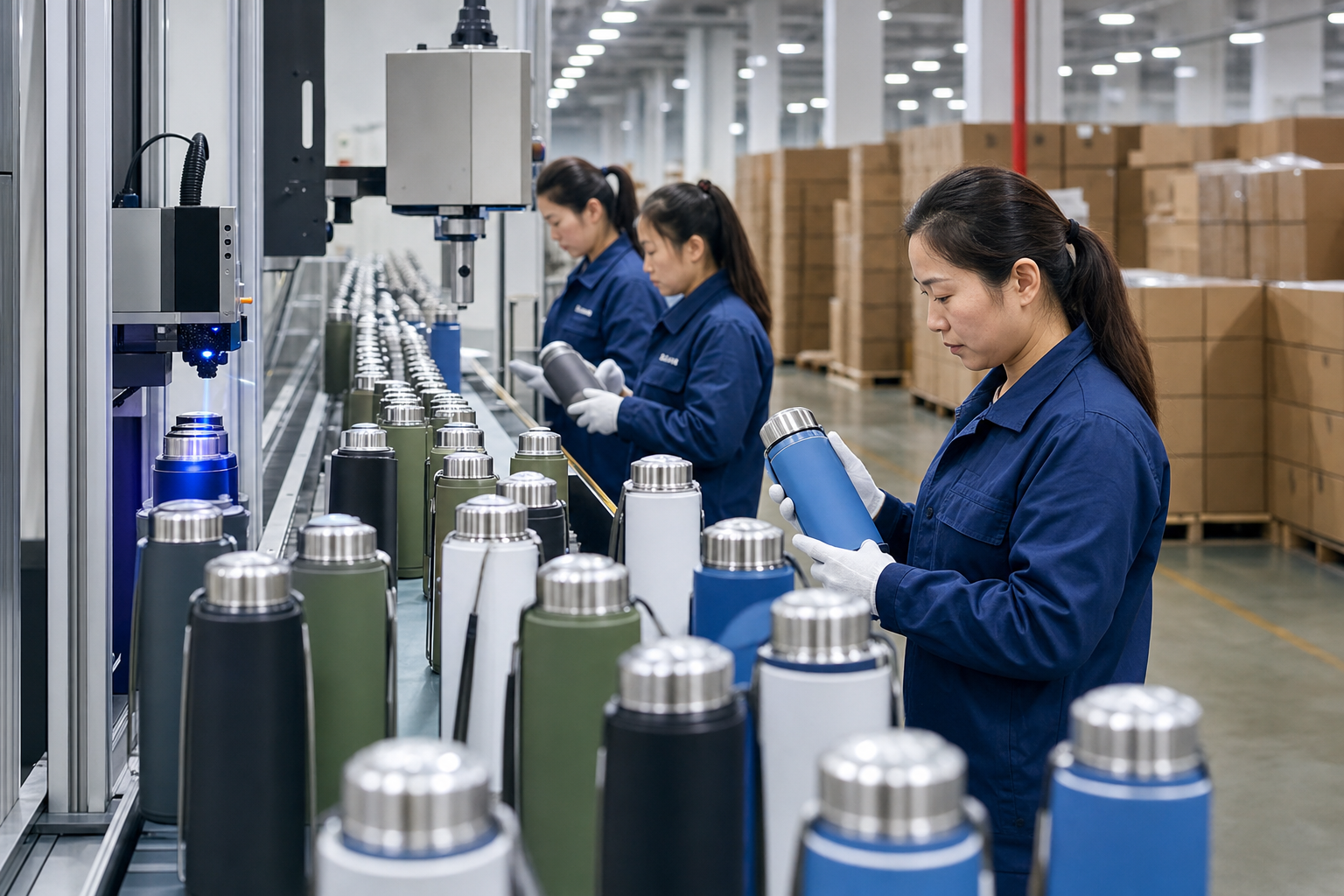
If you are buying the best wholesale thermos flask for outdoor retail or a promotional program, the first mistake is treating all stainless thermos bottles as the same. They are not. A 500 ml vacuum flask with 304 stainless, 0.4 mm wall thickness, and a powder coat behaves very differently from a cheaper 0.28 mm body with a weak seal and inconsistent vacuum. On our line, QC pulled the sample, checked the lid torque, and flagged the leak rate before packing. This is the wrong way to buy if you want stable repeat orders.
For buyers in Europe and North America, the decision is usually about more than price. You need a custom thermos that survives drops, keeps drinks hot for 12 hours or cold for 24 hours, and still looks clean after logo printing. At our Zhejiang factory, we run thermos production at scale and export thousands of units per month, but the real question is whether the spec fits your channel, your margin, and your compliance risk. If the PO says one thing and the artwork file says another, we stop and fix it before the sleeve press starts.
What makes a thermos worth buying
The best wholesale thermos flask is not the lowest quote. It is the one that ships cleanly, holds temp, and does not come back with lid complaints after 3,000 units. We look at six points on the line: steel grade, wall thickness, vacuum quality, lid fit, coating wear, and QC control. A real factory can answer those without stalling.
Start with materials. For custom thermos orders, 304 stainless steel is the standard for the inner and outer shell. 201 steel saves a few cents, but for premium outdoor retail in North America or Europe, that is the wrong tradeoff. On our line, 0.35 mm to 0.5 mm body thickness works; below 0.3 mm, the shell dents if the carton takes a corner hit. A 500 ml flask with a solid double-wall vacuum should stay above 60°C for 6-8 hours and above 45°C for 12 hours, depending on lid design and room temperature.
Buyer note: if a thermos supplier says “12 hours hot” and gives no test setup, push back. Ask for fill ratio, water temperature, room temperature, and lid type. Last month QC pulled a sample that only passed after a silicone ring change, so the test report matters more than the sales pitch. In Zhejiang, a serious thermos factory will show you the data before you place a bulk thermos order.
Choose the right steel and finish
If you are sourcing promotional thermos products, the finish matters almost as much as the steel. Matte powder coating hides scratches better than gloss paint, and it gives the cup a steadier grip when buyers take it on a site visit or into a car. We run a 60-mesh spray line for this because the texture has to come out even, not patchy. Laser engraving stays clean after 500 rubs on the test pad, while silkscreen is the cheaper route for a one- or two-color logo.
For bulk thermos buying, the inner steel has to be food-safe and consistent from lot to lot. Ask for REACH compliance if you sell into the EU, and request food-contact declarations if your market asks for them. Some buyers also want LFGB or FDA paperwork depending on channel and destination. We had a PO last month with “304SS” typed as “304S,” and QC pulled the sample before packing. A China or Zhejiang thermos manufacturer should have those files ready if the line is built for export, not only domestic orders.
- 304 stainless inner wall: preferred for most export orders
- 316 stainless: useful only for special corrosion-sensitive programs, and costs more
- Powder coating: usually adds USD 0.20-0.60 per piece
- Laser logo: durable, usually no color matching issues
- Silkscreen logo: cheaper, but check abrasion resistance
Do not overpay for 316 unless you actually need it. For a promotional thermos, the bigger risk is weak insulation or poor coating adhesion, not the gap between 304 and 316. The math does not work if you pay for a metal upgrade and the vacuum still drops from 12 hours to 8 hours. A good thermos supplier will tell you where the cost adds value and where it does not.
MOQ, pricing, and sample timing
Most thermos distributors ask for price first. That is the wrong question to ask. For a 500 ml custom thermos with a one-color logo, FOB China often lands at USD 2.80-4.20 at 1,000 pcs. Once you add a complex lid, gift box, or full-color print, the quote can move past USD 4.50. We ran a batch last month with a 58 mm lid cap, and the buyer flagged the extra carton insert before we even started sampling. In Zhejiang, the final factory quote comes down to bottle shape, coating, lid tooling, and whether you want retail packaging in 1 pc or bulk-packed.
Typical MOQ for a standard factory thermos model is 1,000-3,000 pcs per color. If you want a thermos customizable with a unique body color and embossed branding, the MOQ usually goes to 3,000-5,000 pcs because the coating line needs a separate setup and the carton count has to match the shipment plan. Samples take 7-15 days for a stock model and 15-25 days for custom tooling or special print. We ship faster on plain samples, but a new matte finish or laser logo slows the line. Mass production is usually 30-45 days after sample approval and deposit.
Practical rule: if a thermos manufacturer promises 10,000 pcs in 12 days with custom coating, be careful. The math doesn't work. Vacuum forming, coating curing, and leak testing all take time, and QC pulled the sample apart if the weld seam shows even a 0.3 mm shift. A reliable thermos factory gives you a schedule it can hold, not a number pulled from a PO typo.
Test the flask before you order
You do not need to become a lab engineer. You do need to know which tests matter before you place a PO. On our line, a sample can pass and the first 5,000 pieces still fail if the lid thread shifts by 0.3 mm or the vacuum pump setting changes. That is why factory thermos QC beats a polished brochure every time.
For export orders, ask for an inspection plan tied to AQL. AQL 2.5 works for visible cosmetic defects, but leakage and vacuum loss need tighter control. Ask the thermos supplier to check:
- 100% leak test on each bottle or at least each batch
- Vacuum retention sample test after 24 and 48 hours
- Print adhesion with tape pull or abrasion rub
- Drop test from 1 meter for retail-ready programs
- Carton compression for distributor thermos shipments
For outdoor retailers, the lid is usually the first problem. A push-button lid is handy, but it adds moving parts and more breakage points. Screw lids are simpler and usually hold up better for thermos bulk orders. We had a buyer flag a PO typo once—push lid instead of screw lid—and the math did not work after the returns forecast came in. A good supplier will tell you which lid fits your channel instead of forcing one choice.
Logo, packaging, and retail readiness
A custom thermos only earns its keep if it lands ready for the channel. For outdoor stores, the box needs to survive a 1.2 m drop test and still scan clean at the counter. For a promo run, the print area has to carry the brand without pushing freight up. We have seen a 200 g carton change the pallet count from 60 to 56 on a 5,000 pcs order, and that is where the math starts to bite.
The wrong question is which logo method looks the fanciest. Ask which one survives the line. Laser engraving holds up on 304 stainless and stays sharp after 50 washes. Silkscreen is the workhorse for a one-color mark with a 0.3 mm line width. Heat transfer can carry a 4-color logo, but QC pulled the sample once the surface wipe was rushed and the edge went fuzzy. On a thermos customized for retail, a clean one- or two-color logo, a matched body color, and a box with a window cut are easier to sell than a busy print that chews margin.
Do not let packaging become an afterthought. A 200 g increase per unit may sound small, but on 5,000 pcs it can add freight cost fast and change your pallet count.
If you are a thermos distributor or thermos vendor serving three or four accounts, standardize on two or three core SKUs and keep the branding flexible. We run that way for a reason. One buyer flagged a PO typo on the sleeve color, and it would have stalled the whole lot if the body SKU had also changed. Fewer moving parts keep stock cleaner, and the reorder cycle stays sane.
How to choose a supplier in China
Not every thermos supplier runs its own factory. Some are trading companies with decent English and weak process control. That works for a simple repeat order. For a custom thermos program, ask who owns the tooling, who runs the vacuum line, and who signs off on inspection. In Zhejiang, the factories we trust are the ones that will show you the vacuum furnace log and the QC board without dancing around it.
Ask direct questions: How many units per month can you produce? What is the MOQ per color? Do you have BSCI or other social compliance audits? Can you provide REACH or LFGB documents? What is your lead time for repeat orders? A serious thermos factory should answer clearly. On a 500ml model, a mid-size line may handle 300,000-500,000 units per month, but the real choke point is often the coating booth or the carton pack line. QC pulled the sample, checked lid torque at 0.8 N·m, and that told us more than a polished sales deck.
Do not chase the lowest FOB number and call it a sourcing win. Check whether the supplier can repeat the same color, same print position, and same lid torque six months later. That is the real test. Saving USD 0.08 sounds neat on paper, then the buyer flags a shade shift or a typo on the carton PO and the math falls apart. If you work with distributor channels, one late carton or one off-spec lid can eat the whole margin.
Request factory pricing for your thermos program
Send your target size, logo method, and destination market. We will match the right thermos bulk spec, MOQ, and lead time from Zhejiang.
Frequently asked questions
What is a realistic MOQ for a custom stainless thermos?
For a standard 500 ml or 750 ml custom thermos, realistic MOQ is usually 1,000-3,000 pcs per color. If you want a unique coating, special lid, or gift box, expect 3,000-5,000 pcs. In Zhejiang, a factory thermos line may allow lower MOQ on stock bodies, but you will pay more per unit. For a promotional thermos run, ask for mixed-color carton packing only if the supplier can manage it without slowing production. Lower MOQ sounds good, but it often increases packaging cost by USD 0.15-0.40 per piece.
How much does the best wholesale thermos flask cost FOB China?
A good 500 ml stainless thermos usually starts around USD 2.80-4.20 FOB China at 1,000 pcs with basic logo printing. Powder coating, laser engraving, better lids, or retail packaging can push it to USD 4.50-6.20. For bulk thermos buyers, the cheapest quote is not always the best deal because leakage claims and replacement costs can erase the savings. If you want a true manufacturer thermos program, ask for a quote split by body, lid, print, and packaging so you can see where the money goes.
What test standards should I request from a thermos supplier?
Ask for leak testing, vacuum retention testing, and print adhesion checks at minimum. For export programs, REACH is important for Europe, and many buyers also ask for LFGB or FDA-related documents depending on market requirements. AQL 2.5 is common for cosmetic defects, but leakage should be controlled much tighter than that. For retail or distributor thermos orders, request a drop test from 1 meter and carton compression checks. A good thermos factory in China will already have a written QC plan and can show sample records.
Which logo method is best for a customized thermos?
Laser engraving is the most durable and usually best for premium outdoor retail because it does not fade or peel. Silkscreen is cheaper and works well for simple one-color logos on promotional thermos orders. Heat transfer can handle more detailed graphics, but it needs tighter process control. If your brand uses the bottle outdoors, choose a finish and logo method that survives abrasion. On matte powder-coated steel, laser engraving often gives the cleanest result. For a thermos customizable at scale, keep the logo simple to reduce rejection risk.
How long does production take in China or Zhejiang?
For stock models with a simple logo, sample time is often 7-15 days and mass production 30-45 days after approval and deposit. If you need special coating, new tooling, or a complex lid, sample time can extend to 15-25 days. In Zhejiang, a well-run thermos manufacturer can handle repeat orders faster, but you should still allow time for vacuum testing and packaging. If you need a promotional thermos tied to a launch date, build in at least 2-3 weeks of buffer for freight, especially during peak season.