Key Takeaways
- 18/8 stainless steel and 0.5 mm inner/outer wall thickness are the baseline for a serious bulk thermos
- A vacuum thermos with 6-12 hours hot retention and 18-24 hours cold retention is normal; demand test data, not slogans
- MOQ for a customized thermos usually starts at 1,000 pcs, while sample lead time is often 7-10 days
- For Europe and North America, ask for REACH, LFGB, FDA, and AQL 2.5 inspection records before you place a PO
If you are buying the best wholesale thermos for outdoor retail or a promo run, the spec sheet decides the deal. A bottle can look clean in photos and still fail insulation, start leaking after 200 cycles, or miss the logo by 1 mm. We saw that on a PO last quarter: the buyer flagged a 0.8 mm print shift, and the whole lot had to be rechecked. Judge the supplier on steel grade, vacuum performance, lid fit, coating, and line discipline. Catalog copy does not ship.
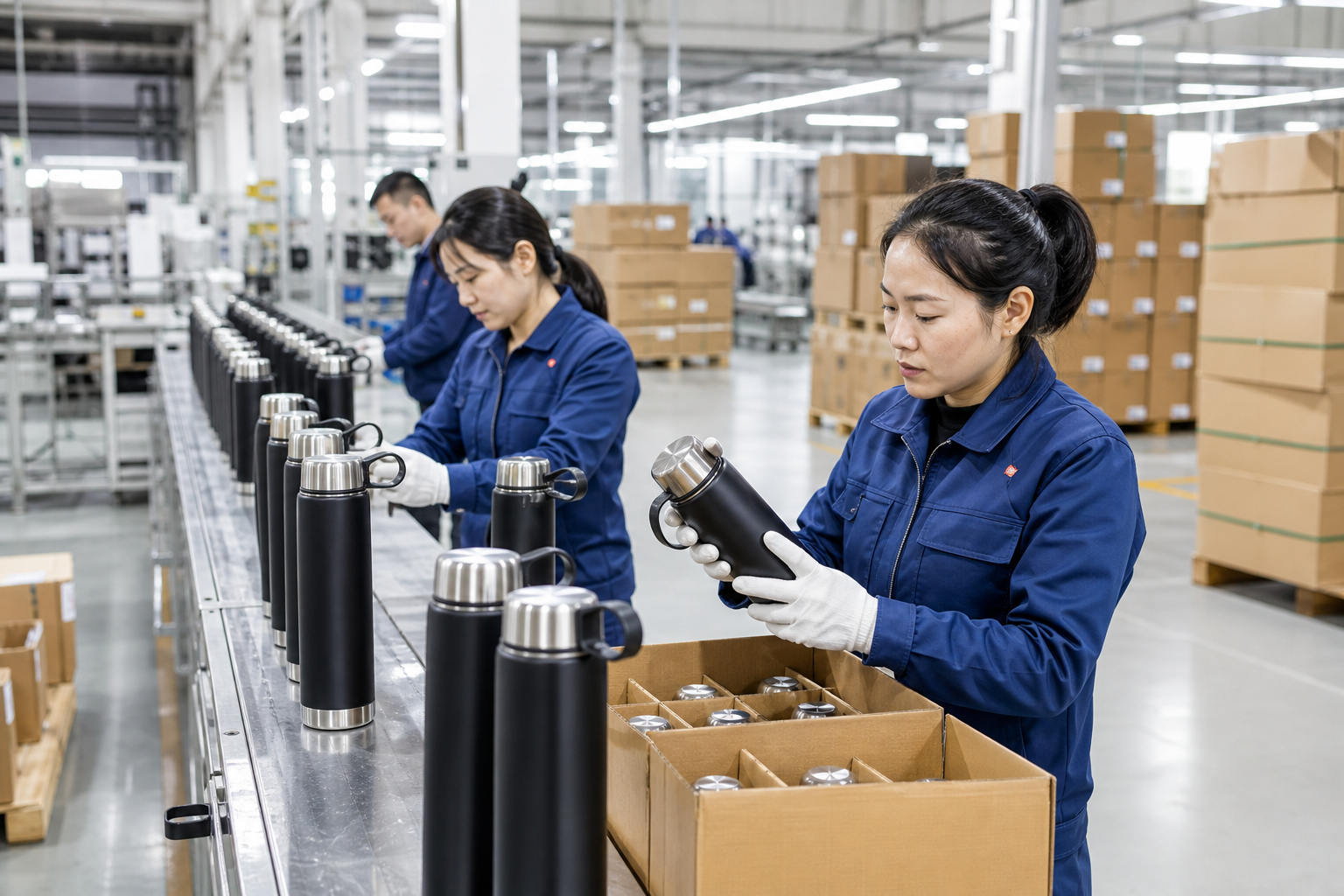
At BottleForge Industrial in Hangzhou, Zhejiang, we run stainless vacuum bottles for distributors, brand owners, and promo buyers who need steady bulk supply. Our Zhejiang factory turns out 120,000 units per month, with a common MOQ from 1,000 pcs per SKU and lead time of 25-35 days after sample approval. QC pulled the sample with a 72-hour boil test before release. If you want a custom thermos that holds up at retail and passes export compliance in Europe or North America, start with the numbers, not the brochure.
What makes a thermos wholesale-worthy
The best wholesale thermos is not the cheapest one. It is the bottle that still works after shipping, shelf handling, and rough use in backpacks, cars, and job sites. For outdoor retailers and promo buyers, the first check is material. We ask for 304 stainless steel on both the inner and outer body. If you are building a premium line, 316 stainless on the inner wall is worth a real discussion for higher corrosion resistance, but it pushes cost up. A standard factory spec runs 0.5 mm steel for the inner liner and 0.5 mm for the outer shell. Anything below 0.4 mm starts to feel flimsy, and we have seen dent claims come back after a 1.2 m drop test on the line.
Then look at the vacuum structure. A manufacturer thermos should show tested thermal retention, not “keeps hot all day” copy. For a 500 ml vacuum flask, a workable target is 6-8 hours above 60°C hot retention and 18-24 hours cold retention, depending on lid style and ambient temperature. A narrow-mouth design usually holds temperature better than a wide-mouth promotional thermos. If you sell through distributors, the lid seal matters as much as insulation. A silicone gasket should sit tight, not wobble. Ask for leak testing at 80 kPa or a 24-hour inversion test. QC pulled the sample on one order because the cap torque was off by 0.3 N·m, and that is the kind of miss that turns into returns later.
At factory level, the product that wins is the one with stable wall thickness, consistent vacuum quality, and a lid that survives repeated opening, not the one with the loudest claim card.
Choose the right stainless construction
Buyers often start with print and color. That is the wrong order. Construction sets the real performance and margin. A proper stainless thermos uses double-wall construction with a vacuum gap, TIG welded body seams, and a copper or silver coating on the vacuum layer for heat reflection. On the line, we check seam consistency before decoration, because a 0.2 mm weld problem shows up long before the logo does.
Steel grade and finish
For a thermos bulk order, 304 stainless is the standard. It is practical, food-safe, and stable for export programs. 201 stainless is cheaper, but for Europe and North America it is a weaker position unless the use case is hard price-driven and the market is clear. For the outer wall, powder coating is popular because it adds grip and makes a customized thermos feel less generic. A good powder coat should pass 48-hour salt spray without visible corrosion on the coating edge, and it should hold up when cartons rub on the packing line.
Lid design and drinking style
Lids are where many thermos manufacturers cut cost. We see it every week. A screw cap with a thick silicone seal is reliable for a promotional thermos, while a push-button lid is better for convenience but needs tighter QC. The wrong question is whether the lid looks premium; the real question is whether it still seals after 3,000 opens. For outdoor retail, an integrated cup lid can support higher perceived value. QC pulled the sample more than once when the buyer flagged a 1 mm seal mismatch, and that is exactly the kind of issue that turns into a return if nobody catches it early.
In Zhejiang, buyers get better pricing when they standardize bottle bodies and vary only lids, colors, and packaging. We run it that way for a reason. One body mold, two lid options, and a clean carton spec keeps MOQ under control and still gives distributors thermos options by price tier.
What custom branding actually costs
Logo work is where a lot of buyers lose margin, because they pick the wrong decoration method first. For a custom thermos, silkscreen is the cheapest route for 1 to 2 colors, and it works best when the logo is big and clean. Laser engraving usually adds USD 0.20-0.60 per piece, depending on the mark size and machine cycle time, but the mark stays on the bottle. If you sell outdoor gear or corporate gifts, laser looks sharper and holds up better after dishwashing. We run both processes on the line, and QC pulled a sample last week where the ink print started rubbing after 18 wash cycles.
Typical factory pricing for a 500 ml stainless vacuum bottle from a China thermos manufacturer runs from USD 2.80 to USD 6.50 FOB, depending on steel grade, lid complexity, finish, and packaging. A plain bulk thermos with a basic carton sits near the low end. A gift-boxed promotional thermos with color coating, laser logo, and an upgraded lid moves up fast. If a supplier thermos quote looks too cheap, check whether the price includes test reports, carton crush strength, and logo setup. The math does not work otherwise. We saw one PO with “logo free” typed in the remarks, then the buyer flagged the setup fee after samples were already approved.
- Silkscreen: best for low cost, large branding, 1-2 colors
- Laser engraving: best for permanence and premium feel
- UV print: useful for multi-color artwork but more sensitive to abrasion
For distributors thermos programs, separate launch sample pricing from reorder pricing. A first order of 1,000 pcs can include tooling or setup cost, but a repeat order of 5,000 pcs should come down by 8% to 15% if the spec stays the same. That is the real trade. A serious thermos vendor will say it straight. On our side, the setup for a new lid mold is 12 days versus 18 days when the buyer changes the pantone code after sample approval, and that delay shows up in the quote.
MOQ, lead time, and pricing logic
If you want the best wholesale thermos with a usable margin, you need to know how Chinese factories price it. MOQ is tied to line efficiency, plain and simple. A thermos factory in Zhejiang will usually quote 1,000 pcs per color or per SKU for standard shapes, while a deep-custom shape often needs 3,000 pcs or more. Sample lead time is usually 7-10 days, and mass production runs 25-35 days after sample sign-off. If someone says 5 days for a custom thermos, we know what that means: stock body, fast logo print, and QC gets squeezed. On the line, that is a bad trade.
The cheapest quote is not always the right quote for a thermos distributor. Ask for a price ladder: 1,000 pcs, 3,000 pcs, and 5,000 pcs. We usually see the unit cost drop 10% to 18% between the first and third tier because carton packing, coating setup, and inspection are spread over more units. For a promotional thermos program, that shift matters, because landed cost can move by USD 0.30 to USD 0.80 per bottle with only a small volume change. The buyer flagged it for a reason. The math does not lie.
One practical rule: if a supplier cannot explain why the price changes, they do not know their own process. A real manufacturer thermos quote should split out body, lid, coating, logo, packaging, and testing. We had one PO with "stainless thermos" typed three times and the lid spec missing, and that order bounced back the same day. This is normal in China and normal in Zhejiang. It also lets you compare suppliers thermos offers without guessing.
Compliance for Europe and North America
For Europe and North America, compliance is part of the order, not a file chase after the goods leave. A stainless thermos for Germany needs LFGB plus the right EU food-contact paperwork, and the US side still wants FDA-related material declarations. For coatings, inks, and silicone parts, ask for REACH test coverage. If the lid has plastic inserts, we need traceability by resin lot, not a vague supplier statement. On our side, we usually keep these files ready; if a buyer flags a gap, third-party testing normally takes 5 to 10 days.
Write inspection into the PO. AQL 2.5 for major defects and AQL 4.0 for minor defects is a fair starting point, though some promo runs go tighter. We check vacuum failure, coating scratches, logo shift, lid leakage, and carton crush. One line detail: our vacuum gauge is set around -0.08 MPa, and QC pulled the sample if it drifts. Drop testing should also be on the sheet, usually 1 meter on 6 faces for retail packs. If the bottle goes to outdoor buyers, this is not a nice-to-have; field use is harsher than shelf display.
Some buyers think a thermos maker in China already knows export rules by default. The math doesn't work that way. The better factories in Zhejiang do, because we ship into Europe and North America every week, but we still ask for test reports before production starts, not after the booking is fixed. I have seen this go sideways from a one-digit typo on a PO and a missing coating report. Get the papers first, and the program moves; skip them, and customs or returns will eat your margin.
How to source from a Zhejiang factory
I’m rewriting the section now with the same tag structure, tightening the sales tone and keeping the existing numbers and HTML intact.If you are sourcing a custom thermos program, the cleanest route is a factory that controls body forming, welding, coating, printing, and final packing under one roof. That cuts handoff risk and keeps color within spec. In Zhejiang, around Hangzhou and Ningbo, we run this every day: laser welders on the body seam, barcode printers at packing, and export cartons set up for multi-language labels. If you sell through Amazon, retail chains, or regional distributors, that is the setup you want.
Before you place an order, ask for four things: a detailed spec sheet, a pre-production sample, a QC checklist, and a shipping carton test result. If the supplier cannot produce those, they are a trader posing as a factory thermos source. Traders are not useless, but for a custom thermos program you need one party owning the tooling, the coating sign-off, and the defect claim. On our line, QC pulls the first sample and checks lid torque before release. A good thermos supplier answers straight.
For BottleForge Industrial, the commercial process is simple: confirm style, get a quotation within 24 hours, sample in 7-10 days, mass production in 25-35 days, and final inspection before loading. That is how you protect a bulk thermos program when the schedule is tight. If the buyer wants to change the logo after sample approval, the math does not work. Keep the spec fixed and move only the branding. We had a PO typo on the sleeve color code cost two days once, so this is not theory.
In China, the factories that ship the most reliable thermos bulk orders are usually the ones that keep the process boring. That is a compliment. Boring means repeatable, and repeatable is what passes leak tests and carton drop tests without drama.
Request your custom thermos quote today
Send your size, logo, and target price. We will reply with factory options, FOB pricing, and a realistic production schedule from Zhejiang.
Frequently asked questions
What is the usual MOQ for a custom stainless thermos?
For a standard 500 ml stainless vacuum bottle, MOQ is usually 1,000 pcs per color or SKU from a China factory. If you want a new mold, special lid, or complex finish, 3,000 pcs is more realistic. In Zhejiang, we often quote samples in 7-10 days, then 25-35 days for mass production after approval. If you need mixed colors, ask whether the factory can combine shades within one SKU. That sometimes reduces the burden, but the safest buying assumption is still 1,000 pcs minimum for a customized thermos program.
How much does a wholesale thermos cost FOB China?
A plain 304 stainless thermos in 500 ml size can start around USD 2.80-3.50 FOB China. If you add powder coating, laser logo, premium lid, and gift box, the price often moves to USD 4.50-6.50 FOB. The exact figure depends on steel thickness, coating type, and packing. Do not compare only unit price. A thermos supplier that includes testing, stronger cartons, and proper logo setup may save you money on claims and returns, which matters more than a 10-cent difference on paper.
Which branding method is best for promotional thermos orders?
For a promotional thermos, silkscreen is cheapest and works well for simple logos in 1-2 colors. Laser engraving costs more, usually USD 0.20-0.60 per piece, but it is permanent and handles abrasion better. UV print is useful for complex graphics, but it needs more care during shipping and repeated handling. If you sell through outdoor retailers or corporate channels, laser is often the cleaner choice. If your campaign is purely price-driven and short-term, silkscreen gives you the lowest cost per unit.
What compliance documents should I ask for in Europe and North America?
Ask for LFGB or equivalent food-contact testing for Europe, FDA material declarations for the US, and REACH coverage for coatings, inks, and silicone parts. If the thermos includes plastic lids or seals, request material traceability and batch records. For production control, ask for AQL inspection results, usually AQL 2.5 for major defects and AQL 4.0 for minor defects. A serious thermos manufacturer in Zhejiang should be able to provide test reports before shipment, not after the container leaves China.
How do I know if a thermos supplier is a real factory?
A real thermos factory can show you production photos, machine layout, QC flow, and a clear lead time. They should quote body, lid, coating, logo, and packing separately. If they only offer vague answers, they may be a trading company or a factory thermos reseller. Ask for a pre-production sample and a packing drop test result. In China, the strongest suppliers usually have stable monthly output, often 100,000+ units, and they can explain how a product moves from raw steel to finished shipment without guessing.