Key Takeaways
- 316 stainless custom thermos models usually add USD 0.40-1.20 over 304, but improve corrosion resistance for salty or acidic use.
- A practical MOQ for a promotional thermos is often 500-1,000 units; complex custom lid programs can push it to 3,000 units.
- Double-wall vacuum flasks with 0.4-0.5 mm inner wall and 18/8 stainless typically hold 60°C+ for 6-8 hours in lab testing.
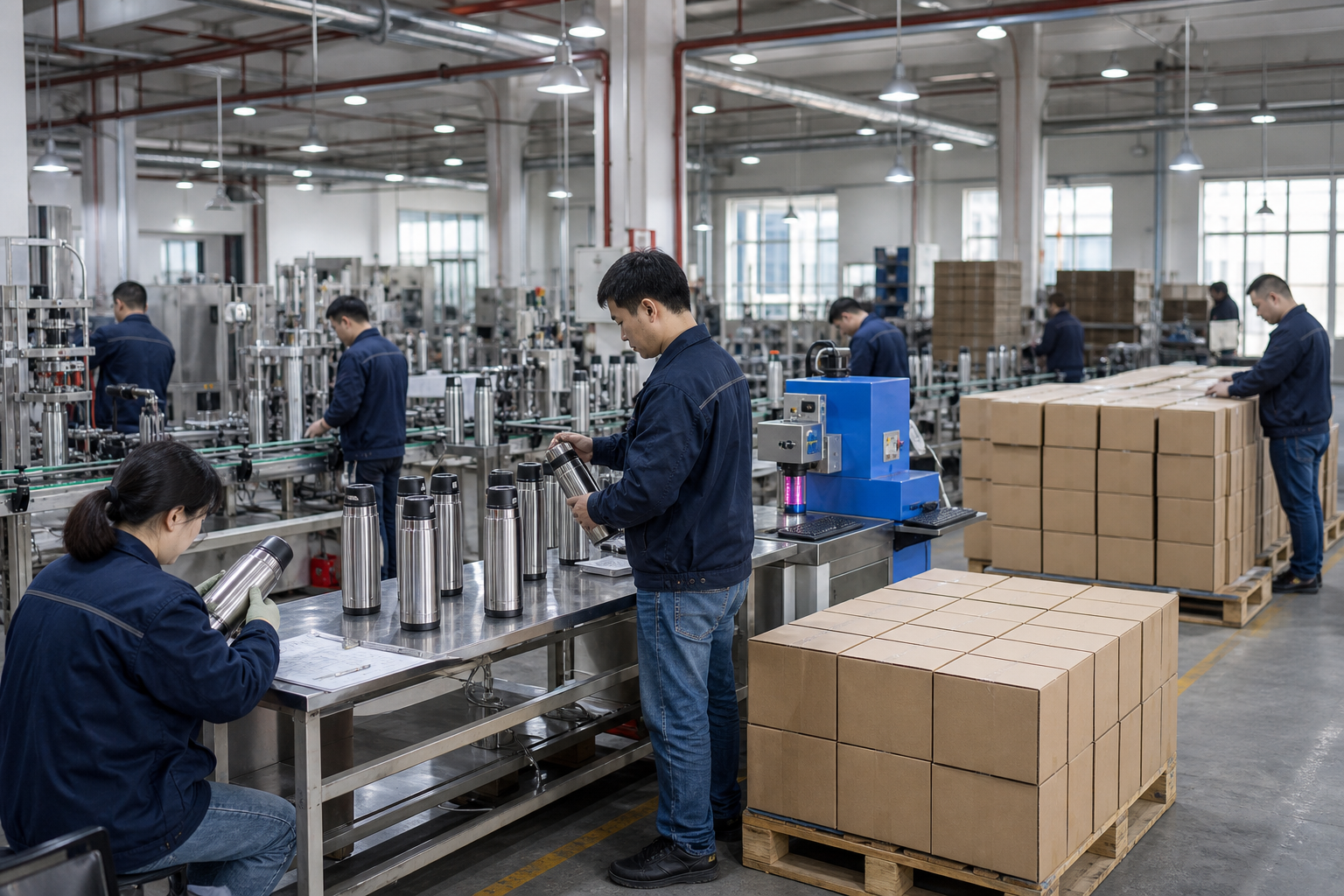
- A reliable Zhejiang factory can produce 80,000-120,000 units per month and still offer REACH, FDA, and ISO-based documentation.
If you are sourcing the best wholesale vacuum flask, the real question is not “which bottle looks nice.” It is whether the thermos holds temperature, survives 1.2-meter drop tests and carton shakes, passes your market’s compliance rules, and still leaves margin after freight and decoration. A cheap bulk thermos can look clean on a catalog page, then show condensation, lid leaks, or a rough laser mark after 200 uses. We have seen that fail on the line.
For outdoor retailers and promo brands, the buy is usually price, lead time, and customization depth. A serious stainless thermos supplier in Zhejiang or elsewhere in China should quote 500 units, 5,000 units, or 50,000 units with clear insulation data, AQL inspection terms, and decoration limits. If they cannot put those numbers in writing, the math does not work. QC pulled a sample with a 0.3 mm lid gap last month, and the buyer flagged it before packing.
What buyers really pay for
Do not start with decoration. Start with the bottle structure. A serious stainless thermos usually uses 18/8 or 304 stainless steel on the inside and outside, with a vacuum layer between the walls. For marine use or salty environments, 316 stainless is worth the discussion because it holds up better against chloride exposure. That means fewer rust complaints and fewer returns when the buyer fills it with coffee, tea, or sports drinks. On the line, QC pulled a 24-hour heat-retention sample and checked the weld seam with a flashlight; the seam tells you more than a shiny lid ever will.
Price moves fast with wall thickness, cap design, finish, and packaging. A plain 500 ml bulk thermos with a screw cap may land around USD 2.20-3.50 FOB China at 1,000 units. Add powder coating, engraving, and a premium lid, and you may be at USD 4.20-6.80. If someone offers a custom thermos below that with no clear spec sheet, ask what got cut: stainless grade, insulation time, or QC. We have seen that go sideways. One buyer once sent a PO with a typo on the lid color code, and the math did not work until we caught it before mass production.
- 304/18-8 stainless: standard export baseline
- 316 stainless: higher corrosion resistance, higher cost
- 0.4-0.5 mm inner wall: common for durable vacuum flask builds
- 500 ml and 750 ml: the most practical retail sizes
Insulation specs that matter
Marketing claims are cheap. Measured performance is what counts. For a distributor thermos or promotional thermos, ask for the test setup: starting water temperature, ambient temperature, fill level, and lid type. If the supplier cannot give those four points, “12 hours hot” is just a line on paper. We usually see 95°C fill water, 20°C ambient, and a 90% fill level on the test sheet. At that setup, mid-tier bottles should hold 60°C or above after 6-8 hours; heavier-wall 304 stainless models do better. QC pulled the sample from the line and rechecked it in the lab kettle, and the result matched only when the cap spec was the same.
Cold retention matters too. A custom thermos for iced coffee or daily hydration loses buyer trust fast if the lid leaks or the neck sweats. The silicone ring, cap seal, and vacuum integrity matter more than the printed logo. We ship a lot of thermos bulk for outdoor retail, and the same complaint comes up: one weak drop test, then the buyer flags condensation marks after a backpack run. That is the wrong question to ask if the quote only shows “cold for 24 hours.” Ask for ASTM-style thermal methods, then add drop and leak checks. A clean supplier thermos report should separate lab numbers from production averages. A PO typo on lid color once turned into a 3,000-piece hold, so we check every spec line before the line starts.
Ask for the test method, not just the result. A vacuum flask that says “12 hours hot” but gives no ambient temperature or lid spec is not a buying decision.
Customization without ruining margins
Custom thermos projects go sideways when the buyer over-designs the bottle. A clean logo, one body color, and one cap option usually move faster than a custom thermos program with five colors and three lid mechanisms. Every extra variant adds setup time, carton confusion, and dead stock risk. We ran one promo job last month with three lid SKUs; QC pulled the sample, then the buyer flagged the mixed parts on page 2 of the PO. If you want a customized thermos for a campaign, keep the base model simple and spend on print quality, packaging, and shelf-ready presentation.
Common decoration methods include silk screen, pad print, UV print, laser engraving, and water transfer. Laser looks clean on 304 stainless, but it does not give you a loud color brand statement. Silk screen is cheaper at scale, often around USD 0.10-0.30 per unit depending on colors and size, while laser engraving may cost USD 0.15-0.45. For a thermos promotional run, one-color print on the body plus custom insert cards in the box is usually the better call. We ship those jobs all the time. A buyer once asked for full-body graphics on a 500-unit order; the math did not work, and the shelf message got buried under the artwork.
- Logo area: typically 30-60 mm wide on standard bottles
- Laser engraving: best for permanent branding
- Silk screen: best for larger color logos at volume
- MOQ impact: extra print colors can add 200-500 units to the order floor
MOQ, lead time, and factory fit
If you are checking a thermos factory, ask three numbers first: MOQ, lead time, and monthly capacity. A real manufacturer thermos partner in Zhejiang answers straight. No story. For a standard 500 ml custom thermos, MOQ is often 500-1,000 units for stock shapes, 3,000 units for a new cap, and 5,000 units or more for a fully customized mold. We once had a buyer flag a PO typo on cap color, and that 300-piece mismatch turned into a week of back-and-forth. Lead time is usually 20-35 days after sample approval, plus 5-7 days for export packing if you need FNSKU labeling or retail carton work.
Capacity matters if you sell into seasonal outdoor channels or distributor thermos programs. A Zhejiang factory running multiple vacuum lines can often output 80,000-120,000 units per month, but only if the design is stable and the decoration is straightforward. QC pulled the sample on a 65 mm lid because the torque felt loose after vacuum aging, and we stopped the line before it became a bigger problem. If your order needs multiple colors, multiple SKUs, and strict ship windows, pick a supplier thermos partner that already runs export schedules, not a shop used to domestic orders. The best wholesale vacuum flask is not the cheapest one; it is the one that lands in your warehouse on time with the least rework. The math does not lie.
Practical supplier filter
- Can they quote FOB Ningbo or Shanghai clearly?
- Do they provide BSCI, ISO 9001, and REACH-related documentation?
- Can they show AQL 2.5 or 4.0 inspection standards?
- Do they confirm lid leak testing and vacuum aging checks?
Quality control that prevents returns
Retail returns on stainless thermos products usually come from five issues: leaking lids, weak vacuum, dents in transit, bad coating, and decoration that peels. We see the same pattern on the line again and again. Quality control has to start before production. Ask for pre-production samples, first article checks, in-line inspection, and final random inspection under AQL. For most export programs, AQL 2.5 on major defects and 4.0 on minor defects is a solid starting point, though some distributor buyers push for tighter limits. One bad lid lot can sink the whole shipment.
Run vacuum leak testing, insulation spot checks, coating adhesion testing, and dishwasher guidance if you plan to print that claim. For custom thermos products going to North America or Europe, the factory needs to understand REACH and food-contact rules. Some buyers also ask for migration testing on metallic parts and coatings. We ship those reports every week. The buyer flags the missing page, not the cup, and that is the right way to look at it. A good supplier does not argue about documents; a weak one says the paperwork is "too much trouble." In our shop, the QC pulled the sample after a lid torque check at 0.8 N·m and caught a loose gasket before packing.
Packaging matters too. A 500 ml bottle in a thin white box is asking for damage claims. A retail-ready thermos customized for shelf sale should use insert trays, corner support, and carton drop resistance matched to the shipping lane. We once saw a PO with "500ml" typed as "50ml" on the carton mark. The math does not work. Factory thermos experience shows up in these details: which carton survives a 1.2 m drop test, which spacer keeps the cap from scuffing, and which pack looks fine on a sample desk but fails after 18 days on ocean freight.
Picking the right product mix
Your best wholesale vacuum flask range should fit how customers place orders, not how the factory likes to run the line. Outdoor retailers usually ask for rugged 500 ml and 750 ml models with carabiner-compatible loops, matte powder coating, and a screw lid that closes cleanly after a drop test. Promotional buyers lean toward 350 ml to 500 ml bottles with simple branding and fast replenishment. We had a buyer flag a PO once because the lid finish changed from matte to gloss on a 500 ml sample. Same bottle shape, different channel. If you serve both, keep the body the same and change only the print or the box insert. That keeps SKU control tighter and pricing cleaner.
A practical first-order mix usually looks like this: 500 ml standard bottle at USD 2.20-3.20 FOB, 750 ml premium finish at USD 3.40-5.10, and a gift-boxed promotional thermos at USD 2.80-4.50. On one run, QC pulled the sample at 18 mm cap height because the carton insert was rubbing the lid; that kind of small mismatch turns into a headache later. If you need thermos suppliers that support distributor programs, ask whether they can hold stock in Zhejiang for repeat releases. Local buffer stock can cut replenishment from 30 days to 7-12 days. That gap matters when your channel is tied to a launch date or a winter promotion. The math works.
For brand owners, pick one base bottle and one secondary variant, then lock the spec sheet early. For distributors, repeat orders beat novelty. A thermos distributor makes money on clean reorders, not on a new mold every quarter. We’ve seen this go sideways when a buyer tried to add a third lid style at 500 MOQ; the line had to reset twice, and the margin disappeared.
Request a factory quote with real specs
Send your target size, logo method, MOQ, and delivery window. We will quote a custom thermos program with clear FOB pricing and lead time.
Frequently asked questions
What is a reasonable MOQ for a custom stainless thermos?
For stock shapes, 500-1,000 units is normal at a China factory. If you want a new lid, special coating, or new mold, MOQ often rises to 3,000-5,000 units. For a fully customized thermos, plan for more setup time and higher unit cost. A Zhejiang supplier can sometimes reduce MOQ if you accept a single color, one logo position, and standard packaging. If you need thermos bulk for a retail test, ask for one sample batch of 50-100 units before committing to the full run.
How much does a wholesale vacuum flask cost?
A plain 500 ml stainless thermos can start around USD 2.20-3.50 FOB China at 1,000 units. Add powder coating, laser engraving, upgraded lids, or gift packaging, and pricing often moves to USD 4.20-6.80. 316 stainless usually adds USD 0.40-1.20 depending on thickness and finish. Freight, duties, and local compliance costs are separate. If a supplier quotes far below that range, check the insulation spec, wall thickness, and whether the lid is truly leakproof.
Which stainless grade should I choose: 304 or 316?
For most promotional thermos and retail programs, 304 or 18/8 stainless is enough. Choose 316 if the bottle will see salty environments, acidic drinks, or premium positioning where corrosion resistance matters. In practical terms, 316 gives you a stronger story for higher-end outdoor retail, but it is not necessary for every order. A good thermos manufacturer should tell you the exact grade for the inner and outer walls, not just say “stainless steel” on the quote.
What certifications should I ask a thermos supplier for?
For Europe and North America, ask for REACH-related documentation, food-contact declarations, and factory audit records such as BSCI or ISO 9001 if available. If the product includes coatings, inks, or seals, ask what materials are used and whether the factory can support third-party testing. For retail channels, also request AQL inspection terms and vacuum retention test reports. If you sell through Amazon or similar channels, packaging support such as FNSKU labeling and carton marks is also important.
How long does production take in China?
For a standard custom thermos with confirmed artwork, sample approval, and normal packaging, production usually takes 20-35 days. Add 5-7 days if you need retail box printing, barcode labeling, or special inserts. During peak season, a China factory may extend that by one to two weeks. In Zhejiang, larger factories with 80,000-120,000 units per month can move faster, but only if your design is stable and your payment, artwork, and compliance documents are ready.