Key Takeaways
- A workable MOQ for custom wholesale water bottles is usually 1,000 pcs, with 15-25 day lead times after sample approval.
- For stainless steel, 18/8 SUS304 and 0.4-0.5 mm wall thickness are the common export-grade baseline.
- AQL 2.5 major / 4.0 minor is normal for bulk drinkware QC, but your carton and drop tests matter too.
- FOB China pricing for a basic 500 ml bottle can start around USD 1.20-1.80 depending on finish, lid, and print.
If you are sourcing the best wholesale water bottle, the hard part is not finding a supplier. It is finding one that can hold price, pass testing, and ship on time without turning your PO into a cleanup job. A $0.18 gap per unit sounds small until carton damage, rework, and a late vessel eat the margin. We have seen that math fail on a 20,000-piece order.
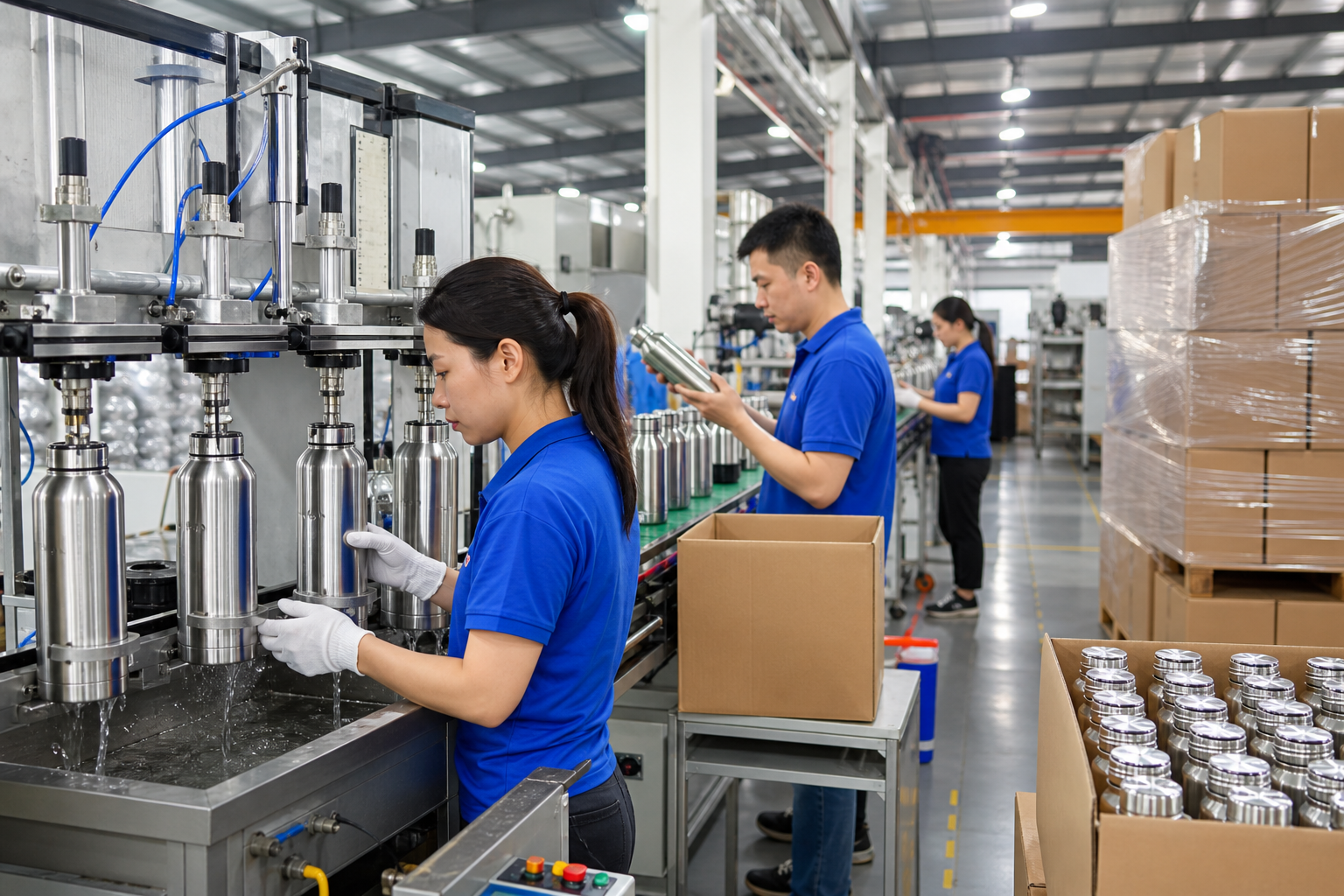
At our Zhejiang factory, we run drinkware for export at scale, with monthly output above 600,000 units and a standard MOQ starting at 1,000 pcs for many SKUs. The line does not forgive vague specs. If a seller cannot give you material grade, wall thickness, lead time, and test standard in one call, you are not buying wholesale drinkware—you are betting on a supplier who has not checked the gauge table. A buyer once flagged a PO typo on 304 stainless as 304S; QC pulled the sample, and the issue was caught before molding started.
Start with the use case
Before you ask for quotes, pin down the job. A gym bottle, school bottle, outdoor canteen, and premium corporate gift are four different builds. If you need a best wholesale drink bottle for retail, shelf appeal, leak testing, and decoration consistency matter. If you need bulk drinkware for promotions, landed cost, carton count, and defect rate drive the buy. If you need a bulk canteen for camping or tactical channels, the lid structure and impact resistance matter more than shiny packaging. We run this split every week on the line, and the wrong brief costs a full round of samples.
Be clear on volume, market, and price band. A buyer in Europe may need REACH-compliant coatings and food-contact declarations. A North American Amazon seller may need FNSKU labeling, carton drop resistance, and barcode-ready packaging. A distributor buying wholesale drinkware for a chain account may need mixed SKUs in one 40HQ. In Zhejiang, the fastest samples come from buyers who send a one-page spec sheet with target volume, lid type, logo method, and test standard. That saves 2 to 3 days and usually avoids one sample rework. QC pulled the sample on a 1.5 mm lid seal once, and the buyer flagged it before we shipped the second round.
Do not let a supplier push the stock item just because it is on the shelf. The math does not work if the margin misses your channel. The best wholesale canteen for your market is the one that fits your sell-through, not the one that clears their warehouse first.
Materials decide margin
For stainless steel, the export spec we run is SUS304 on the inner wall and outer shell, with 18/8 composition. On a 500 ml bottle, that is the line buyers trust. Some factories will quote SUS201 on the outside or a full 201 build to shave cost, and the math only works if your market accepts a lower corrosion margin and you state it plainly. For a premium wholesale growler program, 304 is the safer call, especially when the bottle will hold acidic drinks or sit in a hot warehouse for 3 to 6 weeks. QC pulled a salt-spray sample last month, and the 201 shell showed early spotting.
Wall thickness is where quotes get slippery. A true 0.4 mm body is lighter and cheaper, but dent resistance drops fast. At 0.5 mm, you get better rigidity and less oil canning on the surface. If you are sourcing growler bulk or beer growler bulk for retail, ask for thickness by part: body, base, lid shell, and handle if there is one. Do not accept “0.5 mm” unless the supplier shows a caliper report or incoming material spec. We had one PO typo that said 0.05 mm on the body; the buyer flagged it before we cut steel, and that saved a headache.
For plastic bottles, Tritan, PP, and PET solve different jobs. Tritan is clearer and fits premium shelves, but it costs more. PP is standard for promotional drinkware wholesale orders because it is cheap and easy to mold. Glass works for specialty bulk drinkware, but breakage and carton cost are part of the bill. If your order is alcohol flask bulk or alcohol flask wholesale bulk, confirm the liner, surface finish, and leak test method before you approve tooling. We run a 1.2 m drop test on the packing line, and that usually tells you more than a sales promise.
Price is not just unit cost
People ask for unit price first. Wrong question. Ask for the full landed cost after print, packaging, and freight. A plain 500 ml stainless bottle often lands at USD 1.20-1.80 FOB China, depending on MOQ, lid style, and finish. Add USD 0.08-0.25 for one-color silk screen, USD 0.20-0.45 for laser marking on a curved body, and USD 0.10-0.30 for retail packaging. We had one buyer flag a PO because the carton spec was missing; the “cheap” quote turned expensive fast.
For beer tumbler bulk or beer tumbler wholesale bulk programs, check condensation control, powder coating reject rate, and carton fit. We run the coating line in-house in Zhejiang, and that can save 5-7 days versus splitting the job across two vendors. That matters when you are loading a container for a summer promo. Freight density is the other piece. A 500 ml bottle packed 50 pcs/carton can move better than 25 pcs/carton if the carton size is tuned, even when the unit price is a touch higher. The math does not work any other way.
Ask for an itemized quotation with FOB Ningbo or FOB Shanghai, sample cost, tooling cost if any, and replacement policy for broken units. QC pulled the sample, checked the rim with a caliper, and we caught a 1.5 mm gap before it went into mass production. If the supplier will not break out the numbers, you will pay for them later.
Quality control you can verify
For wholesale drinkware, quality is not a slogan. It needs a test plan. Our usual factory QC package covers visual inspection, vacuum retention or leak test, dishwasher resistance where the model allows it, and a carton drop test. For export lots, AQL 2.5 major and 4.0 minor is a normal starting point, but the checklist has to be tight. A bottle can pass appearance and still fail in a warehouse because the cap thread is off by 0.3 mm.
For stainless insulated bottles, ask for thermal performance data at 20°C room temperature and fixed fill conditions, not loose “12-hour hot” marketing. If a supplier says 24 hours hot, ask for the setup: fill temperature, initial water volume, ambient temperature, and lid type. We run that test on the bench with a thermocouple, and the buyer usually flags the same issue: the claim is fine, the test method is not. The same goes for growler wholesale and wholesale growler lines, where seal performance matters more than sales copy. For export to the EU or North America, collect food-contact declarations, LFGB where applicable, and REACH-related material statements before the truck leaves the gate.
We tell buyers to check three things on the first run: lid torque consistency, surface finish variation, and carton compression. QC pulled the sample at 18 N·m, and that number tells you more than a catalog page. If those three hold, the line is usually controllable. If they do not, the supplier is not ready for scale. We've seen that go sideways too many times.
Choose the right customization
Custom branding helps only when the decoration matches the bottle surface and the order size. Silk screen is the low-cost choice for flat panels or a gentle curve, and we run it on wholesale canteen and canteen wholesale jobs all the time. Laser engraving gives a cleaner mark on 304 stainless steel. UV print works for detailed art on some plastic bottles, but the rub test depends on coating thickness and curing time.
If you are buying alcohol flask wholesale or alcohol flask wholesale bulk, the decoration call gets tighter because the print window is small and the flask shape fights the artwork. A buyer once pushed a 6-color logo onto a 30 mm tall panel; QC pulled the sample, and the text was a blur from 1 meter away. For beer growler wholesale programs, we usually keep it to one logo at one spot and let the carton do the selling. That is the safer move.
Tooling changes, Pantone checks, and multi-location logos can add 5-10 days to production. We have seen it go sideways when the PO said "navy" on one line and the artwork file said Pantone 296 C. If your launch date is fixed, lock the art early. The buyers who move fastest in Zhejiang approve the first proof and save the edits for the next PO.
Supplier checks that save trouble
You do not need a perfect supplier. You need a supplier with stable systems. Ask for ISO 9001 if they have it, BSCI or equivalent social compliance if your retail channel requires it, and recent third-party test reports dated within the last 12 months. Then ask who owns the order on their side: sales, production, or a project engineer. If nobody can name the person, expect delays. We saw one PO with the buyer’s item code typed wrong by one digit, and that small typo turned into a 3-day sample check loop.
Factory capacity is another practical signal. A Zhejiang plant making 600,000+ units per month can support repeat orders, but only if planning is disciplined. Ask about line count, daily output, and the percentage of orders shipped on time over the last quarter. A serious exporter should answer with numbers, not slogans. For drinkware bulk programs, a lead time of 15-25 days after sample approval is normal. If a supplier says 7 days for custom work, be careful. Either they are guessing or they are shipping someone else’s stock. QC pulled the sample at 1.2 mm wall thickness before we released one lot, and that is the kind of check that saves a claim later.
Check whether the factory can handle mixed categories. A plant that can produce bulk growler, canteen, and beer tumbler in bulk orders usually has stronger process control than a trading-only seller. China has good factories, but the best ones in Zhejiang run like engineering teams, not quote machines. We’ve seen this go sideways when a buyer asked for three SKUs, two lids, and one colorway change in the same week; the line handled it because the mold room, packing desk, and QC all knew the schedule.
Plan the order like a buyer
The cleanest way to source the best wholesale water bottle is to run the order in stages. First sample the function: leak test, lid fit, and finish. Then approve pre-production samples with the final artwork and packaging. After that, lock the PO and reserve freight space early if your season is tight. We had a buyer flag a 1 mm cap mismatch on a 500 ml run, and the line stopped for half a day. That sequence cuts the mistakes that eat margin.
For your spec sheet, include capacity, material grade, wall thickness, lid style, color code, logo method, packaging count, carton dimensions, and required standards. If you need canteen bulk or wholesale drinkware across multiple SKUs, keep one master specification matrix. A plain Excel sheet works. It lets you compare similar products without mixing up print methods or finish options. If your channel includes Amazon or retail chains, add barcode placement, carton labels, and master carton rules. For beer growler wholesale bulk and beer tumbler wholesale bulk programs, this matters because one crushed carton can wipe out the savings from a $0.18 unit discount. QC pulled the sample, checked carton drop resistance at 80 cm, and found the inner divider was off by 3 mm.
The best buyers do not chase the lowest quote. They buy repeatability. That is why experienced procurement teams in Europe and North America often work with a Zhejiang factory that can document the order from material receipt to final carton check. If the supplier cannot show batch traceability, the math does not work. We ship plenty of orders, but the ones that go smooth start with a clear PO and a clean sample sign-off.
Request a quoted spec sheet today
Send your target capacity, material, MOQ, and decoration method. We will return a practical quote with lead time, FOB price, and testing details.
Frequently asked questions
What is a normal MOQ for a custom wholesale water bottle?
For many standard custom bottles, MOQ starts at 1,000 pcs per design or color. Some simple stock models can go lower, around 500 pcs, but the unit price usually rises 10-20%. For multi-color logos or special packaging, 2,000 pcs is more realistic. In our Zhejiang facility, the most common export MOQ sits at 1,000-3,000 pcs because that keeps decoration and carton planning efficient.
How much should I expect to pay FOB China?
A basic 500 ml stainless bottle often lands around USD 1.20-1.80 FOB China depending on material, lid, finish, and print. Add USD 0.08-0.25 for silk screen and USD 0.20-0.45 for laser engraving. Premium vacuum bottles with better coatings or complex lids can move into the USD 2.20-3.80 range. Freight, duties, and packaging are extra, so always ask for an itemized quote.
Which material is best for wholesale drinkware?
It depends on the market. SUS304 stainless steel is the safest default for premium drinkware because it resists corrosion and supports thermal performance. Tritan is better for clear sports bottles and kid-friendly applications where visibility and impact resistance matter. PP is fine for low-cost promotional orders. For EU and North America, make sure the supplier can provide food-contact declarations and material traceability.
What QC standard should I require from a factory?
Start with AQL 2.5 major and 4.0 minor for final inspection. Then add leak testing, cap torque checks, carton drop tests, and thermal performance verification if it is insulated. Ask for samples of the inspection report, not just a promise. If you are buying 10,000 pcs or more, consider a third-party pre-shipment inspection to catch issues before the container leaves China.
How long does production usually take in China?
For standard custom drinkware, 15-25 days after sample approval is common in China. If tooling is new, artwork is complex, or the finish requires extra curing, add 5-10 days. Peak season can extend timelines further. A good supplier in Zhejiang should give you a realistic schedule with milestone dates for sample sign-off, production start, inspection, and packing.