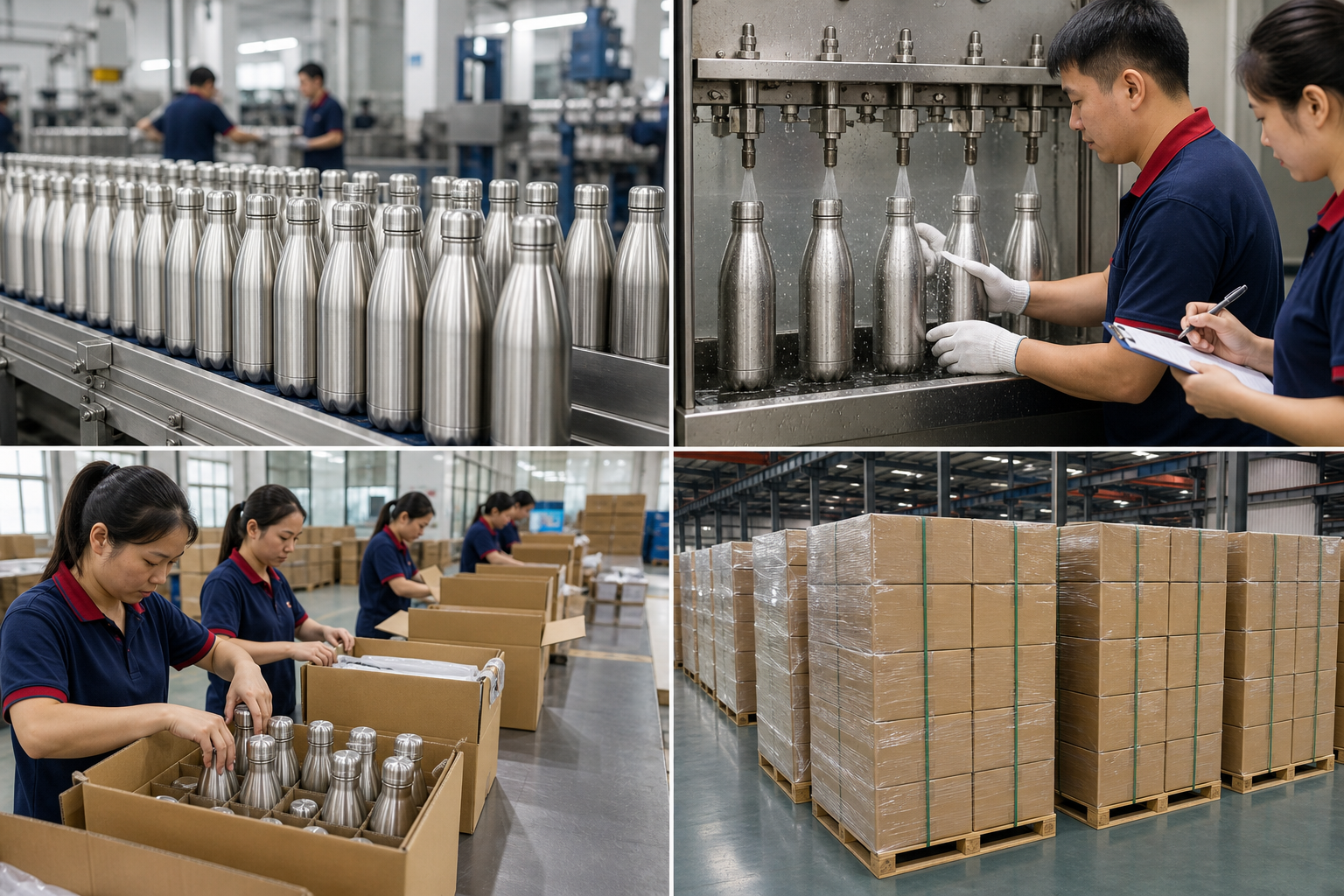
Key Takeaways
- MOQ for standard stainless bottles is usually 1,000 pcs per SKU; custom logos often start at 3,000 pcs.
- A workable FOB China price for a 500 ml 18/8 stainless bottle is often USD 2.15–4.80 depending on finish and lid.
- Lead time is typically 25–35 days after sample approval, not counting ocean transit.
- AQL 2.5 major / 4.0 minor is a common inspection target for wholesale drinkware shipments.
If you are sourcing the best wholesale water bottles, you are not just buying a bottle. You are buying margin, lead time, a compliance file, and a container that has to land on schedule. We run this every week. Buyers who start with specs, not samples, usually save themselves a lot of back-and-forth. Wall thickness, lid type, coating method, and carton pack-out decide whether a program works or gets stuck in rework.
At BottleForge in Hangzhou, Zhejiang, we see the same pattern on the line: a buyer asks for “good quality and competitive price,” then the real work starts when we define the use case. A 500 ml stainless steel bottle for retail is not the same as a bulk canteen for a school distributor, and a beer growler wholesale order needs different closure parts and leak testing than a standard travel bottle. QC pulled the sample at 12 mm wall thickness on one job because the PO typo called for 1.2 mm, and the math did not work. China has the tooling depth to cover all of it, but you still need a hard sourcing process.
Start with the use case
The best wholesale water bottles are the ones that match the buyer’s channel. Retail packs, promo gifts, school orders, sports events, and hotel use each need a different spec. Buy on price alone, and you usually pay later in dent claims, slow sell-through, or returns.
Start with capacity, material, and closure. A 500 ml double-wall stainless bottle with a screw cap fits premium retail. A 750 ml single-wall PET bottle works better for event handouts. If the order is for outdoor programs, ask for insulation, a carry handle, or a wide mouth for ice. Those choices change tooling, unit cost, and carton count. We have seen a buyer push back on a 5 mm wider cap neck, then the math still failed on freight.
- Retail programs: focus on appearance, box quality, and coating consistency.
- Promotional bulk drinkware: focus on logo area, short lead time, and price.
- Field or camping buyers: focus on durability, lid security, and weight.
A procurement manager also needs to confirm the destination: chain store, Amazon FBA, or a distributor warehouse. The pack spec changes. A bottle that works as a wholesale drinkware giveaway may fail a retail drop test or a barcode label check. QC pulled the sample on a 1.2 m drop last week, and the buyer flagged a 2 mm carton gap. In Zhejiang, we run multiple bottle bodies on the same line, but the right wholesale bottle is chosen by end use, not by what sits on the shelf that day.
Read the material and thickness
Material is where a lot of buyers lose margin. For stainless steel, 304 stainless is the normal spec for the best wholesale water bottles in most export markets. If you chase the lowest unit price, 201 stainless will look tempting, but we’ve seen that story go sideways on rust spots and brand perception. For sports bottles and promo runs, BPA-free Tritan, PP, and PET still make sense when weight is the main target.
For metal bottles, ask for the real wall or shell thickness. A common single-wall stainless body runs 0.4 mm to 0.5 mm gauge. Double-wall vacuum bottles are judged more by the inner and outer shell build than by one simple thickness number, and the forming quality still matters. If the supplier cannot tell you the gauge, you are not comparing the same product. For canteen wholesale programs, a 0.5 mm body usually takes dents better than a 0.35 mm body, even if the lighter one looks cheaper on the quote. QC pulled the sample, and the 0.35 mm canning mark showed up after one drop test.
What to request on the RFQ
- Exact material grade, such as 304, 316, Tritan, or PP.
- Body thickness or gauge in mm.
- Surface finish: matte powder coat, satin, mirror polish, or spray paint.
- Food contact compliance: LFGB, FDA, REACH, and if needed California Proposition 65.
In Zhejiang, the tooling base is deep, so you can source low-cost bottles fast. That is not the question. The math does not work if the material claims are soft and the test report is missing. For a wholesale canteen or canteen bulk supply program, ask for material certificates and third-party test reports before you start talking about packaging artwork. We ship from lines that can hit MOQ 3,000 pcs, but the buyer flagged a PO typo once—304 became 201—and that single line item changed the whole order.
Price by structure, not by headline
Procurement errors usually start with a fake comparison. One factory sends USD 2.20, another sends USD 3.10, and the buyer assumes the gap is profit. That is often wrong. We ship quotes where the cheap side left out printing, the foam insert, leak testing, or a better lid. Compare wholesale drinkware by structure: bottle body, lid, coating, packaging, and compliance cost.
For a standard 500 ml stainless steel bottle, FOB China pricing often lands around USD 2.15–4.80, depending on whether you choose single-wall or vacuum insulation, one-color print or laser engraving, and a plain carton or a full retail box. On our line, a 0.4 mm lid gasket or a 304 inner wall can move the number fast. A bulk growler in stainless or glass usually costs more because of volume, closure strength, and breakage risk. Beer growler bulk programs also need a reinforced handle and tighter packing, so freight per unit goes up.
Ask for an itemized quote. If you are buying beer growler wholesale or beer tumbler wholesale bulk, the sheet should show the closure type, carton spec, and outer carton quantity. This is the part buyers skip, then the math does not work. A 24-piece carton and a 12-piece carton can change ocean freight efficiency by 8% to 15%. For alcohol flask bulk or alcohol flask wholesale bulk programs, packaging is even more sensitive because the shape and gift-box presentation add real cost. We had one PO where the buyer flagged a typo on the outer carton count, and QC pulled the sample before packing.
Do not compare two wholesale drinkware quotes until you know whether they include the same print method, lid, and packaging level.
Customization that still ships on time
Custom logo work is where schedules slip. We see it on the line all the time. A Zhejiang factory can run silkscreen, laser engraving, UV print, heat transfer, and powder coat color matching, but each method adds a different setup step and a different defect check. If the buyer wants 30 days door to door, keep the decoration simple and lock the PO early.
For the best wholesale water bottles, logo placement has to follow the bottle body and lid geometry. A 180 mm wrap print on a tapered bottle will drift and look off-center. Laser engraving gives a clean, durable mark on stainless steel, which is why we ship it on premium wholesale canteen and wholesale growler orders. Silkscreen stays cheaper for one-color logos. UV printing handles full-color branding, but the coating has to be stable or the buyer flags the finish.
- Silkscreen: low setup cost, good for 1–2 colors, efficient at 1,000+ pcs.
- Laser engraving: durable, premium, no ink, often 3–7 days faster than multi-color print.
- UV print: best for detailed graphics, but requires tight coating control.
For canteen wholesale buyers, ask for a logo proof with Pantone code, print area in millimeters, and a signed sample photo before production. QC pulled the sample before we moved the line last week, and the buyer had a PO typo on the lid position that would have cost a full reprint. Some factories will say yes at quotation stage to keep the price looking good. That is the wrong question to ask. A disciplined supplier in Hangzhou, Zhejiang should tell you what repeats at 5,000 pcs, not what looks clean on a sample bench.
Testing, standards, and QC
If a supplier cannot walk you through the test list, keep looking. We run leakage checks, finish checks, adhesion checks, odor checks, and carton integrity checks on the line before goods leave. For export orders, ask for REACH and LFGB where they apply, and make sure the factory knows whether the shipment is headed to the EU or the U.S. We have had buyers send a PO with “USA market” and no test spec; that typo turns into a slow, expensive mess. North American buyers often ask for FDA-related declarations and can request lead and cadmium results on decorated surfaces.
A proper QC plan starts with pre-production sample approval, then in-line checks, then final inspection. On bulk canteen orders, many buyers use AQL 2.5 for major defects and 4.0 for minor defects. That is not a magic shield. It is a working standard. For vacuum bottles, we run a 24-hour leak test and a hot-water retention test. For glass or beer growler bulk orders, add drop tests and carton compression tests; breakage often shows up in transit, not at the factory. QC pulled the sample once and found a 2 mm gap at the lid seal. We stopped the line.
Ask for third-party lab reports, not just internal records. If the order is 10,000 pcs or more, add a pre-shipment inspection and photo records of carton markings. On one Zhejiang program with monthly output above 300,000 units, the buyer flagged a carton code mismatch and we fixed it before booking. That is the right way to spend half a day. A factory at that scale should handle it without derailing the schedule, but only if you lock specs early.
Plan MOQ, lead time, and freight
MOQ is a cash-flow decision, not a slogan. For standard wholesale water bottles, we run 1,000 pcs per color or SKU as the normal floor. For custom logo or custom shape programs, 3,000 pcs makes more sense, especially if the buyer wants a special lid or a custom lid color. We had one PO where the buyer flagged a lid-color typo, and the reprint cost ate the savings from a “cheap” quote. Ask what gets cut: color consistency, packaging, or production priority.
Typical lead time is 25–35 days after sample approval and deposit for mainstream stainless steel items. For complex vacuum builds, custom packaging, or peak-season orders, 40–45 days is the safer call. QC pulled the sample on a 1.2 mm wall bottle before release; that extra check saved a late-stage complaint. Ocean transit to Europe and North America adds about 18–30 days, depending on route and port. Plan on 60 days or more from PO to warehouse receipt.
Use packaging density to lower landed cost. A 500 ml bottle packed 24 pcs per carton can ship better than 12 pcs per carton, but only if the retail channel accepts the box size. For Amazon FBA drinkware, carton dimensions and FNSKU placement matter as much as the bottle itself. We’ve seen this go sideways when a buyer pushed for a smaller carton, then the outer box failed a 9 kg drop test. If you are building a wholesale growler or beer tumbler bulk line, freight and carton strength belong in the product spec, not after the quote.
At BottleForge in Hangzhou, Zhejiang, our monthly output is above 320,000 units, which gives us enough line capacity to handle repeat wholesale drinkware programs without random changeovers. We ship on scheduled runs, and the line can hold steady when the same SKU comes back every quarter. That matters when a buyer wants a best wholesale drink bottle program replenished on time, not patched together at the last minute.
Match the bottle to the channel
No single bottle wins every channel. We see it on the line every week. The SKU that works in retail shops is rarely the same one that fits promo distributors, and neither matches bulk canteen supply for schools or outdoor buyers. Channel math decides the order.
If you are buying canteen bulk or wholesale canteen for schools and institutions, go after durable bodies, simple lids, and easy cleaning. We run leak tests on 300 ml and 500 ml samples for this group because one sticky cap can sink repeat orders. If you are sourcing beer growler wholesale bulk for beverage or hospitality clients, the buyer will ask about seal strength, handle comfort, and volume calibration. If you are looking at alcohol flask in bulk or alcohol flask wholesale, the job shifts to gift appeal, stainless finish, and discreet branding instead of insulation. For beer tumbler in bulk or beer tumbler bulk orders, pack-out speed and retail-ready finish matter more than a fancy shape.
- Retail: margin, shelf appeal, UPC labeling, and a low defect rate.
- Promotional: fast customization and a low unit cost.
- Institutional: durability and replacement availability.
The best wholesale water bottles are not the flashiest. They fit the channel, pass compliance, and leave the buyer enough margin to keep selling. We had a PO last month with the wrong carton count, and the buyer flagged it before we packed. That is why sourcing in Zhejiang and across China works best when you treat the bottle as a sales tool, not a pretty sample.
Source your next bottle program with confidence
Send your target capacity, target price, and market. We will turn it into a workable wholesale drinkware spec, MOQ, and lead time from Zhejiang.
Frequently asked questions
What MOQ should I expect for wholesale water bottles?
For standard stainless steel wholesale water bottles, MOQ is usually 1,000 pcs per SKU. If you need a custom logo, special lid, or custom color, 3,000 pcs is more realistic. For glass, growler, or aluminum-style programs, the MOQ can rise to 3,000–5,000 pcs because of packaging and setup. A supplier in Zhejiang should tell you whether MOQ is tied to decoration or to the bottle mold itself. Do not accept a vague answer; ask for MOQ by color, by print method, and by carton spec.
What is a realistic FOB China price for a good bottle?
For a 500 ml 304 stainless steel bottle, a realistic FOB China range is USD 2.15–4.80 depending on wall structure, lid type, coating, and print. Single-wall bottles with basic silkscreen can sit near the low end. Double-wall vacuum versions with powder coating and laser engraving move higher. For beer growler wholesale bulk, the price can be significantly higher because of size, closure, and packing protection. Always compare like for like, including packaging and testing.
Which certifications matter for Europe and North America?
For Europe, ask for REACH and LFGB where applicable. For North America, request FDA-related food contact declarations and, when decoration is involved, lead and cadmium results if your buyer requires them. If the product is vacuum insulated, ask for thermal performance test data too. A serious factory in China should also be able to share an internal QC checklist and third-party lab reports. If the seller cannot provide documents before order confirmation, that is a warning sign.
How do I reduce defects on a drinkware bulk order?
Use a written specification sheet with material grade, thickness, logo placement, color code, and packaging details. Approve a golden sample before mass production. Set AQL 2.5 major and 4.0 minor for final inspection, and require a 24-hour leak test for vacuum bottles. For glass or beer growler in bulk shipments, add carton drop testing and edge inspection. A pre-shipment inspection in China usually costs far less than replacing 3% damaged units later.
Can I mix multiple styles in one container?
Yes, but only if the carton dimensions, pallet pattern, and export labels are managed carefully. Many buyers mix 2–4 SKUs to improve container utilization, especially for wholesale drinkware or canteen wholesale programs. The problem is inventory discipline: mixed loads slow receiving and complicate FNSKU or retail labeling. If you are doing Amazon FBA, mixing is possible, but you need clear carton markings and SKU separation. For lower-volume distributors, a mixed container can cut freight cost by 8% to 12% if planned well.