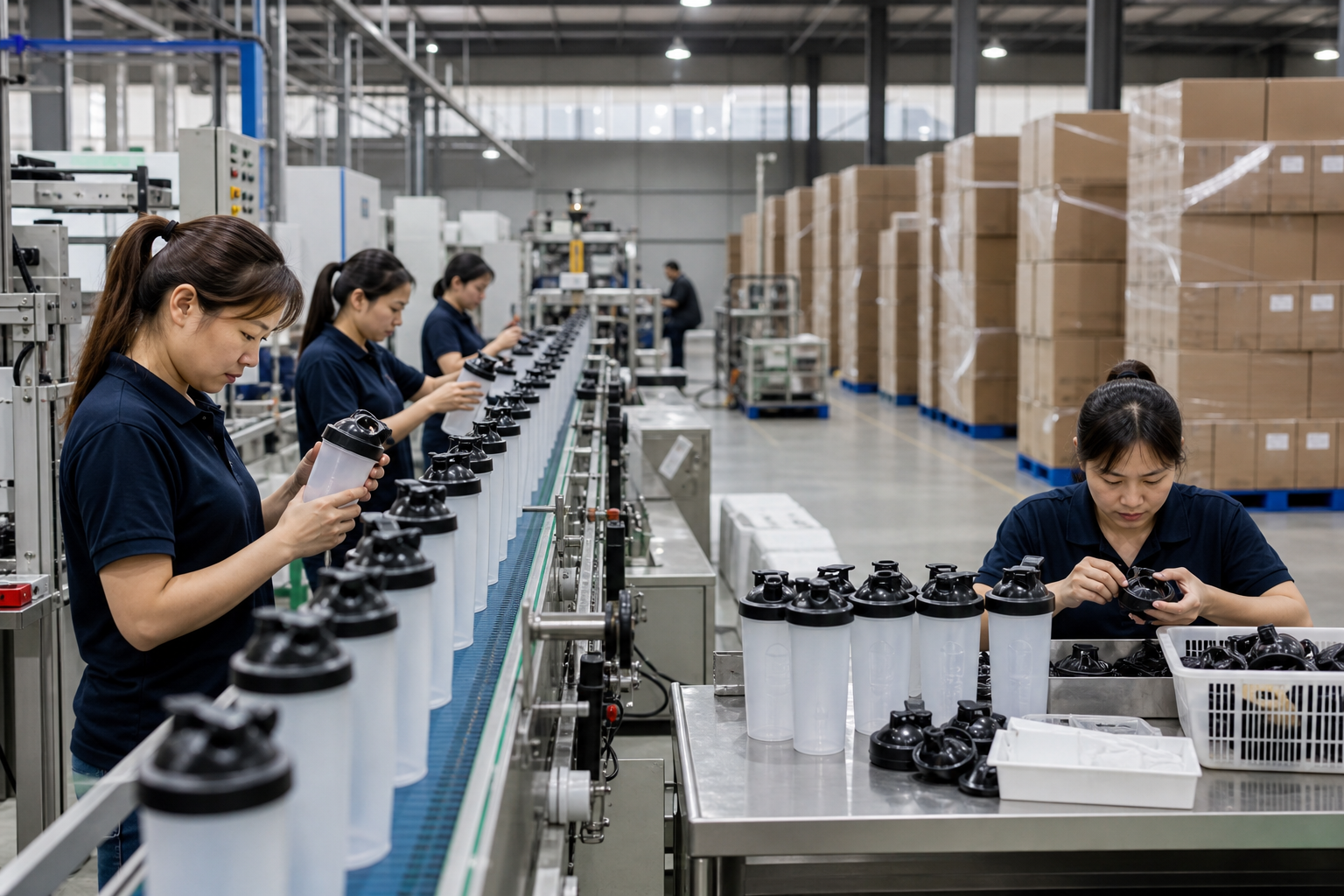
Key Takeaways
- Blender bottle bulk orders usually start at 500-1,000 pcs per SKU, with printed samples at USD 25-80.
- A practical shaker spec uses PP lid, Tritan or PETG body, silicone gasket, and 0.6-0.8 mm wall thickness.
- For China sourcing, FOB Ningbo or Shanghai is common; 30-45 days lead time is normal after sample approval.
- Insist on AQL 2.5/4.0 inspection, REACH or FDA material declarations, and drop-test confirmation before shipment.
If you are buying blender bottle bulk for retail, gyms, or private label, the real problem is not finding a factory. The problem is sorting a bottle that looks right from one that survives daily use, passes compliance, and still leaves room for your margin. In Zhejiang and across China, we see hundreds of shaker bottles that look the same on a shelf. The split shows up in gasket fit, thread accuracy, lid torque, and whether the print still holds after 50 dishwasher cycles.
For procurement managers and brand owners, this is a technical buy, not a catalog order. Ask for material grades, wall thickness, drop-test data, and the real MOQ by decoration method. On our line in Hangzhou, a 300 ml shaker with a 78 mm mouth and a 1.2 mm gasket can run 300,000 units per month, but that does not mean every unit is fit for your PO. The buyer flagged one PO last month because “blender botlle” was typed wrong on the artwork file, and that kind of sloppiness usually shows up again in QC. You need a supplier that ships consistent drinkware wholesale quality, not just a low unit price.
What buyers really need
When you source blender bottle bulk, you are buying repeatable performance, not just a plastic cup with a mixing ball. A lid that seeps in a gym bag kills repeat orders fast. A print that peels after one wash does the same. We had a buyer flag a 600 ml sample after QC pulled it on a 1 m drop test, so the first question is use case: protein shakes, meal replacement, pre-workout, or a promo giveaway. Each one changes the cap, the fill volume, and the carton pack.
For private-label runs, we ship 500 ml, 600 ml, and 800 ml most often. If the channel is fitness, the right spec is a screw-on lid, a flip cap that snaps hard, and a food-grade silicone sealing ring. A lot of Zhejiang suppliers will sell the same bottle under drinkware wholesale, wholesale drinkware, or bulk drinkware. Fine. That is sales talk. The math is the thread and the gasket. We hold lid thread tolerance at ±0.2 mm, and the gasket compression set should stay below 20%, or the line starts leaking after hot-fill and cold storage cycles.
Practical buyer checklist:
- Body material: Tritan, PETG, or PP, picked against target cost and clarity
- Gasket: silicone, 40-60 Shore A, with clean flash control
- Mixing element: stainless ball, whisk insert, or molded agitator; 24 g to 32 g is common
- Decoration: silk screen, UV print, or laser mark, matched to wash-cycle demand
- Test: leak test, drop test, odor check, dishwasher cycle check, then AQL 2.5 inspection
Materials and construction choices
For a serious program, material choice sets the landed cost and the return rate. Tritan is the best pick for premium shaker bottles because it gives glass-like clarity and better impact resistance than basic PET. PETG costs less and still looks clean, but it scratches faster on the packing line. Polypropylene works for lids, caps, and some low-cost bodies, but it will not carry a premium shelf look. If you are building a beer tumbler bulk or beer tumbler wholesale offshoot for events, the same logic applies: clarity, odor control, and print durability beat a low first quote. We had one buyer push back on a 0.12 USD difference per set, then QC pulled the sample after the pad print rubbed off in 20 cycles.
Wall thickness is where a lot of buyers get burned. A body at 0.5 mm can look fine in photos, but it feels thin and can warp under hot fill. For most shaker jobs, 0.6-0.8 mm is the safer window. Caps and hinges need enough meat around the pivot point to survive at least 3,000 open-close cycles. If the factory cannot show cycle-test data, assume the hinge life is wishful thinking. We run this test with a jig, and the gauge does not lie. In Zhejiang, the better factories keep that record because European and North American buyers ask for traceability, not sales talk.
Do not approve samples based on appearance alone. A shaker bottle can look premium in a photo and still fail on lid torque, odor, or dishwasher stability.
If your range includes a bulk canteen line or canteen wholesale program, keep the engineering specs matched across SKUs. Shared lids, common gaskets, and one masterbatch color cut down on inventory mess. That is how seasoned buyers keep drinkware wholesale cost under control without creating a warehouse headache. We saw this go sideways on a 5,000-piece order when the PO typo changed the gasket color code from black to blue, and the line had to stop for a full day.
MOQ, pricing, and lead time
Let’s talk numbers, because that is where a sourcing deal gets decided. For blender bottle bulk orders, we usually see 500 pcs MOQ for a stock mold with one-color print, 1,000 pcs for a custom color, and 3,000 pcs if you want a full custom mold or a lid shape that needs new tooling. On one run last month, QC pulled the sample and found a 1.2 mm gap at the flip cap hinge; that kind of issue is why low-MOQ promises need a hard look. Sample cost usually sits at USD 25-80 for existing tooling, while a new mold can run USD 2,500-8,000 depending on cavity count and lid detail. If a supplier says 100 pcs at factory price, the math does not work.
For FOB China pricing, a basic 500 ml shaker can land around USD 1.10-1.80 at 1,000 pcs, while a premium Tritan version with custom print may sit at USD 1.90-3.20. That spread moves with decoration, packaging, and carton spec. A kraft box, shrink wrap, or retail belly band can add USD 0.10-0.45 each; one buyer flagged a PO typo where “12 pcs/carton” was entered as “120 pcs/carton,” and the carton cost blew up overnight. Lead time is usually 20-30 days for stock tooling and 30-45 days for custom colors or printed cartons. If you need peak-season delivery to a U.S. warehouse or EU distribution center, add ocean transit and customs clearance on top. We ship on a 7-day packing schedule when the line is clean, but a late artwork file kills that fast.
Factories in Zhejiang that handle both wholesale canteen and wholesale growler programs often keep tighter line control because they run mixed-material jobs all week. Still, do not confuse capacity with speed. A plant making 300,000 units per month can miss your ship date if your file is late or your packaging spec is vague. We’ve seen it go sideways on a 3 mm lid drawing and a missing pantone code.
- FOB terms: normal for export procurement
- Payment: 30% deposit, 70% before shipment is standard
- Inspection: pre-shipment AQL 2.5 major, 4.0 minor
- Documentation: commercial invoice, packing list, COO, test reports
Customization that sells
If you are building a private-label line, decoration is not cosmetic. It changes perceived value, shelf price, and return rates. On the line, we have seen a matte body with one-color silk screen sell well in gym channels because the logo stays clean and the MOQ stays low. UV print gives sharper gradients when the brand uses three or four colors. Laser engraving holds up on stainless parts, but only if the surface finish supports it. For alcohol flask bulk or alcohol flask wholesale programs, laser or pad print usually makes more sense than full-wrap graphics. The flask is small. The mark has to stay sharp.
You also need to think by channel. A beer growler bulk or beer growler in bulk order for a brewery needs a different look than a fitness shaker. One buyer wants rugged, utilitarian branding; the other wants a clean shelf face. We shipped a 1,200-piece growler order where the buyer flagged a 3 mm logo shift on the first sample, and QC pulled it back before mass run. The same logic applies to growler wholesale and growler bulk orders for distributors. This is the wrong question to ask: “Can the factory print it?” Ask whether the print style fits the channel.
Good custom spec includes:
- Pantone reference and acceptable delta E, ideally under 2.0 for key colors
- Logo placement with exact mm measurements
- Print durability requirement, such as 50 dishwasher cycles
- Packaging language, barcode, and FNSKU if you sell on Amazon
If you also need alcohol flask wholesale bulk or beer tumbler wholesale bulk SKUs, ask the supplier to standardize cartons and master case sizes. We run 24-piece inner cartons and 48-piece master cases on a few repeat programs because the math works better in freight and warehouse handling. A buyer once sent a PO with “FNSK” instead of FNSKU, and that one typo delayed carton labels by two days. Standard boxes keep the U.S. and Europe shipments moving.
Compliance and quality control
For European and North American buyers, compliance is the starting point. Ask for food-contact declarations, REACH paperwork for EU shipments, and FDA-compliant material statements for the U.S. If you are buying stainless parts, get 304 or 18/8 confirmation in writing. A photo of a spec sheet is not enough. For plastic parts, ask whether the resin is virgin, regrind, or a blend. If it is blended, ask for the percentage. We had one buyer flag a PO typo on a resin note, and the line had to stop for half a day.
QC starts before production. Approve a golden sample, then freeze artwork, color, and packaging. During mass production, we run AQL 2.5 for major defects and 4.0 for minor defects. The ugly problems are usually small ones: loose lids, crooked logos, scratches, weak sealing, and odor complaints. Those drive returns. A factory that does proper in-line checks should show torque tests, leak tests, and visual checkpoints. On a 24,000-unit run, our leak tester caught 37 caps with uneven torque. Zhejiang factories that export every week know this drill, but write it into the PO anyway. The math does not work when the buyer assumes it is “standard.”
Ask for these documents:
- Material safety declarations
- Pre-shipment inspection report
- Carton drop-test result if you use e-commerce fulfillment
- Batch photos and production traceability
If your program includes canteen bulk or bulk canteen items, keep the compliance file matched across SKUs, so you are not rebuilding the same packet for every container. That saves time when your broker or Amazon compliance team asks for the papers again. We ship mixed cartons this way all the time, and it cuts repeat work fast.
Choosing the right China supplier
Not every factory that says it can do drinkware bulk or drinkware wholesale deserves your PO. We want a supplier that answers on tooling, lead time, and export paperwork without circling the question. Ask how many production lines they run, how many QC staff sit on each line, and whether they own the mold or pay a third party. One Zhejiang factory told us “4 lines, 12 QC, mold owned in-house” in 20 seconds. Good sign. If the answer is just “no problem,” walk away.
In this business, the better supplier can tell you why a lid needs a 1.2 mm hinge rib, why the logo has to move 3 mm off the curve, and why a sample can pass while mass production fails after a resin change. That is line experience. We ship a lot of mixed orders, and the buyer flagged one PO because the carton typo said 24 pcs when the packing list showed 20; that kind of mess burns time fast. You want a partner who can run wholesale growler items and fitness shakers without mixing pack specs. We’ve seen that go sideways more than once.
Before you send a deposit, confirm:
- Exact MOQ by color and decoration method
- Tool ownership and mold lead time
- Daily output and monthly capacity
- QC checkpoints and inspection scope
- Shipping terms from Ningbo, Shanghai, or another export port
If you are comparing several suppliers, ask for one printed sample, one unprinted body, and one packaging mockup. QC pulled the sample at 0.3 mm print shift, and that told us more than a polished sales deck. It is the fastest way to see who understands blender bottle bulk sourcing and who is just forwarding a catalog from China.
Request a factory quote with real specs
Send your target MOQ, material, print method, and destination port. We will quote clearly, with no vague pricing and no hidden process gaps.
Frequently asked questions
What is the usual MOQ for blender bottle bulk orders?
For stock molds, most factories in China will ask for 500-1,000 pcs per SKU. If you need a custom color, expect 1,000 pcs. If you want a new mold, 3,000 pcs is more realistic. Printed samples usually cost USD 25-80, depending on the decoration method and whether you want a retail box. A serious Zhejiang factory can still move fast, but they will not do true factory pricing on 100 pcs.
What price should I expect for a private label shaker bottle?
For a standard 500 ml shaker, FOB China pricing often starts around USD 1.10-1.80 at 1,000 pcs. Premium Tritan versions with better print and packaging can land around USD 1.90-3.20. Add USD 0.10-0.45 for packaging, depending on whether you use a kraft box, shrink wrap, or belly band. If a quote is far below that, ask what got removed from the spec.
What compliance documents should I request from the factory?
Ask for food-contact declarations, REACH documents for EU orders, and FDA-compliant material statements for U.S. sales. If stainless parts are involved, request 304 or 18/8 confirmation. For export QC, also ask for a pre-shipment inspection report, carton photos, and batch traceability. If you sell on Amazon, keep the packaging spec ready for FNSKU labeling and carton compliance.
How do I check quality before shipment?
Use a golden sample and then inspect production with AQL 2.5 for major defects and 4.0 for minor defects. Pay close attention to lid torque, leak testing, print alignment, scratches, and odor. A good factory should also confirm wall thickness, usually 0.6-0.8 mm for shaker bodies, and provide drop-test or cycle-test data if you request it. Do not rely on photos alone.
Can one supplier handle blender bottles, canteens, and growlers?
Yes, if the factory has the right tooling and line setup. Many Zhejiang suppliers make shaker bottles, wholesale canteen items, and wholesale growler products in the same export facility. The key is not product variety but process control. Check whether they own molds, how many units per month they can produce, and whether they can keep artwork, cartons, and inspection specs separate across SKUs. That is what prevents expensive mistakes.