Key Takeaways
- Typical MOQ for blender bottle custom is 3,000 pcs; custom colorways often start at 5,000 pcs.
- FOB China pricing for a basic shaker bottle usually lands around USD 1.20-2.80 depending on material, lid, and print.
- Plan 35-45 days for production after sample approval; rush jobs usually cost 8-15% more.
- For Europe and North America, ask for REACH, FDA contact material files, and AQL 2.5/4.0 inspection records.
If you are sourcing blender bottle custom for retail, gyms, supplement brands, or distributor programs, do not treat it like a print job. It is a bottle, a shaker insert, and a lid that has to seal after repeated drops and 20 wash cycles. We have had buyers send a logo file and expect the unit price to stay flat. It does not. In Zhejiang, the buyer usually misses the cost drivers first: mold structure, cap tooling, carton spec, and test work.
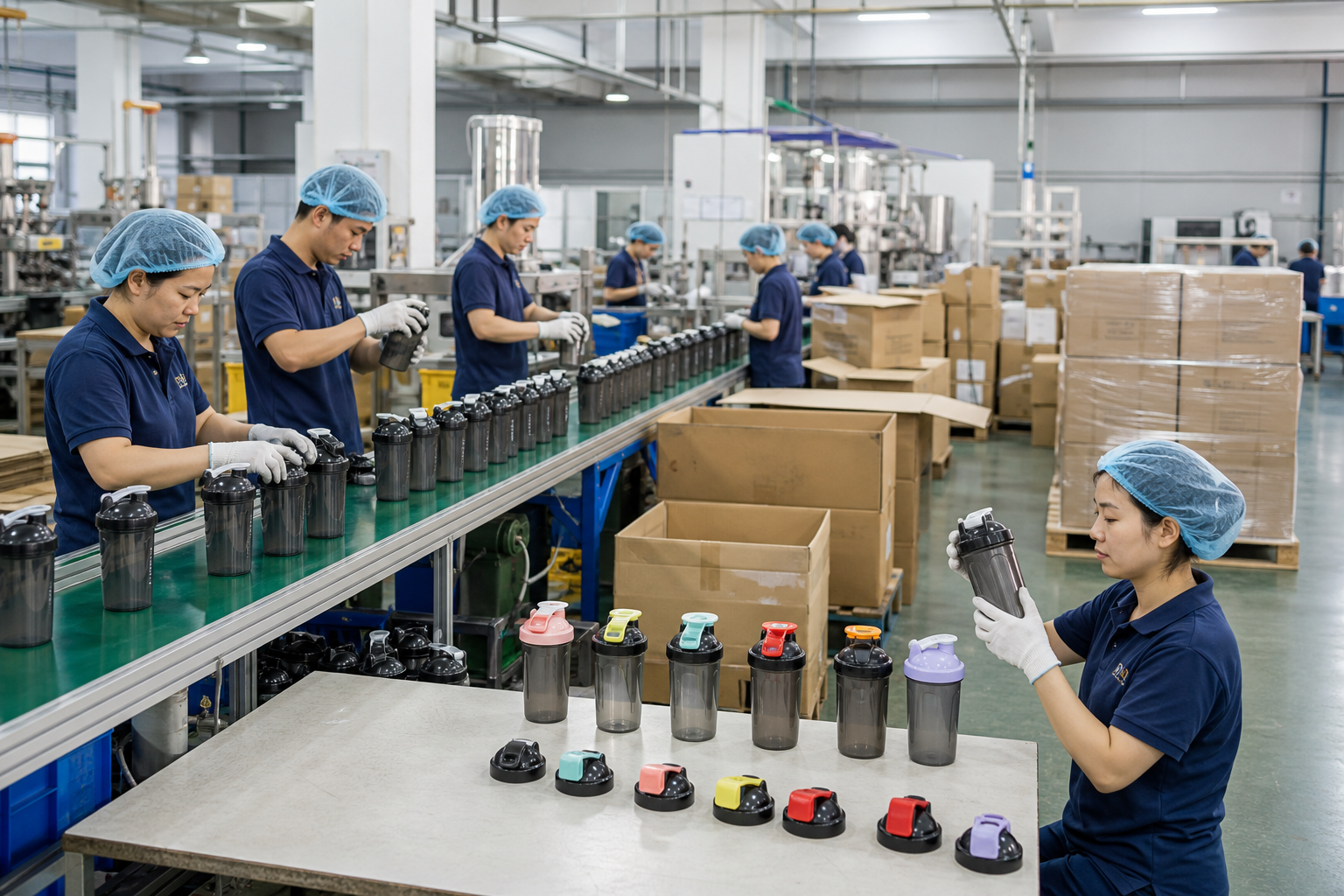
The clean way to buy custom drinkware is function first, decoration second, freight last. At BottleForge in Hangzhou, Zhejiang, we run 300,000 units per month across multiple lines, with MOQ starting at 3,000 pcs for standard shaker shapes and 5,000 pcs for custom colors. QC pulled a 0.5 mm seal gap on one lid run last month, and that is the kind of thing that decides whether a program ships clean or gets held. The math does not work if you start from artwork. You need a canteen manufacturer, not just a canteen vendor, who can point to the weak spot before the PO is signed.
What buyers mean by blender bottle custom
When buyers say blender bottle custom, they usually mean a shaker bottle for protein, pre-workout, or meal replacement drinks with their own logo, color, and packaging. On our line, that can mean three different jobs. One is a stock 600 ml or 800 ml body with one-color silk screen. Another is a bottle built around a buyer’s Pantone color, printed carton, and barcode label. The third is a full customized drinkware project with a new shape, molded logo, and a cap spec the factory has to tool up for.
The cost moves fast once you go past decoration. A standard PP shaker with wire whisk insert and flip cap can work for a canteen distributor or a gym chain. A premium version with Tritan body, stainless steel mixing ball, leakproof screw lid, and embossed measurement marks sits in a different price band. We had a buyer push for “promo pricing” on a Tritan sample with a 2 mm wall and printed carton; the math did not work, and QC pulled the sample for a lid fit check anyway. If the brief says canteen pricing, do not chase retail finish. That is how margins disappear.
What to define first:
- Capacity: 500 ml, 600 ml, 750 ml, or 1000 ml
- Material: PP, Tritan, stainless steel, or mixed construction
- Decoration: silkscreen, pad print, heat transfer, laser engraving
- Packaging: single box, color box, bulk pack, or FNSKU label applied
A clean brief helps a canteen supplier quote you without guessing. We ship faster when the buyer sends the capacity, material, and artwork in one email, not three.
Materials and parts that change price
For shaker bottles, the body material drives first impression, but the lid system is where the cost creep starts. PP is low cost, tough, and fits promo runs for canteens and campus giveaways. Tritan usually adds 20-35%; the buyer sees a clearer, glass-like finish, and the shelf price can move up with it. Stainless steel shaker bottles weigh more, and we run them when the customer wants a rugged gym item or a growler-style look. For North America, traceability is not a side issue. QC pulled the sample, checked the resin batch code, and that paper trail saved one order when the buyer flagged a missing lot number.
The closure is the second cost driver. A basic flip cap with a snap hinge is simple to mold, but the hinge thickness has to stay tight or the line starts dropping parts. A threaded sports lid with a gasket costs more and cuts complaint rates. For leak testing, ask for the sealing land tolerance and gasket hardness; a 0.2 mm mismatch can show up as seepage under pressure on a 24-hour test. This is the wrong question to ask if someone says, “Can you just make the cap cheaper?” A factory that knows the job will send exploded views and section drawings, not just a clean render. We had one PO with “lidz” typed in the spec sheet, and that typo led to the wrong insert being quoted.
If you are comparing a customized canteen, customized growler, or customizable canteen program, the body is only one line in the quote. Printing, tooling, and packaging can each add 10-25%. In Zhejiang, we often see buyers put too much budget into the bottle body and too little into the cap. The math does not work. On one 5,000-piece order, the carton size changed by 8 mm after the cap was switched, and freight went up before the samples even cleared.
Practical buying note: if your target retail price is under USD 9.99, keep the build simple. Every extra part adds assembly time, reject risk, and carton volume.
Decoration options that survive distribution
Branding on blender bottles looks simple until you ship 20,000 pcs to a distributor and 2,000 come back with scratches or peeled ink. We saw that on a 550 ml shaker run with a 3-color logo, and the buyer flagged it after one carton test. The safe decoration depends on use, not on what looks good in a sample photo. For high-rotation sports accounts, one-color silk screen is the line workhorse. Cheap. Fast. It is usually enough for a canteen customized for gyms or supplement brands. Laser engraving works on 304 stainless steel and gives a permanent mark, but it does not fit every substrate.
For multi-color artwork, heat transfer can look sharp, but you need to test abrasion resistance on the actual bottle, not just a flat card. We run a 50-cycle wipe test with mild detergent; if the print starts whitening before 30 cycles, the math does not work. If you want a canteen customizable program for retail, ask the canteen manufacturer to quote two print methods and two ink systems. You are buying a decoration system that has to survive warehousing, transit, and daily use. That is the real job.
Packaging matters too. A plain polybag may work for B2B promo shipping, but distributor canteen orders often need a color box, barcode sticker, and carton labels that match the customer’s warehouse flow. On one PO, the buyer typed the SKU as “Bottel-500” and QC pulled the sample before packing started. If you sell on marketplaces, request FNSKU application at the factory. That saves labor later and cuts one handling step. A canteen vendor in China should ship that cleanly. If they cannot, they are not set up for export-scale work.
- Silk screen: best for 1-2 colors and lowest unit cost
- Laser engraving: best for stainless steel and premium positioning
- Heat transfer: best for full-color art with moderate volumes
- Pad print: useful for small curved logo areas and tight placement
MOQ, lead time, and realistic pricing
Let’s be blunt: if someone offers a true custom mold shaker bottle at 500 pcs with a full color logo and export packaging, they are selling a stock item or hiding the tooling cost somewhere. We see this all the time. For most Zhejiang factories, including us, a standard blender bottle custom project starts at 3,000 pcs MOQ for one decoration and one color. QC pulled the sample on a 3,000-piece run last month because the logo sat 1.5 mm off center. If you want a new body color, plan on 5,000 pcs or more. If you want a new mold, the order volume needs to cover the tooling, usually 20,000-50,000 pcs depending on cavity count and lid complexity.
Lead time is not just “production days.” For a normal stock-shape order, sample approval takes 5-7 days, mass production 25-35 days, and ocean freight to Europe or North America can add 18-35 days depending on lane and season. So your end-to-end timeline is often 45-70 days. A buyer once flagged a PO typo on “24,000 pcs” versus “2,400 pcs,” and that single zero changed the booking plan. On FOB China terms, basic shaker bottles usually sit around USD 1.20-2.80, while premium Tritan or stainless options can reach USD 3.50-6.80. These numbers move with resin prices, print count, and carton spec.
Good canteen suppliers will also tell you when a project is too small. That honesty saves you from paying a 15-25% premium for fragmented production. If you need distributor growler or distributor drinkware programs across several SKUs, consolidate artwork and packaging where you can. One shared carton size often cuts freight cost by 6-12% because pallet efficiency improves. We run the line with a 48-carton master case when the buyer accepts it, and the math works. In China, freight math matters as much as unit cost.
Compliance for Europe and North America
If your bottles enter Europe or North America, compliance sits on the PO, not in a side note. For Europe, ask for REACH declarations, food contact material documents, and, where needed, migration test reports under the right EU framework. For the United States and Canada, buyers usually ask for FDA-related material confirmation, Proposition 65 review if the product chain shows any exposure risk, and third-party lab testing on inks and plastics. We had a buyer flag a 3,000 pcs PO because the declaration missed the ink supplier name.
“Food grade” is too loose. The math does not work. A proper factory should give you material specs for PP, Tritan, silicone gasket, and stainless steel grade, with no sales fluff. For stainless parts, ask for 304 or 316, and confirm whether the finish is 18/8 or equivalent. For PP parts, ask for melt flow and pigment stability if the bottle is translucent or bright-colored. On our line, QC pulled the sample and checked the laser mark against the spec sheet before we signed off.
Inspection still decides whether the shipment clears or comes back. AQL 2.5 for critical defects and 4.0 for major/minor defects is a common export setup, and retail programs often tighten that. Ask for leak tests, 1 meter drop tests, and torque checks on threaded lids. If you are buying a custom canteen or customizable growler instead of a shaker, use the same standard. We have seen this go sideways on a 12-day ship-out because the buyer skipped the cap torque check and found seepage at carton opening.
How to choose the right supplier in Zhejiang
There are plenty of canteen manufacturers in Zhejiang, and they do not run the same way. One shop is strong on tooling and weak on export files. Another gets samples out fast, then the cartons fail drop test. The right canteen factory is the one that can show stable output, not the one with the slickest pitch deck. Ask for the real monthly shipment number, the number of assembly lines on the floor, and how many SKUs they keep moving at one time. At BottleForge in Hangzhou, Zhejiang, we run 300,000 units per month, and that scale lets us keep multiple custom drinkware programs moving without pushing QC aside.
Check four points before you pick a canteen supplier or canteen suppliers: engineering support, QC process, export paperwork, and packaging control. If you are sourcing canteen custom or canteen customizable models for different distributors, the artwork position and carton marks need to stay consistent from the first lot to the fifth. We had a buyer flag a PO typo on carton quantity last month, and that sort of small miss turns into a bigger headache at the port. The same supplier should handle custom drinkware, custom canteen, and custom growler jobs without acting like each one is a new project.
Ask these questions before you approve the PO:
- What leak test method do you run, and what pass rate do you target?
- Can you send pre-production samples in 7-10 days?
- Do you support third-party inspections before shipment?
- What is the spare parts policy for lids, gaskets, and mixing inserts?
If the answers stay vague, move on. A canteen distributor is buying production reliability, not hope. We run leak tests with a pressure rig on the line, and the math does not work if a supplier cannot name the method, the standard, and the failure rate.
Packaging, freight, and the last-mile problem
Many custom drinkware programs fail after production, not during it. The bottle is fine, but the carton crushes, the label falls off, or the pallet load wastes cube. We see it on the line. For blender bottles, packaging can save real money. A nested bottle and lid in a color box often costs more than a bulk pack, but it protects retail presentation and cuts warehouse damage. If you are shipping to Amazon or a 3PL, ask for barcode labels and carton markings at the factory. QC pulled a sample last week and found one PO had the carton code printed as B-12 instead of B12. That kind of typo turns into inbound rework fast.
Freight planning should sit in the quote from day one. A 600 ml shaker bottle in a color box may take 20-30% more carton volume than a simple polybag version. The math does not lie. That can move landed cost more than a 5-cent print upgrade. For larger programs, ask the canteen vendor to set master carton quantity for pallet stack height and container utilization. We run a 1,200 x 1,000 mm pallet spec on a lot of shipments, and the difference between 24 pcs/carton and 36 pcs/carton can cut ocean freight per unit by 4-8% if the pack stays stable. If the inner tray collapses, the saving disappears.
For distributor canteen or distributor growler orders, lock the packaging early. Changing boxes after sampling looks harmless, but it can push the shipment back 7-14 days. We have seen that go sideways more than once. In China, packaging revisions are where schedules slip quietly. If you want clean execution from a Zhejiang supplier, give them the carton spec before tooling is frozen, not after. One buyer flagged a 3 mm headspace change after approval, and the whole carton insert had to be redone.
When a shaker becomes a broader drinkware line
Most buyers start with blender bottle custom, then the same retail account asks for a custom canteen for hiking, a custom growler for craft promos, and a branded tumbler for office use. That is the right move if you control artwork and packaging from day one. One print file. Three SKUs. We run this a lot, and the line moves faster when the carton size stays close across the range.
Do not push one factory into every job. A solid Zhejiang partner can cover shaker bottles, insulated bottles, and a few promo SKUs, but product fit still matters. If the brief is a lightweight canteen promotional item at low cost, keep the spec simple. If the buyer wants a 304 stainless growler with vacuum insulation, that is a different job on the line. QC pulled the sample at 350 ml fill test, and the weld on the cheaper quote failed. We’ve seen this go sideways fast.
The commercial logic is plain: distributors want restock, not one-off novelty. A canteen customizable program that shares caps, gaskets, and carton dimensions across SKUs saves time every quarter, and it cuts the PO back-and-forth when a buyer flags a typo on the carton mark. That is how you build a steady custom drinkware line from China.
Send your bottle brief for a factory quote
Share capacity, material, logo, and target market. We will give you a practical MOQ, FOB price, and lead time from Zhejiang, China.
Frequently asked questions
What is the usual MOQ for blender bottle custom orders?
For a standard shaker bottle with one logo and one stock body color, MOQ is usually 3,000 pcs. If you want a custom body color or special packaging, 5,000 pcs is more realistic. A new mold often needs 20,000 pcs or more to make the tooling worthwhile. In Zhejiang, factories like ours plan production around line efficiency, so tiny orders usually get a higher unit price and longer lead time.
How much does a custom shaker bottle cost FOB China?
A basic PP shaker bottle with one-color print often prices around USD 1.20-2.00 FOB China. A Tritan version or upgraded lid can move it to USD 2.20-3.80. Stainless steel or premium packaging can push it to USD 3.50-6.80. The final number depends on material, print method, packaging, and how much you want the factory to do before shipment.
What testing should I request for Europe and North America?
Ask for REACH-related material support, food contact declarations, and relevant migration test reports for Europe. For North America, request material traceability and third-party testing aligned to FDA expectations. For both markets, ask for leak tests, drop tests from 1 meter, and AQL inspection records. If the bottle uses stainless steel, confirm whether it is 304 or 316. If it uses silicone, request hardness and odor control data.
Can I get custom packaging and barcode labeling at the factory?
Yes, and you should. Most export-ready factories in China can apply barcode stickers, FNSKU labels, color boxes, and carton markings before shipment. This reduces rework at your warehouse or 3PL. For Amazon-style programs, send the label format early. If you change packaging after samples are approved, expect at least 7-14 days of extra delay and possibly 5-10% added packaging cost.
How do I choose between silk screen, laser, and heat transfer?
Use silk screen if you need low cost and one or two logo colors. Use laser engraving for stainless steel when you want a permanent mark that will not peel. Use heat transfer when your artwork is detailed and you can accept a higher decoration cost. For high-volume distributor drinkware, silk screen is usually the safest starting point. For premium retail, laser or heat transfer can justify the price if the packaging supports it.