Key Takeaways
- Most blender bottle customizable orders land at 500-3,000 units MOQ, with sampling in 5-12 days and mass production in 20-35 days.
- Expect factory prices to move by USD 0.35-1.80 per unit depending on material, lid complexity, and 1-color or full-wrap decoration.
- For EU and North America, ask for REACH, FDA food-contact, and BPA-free declarations before you approve production.
- A good canteen manufacturer in Zhejiang should show leak tests, AQL inspection levels, and packaging specs before you send deposit.
If you are sourcing blender bottle customizable drinkware for retail, gyms, or promo programs, the question is not whether we can print a logo. We can. The real test is whether the bottle holds up through filling, shaking, carton drop tests, and repeat use without leaking, fading, or creating a compliance problem in your market.
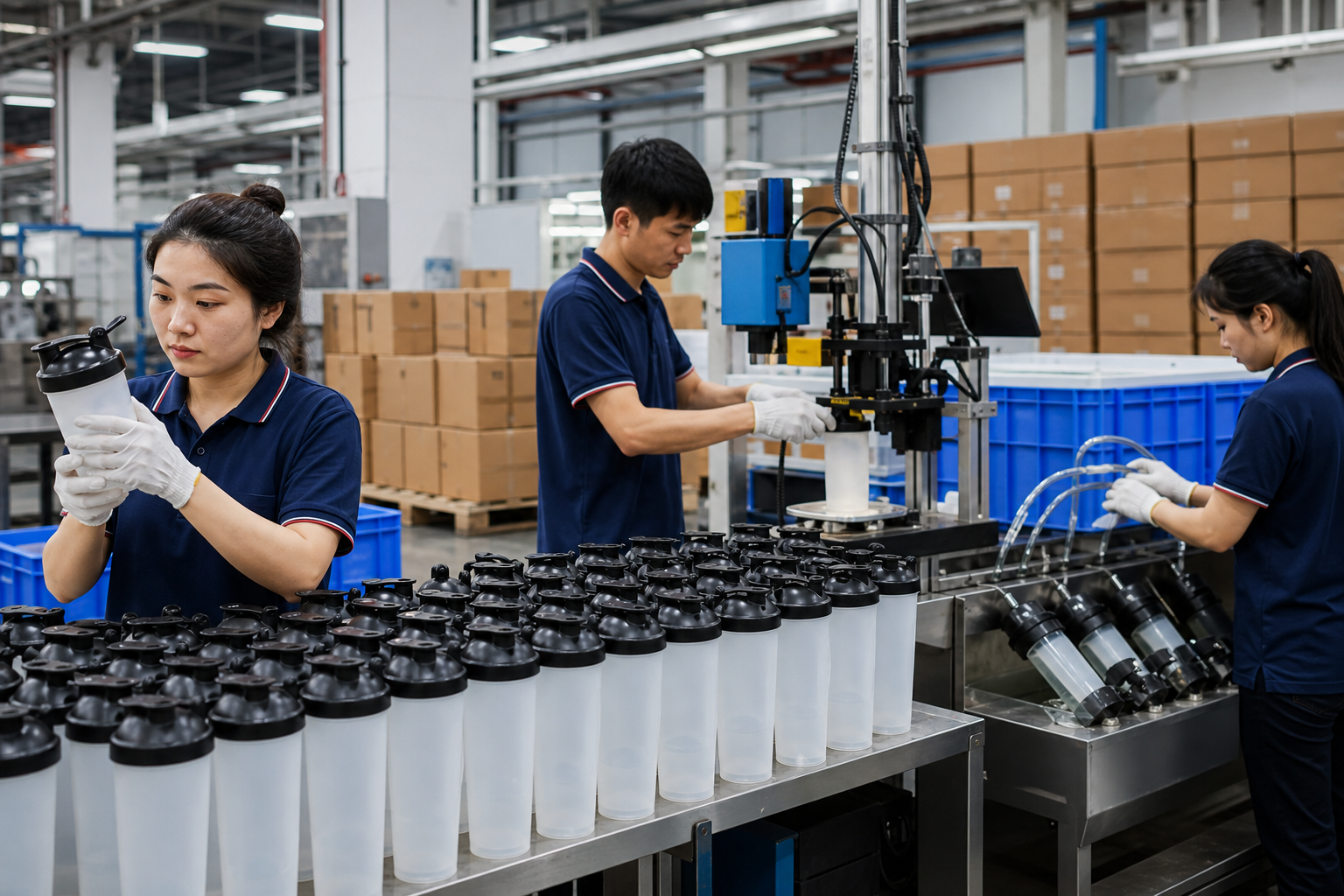
That is where buyers get burned. A gym chain may push for MOQ 500 and a 7-day sample, while a brand owner wants a clean print edge and margin that still works after freight. We run this on the line in Zhejiang every week, and the good orders start with a hard spec: 500 to 3,000 units, 5- to 12-day sample lead time, and a quote tied to resin grade, print area, and carton pack. The buyer flagged a PO typo on a 12 oz model last month, and that kind of miss costs time. The math does not work if the brief is vague.
What buyers actually need
People searching for blender bottle customizable usually want a protein shaker with a logo, not a toy. For B2B buyers, the real decision sits in volume, leak resistance, print wear, and whether the bottle fits your channel. A gym chain orders one way. A distributor program or canteen promo runs on a different spec. We had one buyer flag a 2 mm lid gap on the sample, and that ended the first round fast.
Start with the basics. A 28-32 oz shaker with a PP or Tritan body and a PP lid usually gives the best price-to-durability balance. If you are buying custom canteen stock or a custom drinkware set for retail, go for a finish that reads upmarket on shelf, such as a frosted body, matte coating, or laser marking. For canteen distributors, carton size and outer case count matter just as much as the logo. This is the wrong question to ask if you only look at the unit price. We ship 12-day samples on this spec, and the math changes once a carton is 24 pcs instead of 36 pcs.
- Volume: 28 oz, 32 oz, and 650-950 ml are the most practical selling sizes.
- Decoration: one-color silk screen is cheapest; laser engraving costs more but holds up after 50 wash cycles.
- Usage: shaker, hydration bottle, or promotional bottle changes the lid and wall spec.
- Packaging: retail box adds about USD 0.18-0.60 per unit, depending on print and insert.
Materials that do not cause problems
Material choice drives returns and the brand name on the carton. For a blender bottle customizable order, PP is the cheap, steady choice. It runs light, molds clean, and keeps unit cost down for canteen suppliers and volume buyers. Tritan costs more, but buyers keep asking for it when they want a clear body and a tougher shell. We saw a 10,000-piece order get pushed back last spring because the sample looked cloudy under the QC lamp. If you are quoting a custom growler or customizable growler, stainless steel usually makes more sense; it holds temperature better and looks right on retail shelves.
Wall thickness is where bad complaints start. For a shaker body, 0.8 mm to 1.2 mm is the normal range. Go thinner and the bottle feels weak in hand; go thicker and the price climbs for no useful gain unless the volume is large. On the line, we check this with a caliper, not by eye. For lids, ask for the resin grade and the cycle-test count. In Zhejiang, a proper canteen factory will tell you whether the cap uses a TPE gasket, a silicone seal, or a threaded compression design. If they cannot explain the seal stack-up, they are not ready for export work. We have seen that go sideways on a PO with one wrong cap code.
Practical rule: if your buyer will open and close the bottle 300-500 times, the seal matters more than the logo.
For Europe and North America, ask for BPA-free confirmation, REACH testing, and food-contact declarations. This is not a paperwork box-tick. It keeps your distributor canteen program moving and stops customs from holding a carton for 14 days because one file was missing. QC pulled the sample, the buyer flagged a label typo, and the whole shipment sat. If you sell through distribution, get the documents first and the artwork second.
Decoration that survives use
Decoration is where a lot of blender bottle customizable orders look clean in the mockup and then fail on the line. We’ve seen this go sideways with a 1-color logo that looked fine on screen but rubbed thin after 30 dishwasher cycles. Silk screen printing is the low-cost answer, and it fits simple artwork plus a big run. For a tight budget, this is usually the right call. If you want a cleaner retail look, pad printing works on smaller curved zones. Laser engraving lasts longer, but it only works on coated metal or stainless steel, not every plastic shaker body.
If you are ordering customized drinkware for retail, ask how the factory handles ink curing and abrasion resistance. We run a rub test with a felt wheel at 500 cycles on some jobs, and the buyer flagged it when a matte black print started whitening at the edge. A decent export-grade print should survive 50 to 100 dishwasher cycles in light commercial use, but I still tell buyers to hand wash printed plastic. For a blender bottle customizable promo run, a 1-color logo is usually enough. For brand owners, a full-wrap print can lift shelf impact, yet it also raises defect risk and makes QC slower.
- Silk screen: lowest cost, good for 1-2 colors, ideal for 5,000+ units.
- Laser: best for stainless steel, permanent, premium feel.
- Heat transfer: better for complex graphics, but check adhesion and wear.
- UV print: useful for short runs, but verify abrasion and alcohol resistance.
Ask your blender bottle customizable supplier for printed samples before mass production. A real factory proof beats a digital mockup every time. We had one PO with a missing “S” in the logo, and catching it at sample stage saved a 2,000-unit mess. QC pulled the sample, checked the edge line under a 10x loupe, and sent it back the same day.
MOQ, price, and timing
Let’s look at the numbers that decide whether the PO moves. For a standard blender bottle customizable project from a canteen supplier in China, we run 500 units MOQ for one logo and one color. If you want custom packaging or mixed decoration, 1,000 units is the cleaner number. Special lid tooling pushes it to 3,000 units or more, because the mold cost has to be spread somewhere. The buyer flagged this on a 2,000-piece inquiry last month, and the math did not work.
Factory pricing in Zhejiang usually lands in a narrow band. A basic PP shaker sits at USD 0.85-1.20 FOB, a Tritan version at USD 1.45-2.20 FOB, and a stainless custom growler at USD 4.80-8.50 FOB, depending on insulation and finish. Sample cost is often USD 25-60, and some canteen manufacturers deduct it from the first order. Lead time is 20-35 days after sample approval and deposit. If the line is open and the print method is simple, we can ship rush orders in 15-20 days. QC pulled the sample with a 0.5 mm print shift once, and that batch never went to mass production.
Watch the extras. Carton marks, barcode stickers, retail inserts, and export cartons can add 6% to 15% to landed cost. Ask for FOB Ningbo or FOB Shanghai if you want a clean comparison on freight and forwarder fees. A low factory price means little if the cartons collapse in transit; we’ve seen that go sideways on a 12-day ocean move to LA. Check the PO too. One buyer typed the wrong carton count, and the whole booking had to be reworked.
Quality checks before you pay deposit
Good factories do not hide the QC flow. If you are dealing with a canteen factory in Zhejiang, ask for the inspection points before mass production starts. We usually run incoming material check, in-line visual check, sealing test, and final AQL inspection. For export drinkware, AQL 2.5 for major defects and AQL 4.0 for minor defects is a common commercial standard. If your channel is premium retail, tighten it and get that in writing before the PO moves.
Leak testing is where sloppy suppliers get exposed. A proper shaker should pass an inverted water test under normal lid torque. For stainless or insulated products, we run a pressure check and a vacuum check; on one 500 ml order, QC pulled three samples from batch 2407 and one cap failed at the gasket seam. Ask whether the factory records test samples by batch and lot number. If they can show traceability by production lot, that tells you the line is controlled. If they cannot, the buyer flagged it for a reason, and the math does not work.
Request these documents before approval:
- Material declaration and food-contact statement
- REACH or LFGB test reports if needed for your market
- BPA-free confirmation
- Carton drop-test or transit test data
- Production photos with lot numbers
Better Zhejiang suppliers do not get defensive about this list. They expect it. We have seen orders go sideways when a buyer skipped the paperwork and only checked samples, then found the carton spec was 5 mm short at shipping. That is why experienced canteen distributors and distributor drinkware buyers keep sourcing from China instead of restarting the supplier search every season.
How to choose the right supplier
Not every canteen supplier is set up for export. Some are fine for domestic wholesale in China, then fall apart when you ask for carton labels, shipping marks, or repeat decoration on the same 500 units. We had one buyer flag a PO because the sealing gasket was written as “silicone ring” with no hardness spec, and that small typo turned into a 3-day email loop. A serious custom drinkware partner should quote cleanly, send samples fast, and answer technical questions without going quiet for two days. That is the floor, not a bonus. If they call themselves a canteen vendor but cannot confirm sealing material or carton size, move on.
You should also check how the supplier handles change and repeat work. Can they run a customized canteen at 500 units, then repeat 5,000 units later with the same Pantone match? Can they handle distributor canteen programs with mixed SKUs in one carton plan? Can they keep a custom growler line and your artwork on the same production cycle without the print shifting 1 mm? Those answers tell you whether the partner is a real canteen manufacturer or just a broker. In Zhejiang, the direct factories are usually straight about machine count, mold library, and monthly output. Ask for the number. A capable plant might run 180,000-300,000 units per month across different drinkware lines, and the line usually shows it in the packing area, where you can count the pallet wraps.
Use this simple filter:
- Clear FOB quotation with component breakdown
- Sample confirmed in 5-12 days
- Quality system that mentions AQL, leak test, and traceability
- Compliance documents ready for EU or North America
- Repeat order capability without color drift or print mismatch
If the supplier clears those points, you have something worth building around. If not, you have a short-term quote, not a sourcing relationship. QC pulled the sample with a 24-hour water test, and that is the kind of basic discipline we trust before we ship 10,000 pieces.
Packaging and channel fit
Packaging is where distributor drinkware deals go off the rails. A bottle can look fine in a sample box, then arrive loose, scratched, or with a lid insert cracked after a 35-day sea shipment. We’ve seen this on the line. If you sell into retail, Amazon, gyms, or corporate gifting, the pack has to match the channel, not just the bottle. Carton compression strength, inner tray structure, barcode placement, and shelf size all matter.
For FBA-style programs, tell your supplier to leave space for an FNSKU label and keep the outer carton dimensions stable. For promotional orders, a simple polybag can work, but the master carton still has to survive transit. On one 3,000-piece run, QC pulled the sample because the printed retail box rubbed through at one corner after a 1.2 m drop test. For a canteen promotional campaign or a customizable drinkware bundle, a printed retail box can lift perceived value by 20% to 40%, but only if the print is sharp and the carton survives the trip.
Here is the part buyers miss: channel fit changes the spec. A distributor growler for wholesale clubs does not need the same box as a premium customized growler for boutique retail. A canteen custom program for gyms may need an easy-carry handle and matte finish, while a canteen customized for school campaigns needs a tamper-safe lid and simpler decoration. We had a buyer flag a PO that asked for one carton style across three channels; the math does not work. Force one pack across all channels, and you pay later in returns or slow sell-through.
Get a factory quote on your custom shaker
Send your artwork, target MOQ, and market. We’ll give you a clear FOB price, sample timing, and compliance checklist from Zhejiang.
Frequently asked questions
What MOQ should I expect for blender bottle customizable orders?
For a standard PP shaker with one-color logo, MOQ is usually 500 units. If you want a special lid color, retail box, or mixed decoration, 1,000 units is more realistic. For a custom canteen or custom growler with new tooling, expect 3,000 units or more. A Zhejiang factory with real export experience should quote MOQ clearly, not hide it until after the sample. If you need test-market flexibility, ask for a split shipment plan: 300 units sample run, then 700 units repeat order. That helps distributor drinkware buyers reduce inventory risk.
How much does a custom shaker cost FOB China?
A basic blender bottle customizable project in PP often lands at USD 0.85-1.20 FOB. Tritan versions usually run USD 1.45-2.20 FOB. If you move to stainless steel or insulated construction, pricing goes higher fast, often USD 4.80-8.50 FOB for a custom growler depending on finish and capacity. Decoration adds cost too: one-color silk screen is the cheapest, while laser or UV print increases the unit price. Ask your canteen supplier to separate body, lid, print, and packaging so you can see where the margin is going.
What compliance documents do I need for Europe and North America?
For Europe and North America, ask for BPA-free confirmation, food-contact declaration, and REACH test reports at minimum. If your market requires it, ask for LFGB or FDA-related documentation as well. For printed items, verify that the inks are suitable for food-contact adjacent use even if they do not touch the liquid. A real canteen manufacturer in China should have these ready, especially if they sell into EU channels. If you are distributing through retail or Amazon, keep the PDFs on file before your first shipment clears customs.
What is the normal lead time for custom drinkware from Zhejiang?
Sampling usually takes 5-12 days if the design is standard and the print is simple. Mass production is commonly 20-35 days after sample approval and deposit. If you need special packaging, new molds, or complex decoration, add another 7-10 days. In Zhejiang, a capable factory can move faster, but only if the production line is open and material stock is available. If a canteen factory promises 7 days for a fully customized canteen with new tooling, be skeptical. Fast is possible; unrealistic is expensive.
How do I choose between silk screen, laser, and UV print?
Use silk screen if you need low cost and a clean 1-color logo on a large order. Use laser engraving if the product is stainless steel and you want a permanent mark that will not peel. Use UV print if you need more graphic detail and a higher shelf impact, but check abrasion resistance and alcohol resistance first. For a canteen promotional order, silk screen is usually enough. For a premium customized drinkware line, laser or UV may justify the higher cost. Ask for a physical sample, not only a render.