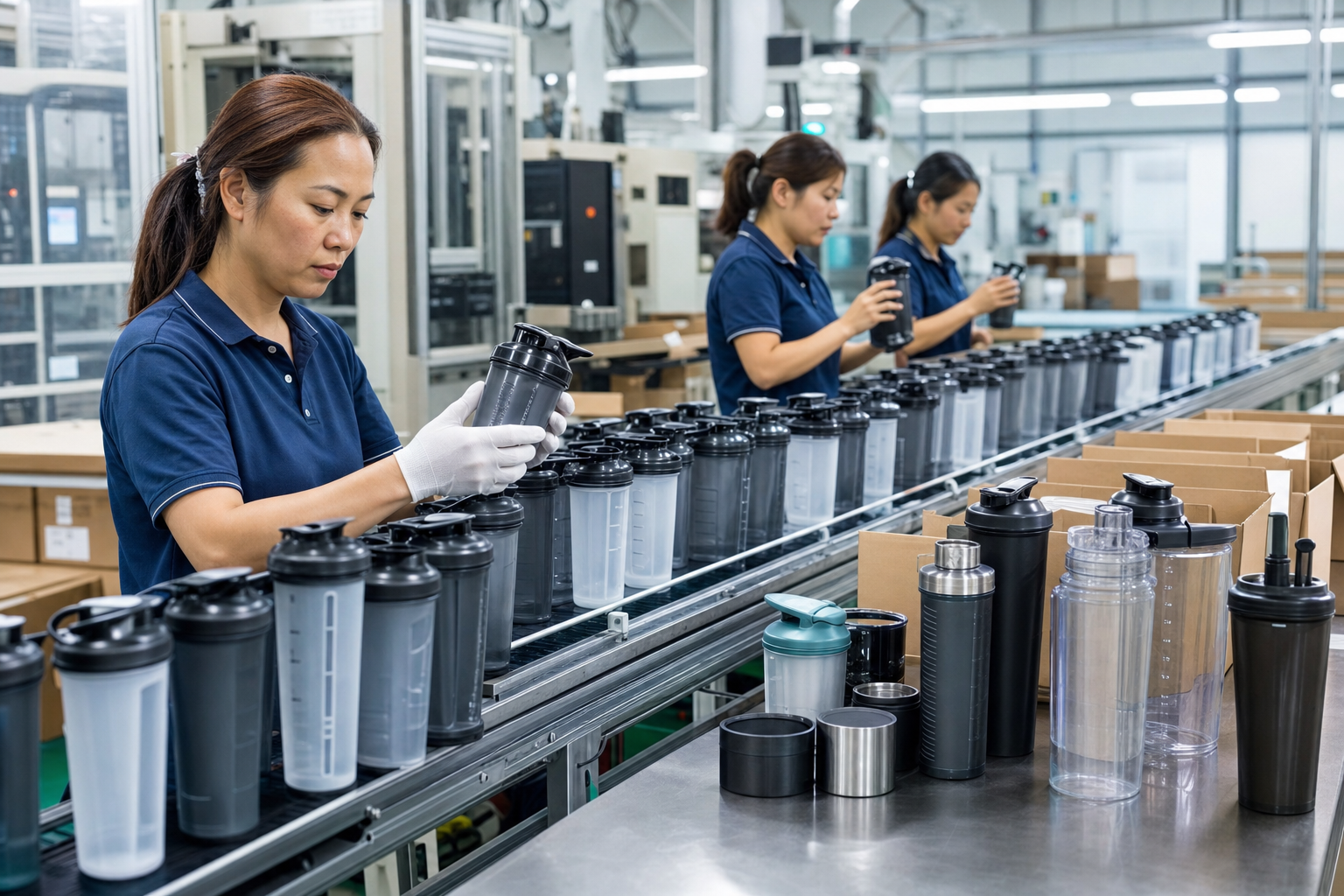
Key Takeaways
- Typical MOQ for blender bottle customized orders starts at 1,000–3,000 pcs, with 25–35 day production after approval.
- A reliable shaker lid needs a leak test standard and torque consistency; weak caps are the fastest way to get returns.
- For EU and US shipments, ask for REACH, food-contact declarations, and a QC plan based on AQL 2.5.
- Decoration choice changes cost fast: one-color silk screen may add USD 0.12–0.25, while laser or full-wrap printing costs more.
If you are sourcing blender bottle customized products, do not treat them like a generic plastic tumbler. A shaker bottle lives or dies on the cap seal, lid torque, thread quality, and whether it still holds up after 50 dishwasher cycles without smell or stress cracking. For Europe and North America, a logo is the easy part. We run this on the line every week, and the real question is whether the spec can hold from 5,000 units to 50,000 units without drift.
We build custom drinkware in Zhejiang, China, and the buyers who get better results ask about wall thickness, drop tests, and decoration limits before they ask for a quote. A good factory should answer MOQ, lead time, AQL, and packaging in the first call. If they cannot, the buyer is not buying a supply chain. They are buying a sample. QC pulled the sample on one order because the PO had a 600ml/600 ml typo, and that small miss turned into a week of back-and-forth.
Building a Repeat Order Program
The first order proves the print and fit. The second order proves we can run the same spec again. If your customizable canteen or customizable growler moves through the channel, set a repeat-order program with a locked BOM: resin grade, silicone grade, carton spec, insert size, and Pantone code. QC pulled the sample against the master carton last week, and that is where most reorder problems start. No locked BOM, no stable batch.
For distributors, the clean setup is a base model plus channel variants. One body, three colors, one logo position, two packaging formats. That gives you a canteen customized line without creating extra tooling or dead stock. We had a buyer flag a PO because the cap color was changed from black to gray without warning; same bottle, different SKU, and the warehouse code broke. If you sell promo and retail accounts together, split the SKUs by print method or cap color so purchasing stays tidy.
Margin lives or dies on reorder timing. A custom canteen sold at USD 3.20 FOB looks fine on paper, but if you rush 2,000 pcs by air because the reorder point was missed, the landed cost can rise 18% to 30%. The math does not work. We prefer forecast-based POs and 30 to 45 days of cover; on one line, that meant a 7-day buffer on caps and 15 mm carton clearance, which cut a lot of rework. That is how serious buyers keep the program alive.
In Zhejiang, repeat business comes from stable production, not nice talk. If a canteen supplier can hold color, keep the defect rate below 1.5%, and ship within 30 days on repeat orders, you have a program that can grow. We run that way on the line: one spec sheet, one inspection standard, one packing list. A buyer once pushed back on a reprint because the PO had a typo in the Pantone code, and the batch was held. That is the wrong question to ask after approval. Build for the second order first.
Send your spec and get a real quote
Tell us the material, quantity, print method, and market. We will answer with MOQ, lead time, and factory pricing from Zhejiang, China.
Frequently asked questions
What is the usual MOQ for blender bottle customized orders?
For standard shaker bodies with custom logo and color, MOQ is usually 1,000 to 3,000 pcs. If you need a new mold, some canteen manufacturers will ask for 5,000 pcs or a mold fee of USD 8,000–25,000. For retailer programs, 3,000 pcs is a practical starting point because it gives enough quantity for testing, sampling, and replenishment without overloading inventory. In Zhejiang, factories that export regularly can often mix colors within the same mold, but the print setup still needs to be efficient.
Can I get food-contact and REACH documents for Europe?
Yes, and you should ask before paying the balance. For Europe, request food-contact declarations, REACH-related material statements, and ink or coating compliance files. If the bottle has stainless parts, ask for the steel grade, such as 304, plus supplier traceability. For silicone gaskets, request material composition and odor testing if your market is sensitive. A good canteen factory in China should provide these documents with the sample or before shipment, not after customs asks for them.
What decoration method is best for a custom drinkware program?
If you want low cost and volume, silk screen is usually best. If you want premium shelf appeal, laser engraving works well on stainless steel, especially for a custom growler or insulated canteen. UV print is useful for full-color artwork, but you need abrasion testing. For a canteen promotional order, one-color silk screen can add only USD 0.12–0.25 per piece. For retail, the extra cost of laser or UV is often worth it because the product looks more intentional and lasts longer.
How do I avoid leakage problems?
Start with the lid, not the bottle. Ask for a leak test on every sample, then require batch testing under AQL 2.5 or stricter for critical defects. Check thread fit, gasket compression, and cap torque consistency. A weak cap can fail even if the body is perfect. For shaker bottles, a 0.6 mm silicone gasket and stable assembly control are better indicators than marketing claims. Ask the canteen supplier for a drop test and shake test with water, not just a photo of the sample.
What lead time should I expect from a Zhejiang factory?
For an in-stock body with custom print, the common lead time is 25 to 35 days after sample approval and deposit. Sampling usually takes 5 to 10 days. If you need new tooling or a modified lid, add 20 to 35 days. A serious Zhejiang factory should quote this clearly and give you a production schedule. If they promise 10 days for a customized canteen with new tooling, they are probably guessing, not manufacturing.