Key Takeaways
- A usable blender bottle distributor program usually starts at 3,000 pcs MOQ and 25-35 days lead time
- A leak-proof shaker needs tighter cap and gasket control than most buyers expect, especially for distributor drinkware
- FOB pricing on custom drinkware can change by USD 0.18-0.65 per unit based on logo method, material, and packaging
- AQL 2.5 for major defects is standard for export orders, but you should ask for drop, leak, and torque tests before approval
If you are sourcing as a blender bottle distributor, the shape is the easy part. The hard part is leak performance, lid fit, logo wear, carton drop results, and whether the same spec still holds in month 12. We saw a buyer flag a 1.5 mm gasket gap on the first pilot run. That kind of miss eats margin fast.
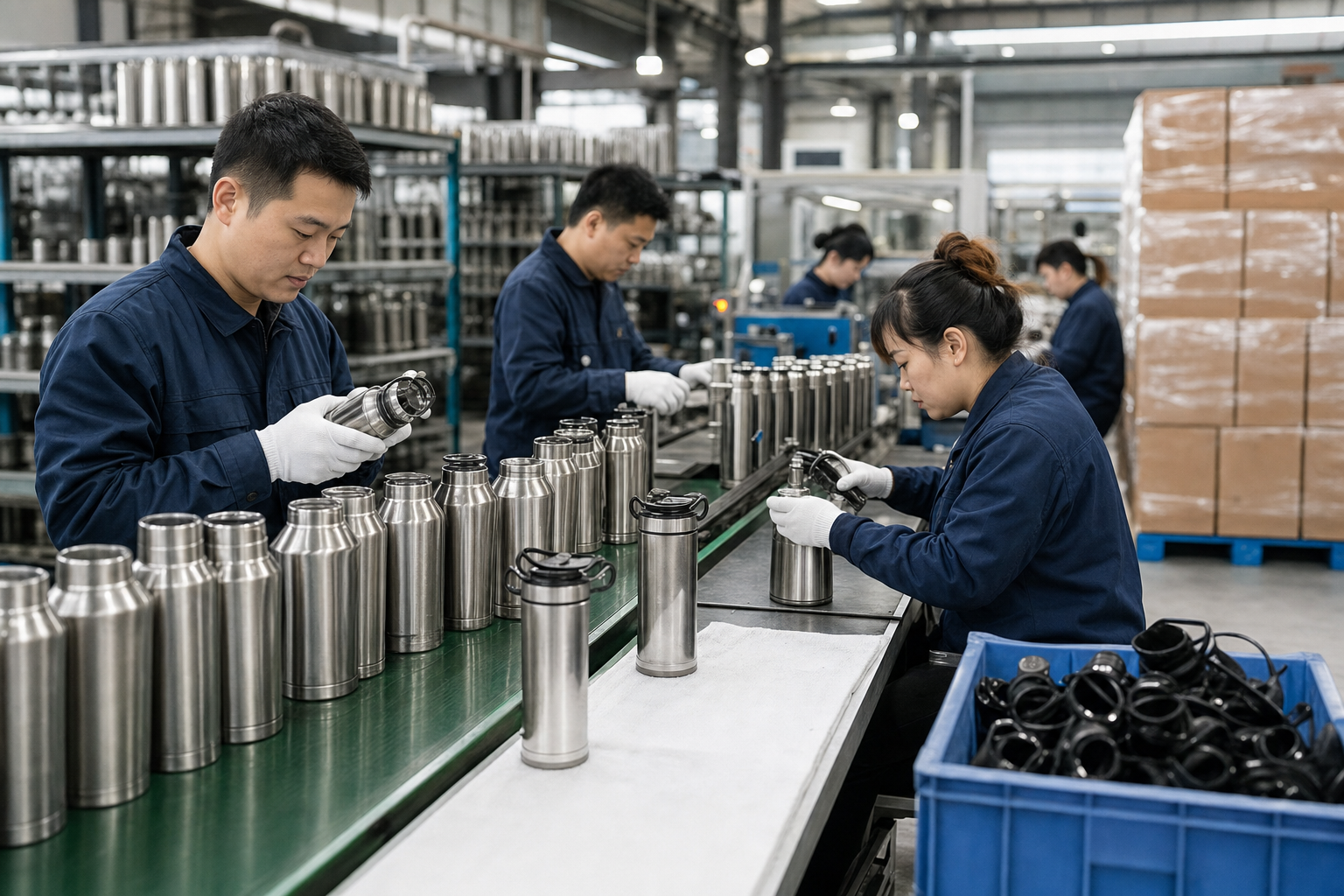
At BottleForge in Hangzhou, Zhejiang, we run custom drinkware for distributors who need speed without turning the order into a returns case. For a standard shaker-style bottle, MOQ starts at 3,000 pcs, and lead time is 25-35 days after sample approval. If you are opening a canteen custom program or a custom growler line, the order is the same: lock the spec first, then talk price. Zhejiang gives us a deep pool for caps, gaskets, and cartons, but the math works only when the factory holds tolerances, testing, and paperwork. QC pulled the sample on the line and checked the lid torque twice.
Start with the product spec
Before you ask for a quote, lock the spec. A proper blender bottle distributor brief is not “700 ml shaker” and nothing else. Write down material, wall thickness, lid type, gasket material, logo method, carton count, and whether this runs as a distributor canteen line or a straight shaker line. If those items are missing, each canteen supplier will price a different build, and the quotes cannot be lined up.
For PETG shakers, 1.5-2.0 mm wall thickness is standard. For stainless or double-wall canteen customized items, 0.4 mm 304 stainless is a common export spec; 0.5 mm gives a heavier hand feel and cuts dent claims. On one PO, the buyer wrote “plain carton” but the line needed FNSKU labels, and QC pulled the sample only after the outer box was already printed. If your channel is Amazon or club retail, the carton spec has to be set early. This is where a lot of programs go sideways.
- Capacity: 500 ml, 700 ml, or 24 oz are the common starting points
- MOQ: 3,000 pcs is practical for a first run in China
- Lead time: 25-35 days after sample approval
- Testing: leak test, drop test, and lid torque test before mass production
We see the strongest orders from buyers who treat the brief like an engineering sheet, not a marketing request. The math does not work any other way. A 3,000 pcs run with a clear spec protects gross margin later, and we run into far fewer price disputes when the buyer sends a clean drawing set from day one.
Materials change your margin
Material choice is where a canteen distributor makes or loses margin. A plastic shaker ships cheaper and colors match faster, but once the buyer asks for premium custom drinkware, the value cue shifts to stainless steel or a clean powder coat. We run this every week in Zhejiang: a 1.2 mm wall on one line, then the buyer flags the same cup because the lid torque feels loose.
For custom canteen orders, PP and Tritan bodies are common. They are light, take impact, and fit sports channels. For a custom growler or customizable growler line, 18/8 stainless steel is the safer call because it handles carbonation and ice better. If you are buying a canteen promotional item, plastic can win on unit price, but the repeat order math often works against it. The channel decides, not your taste.
Typical material trade-offs
- PP: low cost, stable, but lower premium feel
- Tritan: clearer, tougher, usually higher cost by USD 0.35-0.80 per unit
- 304 stainless: export-friendly, durable, better for customized drinkware
- Powder coating: adds USD 0.20-0.50 per unit depending on coverage
If you are comparing canteen suppliers, ask for the exact resin grade and stainless gauge, not the sales name. QC pulled the sample on a 0.8 mm panel once and the buyer rejected it after a drop test. A canteen factory in China should answer both numbers on the spot.
Logo methods affect approval
Buyers often treat the logo as decoration. Wrong call. The logo method changes unit cost, packing time, and how often the buyer flags wear after 30 to 50 wash cycles. Silk screen is still the low-cost choice for a big flat panel on a blender bottle distributor order. We run it on the line with a 90 mesh screen for simple one-color jobs. Laser engraving fits stainless steel when the spec calls for a permanent mark. Heat transfer and wrap decals can look sharp, but they need tighter process control and a higher reject rate if the artwork is busy.
For canteen customizable programs, a one-color silkscreen may add only USD 0.05-0.12 per unit, while laser engraving on stainless often adds USD 0.18-0.40. If the order goes to gyms or team stores, abrasion resistance matters more than a shiny finish. This is the wrong question to ask: “Which logo looks nicest?” Ask which logo still reads after 300 hand washes. We shipped one batch where the PO called for a 35 mm logo, then the buyer changed it to 28 mm after QC pulled the sample and saw the mark sat too close to the shoulder.
Ask for an artwork proof, a logo placement drawing, and one pre-production sample. Do not approve from a PDF alone.
When you source from China, especially from a canteen manufacturer in Zhejiang, confirm Pantone tolerance before the sample is signed off. A delta E of 2-3 is normal for production; anything tighter means extra sorting and slower output. We saw a buyer insist on delta E 1.0, and the math did not work at MOQ 5,000 because the ink lot drifted by 0.8. Check the PO too—one typo in the Pantone code can send the line down the wrong path for 12 days instead of 18 days.
Compliance is not optional
Custom drinkware for Europe and North America needs paperwork that is boring, but it keeps the shipment moving. If your buyer is asking for a blender bottle distributor program, we should be able to show REACH, food contact declarations, and, where needed, LFGB or FDA material statements. For 304 stainless steel drinkware, ask for migration testing and coating abrasion data. For plastic canteen custom projects, odor test results and BPA-free declarations belong in the file from day one, not after the buyer flags a problem.
Good canteen manufacturers in Zhejiang and across China keep the standard pack ready: BSCI audit, ISO 9001, and third-party lab reports. On our line, QC pulled the sample, checked the lid torque, and the paperwork still went out the same day. If a canteen supplier cannot send these within 48 hours, the process is weak or the export desk is not set up for distributor work. Compliance delays kill launch dates faster than production delays do. That is the wrong place to save two days.
- AQL 2.5 is a workable default for major defects
- Leak testing should be 100% for lid assemblies on launch orders
- Migration testing should match the selling market, not the supplier's standard file
- Packaging inks and cartons should also meet market requirements
For a canteen distributor, the lowest quote often turns into the priciest order once customs holds the carton or retail QA rejects the lot. We have seen a PO typo on the carton size turn a 12-day ship plan into 18 days while the buyer waited for a reprint. The math does not work.
Packaging drives landed cost
Packaging looks minor until you are loading a container. A custom growler in a single retail box costs more than an OPP bag, yes, but the box can pay back on DTC and club retail. For wholesale canteen sets, carton fit matters more than squeezing 2 cents off the bottle. On a 40HQ, one packaging change can lift carton count by 8-15%, and that hits landed cost hard.
We split it into three parts: product pack, master carton, and pallet plan. A canteen for Amazon needs FNSKU placement, drop-tested retail packaging, and barcode placement kept within 2 mm. A promo order for events can run simpler, but we still watch cap scratches and scuffing. QC pulled a sample last week and found a loose insert, and the buyer flagged it before it became a claim. Factories that only do low-margin promo work often skip packaging engineering, so ask for carton compression test data if the order is heavy.
If you want growler or custom canteen programs that scale, ask for a full packing table with inner box size, master carton dimensions, gross weight, and units per 20GP, 40GP, and 40HQ. We had a PO last month with a typo on carton height, and the math stopped working the moment the line packed the first tray. That table is where your margin sits.
Choose the factory, not the salesman
A blender bottle distributor should judge the factory, not the sales deck. A polished rep can cover weak tooling, shaky QC, or a line that chokes at 20,000 units. We run 18 injection machines and 4 assembly lines in Hangzhou, Zhejiang, and that number is the first filter. Ask for monthly output, mold count, and the exact number of new molds they can take at once. If the answer stays vague, the math does not work for a reorder spike.
When you compare canteen vendors, ask for their own inspection flow. We have seen this go sideways when a buyer trusted a glossy sample and skipped the incoming check sheet. A proper canteen manufacturer should show incoming inspection, in-process checks, and final inspection records, not just say “we do QC.” If you need custom drinkware in mixed SKUs, confirm whether the factory can keep color variants separated so caps and gaskets do not get mixed on the bench. Batch traceability sounds boring. It saves a claim later.
What to verify before you place deposit
- Real factory address in Zhejiang or elsewhere in China
- Tooling ownership and mold maintenance responsibility
- Production capacity by month and by product line
- Export documentation experience for Europe and North America
If the factory cannot speak plainly about process, walk away. We once got a PO with “bottle” typed three ways on the same page, and the buyer flagged it before production. That kind of detail tells you who is actually running the line. A good factory answers fast, with numbers, photos, and the inspection log in hand.
Build a launch plan that fits your channel
The right blender bottle distributor plan depends on the channel. Gyms and team orders usually do better with a durable custom canteen or shaker, a clear lid, and an easy-clean gasket; we run those with a 2 mm lid seal and fewer after-sales complaints. Retail buyers push for shelf appeal and carton art. E-commerce is a different fight. The listing photo has to match the sample on the line, or returns eat margin fast.
Do not ask a canteen distributor factory to make six versions of the same bottle on day one. Start with one hero SKU, one backup color, and one logo method. We had a buyer flag a PO typo once—12,000 pcs became 21,000 pcs on paper—and QC pulled the sample before we cut the next run. If the first batch lands, move into customizable canteen colors, then a canteen promotional version, then a stainless customized growler line. That sequence keeps cash tied up in inventory under control and gives you a clean read before you pay for new tooling or decoration.
Chinese buyers who work with Zhejiang factories the right way treat us as a production partner, not a quote desk. If your canteen suppliers understand the channel, they can cut SKU sprawl and help repeat orders stay on schedule. We have seen this go sideways when the buyer tries to launch everything at once; the math does not work. That is how custom drinkware turns into a program instead of a gamble.
Get a quote built for your channel
Send your capacity target, logo file, and market. We will price your blender bottle distributor program with clear MOQ, lead time, and compliance support.
Frequently asked questions
What MOQ should I expect from a blender bottle distributor factory?
For a standard shaker or custom drinkware program, 3,000 pcs is the most practical starting MOQ. If you want multiple colors or mixed logos, expect 5,000 pcs or more because setup time rises. For stainless custom growler or canteen customized orders, some factories will quote 1,000-2,000 pcs, but the unit price usually jumps by USD 0.35-0.90. In Zhejiang, larger canteen manufacturers may support lower MOQ for repeat buyers, but first orders should still be sized around your sell-through, not just the factory's offer.
How do I check if a canteen supplier is reliable?
Ask for three things: capacity, documents, and inspection flow. A serious canteen supplier should state monthly output, often 300,000-600,000 units or more depending on product mix, and provide BSCI, ISO 9001, and food-contact declarations. Then ask for leak test, drop test, and AQL inspection records. If the canteen factory in China cannot show batch traceability or a sample approval process, that is a red flag. Reliability is not about a polished catalog; it is about repeatable production and clean paperwork.
What is a fair FOB price for custom drinkware?
It depends on material and decoration. A simple plastic shaker may start around USD 1.20-2.40 FOB. A Tritan customizable drinkware item may be USD 2.10-3.80. A 304 stainless canteen or customized growler often lands at USD 4.80-9.50, depending on capacity, coating, and packaging. Logo method adds cost too: silk screen might add USD 0.05-0.12, while laser engraving can add USD 0.18-0.40. For an accurate quote, the factory needs your artwork, packaging spec, and destination market.
What compliance documents do Europe and North America buyers usually need?
For Europe, REACH and food-contact compliance are common requests; for some markets, LFGB is also required. In North America, buyers often ask for FDA material statements and migration test reports. If you sell through retail or online, packaging and labeling compliance matters too, including barcode placement and FNSKU if you use Amazon. A good canteen manufacturer or blender bottle distributor partner in China should be able to provide third-party test reports, audit certificates such as BSCI, and a declaration of conformity without delay.
Can you handle both promo and retail orders in one factory?
Yes, but only if the factory is organized. A canteen promotional order usually favors lower-cost decoration and simpler packaging, while retail needs better carton design, stronger QC, and consistent color control. Mixing both is possible if the canteen factory has separate production schedules and clear labeling for each batch. If you want a custom canteen for events and a customized drinkware line for retail, keep one mold platform and change only the surface finish, logo, or pack. That reduces tooling cost and keeps reorders simpler.