Key Takeaways
- For private-label blender bottle orders, expect MOQ from 3,000 units and 20-30 days lead time after sample sign-off.
- Food-contact compliance matters: ask for REACH, LFGB, FDA, and AQL 2.5 / 4.0 inspection records before you place PO.
- A 0.6 mm to 0.8 mm wall thickness on stainless steel usually gives a better balance of weight, dent resistance, and cost.
- The best canteen distributors do not just quote price; they control decoration, packaging, and carton testing from the China factory side.
If you are a blender bottle distributors buyer, you already know the problem: the market looks simple from the outside, but the supply chain is not. One bottle can be a basic shaker for gym retail, another a promotional canteen custom project, and a third a customized growler for a regional beer brand. Treat them like the same SKU, and you pay for it later. We have seen launch dates slip by 12 days, print colors miss the Pantone card, and stock sit in a warehouse because the buyer flagged the shape too late.
The smarter move is to buy drinkware like a factory manager, not like a casual reseller. In Zhejiang and across China, the better suppliers will tell you what they can hold, what they can decorate, and where the weak points sit. At BottleForge Industrial in Hangzhou, we run 500,000 units a month, with a typical MOQ of 3,000 pieces and a standard lead time of 20-30 days after sample approval. QC pulled the sample on a 304 stainless shaker last week and caught a 1.2 mm cap gap before shipment. That is the level of detail you need when choosing a canteen manufacturer, canteen supplier, or canteen vendor for your next custom drinkware program.
What blender bottle buyers really need
Most blender bottle distributors do not need “one bottle.” You need a repeatable product set that can move through retail, gym wholesale, corporate gifting, and Amazon-style fulfillment without eating margin. The real buying decision is not just volume or color. It is whether the bottle survives a 1.2 m drop test, keeps its shape after 30 wash cycles, and still scans clean on a packed shelf.
Start with the use case. A shaker bottle for fitness retail usually needs a sealed mixing system, an easy-open lid, and decoration that does not rub off. A custom canteen for outdoor promotions may need double-wall insulation, a powder-coated finish, and a lid you can open with one hand. A custom growler for beverage distributors may need a heavier gauge body, a tight leak test, and a finish that handles condensation. On the line, we ask these questions before we quote, because a 2 mm wall or a different cap changes the build.
Do not let a canteen distributor push you into stock shapes if your market needs a specific capacity or closure type. That is the wrong question to ask. The right supplier drinkware project starts with the target channel, not the color chart. If you are a canteen distributor selling into Europe or North America, the packaging spec matters too. We have seen a retail carton pass 200 lb burst testing save more money than a 5-cent cut on the bottle, and the buyer flagged the carton first, not the cup.
Materials, walls, and closures
Material choice drives cost, compliance, and failure rate. For stainless steel drinkware, 304 is our standard food-contact grade. It gives the buyer the corrosion resistance they expect, and it avoids the “why is this rusting after 3 weeks?” email we have all seen. If a distributor pushes for lower cost on a promo canteen, 201 sometimes shows up on the outer shell or in a budget body. Fine, but the spec has to say where the savings sit. We had a PO once that just said “stainless steel body”; QC stopped it at the magnet test table until the grade was written in black and white.
For a customized canteen, wall thickness decides dent resistance and shipping weight. On our Zhejiang line, 0.5 mm is a budget build, 0.6 mm is the workhorse spec, and 0.8 mm is what we run for heavier retail or custom growler jobs. Plastic parts should be PP or Tritan, depending on heat use and clarity. If the buyer wants a customizable lid system, ask for the silicone seal spec and the test count: LFGB on the seal, 2,000 open-close cycles on the thread. This is the wrong question to ask: “Can you make it cheaper?” The math works only when the wall, lid, and resin all match the job.
Closures are where suppliers cut corners. A leak-proof lid should pass an upside-down test for 6 hours, no drip at the gasket line. A travel closure also needs torque testing, or the threads crack after a few hundred opens. For brewery promotions, pressure hold and gasket fit matter more than print coverage. The buyer flagged one sample because the cap looked fine in photos but the closure drawing showed a 0.2 mm mismatch at the seal seat. Ask for the drawing. Photos hide problems.
- 304 stainless for food-contact interiors
- 0.6 mm wall thickness for balanced cost and durability
- Silicone seals tested to LFGB or FDA requirements
- Torque and leakage testing on every production lot
Decoration that survives shipping
Printing is where a lot of custom drinkware orders go sideways. The sample looks clean, QC pulls it off the line, and 90 days later the logo starts chalking because someone picked decoration by eye, not by adhesion data. If you are ordering canteen custom work or customized drinkware for a retail launch, lock the print method before you sign off artwork. Screen print fits simple logos and lower unit cost. Laser engraving leaves a permanent mark on stainless steel. Heat transfer handles complex graphics, but it takes more abuse during shipping and warehouse handling.
For blender bottle distributors, the print area is smaller than most buyers expect, especially on tapered bodies or grip-textured shells. The buyer flagged a 3 mm font once, and the line had to stop because it would not hold after curing. If the artwork includes fine text, set a minimum line thickness of 0.25 mm and skip gradients unless the process sample proves it can hold them. On a canteen promotional order, a 1-color logo can cut 15-25% versus a 3-color process, but only if the artwork is set up right. A canteen manufacturer in China should show you the print template before sampling, not after the PO is already in.
Ask for a rub test and dishwasher resistance test. For laser, ask for depth and consistency in mm. For silk screen, ask for cross-hatch adhesion. We’ve seen a buyer push back on this and then lose the whole batch after 12 dish cycles. If you are comparing canteen manufacturers, the one that can explain decoration failure modes usually gives you fewer surprises in mass production. The math works better there than chasing a slightly lower FOB quote.
MOQ, pricing, and margin control
Price only works when you map the full landed cost. A custom blender bottle from a China factory usually sits in the USD 1.80 to 4.50 FOB range, depending on structure, material, and decoration. Then freight, duty, carton setup, and inland delivery land on top. We’ve seen the real landed cost swing 20% to 35% on the same SKU. If your distributor margin is only 12% to 15%, that spread can kill the deal.
MOQ is the first number we check on the line. A canteen customized run at 3,000 units may carry a higher piece price than a 10,000-unit order, but the inventory risk is lower. A buyer once pushed back on a 5,000-unit color MOQ because the first sell-through forecast was only 1,800 pieces in 90 days. He was right. Standard colors often start at 1,000 pieces, while custom Pantone shells usually need 3,000 to 5,000 pieces. If a vendor claims ultra-low MOQ and gives no clear mold charge or color cost, the math does not work.
Here is the practical way to compare quotes:
- Unit price at 3,000 pieces and at 10,000 pieces
- Sample fee and whether it is refundable after PO
- Packaging cost per set
- FOB port, not just ex-factory price
- Inspection cost and spare parts allowance
For North America, we also run barcode labels, FNSKU application, and carton markings into the budget. QC pulled a sample last month and found one carton with a wrong FNSKU sticker size, 58 mm instead of 50 mm, so the buyer flagged it before shipment. Those small line items look minor on paper, then they stack up and add 3% to 8% to the landed price if nobody tracks them.
Compliance and quality control
Compliance is not a sales line; it is a buying requirement. If your market is the EU, you need REACH awareness, LFGB where applicable, and a clear declaration of food-contact materials. For North America, buyers usually ask for FDA-related declarations and test reports from recognized labs. If the bottle has coatings, inks, or rubber parts, we ask for every component, not just the finished cup. The buyer flagged one PO last month because the silicone stopper had no separate report, and that shipment stalled for 12 days.
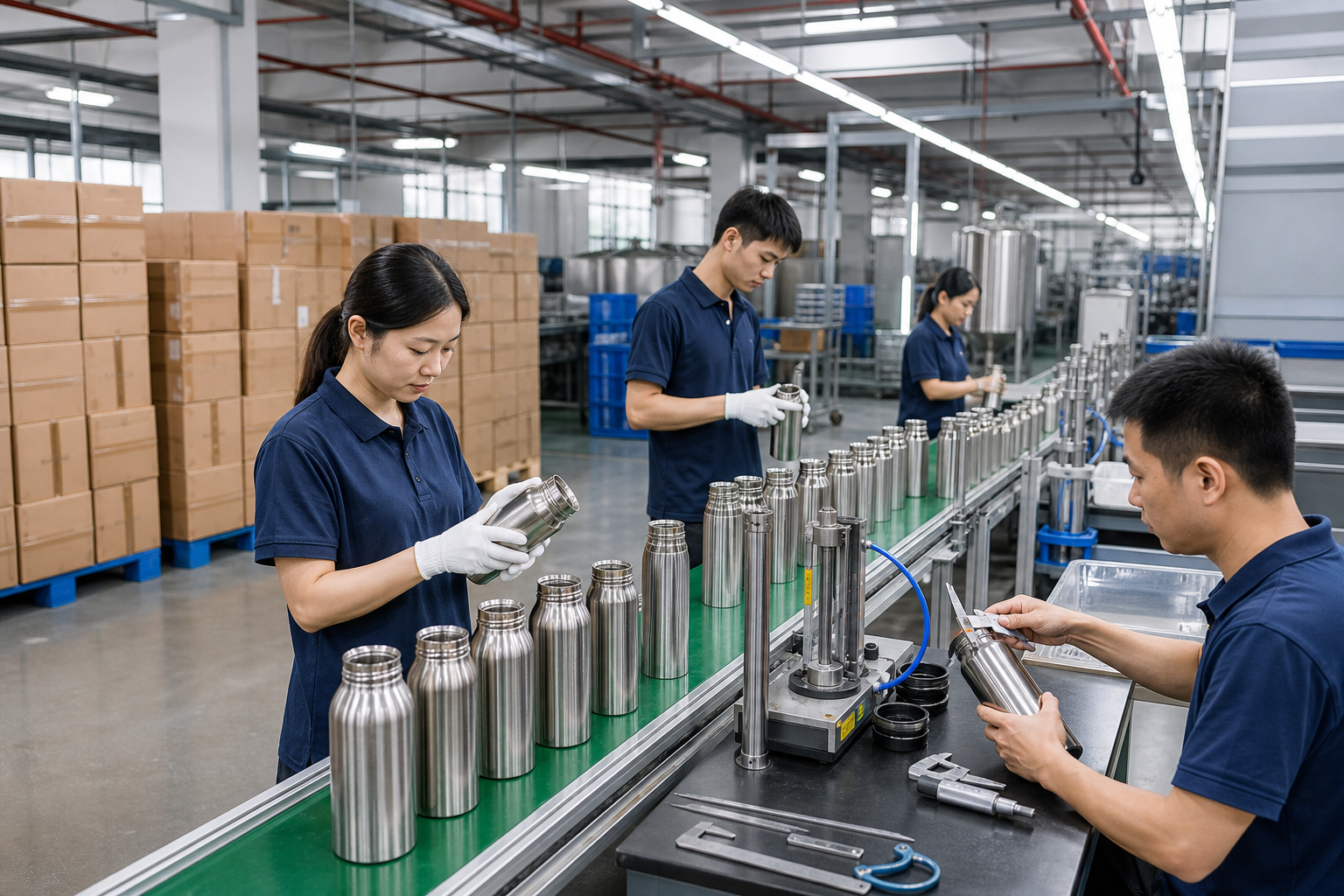
Quality control starts on the line, not at your warehouse. A serious canteen factory in Zhejiang will run incoming material checks, in-process inspection, and final random inspection based on AQL standards. For consumer drinkware, AQL 2.5 for major defects and 4.0 for minor defects is a common commercial structure. We also run leak tests, drop tests, and carton compression checks with simple tools like a vacuum pump, a drop tester, and a 50 kg stack load. If a supplier says “we check everything by hand,” the math doesn’t work. That is not QC. That is a headache.
For custom canteen or custom growler orders, ask for:
- Material certificates for steel, plastics, and silicone
- Production photos and line checkpoints
- Final inspection report with defect counts
- Carton drop-test results
- Pre-shipment photos of pallet loading
Good factories in China will show these records without drama. The ones that stall are the ones we don’t like to ship against full upfront payment. I’ve seen a buyer get burned because the carton mark had a typo on the PO, and the freight forwarder held the lot for three days.
How to manage sample approvals
Sampling is where a drinkware project gets under control, or starts costing money. One sample is not enough when the bottle has four checkpoints: body color, logo position, lid fit, and pack-out. Ask for a pre-production sample, not a hand sample. A hand sample shows the shape; a pre-production sample shows the line can repeat it.
For a customized canteen or customizable drinkware launch, put the sample next to a signed spec sheet. Check capacity tolerance, usually within ±5% for most consumer bottles, and make sure the lid seals without distortion. If QC pulled a sample with a different finish from mass production, stop right there. We saw a buyer approve a matte sample and then complain when the PO said glossy; the math does not work. In our Hangzhou factory, we only close sample approval after artwork, carton art, and test criteria are all signed.
Do not skip packaging samples. If the shipment is going to a warehouse in the US or Germany, the carton has to survive handling. Inner tray fit, bag thickness, and master carton label placement all hit claims rates. A good canteen manufacturer sends the full pack: bottle, lid, sealing gasket, insert card, carton, and outer label. We ship that set before the first 1,000 pcs run, because we’ve seen this go sideways when a buyer flags a typo on the carton and the line has to stop.
Choosing the right China partner
The difference between a canteen supplier and a real canteen manufacturer is control. A reseller can move cartons. A factory can change mold details, hold wall thickness at 0.8 mm, correct lid threads, and keep printing aligned from first sample to packed goods. If you buy from China, that gap matters. A 2 mm thread error looks small on paper, then the buyer flags leaking lids after sea freight and duties land.
Look for a factory in Zhejiang or another established manufacturing region with stable tooling, clear QC, and export experience to Europe and North America. Ask for monthly output, custom share, and OEM/ODM records. We run plants that ship 500,000 units a month, quote within 24 hours, and send test reports fast because the line is set up for it. If they cannot explain mold lead time, decoration limits, or spare-part sourcing, the math does not work for distributor volume. QC pulled the sample, checked the cap torque, and found the weak point in 10 minutes.
For blender bottle distributors, the best relationship is not the cheapest one. It is the one that lets you reorder in 20-30 days, keep artwork consistent, and scale from 3,000 pieces to 30,000 without a product shift. We’ve seen this go sideways when a PO typo changed the logo code by one letter, and the buyer had to wait for a new plate. This is the wrong question to ask: “Who is cheapest?” Ask who can keep the same bottle, the same lid, and the same QC result across repeat orders.
Request a factory quote with full specs
Send your target MOQ, material, logo method, and market. We will quote with FOB pricing, lead time, and QC terms from Zhejiang.
Frequently asked questions
What MOQ should I expect for blender bottle distributors buying custom drinkware?
For most private-label drinkware, expect 3,000 pieces as a realistic MOQ from a China factory. Some canteen suppliers may quote 1,000 units for stock colors or simple print, but custom colors, special lids, or molded logos usually push you to 3,000 to 5,000 units. If you need a custom growler or insulated canteen with Pantone color matching, 5,000 pieces is more common. Always ask whether MOQ applies per color, per artwork, or per SKU, because that changes your inventory risk fast.
How long does production usually take in Zhejiang or China?
A normal lead time is 20-30 days after sample approval and deposit for standard custom drinkware. If tooling changes are needed, add 10-15 days. Complex canteen customized orders with new molds, special coatings, or multi-step packaging can take 35-45 days. Shipping is separate: sea freight to Europe or North America often adds 25-40 days depending on port and season. A serious canteen manufacturer should give you a calendar, not a vague promise.
Which decoration method should I choose for a customized canteen?
For simple logos, screen printing is usually the lowest-cost option and works well on flat or lightly curved surfaces. Laser engraving is more durable on stainless steel and is often the best choice for premium distributor drinkware. If your art has gradients or multiple colors, heat transfer can work, but you should test rub resistance and dishwasher durability. Ask for a sample with the exact logo size, because a 40 mm mark and a 70 mm mark can behave very differently on the same body.
What compliance documents should I request from a canteen supplier?
Ask for material declarations, LFGB or FDA-related test reports where applicable, and REACH-related documentation for the EU market. If silicone or plastic parts are included, request separate reports for those components. You should also ask for AQL inspection records, leak-test results, and carton drop-test evidence. For North America, many buyers also request barcode and packaging compliance for FNSKU or retail routing guides. A canteen vendor that cannot produce documents quickly is a risk.
How can I protect margin when importing custom drinkware from China?
Build the landed cost before you approve the PO. Include FOB price, ocean freight, duty, inland trucking, carton work, labels, and inspection. A unit that looks like USD 2.20 FOB can land 25% to 35% higher once all costs are added. If you are a canteen distributor or blender bottle distributors buyer, reduce risk by ordering standard colors, keeping decoration to one or two colors, and using existing molds where possible. That is usually better than chasing the lowest ex-factory quote.