Key Takeaways
- Typical MOQ for blender bottle factory direct orders starts at 1,000 units per SKU, with 35-45 day lead time after sample approval.
- Expect FOB China pricing for standard Tritan bottle builds around USD 2.10-3.80 depending on lid, decoration, and packaging.
- AQL 2.5 for critical defects and 4.0 for major/minor checks is a practical baseline for drinkware QC.
- Compliance for Europe and North America usually means REACH, FDA food-contact, and often BPA-free declarations plus migration testing.
If you are buying blender bottle factory direct, finding a factory in China is the easy part. The hard part is telling a real production partner from a trading desk that answers fast and vanishes when you ask for testing, artwork fixes, or a repeat run. Price comes second. A $0.18 per unit gap does not matter if the closure leaks, the lid color drifts, or the carton fails an Amazon drop test. We have seen a buyer lose a 5,000-piece order over a 1.2 mm cap mismatch. That is the wrong question to ask.
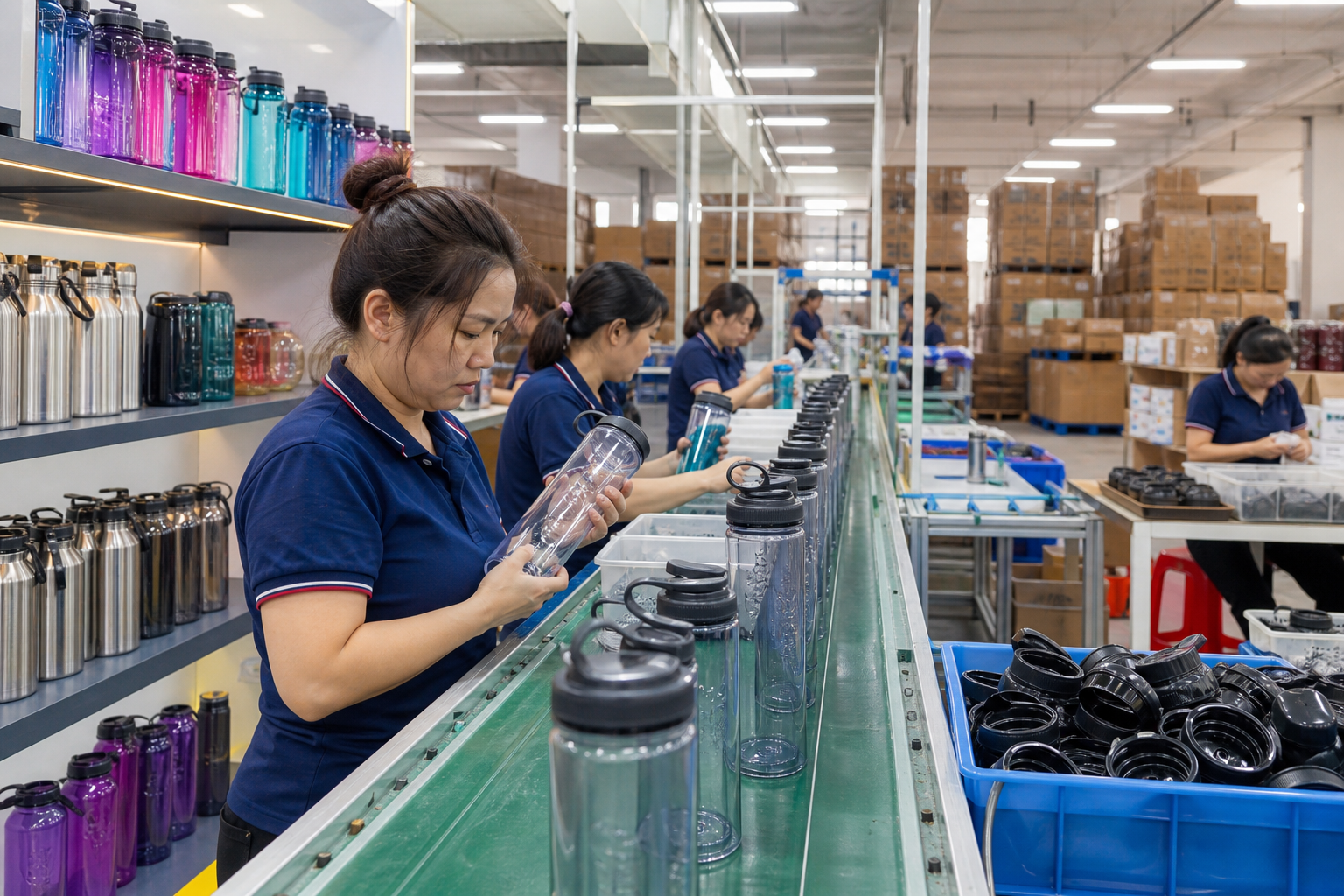
At BottleForge in Zhejiang, we run into this every week. Buyers want custom drinkware that ships on time, clears compliance, and still leaves margin for their market. We ship blender bottle orders in 30 to 45 days when the spec is clean and the PO does not carry a typo like “3000 pcs” on one line and “3,000” on another. Whether you need a custom canteen, a custom growler, or a customizable drinkware line for retail or promotions, factory-direct sourcing only works when you understand tooling, MOQ, decoration, and QC. China has plenty of canteen manufacturers; the real question is which one can hold the same tolerance on every run.
What factory direct really means
Zhejiang is not just a shipping origin. It is where a large share of China’s customized drinkware tooling, lid development, and export packaging know-how sits. If you need a canteen vendor who can move fast on artwork, regulatory labels, and carton revisions, Zhejiang factories usually keep those jobs under one roof instead of pushing them to three different subcontractors. We run that way in Hangzhou. A PO typo on a 24,000 pcs order can waste a day, so the plant that catches it before print plates are cut saves you money. That does not make every Zhejiang factory the right fit, but it does make the handoff cleaner.
Ask for the factory’s export split: if 60% or more goes to Europe and North America, they are more likely to understand REACH, FDA, and retail packaging expectations. QC pulled a sample on one line because the buyer flagged a 1.5 mm lid gap, and that is the kind of check you want before mass production starts.
Choose the right bottle structure
A canteen promotional order for trade shows or distributor giveaways is simpler than a retail launch. If you only need a branded piece for lead generation, we usually keep the stock lid, one-color print, and a plain carton. On a recent 5,000-piece run, the buyer wanted to cut the lid cost by 0.18 USD; we said no and kept the leak test. Cheap is fine. Sloppy is not. Every promo bottle still needs leak testing and a basic odor check.
For canteen distributors or distributor drinkware buyers, a tight spec pays off: capacity tolerance within ±5%, print alignment within 1.5 mm, and carton drop test at 80 cm. QC pulled the sample on the line and caught a 2 mm logo shift before shipment. That is the kind of miss that turns into a complaint on reorder. A stable spec keeps your repeat order clean when your canteen suppliers switch between production lots.
Decoration changes the real price
Customized logos are only part of the bill. A real customizable drinkware job may need a new cap insert, a different gasket, or a revised vent hole. That is tooling, not decoration. We quote USD 1,500-6,000 for partial tooling on a new closure, and a full proprietary lid climbs higher. This is why a canteen supplier should check your drawing before the landed cost is set.
Ask for 3D renders, then a T1 sample. If QC pulled the sample and the lid seal was off by 0.3 mm, stop there. We have seen buyers push straight into mass production and lose a week on the line. In Zhejiang, the better factories cut the tool again and fix it before the buyer flags it on the PO.
Compliance for Europe and North America
Before goods leave the factory, we run a final inspection on quantity, print quality, color tolerance, seal performance, carton strength, and label accuracy. If you use FNSKU or retail barcodes, scan samples from each carton line with the handheld scanner. One wrong sticker batch can hold your Amazon or distributor intake for 12 days, and we have seen that go sideways on a Friday loadout.
For volume control, buyers often ask for 100% inspection on print-heavy promos or a standard pre-shipment check on 100-125 pcs per lot, depending on order size. We ship that way because the math works; a rework in your warehouse costs far more than a QC pass at the line, and QC pulled the sample fast enough to catch a 2 mm print shift on one run.
How to price your first order
Ask for a quotation that spells out material, capacity, weight, decoration, package type, carton dimensions, lead time, sample fee, and payment terms. If the quote skips tolerances, it is not complete. If it says “best quality” and gives no spec, send it back. You need an engineer’s quote, not a sales reply. We run this check on the line with a caliper and a carton ruler, because a 2 mm miss on bottle height or a loose carton spec changes the landed cost.
A clean custom bottle quote might read: 750 ml Tritan body, PP lid, silicone gasket, 1-color silk screen, individual polybag, 50 pcs/carton, MOQ 1,000, sample 7 days, production 40 days, FOB Ningbo. That gives you enough to compare one factory against another canteen vendor or canteen supplier without guessing. We had a buyer flag a PO typo once—750 ml turned into 700 ml—and the math stopped working the moment QC pulled the sample. Check the spec line by line.
Supplier selection without the noise
You do not need ten factories. Two or three is enough if they hit your spec every time. When you compare a canteen factory, a canteen manufacturer, and a canteen vendor, start with process control: incoming QC, in-process checks, final inspection, and lot-number traceability. We run this on the line with 100% spot checks on first articles, and the buyer will feel the difference fast. Then look at reply time. If a plant answers in 24 hours with drawings, tolerances, and a revised quote, that is a good sign. If they need three days to send a simple PDF, the math does not work.
The best customizable canteen and customized canteen programs use repeatable parts. Keep the lid, seal, and body family stable, and you can roll out new colors or logos without paying for fresh tooling each time. We have seen 0.3 mm on a cap groove decide whether a seal passes leak test or gets kicked back by QC. That is how a canteen promotional item turns into a retail line that keeps moving. In Zhejiang, the good factories think in systems, not one-off orders. That's the wrong question to ask if you only care about the first PO. You are not buying a box of bottles.
Before you commit, ask for a factory audit pack: business license, export photos, test reports, and a sample production schedule. A practical canteen distributor partner will send all four without a song and dance. We also check the PO for typo traps—one buyer once wrote 3040 stainless by mistake, and the line almost cut the wrong material. Ask for the pack early. It saves a lot of back-and-forth.
Send your spec sheet for a direct factory quote
We can review material, MOQ, decoration, and compliance in one pass, then quote you from Zhejiang with no middleman markup.
Frequently asked questions
What is a normal MOQ for blender bottle factory direct orders?
For stock molds, 1,000 units per SKU is common. If you need custom colors, private label cartons, or a modified lid, 3,000 units is more realistic. Full tooling for a new canteen or growler lid often starts at 5,000 units to justify the mold cost. In Zhejiang, many factories can do sample runs at 100-300 pcs, but that price is not the production price. Always confirm whether the MOQ is per color, per print, or per total style.
How much should I budget per bottle?
For standard export drinkware, a factory-direct FOB price often lands around USD 2.10-3.80 depending on material and decoration. A Tritan shaker-style bottle with one-color print may sit near USD 2.20-2.70. A stainless custom growler or insulated canteen can be USD 4.50-8.50 or more. Add packaging, inspection, and freight separately. If a quote looks 20% below that range, check whether the supplier omitted the gasket, upgraded lid, or carton specification.
What compliance documents should I request?
For Europe and North America, ask for food-contact declarations, REACH-related screening, BPA-free support where applicable, and third-party migration testing. If you sell in the U.S., material documentation aligned with FDA food-contact expectations is important. For Amazon or retail programs, also ask for carton labeling, barcode readiness, and supplier traceability by lot number. A serious China factory should provide these documents before mass production, not after shipping.
How long does production usually take?
Standard production is usually 35-45 days after sample approval and deposit receipt. If you need a new mold, new lid tooling, or a different decoration method, add 15-30 days. Shipping from China to Europe or North America can add 18-40 days depending on the route and season. If you are planning a seasonal promotion, do not leave the order until the last month; custom drinkware often slips because of artwork approval, not machine capacity.
Can I mix multiple colors or SKUs in one order?
Yes, but the cost structure matters. Many canteen manufacturers allow color splits as long as the total quantity meets MOQ, often 3-5 colorways with 300-500 pcs each. Mixing SKUs is easier if the body and lid family stay the same. If each SKU needs different tooling, your pricing and lead time will rise quickly. For distributor drinkware programs, ask the factory to quote both per-SKU and combined-volume pricing so you can see the real break point.