Key Takeaways
- A practical blender bottle factory should quote MOQ from 500 units and lead time from 18-30 days after sample approval.
- For stainless custom drinkware, 304 steel at 0.5-0.7 mm wall thickness is the normal commercial range; thinner usually means higher dent risk.
- A good buyer should ask for REACH, FDA food-contact declarations, and AQL 2.5 inspection before shipment.
- For branded canteen customizable programs, decoration cost often changes by USD 0.15-0.60 per unit depending on print method and color count.
If you are looking for a blender bottle factory, you are not shopping for one bottle. You are trying to hold unit cost, branding, compliance, and freight risk on a product that gets dropped, shaken, and judged in seconds. This is where buyers lose money. They approve a sample that looks fine, then the lid leaks, the print rubs off, or the carton fails a 1.2 m drop test before it reaches the warehouse.
At BottleForge in Zhejiang, we see the same pattern every season. Buyers ask for one line that can go out as custom canteen, custom growler, or customized drinkware without tying up cash in dead stock. The factory matters more than the label. A real canteen factory or canteen manufacturer should quote the MOQ, mold cost, wall thickness, coating options, and test standards before you place a PO. If they cannot, keep looking. We run a lot of 500 ml and 750 ml jobs, and QC pulled a sample last week with a 0.3 mm cap gap; the buyer flagged it, and that saved a return claim.
What a real factory should quote
When you ask a blender bottle factory for pricing, don’t accept a flat “depends on quantity” line. A proper quote breaks out the bottle body, lid, gasket, packaging, decoration, and freight term. For a standard 24 oz stainless shaker bottle, an honest FOB Zhejiang price usually lands around USD 3.20-5.80 at 1,000 pieces, depending on steel grade, lid complexity, and print method. We’ve run the line on jobs where the buyer flagged a USD 2.90 offer, and the missing items were clear: thinner coating, softer silicone, or a weak mailer box that failed the drop test at 1.2 m.
A canteen supplier or canteen vendor that really ships export orders will show the commercial limits before you ask twice:
- MOQ: 500-1,000 units for standard tooling; 3,000+ if you need a new cap mold.
- Lead time: 18-30 days after pre-production sample approval.
- Sampling: 5-10 days for a decorated sample, longer for custom tooling.
- Packing: 1 pc/box, 24-48 pcs/carton, carton test standard agreed before production.
In Zhejiang and across China, the factories that pass export audits quote cleanly and log every change. That is the right question to ask. A PO typo on “304 stainless” or a missing carton spec can cost a week on the schedule, and we’ve seen that go sideways fast for a canteen distributor or distributor drinkware buyer. A glossy render does not protect your margin.
Material choices that affect margin
Most buyers start with looks and end up paying for returns. Start with material. For stainless custom drinkware, 304 stainless steel is the base spec for food-contact bottles, shakers, and insulated bodies. 316 costs more, and it only makes sense when you need stronger corrosion resistance for sports nutrition, acidic drinks, or a premium SKU. On a normal order, 316 adds USD 0.35-0.90 per unit, depending on size and wall thickness. We saw a PO typo last quarter that listed 316 for the whole range; the buyer caught it after sample approval, and the math did not work.
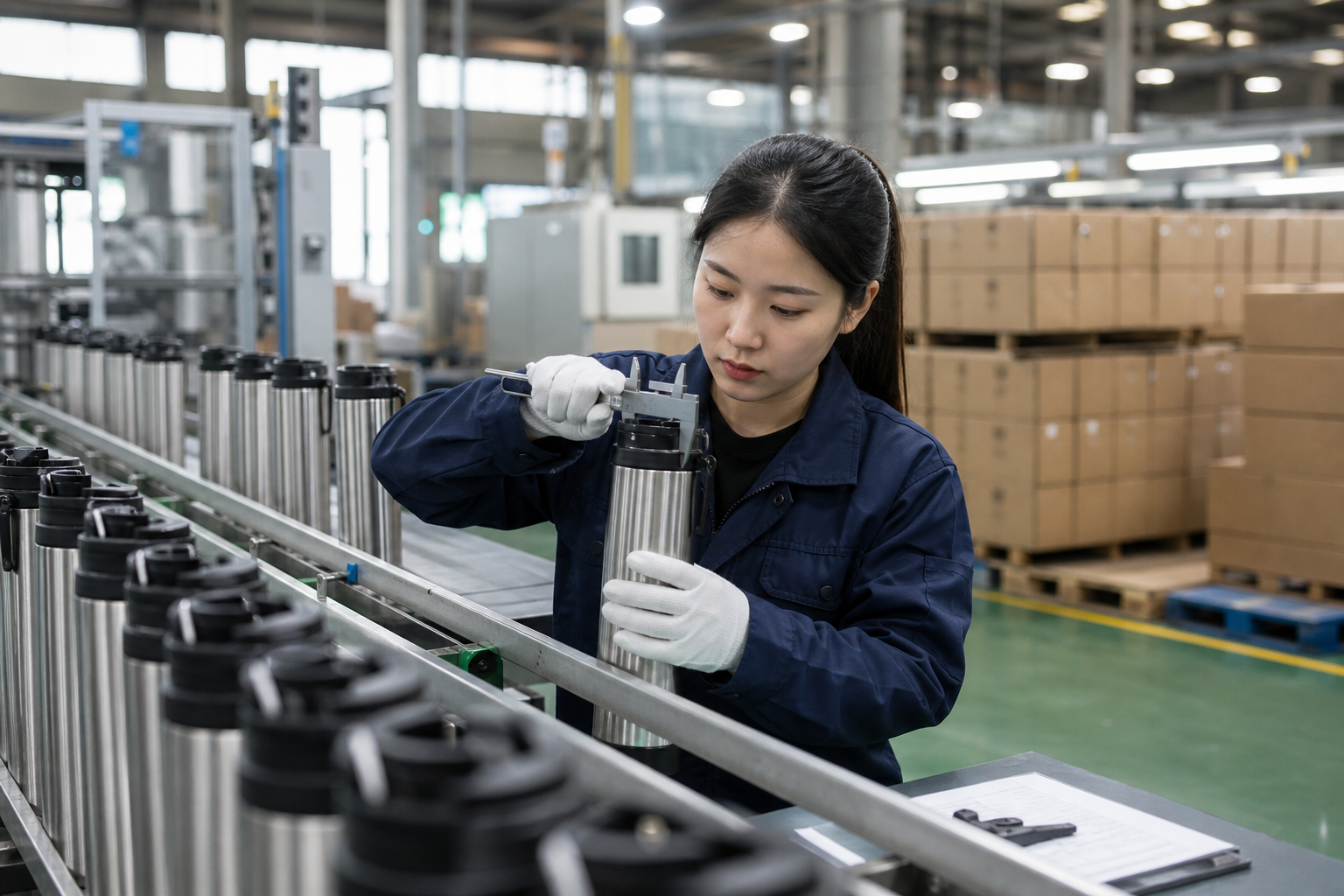
For a blender bottle factory, the body spec matters more than the marketing copy. We run 0.5 mm to 0.7 mm wall thickness on single-wall bottles, and 0.4 mm to 0.6 mm per wall on vacuum-insulated construction. Go thinner and the bottle dents in transit. Go too thick and freight weight goes up for no gain. QC pulled a batch at 0.38 mm on one side, and those units failed the drop test at 1.2 m. If you are sourcing a canteen custom program or customizable canteen line, ask for the exact gauge and tolerance, not “high quality steel.”
Plastic lids are where buyers get burned. Tritan and PP are standard for shakers and caps, but the seal geometry decides leakage performance. We ship lids only after a gasket material spec, a torque test, and a leak test result are on file. If the factory cannot show those three, do not approve the sample. One buyer flagged a lid that looked fine on the bench, then loosened after 200 open-close cycles on the line. This is the wrong question to ask: “Does it look good?” Ask what the gasket is, what torque was used, and how the closure held up after repeated use.
Branding options that actually sell
Decoration sells. A canteen promotional program for retail or corporate gifting needs a print method that survives handling and washing. Silkscreen is the lowest-cost choice for 1 or 2 solid colors, and on our line it still runs fast at MOQ 1,000 pcs. Laser engraving looks cleaner on stainless steel and holds up well, but it exposes the base metal, so the finish reads premium, not colorful. Full-wrap UV print or heat transfer gives stronger shelf impact, yet the unit cost and MOQ both move up.
For a customized growler or custom canteen order, match the branding method to the channel:
- Corporate gifts: laser engraving, 1 color print, matte powder coat.
- Retail shelves: full-color print or embossed logo with high-contrast finish.
- Sports and fitness: bold silkscreen, easy-grip body texture, leak-proof lid.
If you sell as a canteen distributor or distributor canteen buyer, repeatability matters more than novelty. Ask for a logo placement drawing with exact dimensions in millimeters, then check ink adhesion by tape test and dishwasher cycle testing if the market requires it. BottleForge in Zhejiang usually recommends one main logo zone and one secondary brand mark. We’ve seen buyers try to squeeze in 3 logos on a 750 ml body, and the math doesn’t work—QC pulled the sample, and the print looked crowded.
One practical note: a canteen customizable product should not turn into a sample-room experiment. Keep the color system to 3-5 standard Pantone references if you want clean reorders from a canteen supplier in China. We ship faster when the buyer locks the palette early, and the PO typo we see most often is a shade name changed after proof approval.
Compliance and testing you can demand
You do not need a lab coat to buy drinkware the right way. You do need proof the line can ship what your market allows. For the US and Canada, ask for food-contact declarations and, where the inks, coatings, or silicone touch the drink path, FDA-related material statements. For Europe, REACH is mandatory. If you are buying insulated bottles or a custom growler program, ask for a third-party report from SGS, Intertek, or TÜV for the exact SKU, not a lookalike sample. We had a buyer flag a PO once because the carton code said 500 ml and the spec sheet said 16 oz—that kind of typo burns a week.
A solid canteen factory knows the checks that stop claims and chargebacks:
- Leak test for 5-10 minutes under inverted pressure.
- Thermal retention test for insulated models.
- Drop test from 80-100 cm depending on carton spec.
- AQL inspection at 2.5 for major defects and 4.0 for minor defects.
If you buy customized drinkware for Amazon, retail chains, or distributor programs, lock down carton markings, outer carton strength, and barcode placement before we start the line. A bottle can pass the lab and still fail in transit because the retail carton collapsed in export handling. The math doesn't work any other way. We have seen 3 mm carton board and a weak pallet pattern turn into crushed packs after one forklift move. Good factories in Zhejiang will talk about carton compression and pallet layout without being asked.
How to compare factory quotes
Quotes that look equal are usually not equal. When you compare a blender bottle factory quote against another canteen manufacturer or canteen vendor, line up the full commercial package. The lowest EXW or FOB number means nothing if the quote leaves out a better lid, a 0.3 mm thicker body, or a stricter AQL 2.5 check. We had a buyer flag a PO once because one supplier quoted 304 and another quietly switched to 201. Same headline. Different product.
Use this checklist when you review a custom drinkware quotation:
- Body material: 304, 201, or plastic grade.
- Wall thickness: exact mm spec and tolerance.
- Decoration: number of colors, setup fee, repeat charge.
- Packaging: retail box, mailer box, master carton test.
- Compliance: REACH, FDA, CA Prop 65 if applicable.
- Payment terms: 30/70, LC, or negotiated credit for repeat buyers.
For a canteen distributor or distributor growler program, repeatability drives the margin. A factory in Zhejiang that keeps logo position within 1.5 mm, coating gloss steady, and lid torque consistent over 10,000 units is worth more than a supplier shaving USD 0.12 off the sample. QC pulled the sample on our line last month and found the print shifted 2 mm after a tooling change; the buyer never forgets that kind of miss. Cheap quotes are easy. Stable re-orders are not.
If you plan to build a canteen promotional line or a seasonal customized canteen assortment, ask the factory to freeze the BOM and put a change notice process in writing. We run that on the line with a signed engineering sheet, because the second order goes sideways fast if the cap insert or carton spec changes without notice. One typo on a PO, one swapped liner, and the whole shipment becomes a claims case.
What buyers in Europe and North America miss
First-time buyers often obsess over the bottle and miss the paperwork trail around it. Wrong move. If the shipment is headed to EU retail, the file set matters almost as much as the unit price. We ship with item codes, carton labels, pallet dimensions, origin marking, and declarations for silicone, coatings, and inks. One PO last month had a typo on the carton mark, and QC caught it before the line packed 4,800 units. If the product goes through a distributor canteen channel, the buyer will care about reorder speed and color match from batch to batch.
North American buyers ask for private label flexibility and then forget warehousing math. The math doesn't work if you build an eight-color canteen customizable line and expect clean stock control. For a forecast that is still shaky, we run one body shape, two lid options, and three graphics. That gives enough choice without creating dead inventory. We see this on custom growler and customizable growler projects all the time: the buyer wants every option, then the warehouse ends up sitting on 600 units of slow movers. A 2.5 mm artwork shift on a wrap label sounds small; on the pallet, it becomes a claim.
“A product that is easy to spec and hard to reorder is not a business asset. It is a one-time mistake.”
Factories in Zhejiang that handle Europe and North America well keep the catalog tight. One stable SKU with clean documents beats five SKUs with weak control. QC pulled the sample, checked the lid gap at 0.3 mm, and the whole order stayed on track. That is the practical side of choosing a canteen supplier or a canteen vendors partner. We have seen this go sideways when the buyer pushed for too many colors and then blamed the factory for slow replenishment.
A sensible sourcing workflow
Buyers get better results when they treat sourcing like a controlled job, not a design contest. Start with the sales channel, target price, and annual volume. Then lock the material, lid style, and decoration method. After that, request samples. If you start from the sample, the project drifts and the cost stack goes sideways.
At BottleForge, a normal workflow for a blender bottle factory project runs like this: brief review, 2D drawing confirmation, sample quote, sample production, pre-production approval, bulk run, AQL inspection, then shipment from Zhejiang. QC pulled the sample on a 0.8 mm lid fit check before approval. For repeat buyers, we can keep a stable BOM and produce 50,000 to 80,000 units per month across drinkware categories, so distributors and brand owners come back when they need a seasonal launch without changing suppliers.
Do not skip the service side. A responsive canteen factory should answer coating durability questions, spare gasket sourcing, and packaging changes within 24 hours. If they miss that window, your launch slips. We’ve seen a PO with one wrong carton size typo turn into a 12-day delay, and the buyer flagged it before the line started. Good canteen manufacturers in China know export buyers need a factory that can run the same order twice, with the same result.
Request a factory quote with full spec control
Send your target price, MOQ, logo file, and market standard. We will quote the right bottle, not a guess.
Frequently asked questions
What is the normal MOQ for a blender bottle factory order?
For standard stock tooling, a realistic MOQ is 500 to 1,000 units per SKU and color. If you need a new lid mold, the MOQ usually rises to 3,000 pieces or more because the factory must recover tooling cost. For premium custom drinkware with special packaging, some factories will accept 300 units, but the unit price can jump 15% to 35%. Always ask whether the MOQ applies per color, per logo version, or per total order.
How much does a custom canteen cost FOB China?
A simple stainless custom canteen or shaker bottle often lands around USD 3.20-5.80 FOB China at 1,000 pieces. Double-wall insulated models usually start higher, often USD 5.50-9.50 depending on steel grade, lid type, and surface finish. Decoration can add USD 0.15-0.60 per unit for single-color print and more for multi-color or wrap graphics. Zhejiang factories usually quote faster and clearer when the spec is fixed.
What documents should a canteen supplier provide for Europe?
For Europe, ask for REACH-related declarations, food-contact material statements, and third-party test reports for the exact SKU. If silicone or plastic parts are involved, make sure the report covers those materials too. For retail and distributor canteen programs, you should also request carton dimensions, pallet patterns, and barcode data. If the supplier is serious, they will provide a sample approval sheet and production checklist before the bulk run starts.
How do I reduce leakage claims on customized drinkware?
Start with the lid and gasket, not the artwork. Demand a leak test on every sample and a production sample torque check. Ask for the gasket material spec and confirm the fit after 200 open-close cycles. For travel or sports use, a tighter cap thread and better silicone grade often solve more claims than a new body design. If you are buying customized growler or custom canteen products, insist on inverted shipping tests before carton approval.
Can a canteen factory handle both retail and promotional orders?
Yes, but you should not spec them the same way. Canteen promotional orders usually need lower decoration cost and simpler packaging, while retail orders need stronger carton presentation, better finish consistency, and tighter AQL control. A good canteen factory in China can handle both if you give them separate BOMs and separate QC standards. For repeat distributor drinkware programs, a stable SKU is often better than a highly customized one.