Key Takeaways
- A serious blender bottle manufacturer should quote MOQ, lead time, and monthly capacity upfront; 3,000 pieces is a common starting point.
- Look for material details like Tritan, PP, and 0.8-1.2 mm wall thickness instead of vague “food grade” claims.
- For Europe and North America, ask for REACH, LFGB, FDA, and BSCI documentation before you confirm a canteen customized order.
- The right decoration method can change your landed cost by 8% to 20%, especially on customized drinkware with wrap prints or laser marks.
If you are sourcing a blender bottle manufacturer, you are not just buying a plastic cup with a cap. You are buying a product that has to survive 1,000 shake cycles, a hot-fill mistake, carton crush in transit, and still look clean on a retail shelf or in a distributor catalog. That is why the cheap quote often turns into the expensive order. We have seen a 0.3 mm lid gap send a whole batch back to rework.
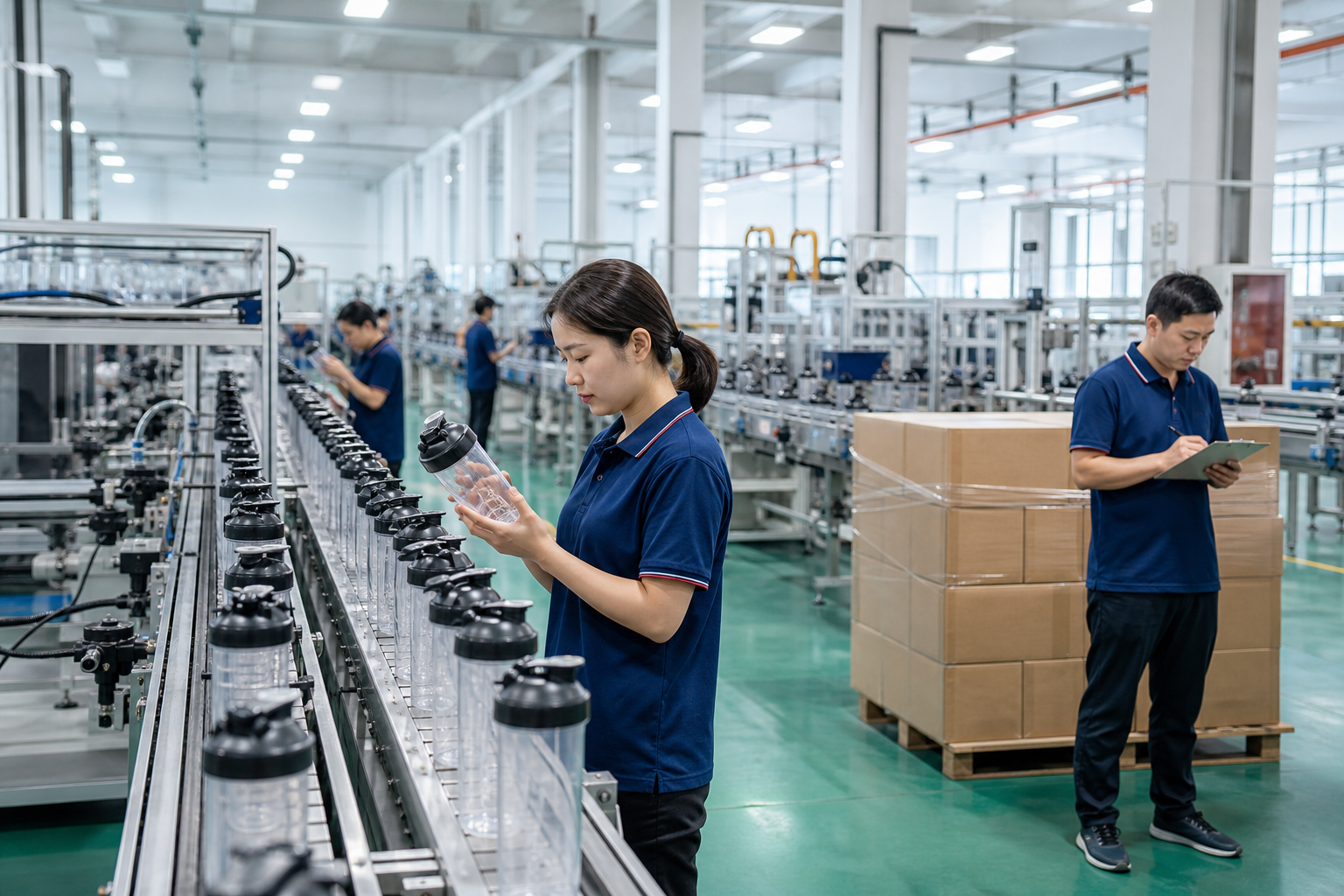
In Zhejiang and across China, the better factories talk in numbers: MOQ 3,000 to 5,000 pieces, sample lead time 7 days, mass production 25 to 40 days, and monthly output above 300,000 units. If a supplier cannot give those figures straight, you are probably talking to a trader, not the line owner. QC pulled the sample, checked the thread pitch, and the buyer flagged a misspelled PO before we ran the carton print. For custom drinkware, that difference matters.
What buyers really need
A blender bottle manufacturer is expected to do three things well: keep the bottle leak-resistant, make it easy to mix powders, and hold decoration from unit to unit. Sounds simple. Then you run 3,000 pieces and the cap torque, gasket fit, and ball whisk bounce start drifting if the line is sloppy. We saw a 0.3 mm gasket change turn into a leak complaint on the first carton.
You should judge a canteen supplier the same way you judge any serious drinkware partner: by process control, not sales talk. Ask how they test shaking performance, whether they run 100% leak checks or only spot checks, and what their AQL standard is for appearance and function. A mature canteen vendor in Zhejiang will usually quote AQL 2.5 for major defects and 4.0 for minor defects on export orders, with traceable batches and clear carton labeling. QC pulled the sample, and a buyer flagged a missing lot code on the PO, so this is where the real work starts.
For distributor drinkware programs, the real question is not “Can you make it?” It is “Can you make it the same way every time?” That is where canteen manufacturers separate themselves from canteen distributors and middlemen. If your project needs a custom canteen, custom growler, or customizable drinkware range, consistency protects your margin. We've seen this go sideways when one shipment came with a 12 g cap and the next one landed at 14 g.
Materials that actually hold up
Most blender bottles run on PP, Tritan, SAN, or stainless steel for premium lines. For North America and Europe, Tritan usually wins the commercial fight because buyers want clarity, impact resistance, and dishwashers that do not haze the body after 50 cycles. PP still sells in budget canteen promo sets, but the surface gloss drops fast; we’ve seen samples lose shelf appeal after 3 months on a hot display rack.
For a canteen customized project, match the resin to the channel. Retail brands ask for a clear bottle, a clean collar, and a tight logo panel; distributor programs push for lower unit cost and 30-day replenishment, and the math does not work if you spec premium parts where they do not add sell-through. We run 0.8-1.0 mm walls in PP and 1.2 mm in Tritan for gym and supplement orders, and QC pulled a sample with a 0.4 mm thin spot near the thread—cap torque failed in warehouse heat, so the buyer flagged it before mass production.
- Tritan: better clarity, higher perceived value, usually USD 1.80-3.20 EXW depending on size and decoration
- PP: lower cost, often USD 0.90-1.60 EXW, suitable for canteen promotional campaigns
- Stainless steel: stronger brand signal, more expensive tooling and assembly, useful for custom growler or premium shaker-style products
Ask your canteen factory to put resin grade, wall thickness, and any BPA-free declaration in writing. “Food grade” without a datasheet will not clear import review, and we’ve seen PO typos on a 12,000-piece order turn “Tritan” into “Tritanium” on the first draft.
MOQ, tooling, and pricing
Pricing for a blender bottle manufacturer order usually breaks into four parts: bottle body, lid system, mixing insert, and decoration. If we already have the mold, a simple custom logo job can start at 3,000 pieces. Need a new body shape, a custom lid, or a full canteen customized exterior? Then tooling fees usually run from USD 2,000 to USD 12,000, and cavity count is what moves the number. QC pulled one sample with a 0.3 mm mismatch at the thread; that is the kind of detail that decides whether the lid fits first time.
In Zhejiang, a capable canteen factory can run 300,000 to 500,000 units per month across several production lines. That beats a tiny price cut. A canteen distributor with retail accounts needs replenishment timing as much as first-order cost, and we have seen buyers lose a whole shelf spot after 21 days out of stock. If you are buying for Amazon or a regional chain, saving USD 0.08 per unit and missing the reorder window is the wrong trade. The line does not care about theory; it cares about cartons moving out on schedule.
Here is the practical rule: under 1,000 pieces, you pay for speed and flexibility. From 3,000 to 10,000 pieces, you can push harder on print setup, packaging, and carton efficiency. Above 20,000 pieces, ask for resin optimization, better packing density, and freight savings. We once caught a PO that said “carton 48 pcs” on one line and “ctn 40pcs” on another; the math did not work until the buyer fixed it. A canteen supplier that knows export pricing should show cost by carton size, not by unit price alone.
Ask for EXW, FOB Ningbo or FOB Shanghai, and landed cost estimates. A price without Incoterms is not a real quote.
Decoration choices that protect margin
Decoration is where a custom drinkware order can go from margin-friendly to margin-killing. A one-color silkscreen looks cheap on paper, but on a curved blender bottle the ink can crack if the mesh count or cure temperature is off. We have seen the buyer flag a 0.3 mm logo shift and then push back on the whole PO. Laser engraving holds up well on stainless steel and some coated bottles, yet it is not the right call for every canteen customized job. Pad print, heat transfer, UV print, and wrap-around labels each carry a different setup fee and a different failure rate.
If the product is pitched as canteen promotional stock, one-color print and standard packaging usually do the job. If you are building a premium customized drinkware line, full-color UV print, individual kraft boxes, and barcode-ready retail labels make more sense. For distributor drinkware programs, re-order speed is the hard metric. A decoration step that adds 4 days can hurt more than a print cost that is a few cents higher. We run that math on the line all the time.
For a custom canteen or custom growler, ask the factory for rub-test and dishwasher-test results. A proper export supplier should tell you whether the logo survives 50 cycles, 100 cycles, or only hand wash. If they dodge that question, they are not ready for serious canteen distributors in Europe or North America. In Zhejiang, stronger factories keep print adhesion records and cure settings on file, because one bad batch at 5,000 pcs can burn a chain account. QC pulled the sample, checked the ink edge, and the result was obvious.
- Silkscreen: lowest setup cost, good for 1-2 colors
- UV print: higher visual impact, better for full-color branding
- Laser engraving: durable, best on steel or coated metal surfaces
Compliance for Europe and North America
If your sales market is Europe or North America, compliance is not optional. For a blender bottle manufacturer, we usually start with REACH, LFGB for Germany-facing buyers, FDA food contact declarations, and a California Proposition 65 review when the material stack calls for it. If the bottle uses stainless steel, ask for 304 or 18/8 paperwork, not a vague line on the quote. If it has a silicone gasket, we check food-grade status and odor at the line, because a 2 g seal with smell complaints can sink a whole PO.
You should also ask for factory certifications. BSCI comes up a lot with retail buyers, and ISO 9001 only matters if the factory uses it in production control, not as a wall frame. We had a buyer flag a typo on a test report once, and the shipment sat for 12 days while the file got fixed. A canteen manufacturer in Zhejiang shipping to Europe should be able to issue commercial invoices, packing lists, test reports, and HS code support without drama.
Do not ignore packaging compliance. Barcodes, carton marks, country of origin, and language lines get checked at the warehouse, and that is where delays start. If the order is going to Amazon FBA, the canteen supplier needs to know FNSKU labels, polybag suffocation warnings where required, and carton sizes that match the platform limit, which is usually 60 cm on one side for smaller cartons. We have seen this go sideways fast, so this is the wrong question to ask after production starts.
How to qualify the right factory
When you compare canteen manufacturers, start with the plain questions. What is the MOQ for a custom canteen? What is the sample lead time? How many production lines do you run? Which quality checks happen in-house? A real factory answers in numbers. A trader usually says “strong supply chain” and stops there. We had one buyer flag a PO typo on the carton count, and that is where a real line manager catches the problem fast.
Here is a practical supplier check list you can use in one call:
- Do you have your own mold workshop or only outsourced tooling?
- What is your monthly output for shaker bottles and custom growler products?
- Can you provide photo or video proof of assembly and leak testing?
- What are your standard carton load quantities and pallet patterns?
- Do you support private label, barcode, and retail-ready packaging?
If your project is a canteen customized program for a chain, ask for sample approval stages: blank sample, decorated sample, pre-production sample, and first article inspection. That sequence saves time later. Our QC pulled a 0.3 mm cap gap on one run, and we stopped the line before packing. In Zhejiang, the stronger factories handle this every week because export buyers expect it. If you are working with canteen suppliers in China for the first time, this process keeps the math from going sideways.
For distributor canteen or distributor growler programs, the best factory partner is not the cheapest one. It is the one that can hold the same model for 18 months, keep the cap tooling stable, and ship an urgent top-up order of 2,000 pieces in 12 days instead of 18 days. We run this kind of reorder work all the time, and the supplier that shrugs at a 48-hour sample revision is the wrong factory for a chain account.
Request a factory quote with real numbers
Send your target price, MOQ, decoration method, and destination port. We will quote from Zhejiang with clear lead time, compliance, and packaging specs.
Frequently asked questions
What MOQ should I expect from a blender bottle manufacturer?
For a standard private-label shaker or blender bottle, a common MOQ is 3,000 to 5,000 pieces per color or logo version. If the factory already has the mold and a basic cap system, some canteen manufacturers will start at 1,000 pieces, but your unit price will be 12% to 25% higher. New tooling usually needs 5,000 to 10,000 pieces to make sense. In Zhejiang, the better factories will state MOQ by item, decoration method, and packaging, not just give one vague number.
Which material is best for custom drinkware orders?
For clear premium shaker-style bottles, Tritan is usually the best balance of appearance and durability. For lower-cost canteen promotional orders, PP is cheaper and typically runs USD 0.90 to 1.60 EXW. For premium metal drinkware, stainless steel is stronger but more expensive to decorate and assemble. If you are building a customized drinkware line for Europe or North America, ask for REACH, FDA, and LFGB support before you choose the material. Material selection should match the channel, not just the catalog photo.
How do I know if the supplier is a real factory?
Ask for monthly output, equipment photos, production line count, and in-house QC records. A real canteen factory in China should be able to explain its process from injection molding to assembly and carton packing. If they claim 300,000 units per month, ask how many lines and shifts support that number. A canteen vendor that cannot discuss AQL, leak testing, or sample approval stages is often a trader or middleman, not the actual manufacturer.
What certifications do I need for Europe and North America?
For export to Europe and North America, most buyers request REACH, FDA food-contact declarations, and often LFGB for German or EU retail accounts. BSCI is commonly requested for social compliance. If the bottle uses stainless steel or silicone, ask for component-level documentation. For Amazon FBA, you also need correct carton labels, FNSKU labels, and packaging that matches warehouse rules. The exact documents depend on material, country, and sales channel, but a serious supplier should prepare the package without delays.
How long does production usually take?
For a standard custom canteen or shaker order with existing molds, sample lead time is often 7 days and mass production takes 25 to 40 days after sample approval and deposit. New tooling can add 15 to 30 days before production starts. If decoration is complex, add 3 to 7 days depending on curing and inspection. Shipping from Zhejiang to North America or Europe is separate, so always build in transit time. A fast quote is not useful if the factory cannot hold the schedule.