Key Takeaways
- Most blender bottle manufacturers in China quote 5,000 pcs MOQ and 25-35 days lead time after sample approval.
- For shaker lids, ask for leakage testing at 1.5 meters and thread fit confirmation before mass production.
- 304 stainless steel or food-grade Tritan usually costs USD 1.35-3.90 per unit depending on volume and decoration.
- AQL 2.5 for major defects and REACH-compliant materials are standard checks for Europe and North America.
If you are sourcing from blender bottle manufacturers, do not treat every shaker or tumbler as the same item. A protein shaker for gym retail, a canteen custom project for a distributor, and a promo bottle for a trade campaign all load the lid differently, seal differently, and take decoration in different places. We have seen buyers approve a sample that looked fine on the desk, then lose money at 3,000 units because the thread spec was never written on the PO. That is the wrong question to ask.
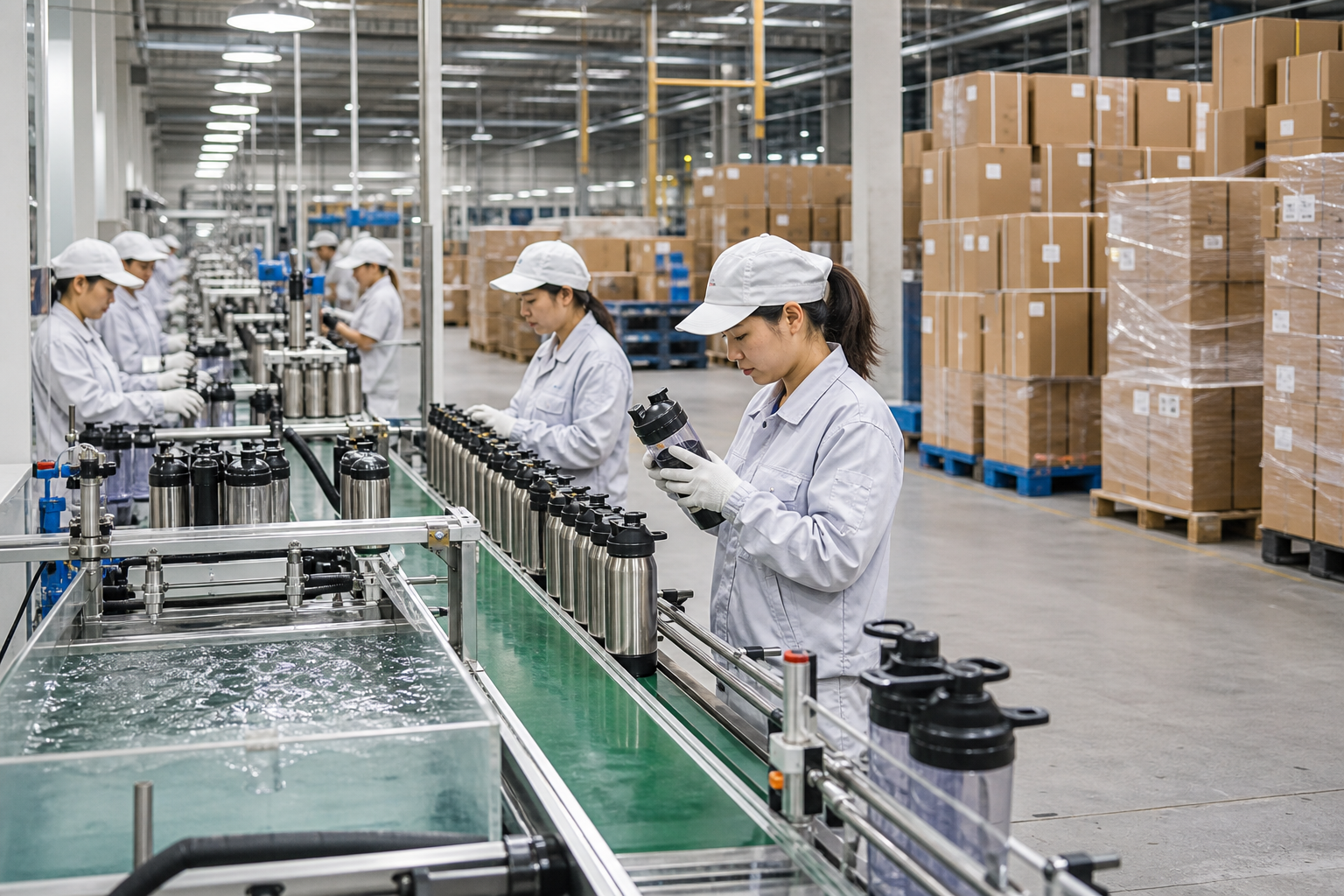
You want a factory answer, not a sales answer. Give us wall thickness in mm, cap torque, material grade, leakage test standard, and MOQ. On the line, QC pulled the sample with a torque wrench and a 1-meter drop test after one buyer flagged a lid pop-open issue on an earlier order. BottleForge in Hangzhou runs 180,000 units per month, with 5,000 pcs MOQ on most custom drinkware and 25-35 days lead time after sample approval. That is the level of detail you should ask from any canteen manufacturer or blender bottle supplier in China or Zhejiang.
What a buyer should ask first
Talk to blender bottle manufacturers about use case first. Color comes later. Is the bottle for whey protein, meal replacement, or a smoothie-style custom growler? Will it go through a distributor canteen channel, ship as canteen promotional stock, or sit in a brand-launch carton? Those answers change the body shape, the lid structure, and the price band. We had a buyer send a PO with “smooothie” typed three times; the line still ran, but the spec had to be fixed before molding.
A buyer brief should cover these points:
- Capacity: 400 ml, 600 ml, 750 ml, or 1,000 ml
- Material: PP, Tritan, 304 stainless steel, or 316 for premium programs
- Decoration: silk screen, laser engraving, UV print, or wrap label
- MOQ: 3,000, 5,000, or 10,000 pcs
- Target FOB price: for example USD 1.80, USD 2.45, or USD 3.20
If a supplier cannot answer those points quickly, you are probably dealing with a trading middle layer, not the factory that owns the tooling and packing line. That is the wrong question to ask if you only care about a low quote. We have seen this go sideways when the buyer flagged a lid leak after the first sample and the seller had no control over the mold. In Zhejiang, a solid factory will send a drawing with tolerance notes within 24 hours. Ask for that, then check whether QC pulled the sample against the PO before you move on.
Materials decide your failure rate
For custom drinkware, materials are a failure-rate choice, not a branding choice. PP lids are cheap and stable, but if the wall section is too thin or the mold cooling is off, they warp. We have seen that on the line. Tritan bodies give better clarity for a customizable canteen or customizable growler, and the buyer likes the clean look, but the resin cost is higher and scratch resistance still depends on handling. On stainless programs, 304 is the default. For wet storage or salty markets, 316 is safer. It adds cost, and for standard distributor drinkware, the math usually does not work.
For a typical shaker bottle, we quote wall thickness at 0.7-0.9 mm for PP parts and 0.5-0.6 mm for stainless shells, depending on geometry. A 0.1 mm cut can save a few cents per unit and trigger a lid fit issue across 10,000 pcs; QC pulled the sample and the cap would not seat on three cavities. A canteen vendor that cannot discuss thickness, gauge, or shrinkage percentage is not ready for export work. In Zhejiang, a decent factory will also tell you the cycle time per cavity and where the gate marks will land before you sign off the mold. We run that check every time.
Use this rule: if the product is supposed to look like customized drinkware and still survive daily use in a gym bag, spend the extra USD 0.18-0.35 on better resin or a thicker shell. That is cheaper than a claim rate over 2%. We had a buyer flag a PO once because the spec said “18/8” on the artwork line and “304” in the material line; that typo cost two days.
Decoration that survives shipment
Brand owners often stare at print color and miss abrasion. We’ve seen a canteen customizable design look clean on day one, then go dull after 500 dishwasher cycles because the ink system could not hold up. For shaker-style products, silk screen is the low-cost route at roughly USD 0.06-0.18 per color per location at volume. Laser engraving on stainless costs more, usually USD 0.12-0.35, but it does not peel. UV print works when the art has gradients or fine type, and it needs proper surface pretreatment on the line.
If you are building a canteen promotional program, ask the canteen manufacturer for rub testing, tape adhesion, and dish-cycle behavior. We run those checks with a standard rub tester and a 65°C wash cycle on sample lots before mass production. For Europe and North America, confirm REACH compliance on inks and pigments. If the bottle is going to Amazon or retail fulfillment, ask whether the cartons can survive a drop test from 80 cm without corner crush. A pretty sample is useless if the pallet lands with 3% box damage.
Buyers in China often ask for “free logo.” That is the wrong question. Ask instead: what is the logo durability after 1,000 rub cycles and what is the cost gap between silk screen and laser?
That shift separates a one-time order from a repeat program with canteen suppliers you can actually trust. QC pulled the sample, the buyer flagged a faint edge lift, and we fixed it before the PO moved ahead.
MOQ, pricing, and true landed cost
Buyers ask for unit price first. The line tells a different story. Mold, packing, freight, and defect risk decide the real number. At our Zhejiang factory, a standard customized canteen or custom canteen shaker at 5,000 pcs usually lands around USD 1.45-2.80 FOB, depending on material and decoration. A premium stainless custom growler sits at USD 3.60-6.20 FOB. Drop below 3,000 pcs, and the price jumps 8-20% because the machine setup, carton test, and packing labor do not shrink with the order.
Here is the math we run:
- Tooling: USD 800-3,500 for a single-color lid or body mold change
- Sample time: 7-12 days for most custom drinkware projects
- Mass production: 25-35 days for repeat items, 35-45 days for new molds
- QC: AQL 2.5 major, 4.0 minor is common for export orders
One buyer once pushed for a rock-bottom quote, then the PO showed no carton count and a typo on the gasket spec. QC pulled the sample, and the risk was obvious. That is the wrong question to ask. If the supplier cannot give packing spec, spare gasket plan, and carton loading count, you are not buying value. You are buying a claim dispute. The better canteen distributors ask for landed cost from day one, because freight from Ningbo to Los Angeles can wipe out a USD 0.12 unit saving fast. We ship enough orders to know that the cheapest factory price often becomes the most expensive invoice.
Compliance for export channels
For Europe and North America, write compliance into the PO. We ask buyers to spell out food-contact declarations, REACH status, and LFGB support files before the line starts. On stainless programs, ASTM-style material expectations and weld consistency matter more than fancy packaging. One PO we saw had the barcode line typed wrong by one digit, and that kind of slip burns a week fast. For retail and Amazon channels, carton labeling, barcode placement, and FNSKU readiness need to be checked before shipment, not after. A factory that keeps those pieces straight is usually the same one that can run custom drinkware at scale without parts going missing.
Do not assume every canteen manufacturer understands retailer requirements. Some make a decent bottle and still miss the paper trail. Others can export, then fail seal compression on 20,000 pcs. We’ve seen that go sideways. The better blender bottle manufacturers in China do both. In Hangzhou and the wider Zhejiang cluster, the stronger teams will show in-process QC reports, incoming resin checks, and final random inspection records. QC pulled the sample on one 304 stainless run and found weld marks outside spec at 0.3 mm. If a factory cannot show those records, this is the wrong question to soften.
For reusable bottles, ask for:
- Food-grade declaration for all contact parts
- Odor test after hot-water soak
- Leak test at inverted 24-hour hold
- Drop test on packed cartons
How to choose a factory partner
The gap between a solid partner and a risky one is speed and plain answers. A real canteen factory in Zhejiang will send 2D drawings, a quote breakdown, and sample photos without dodging the mold-ownership question. We had a buyer flag a PO typo on the gasket spec once, and that saved a bad run. If you are comparing canteen manufacturers, ask who owns the tooling, who signs off on the first article, and what happens if the gasket hardness shifts by 5 Shore A. Normal questions. Good questions.
A strong partner for canteen custom and customized drinkware programs should have:
- Monthly capacity above 100,000 units for repeat SKUs
- In-house QC and metal/plastic assembly lines
- Export packing with barcode and carton verification
- Documented traceability for every lot
You do not need the biggest factory. You need the one that treats a 5,000-piece distributor drinkware order with the same discipline as a 50,000-piece retail run. We run that kind of split all the time, and the math does not work any other way. The best canteen suppliers in China know distributor canteen programs live or die on repeat fill rates and defect control, not on first sample approval alone. If you want to test a new vendor, start with one custom canteen SKU, one print method, and one carton spec. QC pulled the sample, checked the cap torque at 0.8 N·m, then we moved to the next step. If they get that right twice in a row, expand the line.
Send your spec sheet and get a factory quote
Share capacity, material, logo method, and target FOB. We will quote directly from our Zhejiang line with clear MOQ, lead time, and packing options.
Frequently asked questions
What MOQ should I expect from blender bottle manufacturers?
For standard custom drinkware, 5,000 pcs is the most common MOQ from a real factory in China or Zhejiang. Some canteen suppliers will accept 3,000 pcs, but the unit price usually rises 8-20% because setup cost is spread over fewer units. If you need a new mold, budget USD 800-3,500 tooling depending on complexity. For a repeat order with existing tooling, lead time is often 25-35 days after sample approval. Ask whether the MOQ applies per color, per logo, or per carton configuration, because that detail changes the real order size fast.
What materials are best for a shaker bottle program?
For most blender bottle manufacturers, PP lids and Tritan or stainless bodies are the safe standard. PP is low-cost and stable for caps and mixers. Tritan works well when you want a clear customizable canteen look without glass weight, while 304 stainless fits premium or insulated custom growler programs. In export work, 304 is the default unless corrosion resistance or high-end positioning pushes you to 316. For wall thickness, 0.7-0.9 mm on PP parts and 0.5-0.6 mm on stainless shells are common ranges. Always confirm food-contact declarations and odor testing.
How much should I budget per unit FOB?
A typical standard shaker or custom canteen in 5,000 pcs may fall around USD 1.45-2.80 FOB depending on material, decoration, and packing. A premium stainless custom growler can be USD 3.60-6.20 FOB. Silk screen logos may add only USD 0.06-0.18 per color, while laser engraving is often USD 0.12-0.35. If you need retail-ready carton labeling, FNSKU, or special inserts, budget another USD 0.05-0.20 per unit. Always separate product cost, packing cost, and freight when comparing canteen vendors.
What quality checks should I require?
At minimum, ask for AQL 2.5 major and 4.0 minor inspection, inverted leak tests for 24 hours, and a drop test on packed cartons from 80 cm. For custom drinkware sold in Europe, request REACH-compliant inks and food-contact declarations for all parts touching liquid. On stainless products, check weld consistency, passivation if relevant, and cap torque. On plastic shaker bottles, ask for thread-fit checks and gasket compression data. Good canteen manufacturers will document incoming material inspection, in-process QC, and final random checks. If they cannot show records, assume the process is weak.
Can I use one factory for distributor and promotional orders?
Yes, if the factory is organized for mixed programs. A serious canteen factory in China can handle distributor drinkware, canteen promotional packs, and retail custom canteen SKUs in parallel, but only if the tooling, packing, and QC records are clean. The key is to separate the order specs: one carton format for distributor canteen, another for shelf-ready promotional sets, and one artwork file per SKU. Good canteen suppliers will give you a stable sample and repeatable color match across reorders. That matters more than trying to squeeze every project through one lowest-cost setup.