Key Takeaways
- A serious blender bottle OEM manufacturer should quote MOQ, lead time, and leak test data upfront; 3,000 pcs and 25-35 days is a normal starting point for customized drinkware.
- For export, ask for REACH, food-contact compliance, and carton drop testing; don’t accept “safe material” as a technical answer.
- Logo method changes the sell-through: silkscreen is often USD 0.03-0.08 per color, while laser engraving is cleaner for premium canteen customized orders.
- If you plan distributor drinkware or custom canteen programs, confirm lid torque, gasket material, and spare-part availability before approving the sample.
If you are buying shaker-style drinkware at scale, the wrong supplier costs you twice: first in samples that look fine, then in freight, returns, and angry retailers. A blender bottle OEM manufacturer should hand over more than a white bottle with your logo. We need repeatable molding, lids that stay within spec, leak rates that pass a 1-meter drop test, and packaging that survives export. That is the gap between a sellable program and dead stock. One bad cap tooling issue can sink a 20,000-unit order.
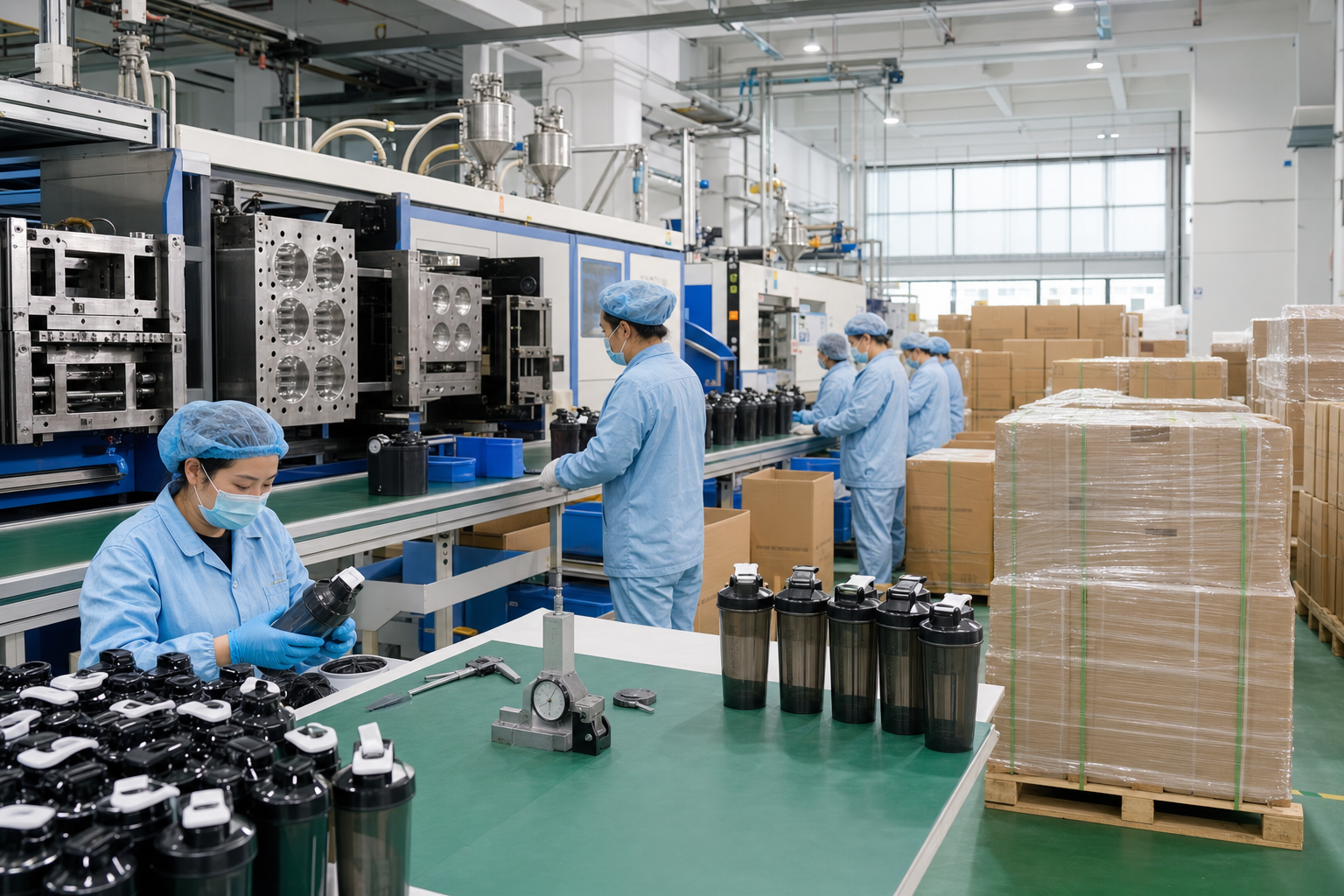
In Zhejiang and across China, the best factories are not the loudest ones. They are the shops that can show monthly output, test data, and a clean route from tooling to carton loading. BottleForge Industrial in Hangzhou runs drinkware programs from 50,000 to 200,000 units per month depending on the line, and we’ve had buyers flag a 2 mm lid gap before mass production even started. The same logic applies whether you want a canteen custom project, a customizable drinkware line, or a distributor canteen program for North America and Europe. This is the wrong question to ask: “Can you make it?” The real question is, “Can you ship the same unit 12 days from approval, then again 18 days later without drift?”
What OEM really means here
When buyers search for a blender bottle oem manufacturer, they want private label control without building a plant. The factory runs the bottle body, lid system, decoration, packaging, and export paperwork while you keep control of spec, branding, and market position. For a blender bottle or shaker bottle, OEM is not logo placement. It covers wall thickness, mold finish, thread fit, closure torque, and the seal on the cap and mixing insert.
A good canteen manufacturer treats this as product engineering, not a print job. In Zhejiang, we can turn a sample in 7-10 days if the mold already exists, but a custom canteen or customized growler often needs 20-35 days for tooling review and first article samples. On the line, we check the thread gauge and the torque meter before we ship. If you only ask for a “custom drinkware” quote, you get vague numbers. Ask for bottle capacity, material grade, cap type, and testing standard, and the math works.
For distributor canteen and distributor growler programs, OEM means repeatability on the second order and the fifth. The carton count stays the same, the color stays within the same tolerance, and the leakage rate does not drift. We’ve seen this go sideways when a buyer changed the PO typo from 5000 pcs to 500 pcs and blamed the factory. That is how a canteen distributor ends up firefighting every quarter.
Materials that actually matter
Material choice sets cost, clarity, smell retention, and compliance risk. For shaker-style bottles, we run Tritan copolyester, PP, AS, and stainless steel accents on the line. Tritan is the one buyers keep asking for on premium retail programs because it stays clear after drop tests and gives the bottle a cleaner shelf look. If the buyer is chasing the lowest landed cost, PP bottle bodies and PP lids cut unit price fast, though the finish looks plainer and the retail margin math gets tight.
For a custom canteen or canteen promotional order, stainless steel is still the workhorse. Double-wall 18/8 stainless steel with 0.4-0.5 mm inner and outer wall thickness is standard in export drinkware; we checked a batch last month with calipers at 0.42 mm and 0.44 mm. For shaker bottles, the gasket and flip cap do the sealing job. A silicone gasket at 40-50 Shore A usually holds up better than cheap TPE through hot-and-cold cycling, and we’ve seen that go sideways when a buyer tried to save 0.03 USD per set. Ask the canteen supplier for the exact material declaration, not just “food grade” on the PO.
- Tritan: clearer, premium look, higher cost
- PP: lower cost, lighter, common for canteen custom programs
- Stainless steel: better for customized canteen and customized growler SKUs
If your market is Europe, ask for REACH and food-contact declarations. If your market is the US, ask for FDA food-contact suitability and migration test reports. Good canteen manufacturers in China and Zhejiang keep these files on hand; QC pulled the sample file for a 3,000-piece order before packing because the buyer flagged a missing date stamp on the test report.
MOQ, pricing, and lead time
Let’s talk numbers. This is where deals get real. A typical blender bottle OEM manufacturer will quote MOQ around 3,000 to 5,000 pcs per color if the body mold is already in the rack. If you need new tooling for a custom growler shape or a customized canteen profile, the first order usually starts at 5,000 to 10,000 pcs. That covers setup, mold amortization, and the extra time on the line. For basic shaker bottles, factory EXW prices can start around USD 1.10-1.80 per unit for simple PP builds, while Tritan or stainless steel models move into USD 2.20-5.50 depending on size, lid complexity, and decoration. QC pulled the sample on a 304 stainless run last month, and the buyer flagged a 0.3 mm lid gap; that kind of detail changes the quote fast.
Lead time needs to be grounded in shop reality. A canteen factory in China with an existing mold may need 25-35 days after sample approval for production and packing. Add custom color matching, special packaging, or accessory kits, and you are looking at another 7-10 days. If a canteen vendor promises 10 days for a new custom canteen project, ask what step they are skipping. The math does not work. We’ve seen this go sideways when the PO says “blue” but the buyer means Pantone 293 C, and the ink test on the spray booth takes two extra rounds.
One practical rule: the more you want a canteen customizable package to include inserts, straps, boxed sets, and multilingual labels, the more you need a clear order forecast to protect margin. A distributor canteen buyer who orders 1,000 pieces today and 8,000 pieces later will pay more than a buyer who commits to a stable run. That is not a sales line, just how we run the line. If you want 12,000 sets with a printed sleeve and spare lid, say it upfront; otherwise the carton spec, label copy, and packing list will keep moving.
Decoration that sells the product
Decoration is not just looks. It changes perceived value, shelf appeal, and how buyers read the line in 10 seconds. For a blender bottle OEM manufacturer, the usual choices are silkscreen printing, heat transfer, pad printing, UV printing, laser engraving, and embossing or debossing if the mold supports it. We run silkscreen at about USD 0.03-0.08 per color per piece, which is why buyers with a 1-color logo keep asking for it. Laser engraving gives a clean mark and holds up well, but it works best on stainless steel and dark-coated surfaces.
For canteen promotional campaigns, go for large branding, not tiny artwork that disappears on the shelf. Retail buyers and event buyers want the logo readable from 3 meters away. We've had buyers push back on this, then the sample came back with a 6 mm logo and the math just didn't work. For premium canteen customized orders, use laser on brushed steel or a one-color print on matte powder coat. For a customizable canteen aimed at gyms or outdoor retailers, a tone-on-tone logo with a textured finish gives a higher-end look without blowing up the quote.
Ask these before approving artwork
- What is the print tolerance on curved surfaces?
- How many rub cycles does the decoration survive?
- Will the logo sit above or below the dishwasher-wear zone?
If you are building custom drinkware for Amazon or retail, decoration failure turns into a return claim fast. That is the wrong question to ask after the PO is signed. A canteen distributor should request pre-production samples with final artwork, not a “similar” print. QC pulled the sample once and found the buyer's PO had a typo in the logo file name; we caught it before the line ran 5,000 pcs.
Testing and compliance you should demand
A factory that cannot show test results is not ready for export. We ask for leakage reports, drop data, thermal numbers on insulated SKUs, and the material file before we print one carton. For shaker bottles, a 1-meter drop test on 6 faces is a normal baseline. For sealed lids, we want inversion leak records or pressure test sheets, not a line in an email. If the bottle goes to Europe, REACH and food-contact declarations go on the desk. For North America, we ask for FDA food-contact compliance statements and any third-party migration test the canteen supplier already has on file.
A serious canteen factory in Zhejiang should also know AQL. For finished goods, AQL 2.5 for major defects and 4.0 for minor defects is common in drinkware inspections, though a retailer can tighten that spec to 1.5 if the channel is picky. Carton drop standards matter too, especially for Amazon FBA or distributor warehouses. We had a buyer flag a PO once because the lid size was typed as 28 mm instead of 38 mm, and that kind of miss turns into a rework mess on the line. A bottle that leaks only after transit is still a bad bottle.
Do not approve a sample just because it “looks good.” Approve it because it survives heat, torque, drop, and leak testing under a defined standard.
If your canteen manufacturers claim certification, ask for the certificate number, issue date, and test scope. Real factories in China do not get offended by this. QC pulled the sample, checked the batch record, and we shipped only after the scope matched the SKU. That is the right question to ask.
How to choose a factory in Zhejiang
Zhejiang has a dense drinkware supply chain. That helps if you know how we run it. A strong blender bottle OEM manufacturer in Zhejiang can source lids, seals, packaging, and coatings fast because the gasket shop, carton plant, and spray line are all within 30 minutes by truck. Proximity alone does not make a good partner. You still need production control, in-house QC, and one person who owns mold issues. If the buyer flagged the mold as “shared,” ask for the mold register and the tool number before you send deposit money.
Look for factory metrics, not slogans. Ask for monthly capacity, number of assembly lines, and actual export share. If a canteen manufacturer says 120,000 units per month, ask whether that is one line, three lines, or a peak-season number from a 25-day run. Ask how many SKUs they can run at once without mix-ups. We once saw a PO typo change “matte black” to “metal black,” and QC pulled the sample before packing. A factory with 30,000 pcs MOQ flexibility but weak line discipline will cost you more than a slightly larger canteen supplier with stable systems. The math does not work any other way.
For canteen distributors, the best partner is usually the one who can support stock and custom development on the same line. That matters when you need a custom canteen launch now and a canteen promotional re-order later. You want a factory that can protect your color formula, carton spec, and pack-out plan from one purchase order to the next. We ship this kind of repeat job all the time, and the buyer usually asks for 2 mm wall-thickness consistency plus a fixed carton count; if the spec drifts, the next order goes sideways fast.
What to ask before you place the order
Before you place the order, ask the questions that catch the real risk. What is the exact MOQ by color and by decoration method? Is the price FOB Ningbo, FOB Shanghai, or EXW Hangzhou? Which gasket material is in the unit, and can we switch it to silicone if the buyer asks? Is the label printed or just a sticker? How many spare gaskets go into each carton? These are the questions that decide whether the job ships clean or turns into a claims file.
If you are buying a custom growler or customized growler for outdoor retail, ask for coating adhesion data and condensation test results. We run a 24-hour salt spray check on some finishes, and the weak ones show up fast. If you are buying a distributor drinkware program, ask whether the factory can hold 500-1,000 pcs per SKU as safety stock. If you are buying canteen customizable bundles for clubs or corporate gifting, ask for gift box dimensions and carton master pack counts. A good canteen vendor should put all of that on one spec sheet; seven email threads mean the buyer flagged something the first time and nobody wrote it down.
At BottleForge Industrial in Hangzhou, we keep it simple: define the product, define the compliance set, approve the sample, then lock the packing standard. QC pulled the sample, checked the gasket groove at 1.2 mm, and we fixed a PO typo before the line started. That is how custom drinkware moves from a rough idea to a repeatable export program in China. The math does not work any other way.
Request a custom quote from Zhejiang
Send your spec, target price, and market. We will confirm MOQ, compliance, decoration, and lead time for your next custom drinkware program.
Frequently asked questions
What is a normal MOQ for a blender bottle OEM manufacturer?
For existing shaker molds, a normal MOQ is 3,000-5,000 pcs per color. If you want a new body shape or a custom growler-style tool, expect 5,000-10,000 pcs on the first run. Decoration can also affect MOQ: multi-color silkscreen or special packaging often pushes the order higher. A serious canteen factory should tell you the MOQ by SKU, color, and print method, not give one vague number for everything.
How much should I expect to pay per unit?
For simple PP shaker bottles, factory pricing often starts around USD 1.10-1.80 per unit. Tritan models usually land around USD 2.20-3.80, while stainless steel or insulated customized drinkware can reach USD 3.50-5.50 or more depending on wall structure, lid design, and decoration. Freight, duty, and packaging are separate. If someone quotes too low, ask whether the price includes cap assembly, carton inserts, and leak testing.
What compliance documents should I request for Europe and North America?
For Europe, ask for REACH and food-contact declarations, plus any migration testing your buyer requires. For North America, ask for FDA food-contact suitability statements and relevant test reports. If the product is a canteen promotional item or a retail SKU, also request carton drop testing and AQL inspection results. Don’t accept a plain statement of “safe material” without documents. A real canteen supplier in China should be able to send these files quickly.
Can I customize the bottle shape and the lid?
Yes, but the cost and lead time change. Minor changes like color, logo, and packaging are fast. A custom canteen shape, a new closure system, or a customized growler profile requires tooling review and can add 20-35 days before production starts. If you need a canteen customizable platform for repeat orders, it is usually smarter to change colors and decoration first, then invest in tooling only after market validation.
How do I know if a factory is reliable?
Check three things: production capacity, quality process, and export discipline. Ask how many units per month they make, what AQL they use, and whether they can provide leak tests and compliance files. If the canteen manufacturer is in Zhejiang or elsewhere in China, ask for a live video of the line, a sample of the carton pack-out, and a clear lead time from deposit to shipment. A reliable canteen vendor gives exact answers, not marketing language.