Key Takeaways
- Typical MOQ for blender bottle private label is 3,000–5,000 units, with sampling in 7–12 days and mass production in 25–35 days.
- FOB China pricing for a basic customized drinkware bottle usually starts around USD 1.45–2.90 per unit depending on material, lid, and print method.
- AQL 2.5 for major defects and 4.0 for minor defects is a common inspection target for export orders.
- A Zhejiang canteen factory with 200,000+ units/month capacity can usually handle private label reorders without pushing lead times beyond 35 days.
If you are buying blender bottle private label products for retail, Amazon, gyms, or distributor channels, the real problem is not finding a bottle. It is finding a factory that can hold the 0.3 mm wall tolerance, pass leak and drop testing, and still land at a price that leaves margin after freight, duty, and packaging. We quote these jobs every week in Zhejiang. The pattern is the same: a buyer starts with a logo idea, then asks for material advice, lid validation, and a MOQ that actually fits the sales plan.
A good blender bottle private label program is never just “print my logo.” You are choosing resin grade, wall thickness, closure torque, leak performance, and carton count, and each one changes the landed cost. One buyer once sent a PO with the lid color typoed as “pms 186C” while the sample had “186 U”; QC pulled the sample, and that stopped the line before 5,000 pcs were packed wrong. If you want a canteen customizable enough for brand work but stable enough for bulk production, think like a procurement manager, not a designer. The math does not work any other way.
What buyers mean by private label
When a buyer says blender bottle private label, we usually hear four different briefs hiding under the same phrase. One buyer wants a logo on an existing mold. Another wants a custom canteen body with a new lid color. A third wants a full customized drinkware line with retail packaging and UPC/FNSKU labels. The fourth wants a custom canteen that sits between a sports bottle and a shaker bottle, with a cleaner story for gyms, nutrition brands, and distributors.
The first question is how much of the product you control. Private label usually means we run an existing bottle mold, so tooling cost stays at zero or stays low. A fully customizable canteen or customizable growler can mean a new mold fee of USD 3,000–12,000, depending on cavity count and wall geometry. That math works if you plan to sell 20,000+ units. If you only want to test the market, it does not. We had one buyer flag a PO typo on the lid code, and QC pulled the sample from the line before it went to packing; that kind of miss is why we push stock tooling first in Zhejiang.
Practical rule: if your first run is under 10,000 units, stay with private label tooling. If you already have distributor commitments, a branded shape can make sense. We’ve seen this go sideways when a buyer ordered a 12,000-piece mold and then tried to move only 3,000 units in the first season. A good canteen distributor protects margin without tying up cash in the wrong mold.
Materials, lids, and wall thickness
Material choice beats logo placement every time. For blender-style drinkware, we usually run PP, Tritan, AS, or stainless steel based on target price and where the buyer will sell it. Tritan bodies show up a lot in custom drinkware because they look clean, hold up against odor, and give the print shop a better surface. Stainless steel fits a tougher custom growler or an insulated sports bottle. PP still works for a non-insulated shaker, but if the buyer wants premium shelf appeal, this is the wrong place to save $0.15 a unit. QC pulled one sample with a scratched 2.0 mm Tritan wall, and the buyer flagged it before we packed the carton.
Wall thickness is the part people try to gloss over. On plastic bodies, 1.5 mm is the cheap lane, while 2.0–2.5 mm gives a firmer hand feel and cuts down warp when the line gets hot. For stainless, the inner wall usually runs 304 at 0.4 mm to 0.5 mm gauge, and the outer shell sits around 0.4 mm to 0.6 mm depending on the build. We’ve seen a PO typo call out 0.05 mm instead of 0.5 mm, and that bottle would have folded in a drop test. The math doesn’t work when the wall is too thin.
- PP: lowest cost, good for promo runs and 5,000-piece MOQ orders
- Tritan: clearer, better retail appeal, higher unit cost
- 304 stainless: stronger brand position, better for premium distributor drinkware
- 316 stainless: niche use, usually unnecessary for standard canteen custom projects
For export orders from China, ask for material declarations and test reports for REACH in Europe and FDA-related compliance for the United States. A solid canteen supplier sends these before you chase them. We ship this paperwork with the sample pack when the buyer asks early. If a factory hesitates, you already know where the line is headed.
MOQ, pricing, and freight reality
MOQ drives the whole quote. A Zhejiang factory will usually set MOQ at 3,000 units for a plain private label shaker, and 5,000 units once you add color matching, custom lid parts, or a second print position. We run this every week. If you want a blue bottle with a white lid, a black bottle with a gray lid, and three logo placements, that is three line setups, not one order.
For a basic blender bottle private label job, rough FOB China pricing usually looks like this:
- PP shaker with one-color print: USD 1.45–1.90
- Tritan body with simple logo: USD 2.10–3.40
- Stainless single-wall bottle: USD 2.60–4.80
- Insulated premium version: USD 5.80–9.50
Those numbers shift with lid structure, Pantone matching, packaging, and order size. Freight is where new buyers get caught. A 5,000-unit pallet load can look fine at ex-factory price, then the landed cost jumps 12% to 28% once carton size, CBM, and destination port charges land on the sheet. We had one buyer flag a PO because the carton spec said 12 pcs/ctn on the draft, then the packing team had 24 pcs/ctn in the sample build. Ask for carton dimensions before you sign. This is the wrong question to skip.
Cheap unit price without freight math is not a saving. It is postponed bad news.
Decoration methods that actually sell
Your decoration choice has to match the channel. Gyms, DTC, and Amazon buyers handle the bottle, set it on wet lockers, and wash it over and over. If the logo starts peeling after 12 washes, the buyer flags it fast. For event canteen promotional units, a low-cost one-color print often does the job. If you want a premium custom drinkware line, decoration matters as much as the bottle shape.
Silkscreen printing is the cheapest and fastest on the line. We run it for 1–2 colors and bigger quantities, and the setup is clean. Pad printing works on curved spots and small logo areas. Laser engraving is the right call for stainless steel when the mark has to stay put and not peel. UV printing can handle complex graphics, but it needs stricter surface prep and the cost jumps. For a customized canteen sold into retail, I’d usually push laser on steel or silkscreen on plastic. One buyer wanted UV on a brushed steel bottle; QC pulled the sample and the contrast was weak, so we dropped it.
Choose by channel, not by taste
A distributor canteen order usually needs durability first. A canteen promotional order needs speed and low MOQ. If you are a canteen vendor serving 6 accounts, standardize on 2 or 3 decoration options so reorders stay clean. A Zhejiang canteen manufacturer with stable print lines can usually hold logo position within ±1.5 mm, which works for most export packaging. Ask for a pre-production sample with the actual Pantone reference and get written approval before mass production. We’ve seen a PO typo on the Pantone code turn into a full reprint; the math does not work if you “fix it later.”
Testing, compliance, and defect control
Buyers should care more about test reports than sales talk. For Europe, ask for REACH, food contact declarations, and heavy metal limits on any printed or coated area. For North America, ask for FDA-related material statements and third-party migration testing if the bottle will contact liquids again and again. If the bottle uses stainless steel, check nickel release data or ask for a 304 material certificate. We once had a buyer flag a PO typo on “304” as “340”; QC caught it before the line ran.
Quality control needs hard numbers. Set AQL before production starts. A common export spec is AQL 2.5 for major defects, AQL 4.0 for minor defects, and zero tolerance for leakage, cracked lids, or odor contamination. On a blender bottle private label order, a leaky cap or mixer seal is a major defect, not a cosmetic issue. If a supplier calls that minor, the math does not work. We’ve seen that go sideways after 2,000 pcs.
Ask for:
- Pre-production sample approval
- In-line inspection at 30% or 50% completion
- Final random inspection before balance payment
- Drop test, leak test, and dishwasher resistance test where relevant
A serious canteen factory in China will know these checks. We run them on the line with a torque tester and a 1 m drop test jig. If the factory pushes back, they are not set up for real custom export work.
Packaging for retail and distribution
Packaging decides whether your bottle feels like a brand or bulk cargo. Private label buyers often focus on the bottle and leave the carton until the freight bill lands. Bad move. A retail-ready blender bottle private label program usually needs color boxes, master cartons, insert cards, barcode stickers, and case packs set for distributor warehousing. If you sell to Amazon, you also need exact carton dimensions, suffocation warnings where required, and FNSKU placement. We once had a PO with the FNSKU typed one digit off; QC pulled the sample and the buyer flagged it before ship.
For customized growler or insulated products, the package has to protect the finish. EPE, molded pulp, or a precision insert cuts transit damage. On one 500 ml canteen run, a 1.2 mm insert saved the satin paint from rub marks, and the claim rate dropped. For a lightweight canteen customizable order, a simple polybag plus carton can be enough for promotional channels. The math changes with your audience and margin. Fancy-looking packaging in the sample room is the wrong question to ask.
Here is the practical way to think about packaging:
- Retail chain: printed box, barcode, display carton
- Amazon: label control, carton sizing, drop resistance
- Distributor canteen order: master carton efficiency and pallet count
- Canteen promotional campaign: fast packing, low cost, simple SKU control
In Zhejiang, factories that run both OEM and ODM programs usually quote packaging separately. That is normal. What matters is the landed cost before you confirm. A good canteen supplier will not hide packaging as a later surprise. We ship from Hangzhou, and a clean packaging quote on day one saves 12 days of back-and-forth later.
How to brief a Zhejiang factory
If you want the quote to be useful, send a brief that looks like you mean business. State the target market, target price, annual forecast, logo format, color preferences, and required compliance. Then add lid preference, capacity, bottle diameter, and whether you want a shaker ball or inner mixer. A Zhejiang factory can turn that into a quote fast if the brief is clean. If it is vague, we send back questions, not magic.
We see the same mistake again and again: buyers ask for “premium quality” and “best price” in the same sentence, then leave out the spec sheet. That is not procurement. That is wishful thinking. If you want a blender bottle private label program to scale, tell the factory the exact use case. Is it a gym shaker, a distributor promo item, or a retail-style custom growler? The cost stack is different on all three. I’d push back hard on anyone who says otherwise.
A practical factory brief should include:
- Target MOQ: 3,000, 5,000, or 10,000 units
- Target FOB budget: for example USD 2.20–3.00
- Artwork format: AI, PDF, or vector SVG
- Packaging target: retail box or bulk pack
- Inspection standard: AQL 2.5 / 4.0
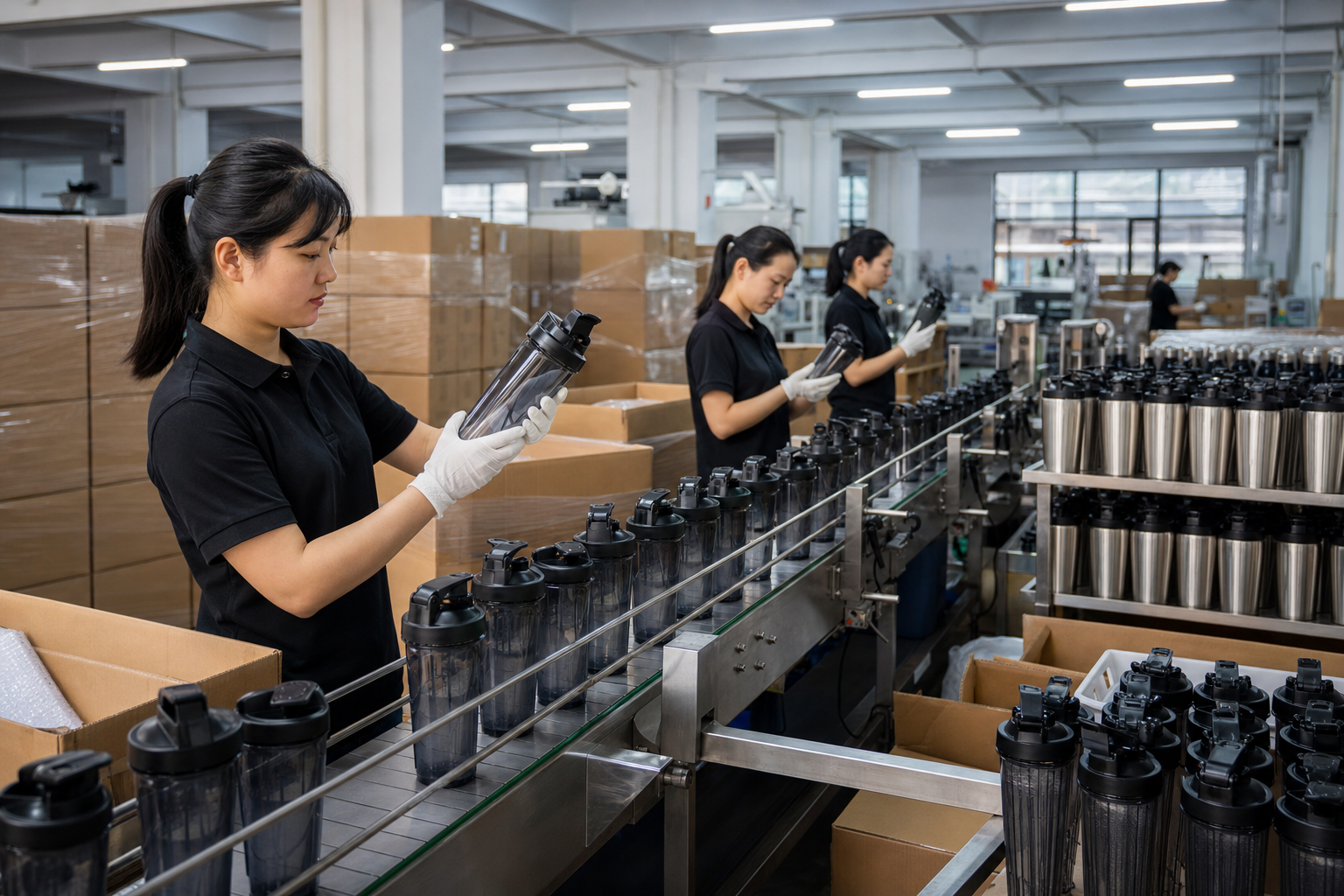
At BottleForge Industrial in Hangzhou, Zhejiang, we run export drinkware orders at roughly 200,000 units per month across multiple lines. Sample lead time is 7–12 days, and mass production runs 25–35 days depending on structure. QC pulled the sample with a 0.3 mm lid gap once, so we reworked the mold before the buyer saw a carton. That is the level you want from a serious China supplier, not a trading desk guessing through your launch.
Request your private label quote today
Send your target MOQ, budget, and logo files. We will quote the right bottle, packaging, and lead time without hiding the freight or quality tradeoffs.
Frequently asked questions
What is the normal MOQ for blender bottle private label orders?
For a standard private label shaker or bottle, 3,000 units is a realistic starting MOQ in China, especially from a Zhejiang factory with existing molds. If you want custom colors, special lids, or complex packaging, expect 5,000 units or more. For fully new tooling, the commercial minimum is often 10,000 units because the mold cost must be spread out. Samples usually take 7–12 days, and mass production is commonly 25–35 days after sample approval.
How much should I budget per unit FOB China?
For basic blender bottle private label products, budget USD 1.45–1.90 for PP, USD 2.10–3.40 for Tritan-style bodies, and USD 2.60–4.80 for single-wall stainless steel. Insulated models can move into USD 5.80–9.50 FOB depending on wall structure and lid design. These are factory-level numbers before freight, duty, and local fulfillment. If a quote is far below these ranges, check material grade, wall thickness, and print method carefully.
What compliance documents should I ask for?
For Europe, ask for REACH-related declarations and food contact statements. For North America, ask for FDA-related material declarations and any available migration test reports. If the product uses stainless steel, request 304 or 316 material certificates. For printed or coated parts, ask whether the inks and coatings are tested for food-contact safety. A serious canteen manufacturer or canteen supplier in China should be able to provide these documents without delay.
Is laser engraving better than silkscreen printing?
It depends on the channel. Laser engraving is better for stainless steel if you want a permanent mark that will not wear off during washing or transit. Silkscreen printing is cheaper and better for larger logo areas, especially on plastic. For canteen promotional items, silkscreen is usually the right choice. For retail premium products, laser engraving or a high-end UV process can look more durable. If you sell through distributors, choose the method that reduces after-sales complaints, not the one that looks best in a sample photo.
How do I avoid quality problems on a first order?
Use a written spec, approve a pre-production sample, and set AQL 2.5 for major defects and 4.0 for minor defects. Make leakage, cracked lids, and odor issues zero tolerance. Ask for in-line inspection at 30% or 50% completion and final random inspection before balance payment. Also confirm carton dimensions and drop resistance before shipping. If your supplier in Zhejiang pushes you to skip sampling, that is usually where problems start.