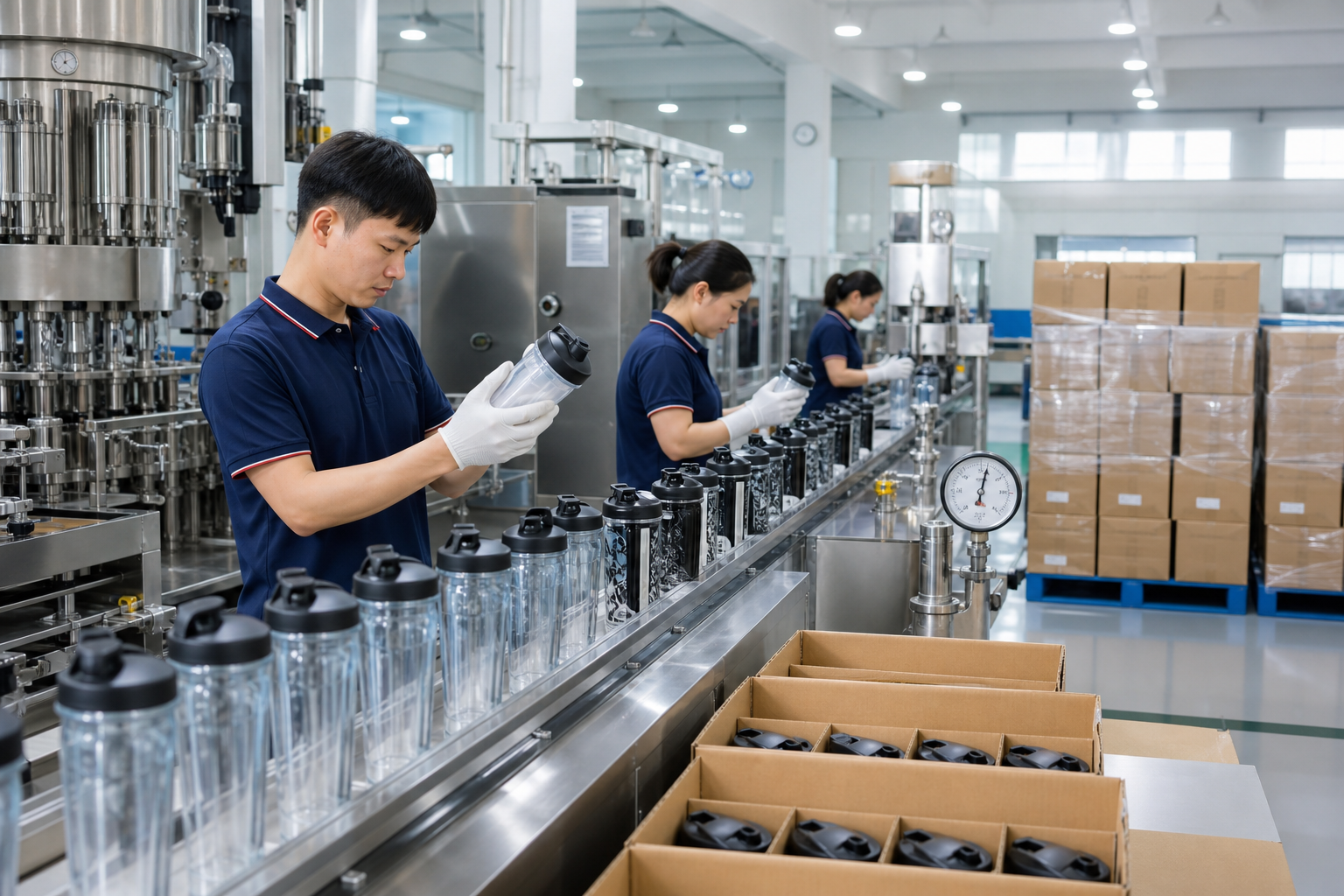
Key Takeaways
- Typical MOQ for blender bottle private labeling starts at 3,000 pcs per color, with lead time around 25-35 days after sample approval.
- Screen print is usually USD 0.12-0.30 per color, while laser marking on stainless parts often adds USD 0.25-0.60 per unit.
- A 500 ml shaker with 0.6-0.8 mm wall thickness and PP/AS body is easier to control than a fully customized mold.
- For EU and North America, ask for REACH, LFGB, FDA, and AQL 2.5 inspection records before shipment.
If you are buying blender bottle private labeling for retail, gym chains, or e-commerce, the trap shows up fast: the bottle looks simple until the first PO lands with the wrong lid, a weak logo print, or a price that only works at 20,000 units. A good shaker bottle is not just a plastic cup with a ball inside. We run this every week, and the difference is in the details: material, 2.2 mm wall thickness, closure torque, ink adhesion, and how the set is packed for shipping.
From our Hangzhou, Zhejiang factory, we see the same buying pattern every week. One buyer wanted a 5,000-piece MOQ, then pushed back when we said the matte spray would add 8 days to the line. Brand owners want custom drinkware that feels premium, distributors want a low-risk SKU they can reorder at 3,000 to 5,000 units, and canteen distributors want a bottle that survives daily washing without labels peeling. The right canteen manufacturer should tell you what can be changed, what stays fixed, and what will move the mold cost, lead time, and FOB price before you pay the deposit. That is the only question that matters.
What private labeling really changes
When buyers ask for blender bottle private labeling, they usually mean three jobs: logo print, color match, or a new bottle shape. Those are different. Logo-only work moves fast and stays cheap. A new cap shape or a new mixing system means tooling, and that changes the whole quote. If you want a customized drinkware line that fits your brand and still leaves margin, define what stays fixed and what can move.
At BottleForge in Zhejiang, we split a shaker job into six parts: body material, lid style, mixer insert, seal ring, decoration, and packaging. On the line, a standard PP shaker body with an AS lid usually runs at MOQ 3,000 pcs and 25-30 days lead time. A new mold is a different story. Plan 35-55 days before mass production, plus tooling from USD 2,000 to USD 15,000 depending on part count and cavity detail. We had one buyer flag a PO typo on the lid color code, and QC pulled the sample before shipment. That is why a lot of buyers start with a custom canteen route: private label the proven structure, sell it, then change the mold only after the numbers make sense.
For a canteen distributor or drinkware buyer, the real question is not “Can you customize it?” It is “Can I reorder it without color drift, print mismatch, or a lid that comes back loose under torque?” I would push back on the first question; it is the wrong one to ask. A reliable canteen supplier should hand you a spec sheet with cap threads, gasket material, and carton pack-out before you sign. If they cannot, you are not buying a controlled product. You are buying a guess.
Materials that pass real buyer checks
For blender bottles and other custom drinkware, the resin decides your unit cost and your return rate. We run PP, Tritan, SAN, and 304 stainless on the line. PP is the budget workhorse. It molds clean, weighs less, and keeps MOQ-friendly pricing, but it does not feel as premium as Tritan. Tritan usually adds about USD 0.35-0.80 per unit over standard PP at normal volumes. Stainless steel sits in a different bracket and fits a custom growler or a premium insulated shaker better.
- PP body: low cost, good for 500-800 ml shakers, and a solid fit for promo runs or distributor canteen orders.
- Tritan body: clearer and tougher, better for retail shelves and customized drinkware programs where the buyer checks appearance first.
- 304 stainless: better for premium canteen customized or customized growler SKUs, but tooling, welding, and assembly take more control.
For Europe, ask for REACH and, where applicable, LFGB. For North America, request FDA-related declarations and migration test support. If your bottle uses seals, confirm silicone grade and compression set. A 1.8-2.2 mm silicone gasket is common on shaker lids; at 1.5 mm we have seen leaks after repeated washing, and QC pulled the sample straight off the bench. If a canteen manufacturer says “food grade” but cannot show test documents, that is sales talk, not compliance. A serious canteen factory in China or Zhejiang should share material traceability and keep the batch record for each resin lot.
If you want a customizable canteen line for outdoor or gym retail, do not chase the cheapest resin. The math does not work. Saving USD 0.18 on the bottle and then replacing units after 60 dishwasher cycles costs more, and the buyer flagged it on the second PO. Buyers in Europe and North America reorder on complaint rate, not first-invoice savings. We ship against that reality every week.
Prints, logos, and finish options
Decoration turns a plain shaker into a brand asset. For blender bottle private labeling, the common methods are silk screen, pad print, heat transfer, laser engraving, and emboss/deboss on mold surfaces. Each one changes the unit cost and the wear life. A single-color silk screen on a plastic body often runs USD 0.12-0.30 per unit at normal volumes. Two colors usually push it up because the line needs tighter registration. Laser engraving on stainless parts lasts longer and usually adds USD 0.25-0.60 per unit. We ran a 5,000 pcs trial last season, and QC pulled the sample after the logo line drifted 0.8 mm.
If your customer is a canteen distributor or canteen vendor serving gyms, supplement brands, or outdoor stores, print wear matters. A logo that scratches off after 30 washes hurts reorders. We ship a lot of matte bodies with small spot gloss or metallic hits for that reason. Soft-touch coating looks good on shelf, but the buyer flagged it when the feel changed after 6 to 8 months of daily use. That is the wrong question to ask if someone says only, “does it look premium?” Ask how it holds up after a dishwasher cycle, a bottle brush, and a gym bag ride.
Do not approve artwork only from a PDF mockup. Ask for a printed sample or at least a digital color proof, and confirm Pantone targets in writing.
For promotional programs, a canteen promotional order should be priced differently from a retail-ready line. You can accept simpler packaging, but the print still has to survive abrasion and sweat. For a canteen customizable range across multiple regions, keep the base body identical and change only the logo panel or sleeve. That cuts SKU count and makes replenishment cleaner for a canteen distributor or distributor growler buyer who needs steady inventory. We once caught a PO typo on a 1,200 pcs reorder: the buyer wrote “matte blck” instead of black, and the line held for half a day while we confirmed the finish.
MOQ, pricing, and factory lead time
The numbers matter more than the presentation. A private-label shaker bottle order from Zhejiang usually starts at 3,000 pcs per color, and mixed colors can work at 5,000 pcs total if the body, lid, and insert stay unchanged. For a basic PP shaker with one-color print, FOB China pricing usually sits around USD 1.10-1.80 at mid-volume. Tritan models are closer to USD 1.80-3.20, and the gap comes from lid structure, insert type, and the packing count. We’ve had buyers push back on that before, then the sample on the table showed why.
Lead time is usually 25-35 days after sample approval and deposit for standard orders. If you need new tooling, add 20-40 days for mold work and engineering samples. A factory that promises 7-day production on a new custom canteen project is cutting corners or not running the line itself. The math doesn’t work. A real canteen factory in China should show monthly capacity; at BottleForge, the drinkware line runs at about 1.2 million units per month across multiple product families, which is how we keep repeat orders steady once the spec is frozen. QC pulled the sample, checked the cap torque, and we shipped only after that passed.
For distributor canteen buyers, the cheapest quote is rarely the safest. Check landed cost: FOB price, carton size, pallet efficiency, test fees, and rework risk. A bottle that saves USD 0.15 but ships in oversized cartons can give that back in freight on the first booking. Ask for BSCI or a similar social compliance file if your retail customer requires it. In Europe, that paperwork can matter as much as the logo, and a PO typo on the carton count can wreck the margin before the goods leave Ningbo.
QC rules that prevent costly returns
Good private labeling starts with QC, not artwork. Before mass production, lock a golden sample with height, diameter, weight, thread fit, and print position. We measure the lid thread with a caliper, not by eye. Then set acceptance criteria to AQL 2.5 for critical and major defects, and tighten it for a national retail order. For shakers and canteens, leak testing is non-negotiable. We run inverted water tests, torque checks on lids, and 1.0-meter drop tests on packed units.
- Dimension tolerance: ±1.0 mm on key fit areas, tighter on a complex lid or a deep draw cup wall.
- Leak test: 100% of first-off samples, then sampled inspection during production.
- Print adhesion: tape test or abrasion test after curing.
- Carton test: 5-layer export cartons, drop and compression check before booking.
If you are ordering customized canteen or customized growler SKUs for the EU or North America, ask for batch-level traceability. That means resin lot, print ink batch, packing date, and the inspection sheet. We had one PO with a typo on the carton mark, and QC caught it before loading. A canteen manufacturer that keeps those records can sort a problem fast. A vendor that cannot trace a bad batch will burn your time and your season.
In Zhejiang, the stronger factories say what failed in pre-production and what they changed. That is the line you want. A smart buyer does not need a perfect first sample. You need a supplier who tells you the truth before the container leaves China. We have seen this go sideways when a buyer skipped pre-shipment leak checks on 3,000 units.
How to choose the right product structure
One bottle does not fit every buyer. For gym retail or supplement bundles, we run best with a 500-600 ml shaker, a tight flip lid, and a steel mixing ball. For outdoor goods, a 750 ml canteen or custom growler usually fits the basket better. For corporate gifting or event handouts, a plain canteen promo item with a big logo panel sells faster than a premium insulated SKU.
Use the structure that matches how the customer drinks, carries, and reorders. A distributor drinkware buyer on a 3-month reorder plan should stay away from tricky lids; every extra part means more defect risk and more packing labor. A custom growler makes sense when the spec needs longer thermal hold and a stronger shelf look. A customizable growler with a stainless body, powder coat, and laser logo costs more upfront, but the math works if the retail target is higher. QC pulled the sample on a hinge issue once, and that line lost two days.
For a canteen supplier or canteen vendors serving several regions, we keep one base structure, two decoration choices, and one master carton spec. Simple. That keeps inventory under control. If you need another SKU later, change only the lid color or sleeve finish. We ship that way. A 28 mm lid and a 32 mm lid do not sound far apart on paper, but the buyer flagged the PO because the carton count changed by 60 pieces. That is the wrong question to ask if the goal is a clean launch.
If you are sourcing from China, bring in the factory engineering team early. A solid canteen manufacturer in Zhejiang will point out details the sales deck misses, like trimming a gasket groove by 0.3 mm or changing the cap thread to cut assembly time by 8-12%. We have seen that lower leakage claims too. Real value. Not marketing.
Start your private-label drinkware project today
Send your target size, logo file, and order quantity. We’ll quote FOB China pricing, lead time, and compliance options from our Zhejiang team.
Frequently asked questions
What is a realistic MOQ for blender bottle private labeling?
For a standard shaker bottle with logo printing only, MOQ is commonly 3,000 pcs per color. If you want mixed colors with the same mold, some factories in Zhejiang will accept 5,000 pcs total. New tooling pushes the project higher because the mold cost must be amortized, and you should expect at least 5,000-10,000 pcs before pricing becomes efficient. For premium Tritan or stainless styles, the MOQ may rise to 5,000 pcs. Always confirm whether the MOQ includes packaging changes, because custom boxes can be a separate line item.
How much does private labeling add to unit cost?
A one-color silk screen logo on a plastic blender bottle often adds USD 0.12-0.30 per unit. Two-color printing can add another USD 0.10-0.25. Laser engraving on stainless parts usually adds USD 0.25-0.60 per unit. If you choose matte coating, sleeve packaging, or a custom gift box, total decoration cost can rise by USD 0.40-1.20. For a basic PP shaker at volume, FOB pricing can stay around USD 1.10-1.80, while Tritan versions often move into the USD 1.80-3.20 range.
Which compliance documents should I request for EU and North America?
Ask for REACH support, LFGB where relevant, FDA-related material declarations, and batch test records for silicone, plastic, and ink. If the product is stainless steel, ask for migration test data and material grade confirmation, usually 304 or 316. For retail buyers, a factory should also provide AQL inspection reports, carton drop test results, and a signed golden sample reference. If your customer requires social compliance, request BSCI or an equivalent audit record. A good canteen factory in China should prepare these without delay.
How long does production usually take?
For a standard private-label shaker bottle, 25-35 days after sample approval and deposit is normal. If the order needs a new mold, add 20-40 days for tooling and engineering samples. During peak season, especially before Q3 retail launches, capacity can tighten and lead time may stretch by a week or two. At our Hangzhou, Zhejiang facility, repeat orders move faster because the structure is already validated, but you should still allow time for print curing, packing, and final inspection. Air freight can shorten transit, not production.
Should I choose a shaker bottle, canteen, or growler format?
Choose by channel. If you sell gym, supplement, or fitness bundles, a shaker bottle is usually the fastest mover. If you sell outdoor or corporate gifts, a custom canteen or canteen customizable line may fit better. If your customer wants a premium thermal product with higher ticket value, a custom growler or customizable growler is the better play. A canteen distributor should avoid overcomplicated structures unless the retail price supports it. Simple, repeatable SKUs are easier to reorder and less risky to stock.