Key Takeaways
- A serious blender bottle supplier directory should list MOQ, sample lead time, and monthly output; a real canteen manufacturer in Zhejiang may run 300,000–800,000 units/month.
- For custom drinkware, expect sample cycles of 7–14 days and production lead times of 25–40 days after approval, depending on print method and packaging.
- For EU and US buyers, ask for REACH, LFGB, FDA, and if needed ASTM or California Proposition 65 documentation before you place a PO.
- A good canteen supplier is judged by repeatability: wall thickness tolerance, leak testing, and AQL 2.5 inspection matter more than a pretty catalog.
If you are building a blender bottle supplier directory, you are not hunting for “a supplier.” You are checking factories, export traders, and middlemen that all say they can do custom drinkware. The gap shows up fast: MOQ, lid fit, coating adhesion, leak rate, and whether the line can repeat 5,000 pieces next quarter without a color shift. QC pulled the sample, and that is where the truth usually comes out.
Buyers in Europe and North America keep asking the same questions: who is the real canteen factory, what can be customized, how long does sampling take, and which documents pass customs and retail audits. We get PO typos on lid codes all the time, and a missing spec sheet can hold a shipment for 12 days vs 18 days. In Zhejiang and across China, the stronger vendors answer with numbers, not promises. If you want a reliable blender bottle supplier directory, build it around capability, compliance, and export discipline.
What a supplier directory must show
A blender bottle supplier directory only works if it shows how the supplier actually runs. Photos are easy to stage. Capability data is harder to fake. You want to know whether the listing is a real canteen factory, a canteen vendor, or a trading company that outsources the job after the deposit clears. We’ve seen buyers get burned by a polished listing and a PO with the wrong lid code.
Every entry should show MOQ, monthly capacity, lead time, main materials, decoration methods, and export markets. For custom drinkware, that means hard numbers: 500 pcs MOQ for a stocked mold, 3,000 pcs for a new canteen customized project, and 25–35 days for bulk production after sample approval. A Zhejiang factory running 500,000 units/month usually keeps the line moving better than a supplier with no tooling shop and no QC lab. The math doesn’t lie.
Do not skip the boring details. Ask whether the supplier has:
- AQL 2.5 final inspection
- Leak testing on 100% of closures or batch sampling
- Food-contact compliance for stainless steel, PP, Tritan, or silicone parts
- Traceable lot numbers and packing records
If the directory cannot show this, it is not a buyer tool. It is a brochure shelf. QC pulled the sample, checked a 0.8 mm seal ring, and the buyer flagged a missing lot number before shipment. That’s the level that matters.
Choosing the right bottle structure
Most buyers use “blender bottle” as shorthand for a shaker-style drinkware item, but the same supplier often also makes canteen custom, custom growler, and other customizable drinkware. That matters because the build logic stays the same: body material, closure system, sealing ring, finish, and decoration method all hit the final selling price and failure rate. We run samples with a torque wrench and a 24-hour water test before we sign off.
For a shaker or blender bottle, the biggest risk is leakage from the lid and thread mismatch after repeated use. For a customized canteen or customizable growler, the focus shifts to thermal retention, dent resistance, and coating durability. A 0.5 mm stainless shell can save cost, but if you are shipping distributor drinkware into retail channels, a 0.6 mm or 0.7 mm wall cuts dent claims. QC pulled the sample and found a loose cap after 40 open-close cycles; that is the kind of issue that turns into a buyer complaint. On sports-style bottles, PP and Tritan are common. On premium bottles, 18/8 stainless is still the workhorse.
If you are building a canteen distributor program, match the product structure to the channel. A canteen promotional item for events can survive with simpler packaging and one-color print. A distributor canteen for retail needs cleaner finishing, barcode labeling, and carton strength, and we check the master carton at 5-ply or 7-ply before shipment. The same rule applies to a distributor growler: what works for an office giveaway will not survive a warehouse and e-commerce mix. The buyer flagged a PO typo on the carton count once, and the math did not work at all.
Pay for the structure you need, not the catalog description you want to believe.
MOQ and pricing without surprises
Pricing is where buyers lose time fast. We had a buyer flag a PO typo on a 3,000 pcs shaker order, and the whole quote changed once the line added laser logo, powder coat, silicone base, individual box, and a retail master carton. A plain stainless bottle can land at USD 1.80, then it moves. That is normal. Finding those adders after sample sign-off is the problem.
For custom drinkware, ask for a quote sheet that splits body cost, lid cost, decoration, packaging, and carton loading. A Shenzhen or Zhejiang export quote for a simple shaker usually starts around USD 1.20–2.40 FOB, depending on capacity, material, and print method. A double-wall custom growler sits around USD 4.50 to USD 9.80 FOB. A premium insulated canteen project can go higher if you add copper plating, vacuum control, or matte finish work. We run those finishes on the line, and the price gap is real.
Ask the canteen supplier these questions before you compare prices:
- Is the quote based on FOB Ningbo, FOB Shanghai, or EXW?
- Does the MOQ apply per color, per logo, or per packaging version?
- Are tooling charges refundable after a target volume?
- What is the re-order price at 5,000, 10,000, and 30,000 pcs?
Cheap first orders often turn into expensive reorders when mold ownership and print setup were never clear. QC pulled the sample on one lot because the silk print shifted 1.5 mm, and that kind of miss gets costly later. Buyers in Europe and North America should price for repeat runs, not just unit cost. This is the wrong question to ask if you only look at the first invoice.
Materials and compliance that matter
If your market is regulated, the material spec is not a footnote. It is the product. A solid canteen factory in Zhejiang should hand over drinking-contact test reports, not a one-line “qualified” sheet. For the US, ask for FDA food-contact paperwork. For the EU, REACH and LFGB carry more weight than vague safety claims.
For stainless steel bottles and shakers, 304 stainless is the normal call; 316 is used when the buyer wants better corrosion resistance, and the price goes up. Lids usually run PP, ABS, or Tritan, with silicone seals for leak control. If you are sourcing customized drinkware with color coating, ask how the coating is cured and whether adhesion testing passed. We once had a buyer flag a lid cap because the salt-spray report was missing; the glossy brochure meant nothing on the line.
For canteen manufacturers serving export clients, the real question is whether they can send the paperwork before the shipment window closes. Good suppliers in China usually have:
- Material declarations by component
- Third-party lab reports
- Carton drop-test data if the product ships into Amazon FBA
- Batch records tied to lot numbers
If you sell into retail, ask for barcode placement, country-of-origin marking, and, when needed, FNSKU labeling before shipment. We had a PO last quarter with the barcode on the wrong panel, 25 mm off spec; QC pulled the sample, and the reprint delayed loading by 4 days. A canteen vendor that handles this cleanly saves real time later.
How to vet a real factory
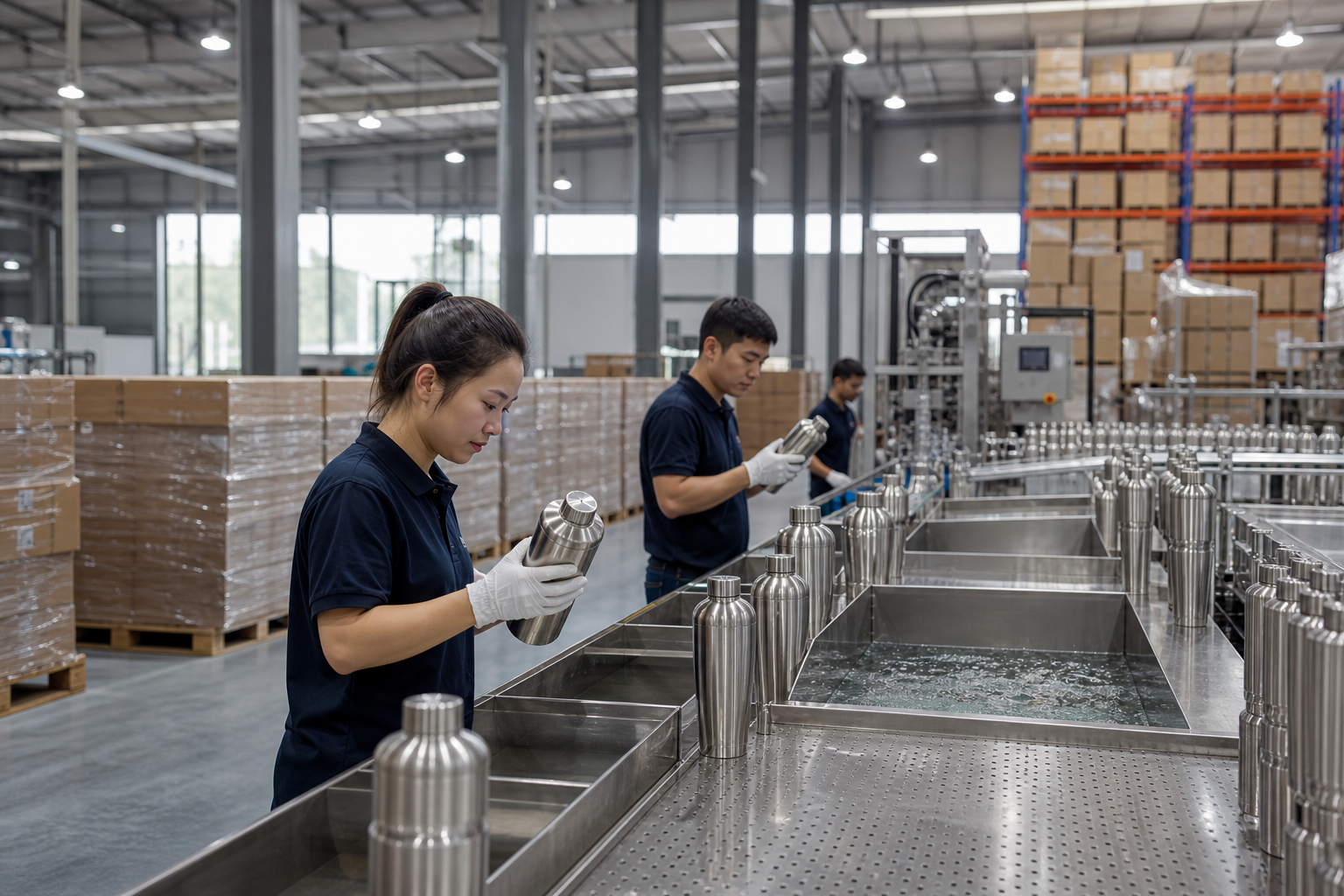
A directory should help you tell a canteen vendor from a canteen factory. A gate photo proves nothing. You need to see whether the plant controls molding, polishing, welding, coating, assembly, and packing. In Zhejiang, a real canteen manufacturer will usually have separate lines for metal forming, vacuum sealing, printing, and final inspection. If they say they make a customized growler but send out vacuum welding, they are not a full-service source. We run into that all the time.
Use this screening sequence:
- Ask for a live video of the production line with a date stamp.
- Request capacity by model, not just total monthly output.
- Check whether the supplier owns molds or only uses shared tooling.
- Confirm sample lead time: 7 days is good, 14 days is acceptable, 21 days usually means delay.
- Request a recent inspection report with AQL levels and defect categories.
For distributor canteen programs, consistency beats one perfect sample. You want the second and third shipment to match the first. QC pulled the sample on our line with a 0.2 mm thread gauge, and that is where weak factories start slipping. A stronger canteen supplier keeps QC, color, thread fit, and box counts stable. If the factory cannot explain how it holds thread tolerance, seal compression, and print alignment, keep moving. The math does not work.
One more blunt point: if the supplier is in China but cannot quote FOB from Ningbo or Shanghai without stalling, you are probably talking to a trader far from the line. We once saw a PO with “Shanghi” typed in the port field, and the buyer flagged it before we even booked space. A direct source in Zhejiang talks in production slots and carton counts, not marketing copy. That is the real test.
Building a directory that helps you buy
The best blender bottle supplier directory is not a static list; it is a working file. Each listing should let you compare canteen suppliers, canteen distributors, and custom drinkware partners by the numbers that hit your margin and your complaint rate. We build columns for material, MOQ, lead time, certification, decoration method, and packaging level. On the line, that is the difference between a clean PO and a mess.
If you sell across channels, split the directory by use case. A canteen promotional supplier may fit a 2,000-unit event run but miss retail carton rules. A custom canteen vendor may handle corporate gift orders but stumble on repeat carton packing for distributor drinkware. A distributor growler source may have strong packaging and weak sample control. Sort by fit, not by how polished the website looks. We’ve seen that go sideways fast.
A simple buyer scorecard works well:
- Factory authenticity: 20%
- Compliance documents: 20%
- MOQ and re-order flexibility: 15%
- Quality consistency: 25%
- Communication and export service: 20%
Once you score suppliers this way, the fake bargains drop out fast. The best canteen manufacturers in China are often not the loudest. They quote a custom drinkware program in plain terms, commit to 30-day delivery, and show export records to Europe and North America without a stack of corrections. QC pulled the sample, checked the cap torque at 12 N·cm, and the weak vendor was easy to spot. That is what a useful directory should surface, especially if you source from Zhejiang or wider China and need a partner that can move from test order to distributor program without changing the spec halfway through.
Source custom drinkware with real factory data
Send your target MOQ, logo method, and market. We will quote from Zhejiang with clear lead time, compliance options, and factory-level pricing.
Frequently asked questions
What should a blender bottle supplier directory include before I contact a factory?
It should include MOQ, unit price at 1,000 and 5,000 pcs, sample lead time, production lead time, factory location, and compliance documents. For export buyers, I also want packaging details, carton size, and whether the supplier can provide REACH, LFGB, or FDA-related test reports. A directory that lists only product photos and a WhatsApp number is not enough. For a real canteen supplier in Zhejiang or elsewhere in China, ask for monthly capacity too; 300,000 units/month tells you more than a slogan ever will.
What is a normal MOQ for custom drinkware?
For stocked shaker molds or a simple canteen custom order, MOQ often starts at 500–1,000 pcs per color or per logo. For new tooling or a fully customized canteen, 3,000 pcs is common, and some canteen manufacturers will ask for 5,000 pcs if you want multiple decorations or special packaging. If a supplier offers 100 pcs with full customization, check whether they are using shared stock and printing only. That may work for samples, but it is rarely a real commercial program.
How long does sampling and production usually take in China?
A normal sample cycle is 7–14 days, depending on mold availability, print method, and whether you need color matching. Bulk production after sample approval usually takes 25–40 days. If you need a canteen promotional order with simple print and stock packaging, 20–25 days is possible. If you add new tooling, matte coating, or special retail boxes, expect the schedule to move. A reliable canteen factory in Zhejiang will tell you the timeline upfront instead of promising 10 days and missing the vessel.
Which certifications matter for Europe and North America?
For Europe, REACH and LFGB are the most common asks on custom drinkware and food-contact parts. For the US, buyers often request FDA-related food-contact declarations and sometimes Proposition 65 screening depending on the market. If your item is going into retail or Amazon FBA, you may also need carton drop testing, barcode labeling, and FNSKU application. A good canteen manufacturer should be able to provide component-level documents, not only a general certificate PDF.
How do I tell a real factory from a trading company in the directory?
Ask for a live factory video, the production process list, and capacity by product type. A real canteen factory can show molding, assembly, QC, and packing on site, and it can speak clearly about tooling ownership and lead time. A trading company usually knows product names and prices, but not line balance, AQL standards, or defect causes. Also ask for the export port, usually Ningbo or Shanghai for suppliers in Zhejiang. If the answers stay vague, treat it as a warning.