Key Takeaways
- A serious blender bottle supplier in China should quote MOQ, lead time, and unit price together, not separately; typical production starts at 500-1,000 pcs.
- For export markets, ask for REACH, LFGB, or FDA-aligned material data, plus AQL 2.5 final inspection and carton drop-test results.
- Custom logo methods change durability and cost by 8-25%; laser engraving usually outlasts silkscreen on stainless bottles.
- A factory in Zhejiang with 300,000 units/month can still miss your schedule if tooling approval, packaging, and label data are not locked early.
If you are sourcing from a blender bottle supplier, the hard part is not finding a factory in China. The hard part is telling a real canteen factory from a trading desk that quotes in 12 hours and ships in 18 days late. For Europe and North America, the details matter: 18/8 stainless, Tritan, BPA-free PP, AQL 2.5 inspections, REACH paperwork, and whether the line can hit your replenishment window without excuses.
At BottleForge in Hangzhou, Zhejiang, we see the same mistakes every season. QC pulled the sample, the logo rubbed off after 50 dishwasher cycles, or the buyer sent a PO with MOQ 300 when their forecast was 3,000. That math does not work. A good blender bottle supplier should give you clear pricing, a lead time the line can hold, and test reports that match the carton mark. If you are buying for distribution, retail, or a promo run, you need more than a pretty rendering.
What a real supplier can prove
When you check a blender bottle supplier, start with proof, not sales talk. A real canteen supplier should tell you the bottle body material, lid material, and test results on the spot. For stainless steel drinkware, we run 18/8 or 304 stainless for the inner wall, usually 0.4-0.6 mm thickness depending on the design, with a food-grade PP or Tritan lid. If the seller needs two days to answer that, the line is not ready, and you are talking to a trader, not a factory.
Export buyers in Europe and North America should ask for the compliance pack before they place a PO. That means REACH declaration, LFGB where needed, and migration reports for stricter retail channels. On our side in Zhejiang, QC pulled the sample, then checked incoming material, in-line inspection, and final AQL sampling. We run AQL 2.5 for critical defects and keep photo records for carton sealing, label placement, and drop damage. One buyer once flagged a lid typo on the carton artwork, and that small mistake would have turned into a chargeback if we had missed it.
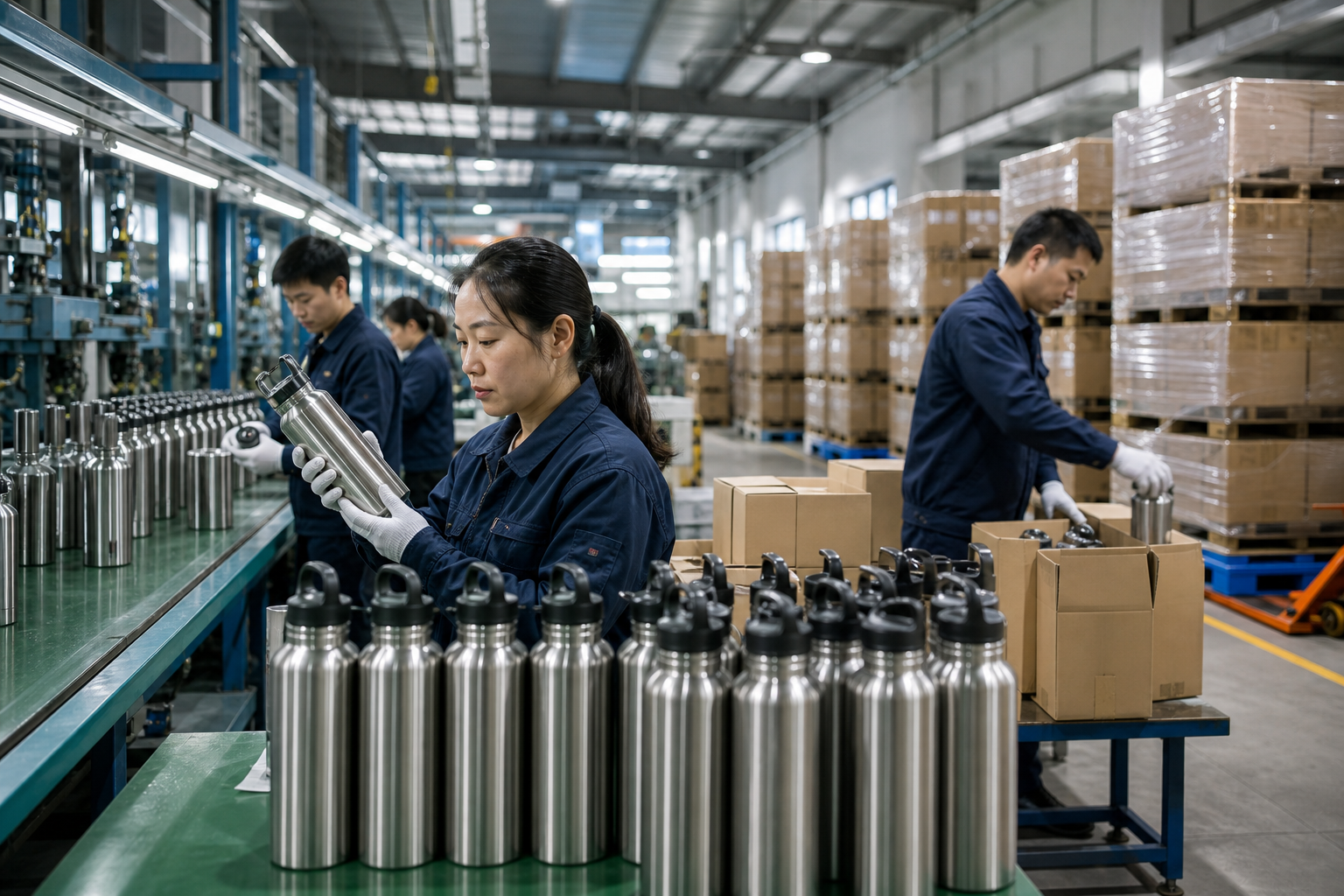
Capacity is the next check. A factory shipping 300,000 units per month only helps if your mix fits the setup. A 500 ml shaker bottle, a custom canteen, and a custom growler do not share the same tooling or packing rhythm, even if the web photos look close. Ask whether the factory has separate tooling, assembly stations, and packing lines for customized drinkware. We have seen this go sideways when a buyer tried to push three SKUs through one line, and the math did not work. Separate lines save 3 days on rework, sometimes 5, and they cut excuses fast.
MOQ and pricing that make sense
Buyers lose time chasing the lowest unit price before they define the job. A blender bottle supplier can quote USD 1.35, USD 2.10, or USD 3.80 for what looks like the same bottle, and the gap usually comes from mold condition, coating, lid complexity, and packaging. We had one PO with “matte grey” typed twice and a “40oz” note on a 500ml shaker. The buyer flagged it on day one. If you want a canteen custom project with a color-matched lid, silicone sleeve, and printed retail carton, the landed cost moves fast. That is normal.
For a plain shaker-style bottle, 500 to 1,000 pcs per SKU is a workable MOQ. For a customized canteen with new tooling or a special lid, 3,000 pcs makes the math work if you want sane pricing. If you are a canteen distributor or distributor drinkware importer, split into 2 or 4 colorways only after you confirm the MOQ per color. We run into this all the time: a buyer asks for six colors, then wonders why each one carries a premium. One extra color can add a full carton of dead stock if the sell-through is slow.
Ask for three layers of quote: ex-works, FOB China, and landed rough math to your port. A proper canteen supplier in Zhejiang should show tooling if applicable, decoration cost, packing cost, and carton configuration. On our line, laser engraving usually adds USD 0.15-0.35 per piece, while full-color wrap printing can add USD 0.20-0.50 depending on coverage. QC pulled the sample at 0.3 mm print shift once, and we corrected the sleeve file before mass production. If your program needs a canteen promotional price point, set the retail or giveaway target first, then build the bottle backward. That is how custom drinkware margins stay alive in Europe and North America.
Materials and performance details
Material decides whether a carton turns into a reorder or a complaint sheet. For this line, we usually separate stainless steel, Tritan, and polypropylene. A blender bottle supplier should tell you how each one handles hot wash, cold storage, and 1.2 m drop tests. For a custom growler, we run thicker stainless and a tighter lid spec than a basic canteen customizable program. For a lightweight promotional shaker, Tritan is the cleaner choice if the buyer wants clarity and lower weight.
Wall thickness is where the argument starts. A 0.4 mm stainless wall works for budget drinkware, but it dents fast on the line and in transit. At 0.5-0.6 mm, you get better rigidity, better finish retention, and fewer returns from distributor growler accounts that stack pallets hard. We had one buyer flag a 0.4 mm sample after QC pulled it with a caliper at 0.38 mm on one side. If your client wants a customized growler for craft beverage retail, ask for vacuum insulation performance, if applicable, and condensate control after 6 and 12 hours. A bottle that sweats in a warehouse is a claim waiting to happen.
For canteen custom and custom canteen projects, lids fail first. Silicone gaskets, spring hinges, and flip spouts need cycle testing, not guesswork. We normally ask for 5,000 open-close cycles on critical parts before launch, and we have seen the math work out that way. A canteen manufacturer with cycle data has fixtures, jigs, and an engineer on the job, not just a logo file. A matte powder coat can look sharp, but if the coating chips at 30 to 50 rubs in a basic abrasion test, the retail shelf will show it in a week. We once found a PO typo on the lid color code, and that small mistake would have sent 3,000 units to the wrong market.
Logo methods and decoration choices
Decoration is where a lot of custom drinkware jobs go sideways. Buyers sign off on a mockup, then ask how the mark is actually applied. A blender bottle supplier should tell you straight whether the logo is silkscreen, laser engraving, heat transfer, UV print, or pad print. Each method changes unit price, color match, wear life, and line speed. For a canteen promotional item going to trade shows or sports events, silkscreen is usually enough. For retail shelves, laser engraving or UV print looks cleaner on stainless.
For stainless bottles, laser engraving is the toughest option. It will not peel, and the finish stays steady after repeated washing. Silkscreen costs less, but on a curved body we need tighter fixture control, and the print can wear after hard use. On our line, screen setup usually runs USD 20-60 per color, and complex artwork costs more. We had one buyer flag a 0.18 mm line on the PO; it disappeared on the sample, so the math did not work. If your client wants a canteen customized with a multi-color logo, lock down Pantone refs and proof tolerance before tooling starts.
Packaging is part of decoration too. A canteen suppliers team that knows retail will ask about barcode placement, hangtags, and FNSKU labels if you ship to Amazon or similar channels. For distributor drinkware programs, the carton mark and outer label often matter as much as the bottle print. That is especially true for distributor canteen and distributor growler orders, because the warehouse needs fast ID. We run a 12 mm print window on some cartons, and QC pulled the sample when the code sat too close to the edge. A strong canteen factory in Zhejiang will confirm print area, logo bleed, and carton count the same day, not after a week of silence.
Lead time and export logistics
Lead time is where a clean quote turns into a mess, so get it in writing. For a standard blender bottle supplier in China, sample lead time is usually 5-10 days if the design uses existing molds and normal decoration. Mass production runs 25-35 days after sample approval and deposit. New tooling adds 15-25 days, depending on mold complexity. We had one buyer flag a typo on the PO, and that cost two days before the line could start. Packaging approval also eats time, and Europe and North America buyers often miss that.
Shipping terms matter too. FOB China is the most common for B2B drinkware, but if you are new to sourcing from China, ask the canteen factory to quote cartons per pallet, pallet height, and CBM per 1,000 units. A distributor canteen order can look cheap at the unit level and turn expensive once freight is added. We ship one program at 180 pcs per carton, and it saved handling compared with a bulk-packed custom drinkware run that needed repacking in the buyer's warehouse. The math doesn't work if you skip the carton plan.
If you sell into Amazon, retail chains, or specialty beverage channels, ask about barcode rules, master carton labels, and test-fit on FNSKU placement. A supplier that already works with distributor growler and customized drinkware programs should know this. In Zhejiang, the better factories keep export packing teams on the floor with inner trays, master cartons, and moisture barrier bags ready for ocean freight. QC pulled the sample last week and checked a 12 mm label gap before release. That matters when your order is crossing from China to a U.S. or EU port in humid season.
How to choose your factory partner
The best blender bottle supplier is not the one with the loudest marketing. It is the one that can answer commercial and engineering questions in the same call. You want a canteen manufacturer that knows decoration, a canteen distributor team that understands order flow, and a canteen factory with the capacity to keep the line moving. Ask for three things: sample photos from real export orders, a production timeline with milestones, and a compliance folder you can send to your retailer. If they cannot show those, walk away.
We tell buyers to compare at least three suppliers on the same brief. Put the same material spec, logo file, packing requirement, and target ship date in front of each one. Then judge responsiveness, clarity, and risk control. A canteen suppliers quote that says “high quality” and “fast delivery” is hiding gaps. A stronger canteen vendor will say, “Sample in 7 days, bulk in 30 days, MOQ 1,000 pcs, AQL 2.5, FOB Ningbo or Shanghai.” That is factory language. Last month, QC pulled the sample and found a 1.2 mm print offset on the tumbler neck; that is the kind of issue a serious supplier catches before shipment.
At BottleForge in Hangzhou, Zhejiang, we run export drinkware around repeatability, not heroics. Clear BOMs, approved color chips, and batch traceability keep the job on track. If you are buying customized canteen, customized growler, or other customizable drinkware for a distributor program, the partner you want is the one who can hold the line when your retail team changes the artwork at the last minute. We have seen buyers push a PO with “blu” instead of “blue”; the math does not work when the carton label is wrong. The cheapest quote is rarely the cheapest outcome.
Get a factory quote built for your market
Send your artwork, target price, and ship date. We will quote MOQ, lead time, decoration, and packing with no guesswork.
Frequently asked questions
What is the usual MOQ for a blender bottle supplier?
For a standard shaker-style bottle, MOQ is often 500 to 1,000 pcs per SKU. If you want a new mold, special lid, or full custom packaging, 3,000 pcs is more realistic. For canteen promotional orders, some factories in China may accept 300 pcs, but the unit price usually rises by 15-30%. Always confirm MOQ by color and by logo method, because silkscreen, laser engraving, and full-wrap print can each have different minimums.
How do I know if a canteen factory is export-ready?
Ask for REACH, LFGB, or FDA-aligned material documents, plus recent AQL inspection records and packing photos. A real export-ready canteen factory in Zhejiang should also show carton test data, barcode samples, and lead times in writing. If they export to Europe and North America regularly, they will know how to handle master carton labels, pallet counts, and FNSKU placement without guessing.
What logo method should I choose for custom drinkware?
For stainless bottles, laser engraving is usually the most durable. Silkscreen is cheaper and works well for simple logos, but it can wear faster. UV print gives better color coverage for complex artwork, though it may raise the cost by USD 0.20-0.60 per piece depending on coverage. If your buyer cares about retail presentation, ask for physical samples before approving a customized drinkware order.
Can I source a custom canteen and custom growler in one program?
Yes, but only if the factory has separate product lines or experienced setup for both. A custom canteen and a custom growler often use different lids, different thicknesses, and different packaging. That can affect the MOQ and the delivery schedule. A Zhejiang factory with 300,000 units per month may still need separate tooling approval, so build in 15-25 extra days for new molds or lid development.
What shipping terms should I ask for when buying from China?
FOB China is the most common and easiest to compare across suppliers. Ask the canteen supplier to quote ex-works and FOB at minimum, then give you carton dimensions, units per carton, and pallet height. If you are a distributor canteen buyer, ask for CBM per 1,000 units so you can estimate ocean freight before confirming the PO. That prevents nasty surprises when you land the goods in Europe or North America.