Key Takeaways
- Most blender bottle suppliers should quote MOQ at 500-1,000 pcs, not “flexible” without numbers.
- For B2B custom drinkware, expect FOB China pricing around USD 1.20-3.80 per unit depending on material, print, and lid.
- A usable factory lead time is 25-35 days after sample approval; anything much shorter needs scrutiny.
- Ask for REACH, LFGB, FDA, or food-contact declarations, plus AQL 2.5 inspection terms.
If you are looking for blender bottle suppliers, you are usually solving three problems at once: unit price, color and logo consistency, and shipment risk. The bottle has to mix clean, survive a carton drop, and pass the buyer’s compliance file. For Europe and North America, looks do not close the order. Ask for wall thickness in mm, gasket material, drop test results, and print rub resistance after dishwasher cycles. We had one buyer flag a 0.8 mm wall as too thin before samples even left the line.
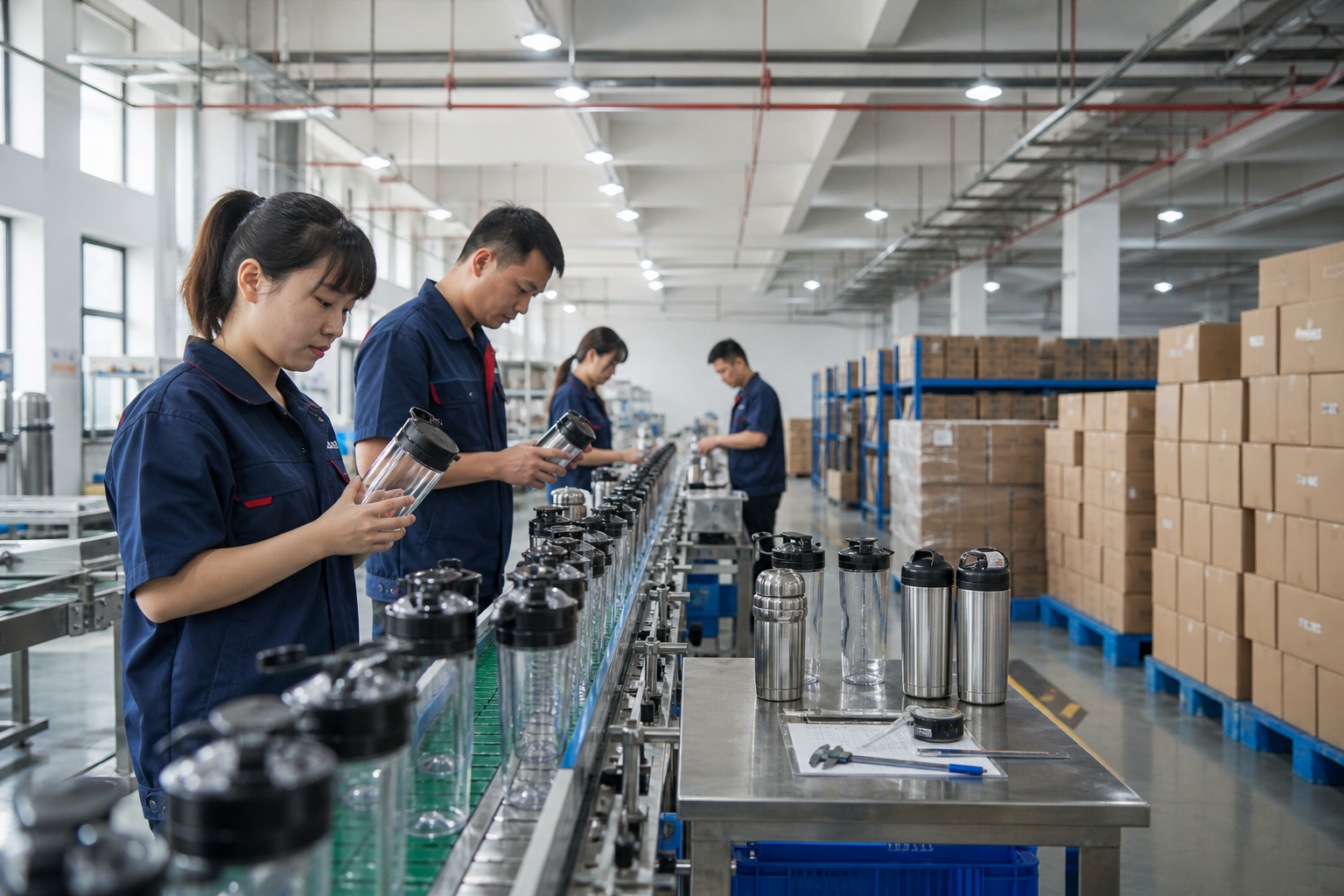
That is where a lot of first-time buyers get burned. They talk to a canteen supplier or canteen vendor that gives a low quote but cannot explain the mold cavity count, the resin grade, or the real lead time. A serious canteen manufacturer in Zhejiang should give samples in 7-10 days, mass production in 25-35 days, and a clear MOQ before you spend a week on back-and-forth. We run lines in Zhejiang, China, and the boring details are the part that saves the deal. QC pulled the sample, checked the gasket fit with a caliper, and found the lid was 0.6 mm off on one batch—small issue, big headache if you ship it.
What buyers really need to check
Do not start with catalog photos when you compare blender bottle suppliers. Start with the parts that fail on the line: body, lid, gasket, mixer ball or insert, print, and packout. We run a 12-point check on these before shipment. One weak part makes the whole bottle feel cheap.
Ask for the resin first. Tritan, PP, and AS behave differently on clarity, odor, and drop impact. For a 600-700 ml shaker, we usually see 1.8-2.2 mm wall thickness on retail jobs; under 1.5 mm, the bottle can feel hollow in hand. The buyer flagged a 1.4 mm sample last month, and the math did not work for a premium shelf price. If you are buying customized drinkware, get the spec in writing.
Check the closure next. A canteen customizable product with a weak cap seal brings complaints fast, even if the body looks good. Ask the canteen factory for torque test data, the leak test method, and whether the lid passed a 24-hour inversion test. We have seen a PO typo on the gasket code turn into a whole recheck at QC, so this is not the place to guess.
- Material: Tritan, PP, or stainless steel
- Capacity: 400 ml, 600 ml, 800 ml, or 1,000 ml
- Leak test: 24-hour inversion test
- Print durability: dishwasher and abrasion resistance
Pricing, MOQ, and real lead times
Buyers often ask for a canteen supplier price before they lock the spec. That burns time. We need the capacity, material, color, logo method, and carton standard before we quote cleanly. For blender bottle suppliers in Zhejiang, China, a simple custom drinkware item usually lands at USD 1.20-2.20 FOB for PP, USD 1.80-3.80 FOB for Tritan, and more if you add a custom lid or mixer insert.
MOQ is where canteen distributors need to look first. For stock body plus one-color logo, 500 pcs is possible at some factories, but 1,000 pcs is the safer number if you want stable color and packaging. On a new mold, tooling usually starts at USD 3,000-8,000, depending on cavity count and lid structure. We had a buyer flag a PO for 200 pcs on a fresh mold. The math does not work.
Lead time matters more than the quote. Sample time is usually 7-10 days. Mass production runs 25-35 days after sample approval and deposit. If a canteen manufacturer says 12 days for a printed custom canteen order, ask whether the line is pulling from stock or whether QC already cleared the first batch. Short answers are fine. Vague answers cost you a shipment.
Practical rule: if the supplier cannot tie the price to a measurable spec, the price will move later.
Materials that pass buyer scrutiny
For B2B drinkware, material choice is not a style call. It drives odor retention, drop performance, unit cost, and return rate. A canteen manufacturer should quote the exact grade, not just “food grade.” We had a buyer flag a PO typo once—“PP” typed where Tritan was approved—and QC pulled the sample before the line ran 5,000 pcs. For Tritan, ask for the brand name and test reports. For PP, ask about heat resistance and whether the bottle warps after 50 dishwasher cycles. For stainless steel, ask for 304 or 316, then check the inner wall gauge in mm.
If you want a custom growler or a customizable growler for breweries or outdoor retail, 304 stainless is the usual baseline. A 0.5 mm inner wall and 0.4-0.5 mm outer wall are common in value-focused production. Premium retail often goes thicker, but the math changes fast on weight and freight. One 18/8 sample we ran came back 120 g heavier than the buyer wanted, and that killed the margin. A canteen factory in Zhejiang should explain how the weld seam affects insulation and whether the powder coat cure hit the right temperature.
For canteen customizable projects, the finish matters too. Matte powder coat hides scratches better than glossy paint, but some logos print cleaner on gloss. If your buyer is a canteen distributor serving gyms, clinics, or outdoor channels, we usually keep the body color neutral and stay with one or two PMS logo colors. Over-designed drinkware tends to look cheap after the first shipment. We’ve seen that go sideways on a 3,000 pcs order, and the buyer blamed the artwork, not the spec.
When to use stainless, plastic, or glass
Plastic works for weight-sensitive promotions and high-volume campaigns. Stainless works for premium retail and temperature retention. Glass fits clean-label positioning, but it is a weak choice for a blender bottle unless the customer accepts more breakage. A good canteen supplier will say that straight. If they dodge the breakage question, that is the wrong question to ignore. On our line, we test a 1 m drop on concrete before release, and the cracked samples tell the truth fast.
Printing and branding that last
Logo work is where a lot of canteen vendors oversell and underdeliver. We’ve had a buyer send a clean one-color logo, then the first sample came back fuzzy at the edge. QC pulled the sample, checked the 200 mesh screen, and the problem was setup, not artwork. For simple branding on a custom drinkware order, silkscreen still gives the lowest print cost. Laser engraving works better on stainless and gives a permanent mark, but it is a poor fit if you need color branding.
If you want a canteen promotional order for events or retail campaigns, check the logo area before you approve artwork. A 35 mm by 35 mm mark on a curved body is easier to keep sharp than a full-wrap design. We had a buyer push for a wrap print on a 500 ml bottle once, and the seam ate the last 4 mm of the logo. For a customized canteen, ask whether the artwork is printed before or after assembly. That changes alignment around the lid and the seam.
Buyers often forget packaging. A distributor drinkware order that ships in plain bulk cartons may be fine for wholesale, but retail customers usually want a color box, barcode, and sometimes an FNSKU label if the goods go to Amazon. Your canteen distributor or canteen suppliers should confirm whether cartons pass a 60 cm drop test and whether inner packs use dividers. We’ve seen one cracked lid turn a good carton into a loss. The math doesn’t work.
- Silkscreen: low cost, good for 1-2 colors
- Laser engraving: durable, best for metal
- Heat transfer: better for detailed graphics
- Pad printing: useful for curved small areas
Quality control without drama
Quality control is not about making the supplier nervous. It is about stopping chargebacks before they land on your desk. A Zhejiang factory should be ready for pre-production samples, line checks, and final inspection. We run AQL 2.5 for major defects and 4.0 for minor defects on most orders, and on premium retail programs buyers often ask us to hold the line tighter with extra sorting at 100% visual check.
For blender bottle suppliers, the checks that matter are leak test, odor, lid fit, and logo adhesion. We use a torque gauge on the lid, and QC pulled the sample if the cap missed the seal by even 1 mm. If you are buying customized drinkware for Europe, ask for REACH-compliant materials and a food-contact declaration. If the product is stainless, request LFGB or equivalent documentation if your channel requires it. In North America, FDA food-contact expectations are common, and the factory should give written confirmation plus third-party lab reports where needed. The buyer flagged one PO typo last year because the logo file name did not match the carton mark, and that kind of mismatch turns into a delay fast.
Do not ignore carton quality. A canteen supplier may ship a clean bottle in a weak outer carton, and the math does not work when the route is LCL or the goods pass through two warehouses. Ask for a 5-layer export carton and a basic drop test. For a distributor canteen order, palletization details matter too: pallet height, stretch wrap, and whether cartons are marked with SKU and lot number. We ship faster when that data is clear, and your warehouse team does not waste half a shift relabeling cartons.
“If the supplier cannot show you a test method, the test probably was not done.”
How to choose the right factory
There is a real difference between a trading company and a canteen factory. A trading company may answer faster, but a factory gives you tighter control on mold changes, Pantone color matching, and inspection. We run both types of inquiries every week in Zhejiang. If you are building a custom canteen or a customized growler, go direct to the factory when the specs are not simple.
Look for evidence, not promises. A real plant should show monthly output, mold rooms, print lines, and QC headcount. One hard number works better than a sales pitch: 300,000 units per month across multiple drinkware lines, with 3-5 export carton checks per batch and 100% leak testing on critical lid assemblies. QC pulled the sample, and the lid failed on the second press test at 120 mmHg. If the supplier cannot state output or sample lead time, the math does not work.
For canteen manufacturers serving distributors, the best partners will tell you what they do not do well. Some handle custom drinkware and sports bottles cleanly, but pass on glass. Some can make a custom growler, but struggle with double-wall vacuum shapes when the logo area is tight. We have seen that go sideways on a 2 mm logo band. You do not need a factory that says yes to everything; you need one that ships the same standard on every run.
If you are building a channel with canteen distributors, ask for repeat-order consistency. A sample that looks good once is easy. A product that matches on the third and fourth run is what matters, and that is the question buyers often skip. We once found a PO typo on the lid code, and the line caught it before packing. That kind of check tells you more than a polished brochure.
Send your spec and get a factory quote
Share capacity, material, logo, and market. We’ll price it clearly from Zhejiang, China, with MOQ, lead time, and compliance details upfront.
Frequently asked questions
What MOQ should I expect from blender bottle suppliers?
For standard custom drinkware, a realistic MOQ is 500-1,000 pcs per color or print setup. If you want a new mold for a custom canteen, plan for 3,000-8,000 pcs tooling economics, even if the factory accepts a smaller trial order. In Zhejiang, China, many factories can do 500 pcs for stock shapes with one-color branding, but the price per unit usually rises if you go below 1,000 pcs. If a supplier quotes 200 pcs on a complex customized canteen, ask how they will hold quality and color consistency.
What is a fair FOB price for a custom shaker bottle?
For a simple PP shaker, USD 1.20-2.20 FOB China is normal. For Tritan, expect USD 1.80-3.80 FOB depending on capacity, lid complexity, and logo method. Add USD 0.10-0.40 for special packaging or barcode labels. A custom growler in stainless steel usually costs more because of material and welding. The key is to compare apples to apples: same volume, same print, same carton spec, same test requirements. A canteen supplier that leaves those details out is not giving you a real quote.
How long does production take in China?
For a sample, 7-10 days is typical if the mold already exists. For mass production, 25-35 days after sample approval and deposit is a normal lead time for a canteen manufacturer in Zhejiang. If you need a customized growler with a new mold or special coating, add 10-20 days for tooling and validation. Shipping time to Europe or North America is separate: sea freight is often 18-35 days depending on destination, while air freight can be 5-10 days but costs much more.
Which compliance documents should I ask for?
At minimum, request food-contact declarations and material test reports. For Europe, ask about REACH and, where relevant, LFGB testing. For North America, ask for FDA food-contact compliance support. If you are buying from canteen suppliers for a retail channel, also request AQL inspection terms, carton drop-test evidence, and a signed spec sheet that matches the approved sample. For Amazon or similar channels, make sure packaging can carry FNSKU labels cleanly without covering safety marks or barcodes.
Can I customize color and logo on the same order?
Yes, but every change affects MOQ and lead time. A one-color body plus one-color logo is the easiest custom canteen or custom drinkware project. Add a Pantone-matched body color, multiple logo colors, or a special finish, and you should expect a higher MOQ, usually 1,000 pcs or more. Canteen customizable projects with mixed SKUs are possible, but the factory will often split them by color or print process. If you want several distributor drinkware variants, ask for a production plan before you approve artwork.