Key Takeaways
- A serious blender bottle vendor should quote MOQ, lead time, and carton data on day one; our standard MOQ is 500 units and lead time is 25-35 days.
- For custom drinkware, ask for material specs: Tritan, PP, 304 stainless steel, and wall thickness, not just product photos.
- In Zhejiang and across China, the best canteen manufacturer setups offer one-stop molding, printing, and packing under BSCI and REACH control.
- If you sell as a canteen distributor or distributor drinkware buyer, get AQL 2.5 inspection terms and final packaging approval before mass production.
If you are sourcing from a blender bottle vendor, the hard part is not finding a factory in China. It is separating a real canteen factory from a trading company that talks well and misses deadlines. We have seen buyers lose 18 days on a bad sample round, then get hit with weak lids, odor complaints, print rub-off, and cartons that fail a 1.2 m drop test before the goods reach Europe or North America.
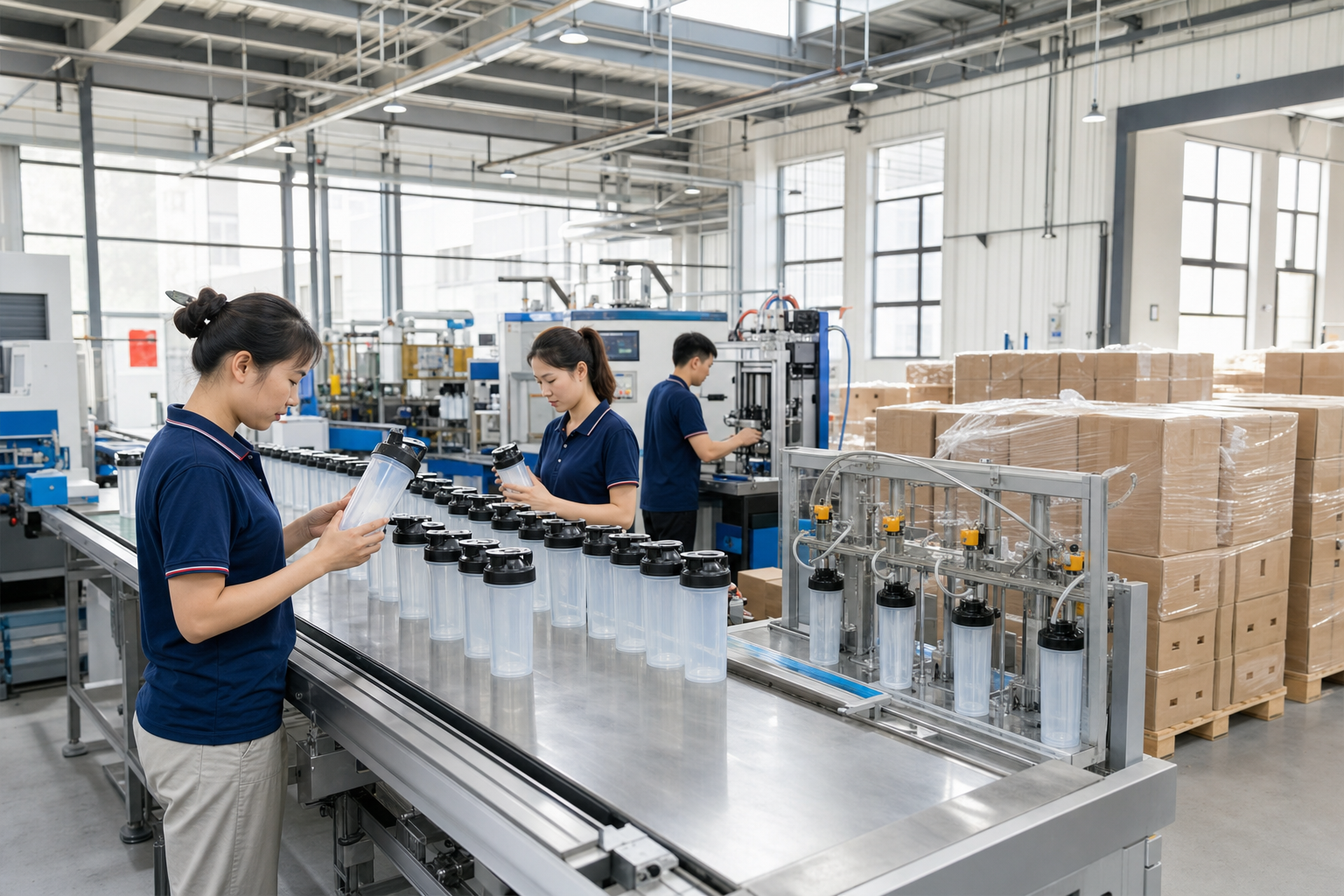
At BottleForge in Hangzhou, Zhejiang, we see the same buying pattern every week. A distributor wants 3,000 to 10,000 units, a brand owner wants one mold with three lid colors, and a retailer needs a custom drinkware line that clears REACH, food-contact checks, and Amazon prep. QC pulled the sample on the line last week because the lid torque was off by 0.3 N·m. The vendor has to handle materials, decoration, testing, and packing with no excuses.
What a blender bottle vendor must prove
A blender bottle vendor is not just a seller with a catalog. You need proof the factory can hold the same fit on every run, from the lid thread to the gasket seat and the print location. If the supplier cannot show a finished sample with the actual lid and gasket, you are buying a promise, not a product. We’ve seen this go sideways on a 5 mm print shift.
Start with factory facts. A real canteen supplier should tell you monthly output, mold ownership, and whether the line is in-house or outsourced. At BottleForge, our Zhejiang plant runs about 600,000 units per month across bottle and tumbler lines, and that number matters when your launch window is fixed. Ask for ISO 9001, BSCI, and food-contact compliance files. If they export to the EU or North America, they should also know REACH, FDA food-contact expectations, and carton labeling rules. QC pulled a sample last week and the buyer flagged a typo on the PO carton mark; that kind of miss costs time.
For custom canteen or customized drinkware programs, the vendor should also confirm:
- material grade and wall thickness
- lid leak test method
- drop-test standard
- print method and rub resistance
- replacement parts policy
Materials that actually matter
Buyers usually start with shape. Wrong move. For a custom canteen, material decides taste retention, drop resistance, carton loss, and return rate. We have seen a 2 m drop test crack the cap, not the body. If you want a customizable canteen that stays in the program, pick the material for the use case, not the trend.
For shaker-style bottles and blender-type items, the common options are PP, Tritan, and AS. PP is low cost and stable, but it is not the premium pick. Tritan gives better clarity and odor resistance, and a lot of North American brand owners ask for it because the shelf look is cleaner. We run these on the line with a 0.8 mm gate mark check, and the buyer flagged one batch because the lid print looked foggy. For stainless lines, 304 stainless steel is the baseline; if a canteen manufacturer quotes 201 for a premium market without clear disclosure, push back. For insulated models, ask for 18/8 stainless, vacuum level, and outer wall gauge.
Put numbers in the RFQ. Ask for 0.6 mm or 0.7 mm wall thickness on plastic bodies, 0.4 mm to 0.5 mm stainless inner walls for most travel formats, and silicone gaskets tested for at least 3,000 open-close cycles. That is not paperwork for fun. QC pulled the sample, and a 2,500-cycle gasket started sticking on the 2,301st round. The math does not work if the buyer wants a low MOQ and a premium feel at the same time.
MOQ, pricing, and lead time realities
Bad pricing starts with a vague brief. A blender bottle vendor needs material, decoration, lid style, carton pack, and test level before the quote means anything. For canteen customizable printing with a single-color logo, a basic PP shaker usually lands around USD 0.85 to 1.40 FOB China at 5,000 units. A Tritan cup with upgraded lid hardware moves to USD 1.60 to 2.80. Stainless insulated units sit higher, often USD 3.50 to 7.50, and the 0.3 mm lid gasket spec can swing the number more than buyers expect.
We run MOQ at 500 units for stock-based customization and 1,000 to 3,000 units when the buyer wants a new color or tooling change. Lead time is 25 to 35 days after sample approval and deposit. We had one buyer flag a PO that said “1,000 pcs assorted” with no color split, and the line had to stop while we waited for the correction. If your canteen distributor calendar is tight, add 7 to 10 days for ocean freight to Europe when the port is moving well; for North America, plan 12 to 18 days depending on booking and vessel space. The cheap quote that skips palletizing, test reports, and export cartons is not cheap. It is incomplete.
Good sourcing uses total landed cost, not unit price alone. A canteen supplier that saves you USD 0.12 and gives you one chargeback is not a supplier you keep.
Decoration that survives distribution
Your logo is inventory risk. We see this every week on the line. A print that looks sharp at the sample stage can scuff off after 12 days in carton transit, and then the buyer flags it before the first shipment clears. For retail, e-commerce, or canteen promotional stock, the mark has to survive rubbing, washing, and carton movement. Pick the process for the surface, not for the artwork mockup.
Silkscreen fits 1 to 3 solid colors on flat bodies or bottles with a gentle curve. Laser engraving gives a permanent mark on stainless steel, but it is a poor fit for every customized growler or coated bottle, so we do not force it. UV print gives more detail, and QC pulled the sample for a tape pull and 24-hour alcohol rub test before we signed off. If you are buying a canteen customized for corporate gifts, ask for those two results before mass production starts. That is the right question to ask.
Packaging carries its own risk. Individual polybags, molded pulp inserts, and a tight inner box cut damage from 3% to below 0.5% if the factory runs the packing line with discipline. We have seen this go sideways when a PO typo changed the inner box size by 5 mm. A Zhejiang export factory should show you drop-test results at 1.0 meter and confirm the master carton passed 5 sides, 1 corner. If they cannot show that, the math does not work.
Compliance for Europe and North America
Compliance is where a lot of canteen suppliers get sloppy. We do not. If your shipment is going to Germany, France, Canada, or the United States, your blender bottle vendor needs the paperwork lined up before the line starts running.
Ask for the material declaration, REACH status, and factory audit documents. For North America, get food-contact statements and, when the buyer asks for it, third-party testing tied to FDA expectations. Retail programs often want ASTM-style drop testing or an in-house equivalent. We have seen buyers reject a PO over a missing test date on page 2, and that is the right call. If the product is sold as a custom canteen or customizable drinkware item for children or fitness use, the test plan gets tighter, not looser.
A solid canteen manufacturer in China tracks batch numbers and keeps retained samples. That matters when a distributor canteen order carries 3 SKUs, or when a canteen distributor reorders the same pack with a 1 mm artwork shift and wants the old standard back. If the vendor cannot tell you which raw material lot went into which production lot, the math does not work when a claim shows up 6 months later. QC pulled the sample, and the tray had the wrong lot sticker; that sort of miss turns into a headache fast.
How to audit a factory before you buy
You do not need to be an engineer to audit a factory. You do need a checklist and the discipline to use it. A canteen factory worth your time should answer technical questions without slipping into sales talk. If they cannot explain tooling lead time, mold steel grade, or leak test setup, keep moving. We once had a buyer flag a PO typo on the lid color code, and QC caught the mismatch before packing.
When you visit or run a video audit, inspect the production flow: injection molding, trimming, assembly, printing, QC, packing, and final pallet loading. Ask how they control rejects and how many inspectors are assigned per line. A decent canteen vendor in Zhejiang should run an in-process inspection plan and a final AQL 2.5 check for major defects. For export orders, ask whether they do 100% lid-fit testing or sample-based checking. We run a 0.2 mm gap gauge on the line; if the lid rocks, the buyer gets complaints later.
Here is a practical buyer test:
- request 3 samples with different logo positions
- ask for full carton dimensions and gross weight
- confirm spare part availability for 12 months
- verify payment terms and incoterms
When distributors should order private label
Private label makes sense when demand is already there, not when the idea is still floating around. If you are a canteen distributor, ask one hard question: can the same SKU be reordered 3 times without changing fit, color, or print quality? We have seen buyers chase a campaign, then QC pulled the sample and found the cap thread off by 0.3 mm. That is where a custom canteen program turns from a one-off into margin.
For canteen distributors serving gyms, outdoor shops, and corporate buyers, the cleanest setup is usually one bottle body, 2 lid options, and 3 print positions. That keeps the tooling bill under control and stops slow stock from piling up on the line. A custom growler program can work for craft beer and gift sets, but the math gets tight fast if the carton is bulky or the bottle is heavy. A 64 oz stainless growler ships fine by sea, yet the landed cost can jump when the buyer flags a 72 g carton insert that nobody asked for.
If you need canteen promotional stock for events, keep the unit price tight and the ship date realistic. If you need a customized growler or custom canteen for retail, spend the extra money on the closure and the pack-out. The market will forgive a plain look. It will not forgive leaks, odor, or a lid that fails after 1 week. We had one PO with a typo on the carton spec, and the buyer pushed back hard because the sample box did not match. That rule holds whether you buy from a canteen vendor in Zhejiang or anywhere else in China.
Source your next blender bottle line with confidence
Send your spec, target price, and pack plan. We’ll quote the right custom drinkware option, not a vague sample.
Frequently asked questions
What MOQ should I expect from a blender bottle vendor?
For a serious blender bottle vendor in China, expect 500 units for stock-based customization and 1,000 to 3,000 units if you need color matching or new tooling changes. For a new mold, some canteen manufacturers will ask for 5,000 units or a mold fee. The real question is not only MOQ but whether they can support repeat orders. In Zhejiang, a factory with stable monthly output should quote 25 to 35 days lead time after sample approval. If the supplier refuses to state MOQ in writing, treat that as a warning.
Which material is best for custom drinkware?
It depends on the use case. For budget canteen promotional items, PP is acceptable and usually the lowest-cost choice. For a better retail-ready custom drinkware line, Tritan is cleaner-looking and more impact resistant. For insulated products, 304 stainless steel is the standard baseline, and many buyers prefer 18/8 stainless for premium positioning. Ask the canteen supplier for material certificates and wall thickness; for plastic bodies, 0.6 mm to 0.7 mm is a common practical range. Do not buy by appearance alone.
How do I verify quality before mass production?
Always approve a pre-production sample and ask for written specs. A good canteen factory should provide leak-test results, logo placement approval, carton dimensions, and a packaging photo set. For export orders, ask for AQL 2.5 inspection terms and retained sample policy. If possible, request third-party testing for REACH or food-contact requirements. For a custom canteen order, even a small change in gasket size can alter leak performance, so never skip the sample stage.
Can I order a custom growler or customizable canteen for retail?
Yes, but you need to balance design with freight and shelf value. A custom growler often sells best when the capacity, closure, and finish match the market. For a customizable canteen, the best retail programs usually keep the body standard and vary the lid, color, or print. Typical FOB China pricing can range from USD 3.50 to 7.50 for stainless insulated units, depending on construction. If your canteen distributor program relies on reorders, keep the structure simple so every batch matches the first one.
What compliance documents should a canteen distributor request?
At minimum, request material declarations, REACH status, and factory audit documents such as BSCI or ISO 9001 if available. For North America, ask for food-contact statements and any third-party testing the canteen manufacturer can provide. For Europe, traceability and packaging compliance matter just as much as the product itself. A reliable canteen vendor in China should also provide batch numbers, QC records, and carton labels that match the commercial invoice. If the supplier cannot produce these on request, you risk delays at customs or retailer receiving.