Key Takeaways
- A serious canteen supplier should quote MOQ, lead time, and capacity upfront; a common factory MOQ is 3,000 units per SKU.
- For blender bottles, 304 stainless steel, PP lids, and food-contact inks are the standard baseline; 316 costs about 8% to 15% more.
- A proper QC plan should include AQL 2.5 for major defects and 4.0 for minor defects, plus leak tests on 100% of sampled units.
- Expect FOB China pricing for customized drinkware to move by USD 0.15 to 0.80 per unit depending on print, finish, and packaging.
Finding a blender bottle vendor is easy. Finding the right one is not. We see this all the time in Zhejiang: a supplier sends a clean quote, then the buyer flags a weak logo after the first 200 pcs, or the lid arrives with a rough mold line and the line stops.
For custom drinkware, the numbers decide the deal. 304 vs 316 stainless, PP vs Tritan lids, 1.0 mm or 0.8 mm wall thickness, 30-day lead time, REACH, 5,000 units or 50,000 units. That is the real test. If a factory cannot keep the same finish after QC pulled the sample on a Friday afternoon, the math does not work.
What buyers should verify first
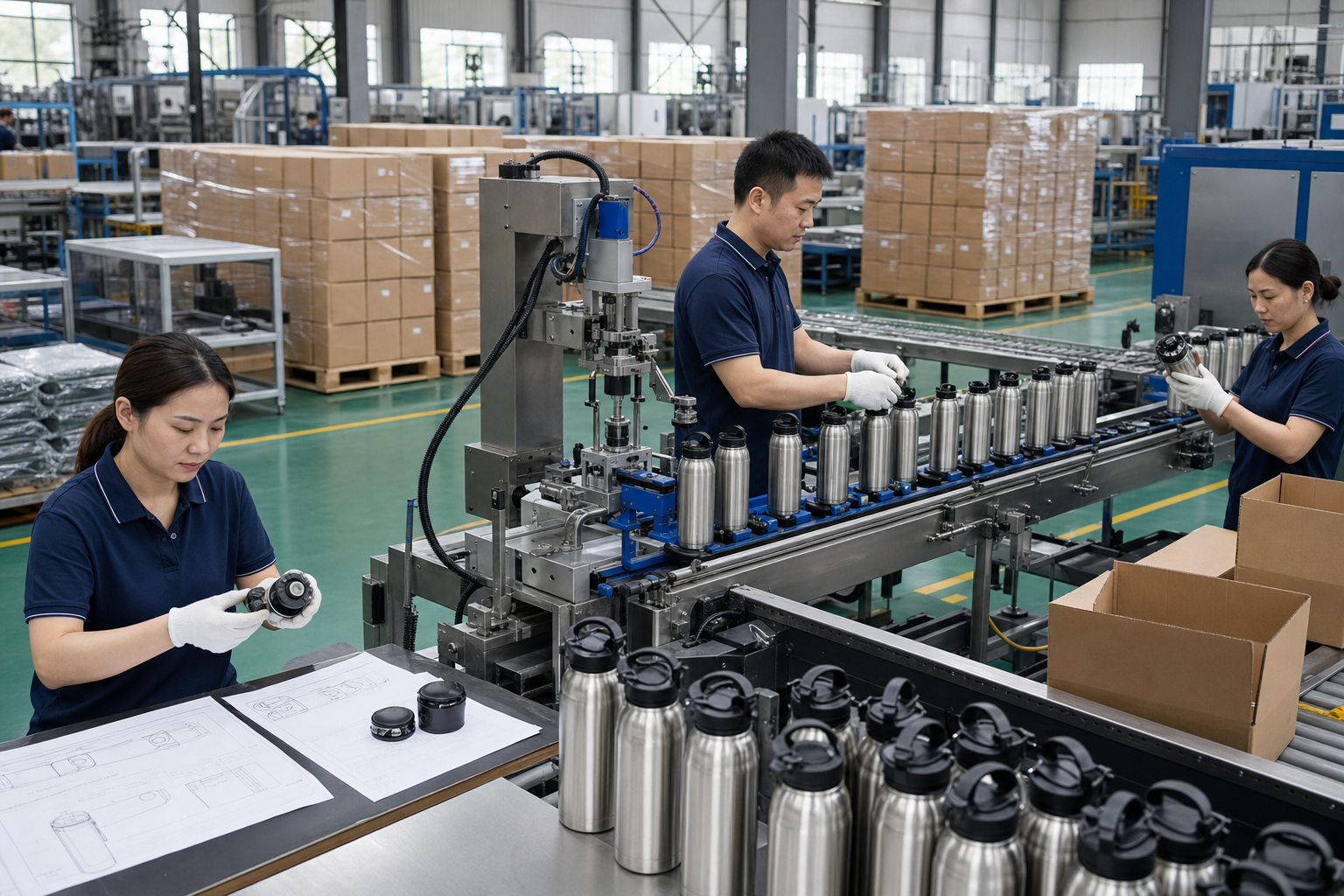
Start with the plain questions. They save cash. Ask where the plant sits, what it makes on the line, and which jobs stay in-house. Lid molding, logo print, carton packing—get each one named. A real blender bottle vendor in Zhejiang should give you monthly output, mold ownership, and the exact parts made under one roof. If the answer stays fuzzy, you’re probably talking to a trading desk, not a factory.
For a promo run or a retail SKU, we want three numbers first: MOQ, lead time, and output. On our side, a normal plant runs 100,000 to 300,000 units per month across several lines, and the 18-day sample-to-shipment clock is not the same as full production. For a straight custom order, 25 to 35 days after artwork approval and sample sign-off is fine. If someone quotes 60 days for a simple bottle, the math doesn’t work. QC pulled a sample once, found a 1.2 mm lid gap, and the buyer flagged it before packing started.
- Ask for the actual factory address in Zhejiang or elsewhere in China.
- Confirm whether they are a bottle vendor, a distributor, or the real maker.
- Request photos of molding, polishing, printing, and packing lines.
- Check if the same plant handles custom blender bottles, custom growlers, and other drinkware SKUs.
Materials that affect sales and returns
Material choice is where a lot of margin disappears later. For a blender-style shaker or custom drinkware program, the bottle body is usually stainless steel or Tritan, while the lid, gasket, and mixing parts are PP, silicone, or ABS. We run 304 stainless as the default on premium lines. It handles corrosion, keeps cost in line, and clears most North America and Europe compliance checks without drama. We only push 316 when the buyer expects harsher use, salty air, or a clear premium story. A 500 ml shaker with 304 usually sells cleaner than a fancy spec that the market does not ask for.
Wall thickness matters more than some salespeople want to admit. On metal canteen customizable products, 0.6 mm is too light if you want a premium hand feel. 0.8 mm to 1.0 mm gives better rigidity and cuts dent claims in transit. QC pulled the sample on a 0.8 mm body and the tape-mark test passed; the 0.6 mm sample came back with a visible flat spot after a simple drop from 80 cm. For insulated designs, check the vacuum level and ask for temperature-retention data, not marketing copy. A proper factory sheet should show 6-hour, 12-hour, and 24-hour tests under fixed room conditions. If a canteen distributor wants repeat orders, returns need to stay below 2% to 3%. “We usually have good feedback” is the wrong question to ask.
Practical rule: if the factory cannot tell you the steel grade, wall thickness, and gasket material in one email, do not place a container order yet.
Print methods and branding control
Branding is where a promotional bottle order looks sharp or it looks cheap. Screen printing is still the workhorse for big logos on flat or lightly curved bottle bodies. We run it on 45 mm logo spans all the time. Laser engraving gives a clean, permanent mark on 304 stainless steel, and it fits premium sets with one-color branding. Pad printing works better for smaller logos on lids or odd-shaped parts. UV print can carry more color, but QC pulled the sample for adhesion on coated metal and plastic more than once, so we test it hard before we sign off.
If you are comparing canteen customized and customized growler programs, ask for sample approval under the same decoration method used in mass production. A buyer once sent us a PO with the print method missing, then blamed us when the logo shade shifted. The math does not work if the mockup uses one ink system and the bulk order runs another. We send a pre-production sample, then check abrasion, dishwasher resistance, and alcohol wipe resistance. For export retail, the logo should pass 30 cycles of gentle wash handling and normal carton movement without lifting. We ship that way, or we do not ship it.
What to request from the vendor
- Logo size in millimeters, not just “large” or “small”.
- Pantone code or CMYK values.
- Print position drawing with tolerance of ±1.5 mm.
- Finish type: powder coat, matte paint, gloss, or bare steel.
Pricing that actually makes sense
A good buyer does not chase the lowest USD quote. Ask what moves the price, and ask why. For a basic custom drinkware bottle, FOB China pricing usually starts around USD 2.10 to 3.20 per unit for simple single-color branding at medium volume. Add powder coating, laser engraving, gift box packing, or a special lid, and you are in the USD 3.80 to 6.50 range. If you want a custom growler with thicker steel, a premium cap, and retail-ready carton packing, expect the number to climb again.
Price breaks are real. At 3,000 units, the setup cost gets spread across a smaller run. At 10,000 units, the per-unit cost drops because the line can keep moving without a tool change or fresh ink setup. That is why distributor canteen programs usually beat one-off brand tests on price. We had a buyer flag a PO once because the spec said 1-color print, but the artwork file had 2 colors; the math changed fast. Do not let the vendor bury extras. Ask if the quote includes mold charges, print setup, inner boxes, master cartons, and carton marks. A quote that looks 12% cheaper can turn out more expensive once you add packaging and testing.
For canteen distributors and distributor drinkware buyers, I would take a clean cost sheet over a heroic low number every time. We run better jobs when both sides know what each line item covers, down to the 2 mm carton gap and the MOQ on the sleeve pack. If the supplier cannot explain the pricing, that is the wrong question to avoid—it is the first one to ask.
Compliance for Europe and North America
If you sell in Europe or North America, compliance sits on the product, not in a folder. For custom canteen and customizable drinkware orders, ask for food-contact declarations, REACH files, and material traceability from the first quote. On one 50,000-piece run, we had a buyer flag a PO typo on “316” versus “304,” and that saved a bad batch before the line started. If the bottle uses stainless steel, get mill certificates for 304 or 316. If it uses plastic parts, ask for BPA-free confirmation and migration test data, not a sales promise.
For the U.S. market, buyers often ask for CPSIA paperwork on children’s lines and food-contact support that matches FDA expectations. For Europe, check REACH, LFGB when the customer wants the stricter route, and clean labeling on carton and product. If you are importing canteen customized or customized canteen goods into Amazon or retail channels, the pack also needs barcodes, country of origin, and FNSKU placement if required. We run this every week, and the math does not work if you leave relabeling to the warehouse.
Do not accept “safe for food use” as a compliance answer. Ask for PDFs, test dates, and the lab name; QC pulled a sample last month and found a missing test date on the report, which is a bad sign. A serious Zhejiang supplier can send that fast. If they cannot, they are not ready for export-scale business.
QC checks before you place the PO
QC protects your margin. Full stop. A proper canteen factory should not lean on final inspection alone. We run incoming material checks, in-process checks, and a final AQL-based inspection. For most blender-style bottle programs, AQL 2.5 for major defects and 4.0 for minor defects is a normal starting point. On one 6000-piece run, QC pulled the sample before the caps reached assembly and caught a 0.3 mm thread drift that would have turned into leak complaints. If the order is for retail gift packs or premium customized growler units, tighten the visual standard and add extra leak testing.
Ask the vendor how they test leakage. Water inversion on sampled units works, and so does closure-cycle testing on the lid. We also look at inverted pressure on the line when the buyer pushes for faster packing, because that is where weak seals show up. For insulated stainless products, ask for vacuum retention checks and dent-resistance handling during packaging. If the cartons are going into Amazon-style fulfillment or a long export lane, the supplier should document carton drop testing with the drop tester, not hand-wave it. If the vendor says “we inspect everything manually,” the math doesn't work. That is a slogan, not a QC plan.
- Check thread fit on lids across at least 30 random units; use a go/no-go gauge, not guesswork.
- Test logo adhesion after tape pull and abrasion, then check for edge lift under 10x magnification.
- Inspect carton compression for export pallets; we usually watch for crush at 200 kg stack load.
- Record defect photos and agree on rework rules before shipment, because a PO typo on carton mark or shade code will slow the whole line.
Choosing the right vendor type
Not every canteen vendor fits the same job. A canteen distributor works when you need mixed SKU buying fast or you only want 300 to 1,000 pieces, but the margin is thinner and the spec control is weaker. A canteen manufacturer or canteen factory is the better call when you need repeatable branding, tooling held to the same drawing, and lead times you can plan around. If you are building a custom drinkware line for 12 months or more, go straight to the factory unless there is a clear reason not to.
For promotional campaigns, some buyers source from canteen suppliers who also handle gifting and packaging. That works if the order is simple. The line can run a basic set in 5 days, no problem. If you need a custom canteen with a new cap mold, a custom growler with a matte spray, or a fully branded distributor growler program, you want the team that actually touches the tooling. We had a buyer flag a PO once because they wrote “black cap” but the sample tag said “black lid”; that kind of typo turns into a week of back-and-forth. In Zhejiang, the stronger factories are used to export timing and can keep a clean sample-to-mass-production trail. That matters more than a polished website.
Here is the blunt test: ask the vendor how many units they can ship in a 30-day window without subcontracting. If the answer is under 20,000 units and your forecast is 50,000, the math does not work. If they can do 100,000 plus and show you a recent 304 stainless order with QC photos, you are talking to the right source. We run this check all the time, and it saves headaches.
Get a factory quote that matches your spec
Send your target MOQ, logo file, and market destination. We will price your custom drinkware clearly, with lead time, packaging, and compliance spelled out.
Frequently asked questions
What MOQ should I expect from blender bottle vendors?
For standard custom drinkware, a realistic MOQ is 3,000 units per SKU and per logo setup. Some canteen vendors will quote 1,000 units, but the unit price often rises by 20% to 35%. If you need multiple colors, lid options, or a custom box, the MOQ may go higher because each variant adds setup time. A serious Zhejiang canteen manufacturer should tell you the MOQ, sample cost, and tooling cost in the first quote, not after three revision rounds.
Is 304 stainless steel enough for a custom canteen?
Yes, for most retail and promotional programs 304 stainless steel is the practical choice. It balances corrosion resistance, cost, and availability. For harsher use or a premium line, 316 can be better, but expect about 8% to 15% higher material cost. If the vendor cannot provide a material certificate, do not rely on verbal claims. Ask for the grade, wall thickness, and test report before you approve production.
How long should production take in China?
For a common customized canteen or blender bottle order, 25 to 35 days after sample approval is normal in China. If the order needs a new mold, special packaging, or a complicated print process, plan for 40 to 55 days. A factory in Zhejiang with stable lines can often support 100,000 to 300,000 units per month, but that does not mean your order gets priority unless the PO, artwork, and deposit are locked on time.
Which branding method is best for export sales?
For durability, laser engraving is the strongest option on stainless steel, especially for a premium custom growler or stainless canteen. Screen printing is usually cheaper and better for larger logos on simpler runs. UV print works when you need more color, but it needs adhesion testing. For export retail, ask for tape test results and abrasion checks. A logo that looks good on a mockup but fails after shipping is a waste of your margin.
What compliance documents should I ask for?
At minimum, request food-contact declarations, REACH support for Europe, and material certificates for metal and plastic parts. For North America, many buyers also want FDA-oriented food-contact support and, for kids’ lines, CPSIA-related documentation. If you are selling through Amazon or major retailers, packaging must also support barcode and FNSKU labeling. A proper canteen supplier should send these documents before production, not after the container leaves China.