Key Takeaways
- Blender bottle wholesale pricing often starts around USD 1.20 to 3.80 per unit at 3,000 pcs, depending on material and lid complexity.
- A practical MOQ for custom logo blender bottles is usually 3,000 to 5,000 pcs; small-runs cost more because setup is fixed.
- For export orders from China, expect 25 to 35 days production plus 5 to 40 days freight, depending on sea or air.
- Quality control should include AQL 2.5 inspection, leak testing, drop testing, and REACH-compliant material checks.
If you are sourcing blender bottle wholesale, you are juggling unit cost, factory capacity, and whether the bottle survives retail handling, shipping, and repeat use. That is where a lot of buyers get burned. The sample passes. The carton line fails. We have seen lids crack after a 1.2 m drop test, and a small logo shift of 2 mm can sink a whole PO. In Zhejiang and across China, the gap between a cheap quote and a reliable program is usually not the price line alone.
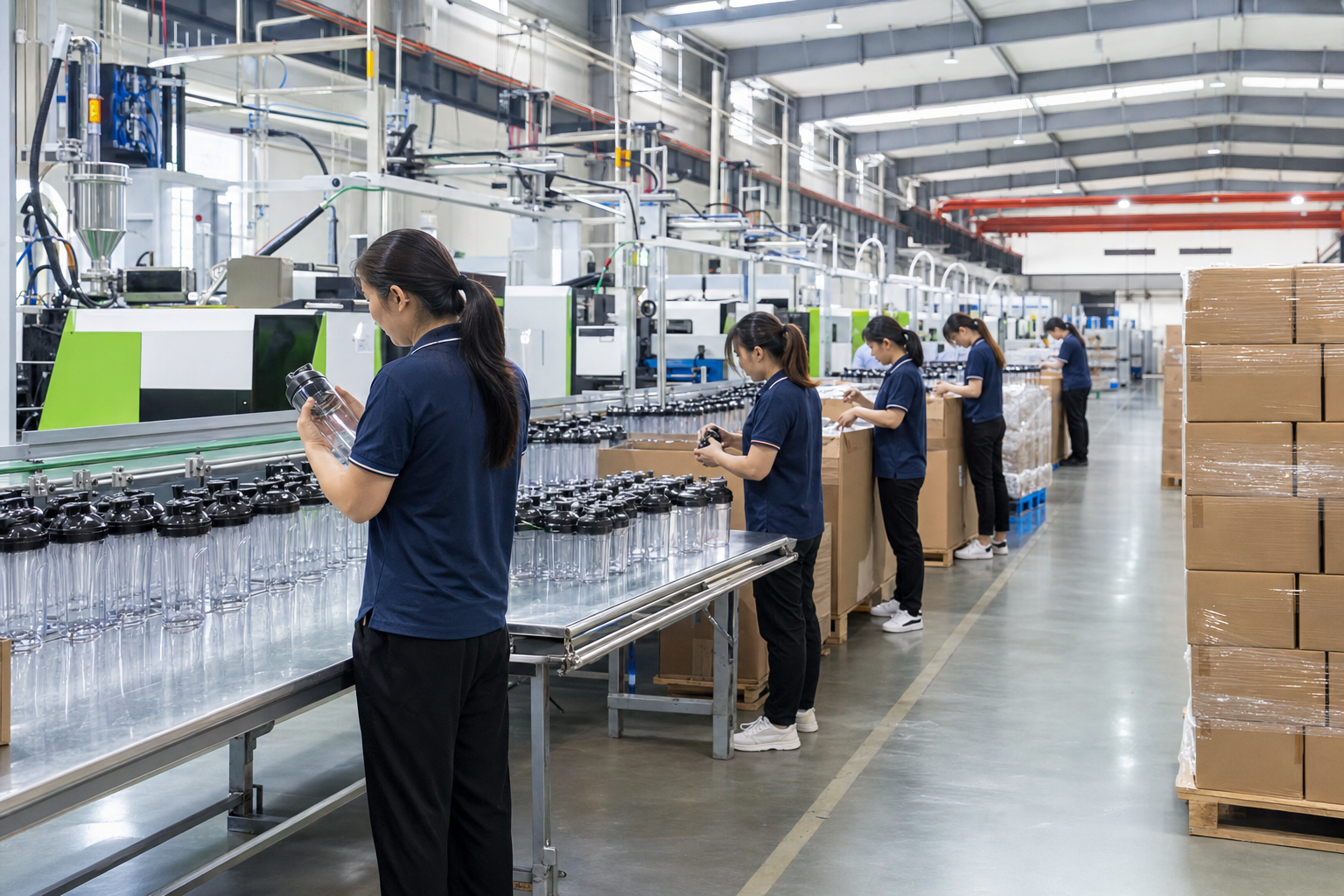
For procurement managers and brand owners, the supplier should explain resin grade, mold cavitation, lid torque, drop-test limits, and packing method without hand-waving. A serious factory in Hangzhou, Zhejiang can run 80,000 to 150,000 units per month on standard drinkware lines, with MOQ starting around 3,000 to 5,000 pcs depending on mold and decoration. QC pulled the sample, checked the seal ring with a caliper, and caught a 0.3 mm mismatch before shipment. If you need drinkware wholesale for retail, Amazon, gyms, or promotions, judge the full production system, not just the sample table.
What buyers actually need
People searching blender bottle wholesale are not asking for a bottle. They want a supply program that repeats month after month for gym retail, ecommerce, corporate gifting, or supplement brands. The bottle is only one piece. We run the line for a shaker that seals, a lid that stays flat, a body that prints clean, and cartons that arrive without crushed corners. Sounds simple. It is where a lot of bulk drinkware orders go off the rails.
Most B2B buyers start with use case, and that is the right place. A protein shaker for the US market needs a tighter closure spec than a promotional canteen wholesale order. If you are also buying bulk canteen, bulk growler, or drinkware bulk from the same factory, ask how they handle PP, Tritan, stainless steel, and glass without mixing parts on the floor. At our plant in Zhejiang, QC pulled the sample at 50 open-close cycles and checked the gasket fit with a 0.2 mm feeler gauge. That is the kind of detail that tells you whether the supplier knows the job or is just quoting numbers.
What to ask first
- What is the exact material: PP, Tritan, AS, or stainless steel?
- Is the lid injection molded in-house or outsourced?
- What is the tested leak rate after 50 open-close cycles?
- How many units per month can the factory actually ship?
If the supplier cannot answer those questions plainly, you are buying a brochure, not a production line. We have seen this go sideways on a PO with the wrong lid color and a typo in the carton count. The math does not work. Ask for the real production number, the actual mold setup, and the ship plan before you move on.
Materials and spec choices
Most blender bottle wholesale programs run on PP bodies and lids. The math is simple. PP keeps the unit price down, and it ships light in cartons. Tritan adds about 15% to 35% on the quote, but it gives better clarity and holds up better in hot washing. For premium retail, some buyers ask for a stainless base or double-wall build. For standard shaker bottles, we usually land on 28 to 32 oz PP or Tritan with a screw-on lid and flip cap. Wall thickness is where a lot of buyers get burned. At 0.6 mm to 0.8 mm, the cup can feel flimsy and warp after hot filling; QC pulled a 0.62 mm sample last month and it failed the squeeze test at the line.
If you are sourcing the best wholesale drink bottle for sports or wellness channels, put the spec sheet in writing:
- Body capacity: 20 oz, 28 oz, or 32 oz
- Plastic grade: food-grade PP or Tritan, with test reports
- Seal ring: silicone, not generic rubber
- Printing method: silk screen, pad print, or laser marking for metal parts
- Packaging: polybag, egg-crate insert, or printed color box
For canteen bulk and canteen wholesale orders, stainless wall thickness usually sits at 0.4 mm to 0.6 mm for single-wall and 0.35 mm to 0.5 mm per layer on double-wall builds, depending on your target price. We run these numbers every week because they change stamping yield, polishing time, and reject rate. A buyer once pushed a 0.38 mm single-wall spec to hit a lower FOB, then flagged dents after transit testing. The quote looked good on paper. The math did not work.
MOQ, pricing, and lead time
Blender bottle wholesale pricing comes down to mold ownership, decoration, and packing. Material weight matters, but it is not the main number. For a standard 28 oz shaker with one-color logo, we usually quote USD 1.20 to 1.80 at 5,000 pcs. Add a custom color lid, printed measurement marks, or premium packaging, and you are looking at USD 2.20 to 3.80. If you switch to a stainless model or insulated version, the price jumps fast because raw material and welding costs go up. We had one buyer push back on a USD 0.18 lid upgrade, then the cartoning spec changed and the math stopped working. What is not normal is a supplier who hides tooling, sample, or carton charges until after deposit.
Lead time from a factory in China is usually 25 to 35 days for stock-based customization, plus freight. New molds add 10 to 20 days. If you need alcohol flask bulk or alcohol flask wholesale bulk, the same rule applies: the clean price depends on whether the factory already owns the mold. If not, tooling can run USD 800 to 2,500 depending on complexity. For growler bulk and beer growler wholesale programs, stainless welding and vacuum sealing add time and cost. QC pulled the sample on a 1.5 mm wall reading and the seam needed a second pass, so we shipped the rework one week later than planned.
Ask for a pro forma invoice that separates product price, decoration charge, tooling, packaging, and shipping terms. If the supplier cannot break out the numbers, you do not have a usable sourcing quote.
That breakdown is more useful than a low headline number. A factory in Hangzhou, Zhejiang may run 100,000 units per month on shaker lines, but one artwork change after approval will move both cost and delivery. We once saw a PO with the lid color listed as “bleu” instead of blue, and the buyer flagged it before production started. Lock the spec early. There is no shortcut here.
Quality control that prevents returns
Drinkware wholesale programs usually go wrong in two spots: seal performance and decoration consistency. A shaker bottle that leaks in a gym bag comes back. That is a return, not a small complaint. We run incoming material checks, in-process inspection, and final random inspection under AQL 2.5. For retail shipments, we ask for 100% visual inspection on lids and functional spot checks on one carton per lot. On a 12,000-piece order, we also bring in third-party inspection at the factory gate before balance payment.
For blender bottle wholesale, the basic technical tests should include:
- Leak test with water at room temperature and after shaking for 30 seconds
- Drop test from 80 cm to 100 cm on carton corners
- Odor check on plastic parts after washing
- Thread fit and lid torque consistency
- Print adhesion test after 24-hour cure
For metal categories like wholesale growler, beer growler bulk, or beer tumbler wholesale, add salt spray if the finish is coated, and check the weld seam with a 0.2 mm feeler gauge. If you are sourcing alcohol flask in bulk, check whether the cap chain or gasket survives repeated flexing. A decent China factory should work to ISO 9001 procedures and hand over REACH or FDA-style material declarations on request. If a supplier in Zhejiang says “no problem” but cannot show test documents, the buyer flagged it. We’ve seen that go sideways fast.
Also ask for defective rate targets. For a mature line, finished goods below 1.5% is fine. If it is above 3%, the math does not work. Pull the packing method, tooling wear, or operator training apart and find the weak point. QC pulled the sample on one run and found a lid torque drift of 18%, which is how a simple PO typo turns into a box of returns. Bulk drinkware is not a category where you can count on luck.
Custom branding and packaging
Logo work is where a lot of drinkware wholesale buyers give up margin. The bottle is not the whole product. Shelf price comes from the logo, the carton, and how the piece looks when the buyer opens the box. For PP shaker bottles, silk screen printing is the low-cost route and it holds up well for 1 or 2 colors. We run this on a flatbed screen line with 0.2 mm registration checks. Laser engraving fits stainless steel, aluminum parts, and premium lines, but the unit cost is higher and it does not suit large filled areas. The wrong question is “which method is best?” The real question is “which method fits the MOQ, the artwork, and the selling price?” Get that decision done before tool approval, not after.
For bulk drinkware programs, packaging has to match the channel. Ecommerce wants drop protection and enough space for barcodes. Retail wants hang tags, carton labels, and sometimes FNSKU placement if the shipment goes to Amazon. We once had a buyer flag a PO because “12 pcs/ctn” was typed as “21 pcs/ctn”; QC pulled the sample carton and caught the mismatch before we shipped. Brand owners often underplay carton strength. A five-ply export carton with a tested burst strength of 10 to 12 kg/cm² is a better call than saving a few cents on paper. If your order includes beer tumbler bulk or beer tumbler in bulk, add carton partitions to cut scuff marks and keep the retail face clean. For canteen wholesale and wholesale canteen shipments, ask for a master carton that keeps the handle direction the same. We’ve seen that go sideways when the handles face both ways.
A capable supplier in China should give you PMS color matching, printed packaging proofs, and a sign-off sample before mass production. On our side, we keep one sealed golden sample in the office and one in QC, both labeled with the PO number. If your brand standards are strict, insist on a pre-production sample and a retained reference sample from both sides. That one step saves days of back-and-forth later.
How to shortlist a factory
You do not need 20 suppliers. You need 3 suppliers that can ship on time. Start by checking whether the factory is a real manufacturer or just a trading layer. Ask for the machine list, QC records, and export history. A proper Chinese supplier can show product photos from the line, not catalog renders. We run into this all the time in Zhejiang: one plant does plastic drinkware, another does stainless, another does glass. The cleanest shops stay in one lane.
Use a short qualification checklist:
- MOQ: can they do 3,000 pcs or less for a first order?
- Capacity: can they support 80,000+ units/month?
- Certifications: BSCI, ISO 9001, REACH, food-contact declarations
- Sampling speed: 5 to 10 days for standard products
- Communication: clear replies on spec, tolerance, and packing
If you are comparing stainless lines, growler wholesale and wholesale growler suppliers should explain vacuum retention and lid gasket life without hand-waving. For alcohol flask wholesale and alcohol flask wholesale bulk, ask how they control seam finishing and cap alignment; QC pulled one sample here that missed a 0.3 mm gap, and that killed the carton's fit. The same logic applies to beer growler wholesale or beer growler wholesale bulk. A factory that works for one segment may fall apart in another, so do not assume all wholesale drinkware is interchangeable. Ask for current export customers by region if they will share anonymized references. That is the right question. Procurement gets easier when you verify the production discipline before the first PO, not after the buyer flags a typo on the packing spec.
Buying terms that protect margin
Good sourcing is not just unit cost. It is cash flow and landed cost staying where you modeled them. For blender bottle wholesale orders, spell out Incoterms with no wiggle room: FOB Ningbo or FOB Shanghai works cleanly if you already have a freight forwarder. If the factory books the boat, ask for CIF only after you check the freight markup line by line. We had one buyer flag a PO where the port name was typed wrong, and that 1-word typo turned into a 3-day hold at booking. Payment is usually 30% deposit and 70% before shipment, and repeat accounts can sometimes move to 20/80 or partial OA if the factory has enough history on the file.
For drinkware bulk programs, a few clauses matter more than people admit:
- Sample approval counts only when it is signed and dated
- Artwork file version must be locked before production
- Quality claims window should be 7 to 15 days after receipt
- Replacement policy should state defect threshold and shipment mode
If you are sourcing bulk canteen, bulk drinkware, or a mixed basket of wholesale drinkware, keep each product family on its own PO. One line for shaker bottles, one line for metal items, one line for glass. That keeps QC notes and customs forms clean, and our line runs smoother when the carton marks match the PO. A Zhejiang factory that ships export orders should not fight this. If they do, the math does not work. A supplier that promises everything with no limits is usually hiding the part that hits margin later.
Get a real wholesale quote, not a guessing game
Send your target capacity, logo file, and destination port. We will quote factory price, MOQ, lead time, and packing details clearly.
Frequently asked questions
What is a realistic MOQ for blender bottle wholesale orders?
For standard shaker bottles, a realistic MOQ is usually 3,000 to 5,000 pcs per SKU when you want custom logo or color work. Some factories in China will quote 1,000 pcs, but the unit cost is often 20% to 45% higher because setup and packing are spread over fewer pieces. If you need multiple colors, separate lids, or custom tooling, the MOQ may rise to 8,000 pcs. For stock models with simple branding, sample-to-production turnaround can be as fast as 25 to 35 days after approval.
How much should I budget per unit?
For a basic 28 oz PP shaker, budget roughly USD 1.20 to 1.80 at 5,000 pcs. If you upgrade to Tritan or add more complex printing and premium packaging, expect USD 2.20 to 3.80. Stainless or vacuum-insulated versions cost more because of raw material, welding, and finishing. If the quote looks far below that range, check whether the supplier excluded packaging, tooling, or freight. A cheap quote that misses 3 hidden charges is not cheap.
What quality documents should a China supplier provide?
At minimum, ask for material declarations, food-contact compliance documents, and factory audit evidence such as ISO 9001 or BSCI if your channel requires it. For Europe, REACH-related declarations are important. For US retail, buyers often also request FDA-style material confirmation. If the product includes metal parts, ask about surface coating and migration tests. Good factories in Zhejiang can usually provide these documents within 2 to 5 working days after request. If they cannot, treat it as a sourcing risk.
Can one factory handle shaker bottles and stainless drinkware?
Sometimes, but not always well. A strong plant may handle plastic blender bottles, canteen wholesale, and some stainless items through separate production lines or controlled partner factories. The key is whether they manage each category with the right tooling and QC, not whether they list every product on a website. For beer growler wholesale bulk, for example, welding and vacuum testing matter. For plastic shaker bottles, lid fit and leak testing matter. Ask for production photos, machine lists, and monthly output before assuming capability.
What is the normal lead time for a first order from China?
For a standard custom blender bottle wholesale order, expect 25 to 35 days production after sample approval and deposit. If you need new molds, new colors, or complex packaging, add 10 to 20 days. Ocean freight to the US or Europe can add 18 to 40 days depending on lane and season. Air freight is much faster, but it can cost 4 to 8 times more per kilogram. Plan around your launch date, not around the fastest-case factory promise.