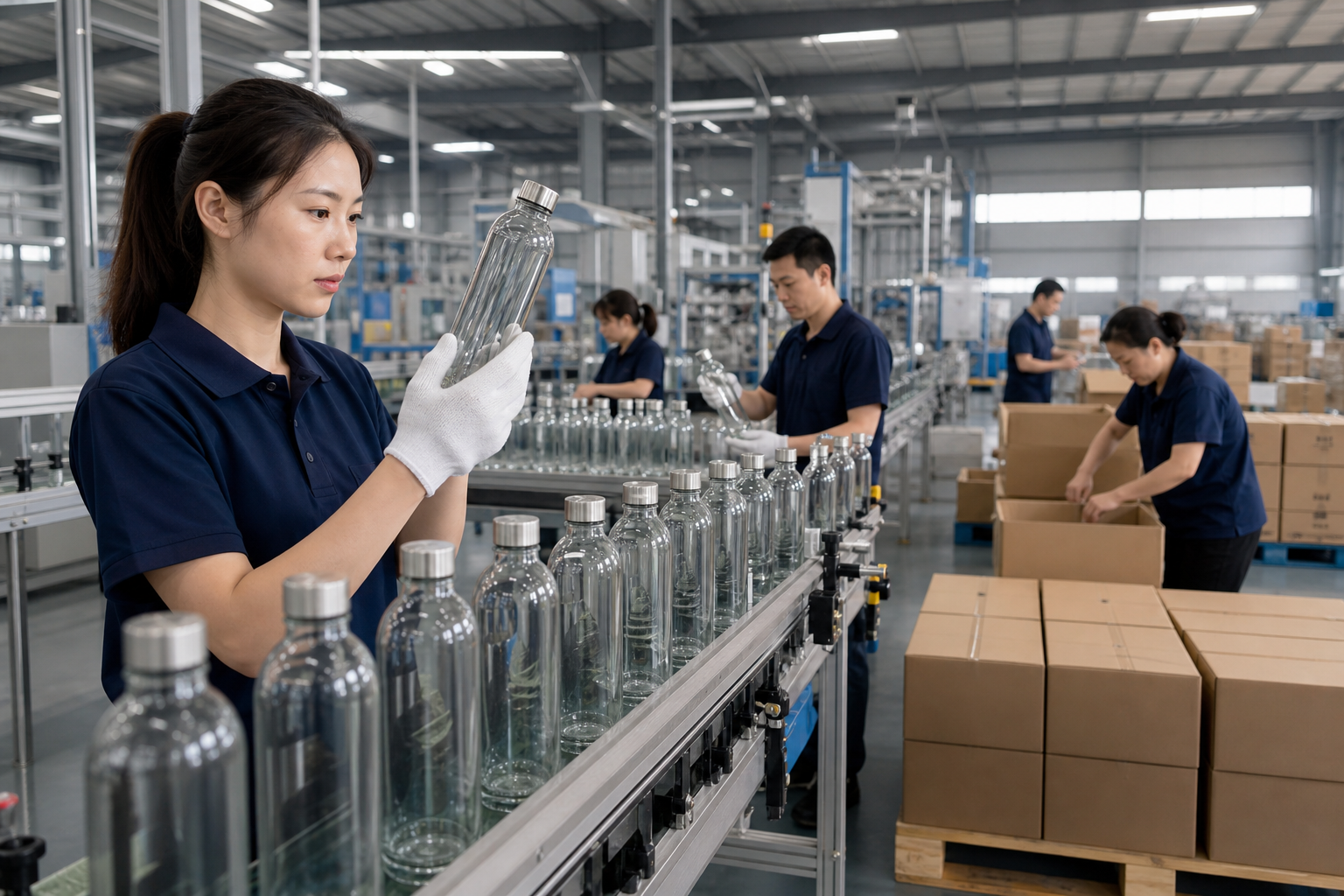
Key Takeaways
- Typical MOQ for borosilicate glass bottle bulk starts at 1,000–3,000 pcs per SKU, depending on mold and decoration.
- A 2.0 mm wall is common for retail-grade glass water bottles; 1.5 mm is cheaper but more fragile in transit.
- Lead time from a borosilicate glass bottle factory is usually 25–35 days after sample approval and deposit.
- For EU and North America, ask for REACH, LFGB where needed, and drop-test packaging confirmation before shipment.
If you are buying borosilicate glass bottle bulk for a wellness brand or a sustainable retail program, the first mistake is treating glass like a simple commodity. It is not. A 1.8 mm wall, proper annealing, cap fit, and the decoration method move breakage rates, freight cost, and customer complaints faster than a 5% price swing. We run this every week in Hangzhou, and a factory that knows the job will talk about thermal shock, tolerance, and carton packing before anyone mentions “nice-looking samples.”
You also need to separate marketing language from factory reality. A borosilicate glass bottle custom order for 3,000 units is a different job from a borosilicate glass bottle wholesale program at 50,000 units. QC pulled the sample on a 28 mm neck finish and found a 0.6 mm cap gap; the buyer flagged it, and the math stopped there. This is the wrong question to ask if you start from photos. If you want a custom glass water bottle that lands intact, passes REACH, and holds a premium shelf price, buy on specifications, not on pictures.
What borosilicate really means
Borosilicate is not a carton sticker. It is a glass recipe with more boron oxide, so it holds heat swings better and stays more stable with acids, tea, and repeated washing than soda-lime glass. On our line, a 500 ml bottle that goes through hot-fill at 85°C and then a cold rinse needs that margin, or QC will pull the sample. The bottle still has to be designed right, with the wall thickness and neck finish matched to the closure.
For buyers, the chemistry matters less than the numbers on the drawing. A 240 ml to 500 ml borosilicate glass bottle bulk order usually runs at 1.8 mm to 2.2 mm wall thickness. At 1.6 mm, breakage starts to show up in carton drop tests. At 2.4 mm, the bottle gets heavier, freight goes up, and the shelf price feels it. In Zhejiang, we ship plenty of low piece-price quotes, but the buyer flagged it fast: the landed cost is cartons, dividers, and ocean freight, not just the glass unit price.
- Thermal shock: ask for test data, not vague claims.
- Surface quality: inspect for seeds, bubbles, and mold seams.
- Dimensional control: neck finish matters for cap leakage.
If you sell a customizable glass water bottle to health-conscious buyers, the spec sheet has to hold up in QA and at the DC. One bad PO typo on cap size turns into leakage, returns, and a long email thread. That is the baseline.
Set the spec before pricing
Most price disputes start because the buyer asked for a “nice” bottle instead of a defined bottle. A borosilicate glass bottle customizable program should start with volume, height, diameter, mouth finish, wall thickness, and decoration method. Without those five inputs, the quote is just a placeholder. We see this on the line all the time.
For a bulk glass water bottle, the neck finish matters first. A 28 mm or 38 mm finish changes cap sourcing, gasket design, and leak risk. If you want a straw cap, bamboo lid, or stainless steel cap, the thread profile has to match the closure. One buyer sent us a PO with “fits all lids” written on it; QC pulled the sample, and the cap failed a 1.5 m drop test because the finish tolerance was off by 0.3 mm. That is the wrong question to ask.
Use a spec request like this:
- Capacity: 350 ml, 500 ml, or 750 ml filled to brim and marked fill line
- Wall thickness: 1.8 mm minimum, 2.0 mm preferred for retail
- Decoration: silk screen one color, decal, frosted finish, or laser mark
- Packaging: individual box plus 24 pcs/carton, or custom mailer for Amazon FBA
If your borosilicate glass bottle supplier cannot quote against those details, they are not ready for wholesale work. In Hangzhou and across Zhejiang, the better suppliers ask the annoying questions early, then run the sample again before they talk price.
How to judge factory capability
A borosilicate glass bottle factory is not just a building with kilns. We look at the full line: forming, annealing, inspection, decoration, packing. Ask for monthly output, current lead time, and how many molds they run in parallel. A solid Zhejiang factory can ship 300,000 to 800,000 units a month across several drinkware lines, with 25 to 35 days after sample sign-off for standard borosilicate glass bottle wholesale orders. On one audit, the buyer flagged a 2 mm wall-thickness drift at the bottle shoulder; that kind of miss tells you more than a shiny showroom.
Do not skip the boring questions. How many inspectors check each lot? What AQL do they use? We usually see AQL 2.5 for critical defects and 4.0 for major defects, but only when QC pulled the sample and logged it against a clear check sheet. Ask how they pack for drop resistance. A customized glass water bottle can pass visual inspection and still fail in transit if the carton strength is wrong. The math does not work if the carton only survives 6 drops in a corner test.
What to verify on a factory audit
- Annealing lehr temperature control and recordkeeping
- Incoming raw material traceability
- Cap and gasket sourcing consistency
- REACH and food-contact documentation for Europe
- Export carton compression testing
The cheapest borosilicate glass bottle distributor often turns costly once you count breakage, rework, and a launch that slips by 12 days.
If you buy from a borosilicate glass bottle distributor rather than directly from the manufacturer, ask for factory traceability. No trace, no deal. We have seen PO files with a simple typo on the carton count, and the line kept waiting while everyone argued over who approved it. Without traceability, you are paying a markup for slower answers.
Decoration that sells, not just decorates
For wellness brands and sustainable retailers, decoration is where the bottle turns into a sellable item. A borosilicate glass bottle promotional item with a plain one-color print can pass for samples, but repeat sell-through depends on the finish matching the brand tier. On our line, a clean silk screen usually lands at USD 0.12 to 0.35 per piece, based on coverage and firing temp. Laser engraving or matte frosting costs more, yet buyers keep asking for it because the shelf price holds better.
Choose decoration by use case. That is the right question. A borosilicate glass bottle custom project for a yoga studio chain usually needs a small logo and a bamboo cap, while a customizable borosilicate glass bottle for e-commerce often needs a full-color decal, retail sleeve, and a clear FNSKU sticker zone. For Europe, we check REACH and food-contact requirements for inks and coatings; for North America, we get written confirmation that the lid or insert meets FDA-relevant contact expectations. We once saw a PO where the buyer flagged the cap as “decorative only,” then changed the spec after QC pulled the sample and found the liner touched the liquid.
Be careful with dark prints, wraparound art, and frosted finishes on clear glass. They look premium, and they also hide bubbles and small scuffs during QC. For a borosilicate glass bottle customized for retail, ask for a pre-production sample with the exact print position and Pantone code on real glass. A PDF mockup is not enough. Zhejiang factories can handle this, but we need approval on the actual bottle, not a screen image. On one 5000-piece run, the buyer approved a 2 mm logo shift on paper and then rejected the lot when the mark sat too low after firing.
Packaging and freight change the math
Glass price is only half the bill. Freight, cartons, dividers, and breakage reserve decide the rest. We ship a 500 ml borosilicate bottle at FOB Ningbo or Shanghai all the time, then the buyer sees the landed cost jump after the packing list is fixed. Do the math on carton count alone and you will miss it.
For a 500 ml bulk glass water bottle, one export carton usually holds 24 pcs with molded pulp or paper dividers, and the master carton may need 5–7 layers depending on bottle weight. QC pulled the sample last week and checked a 1.2 m drop on the corner; that is the sort of test that saves a claim later. If the bottle goes to Amazon, we pack individual retail boxes with FNSKU labels and suffocation warnings. For wholesale, a plain master carton with a barcode on the outer case is cheaper and faster.
Ask your supplier borosilicate glass bottle team to provide:
- Carton dimensions and gross weight
- Drop-test method and pass criteria
- Pallet loading plan
- CBM estimate for each SKU
We run into the same mistake on PO review: the buyer approves the bottle, then flags the carton size only after the freight quote lands. That is the wrong question to ask. In Zhejiang, a good factory treats packaging as part of the SKU, and if the line skips that step, the breakage rate shows up at your warehouse, not ours.
Pricing, MOQ, and negotiation
Let’s be blunt: “bulk” means different numbers to different buyers. For a custom glass water bottle, MOQ usually starts at 1,000 to 3,000 pcs per color or print. If you move to a full custom mold, the floor goes up fast. We run standard shapes from an existing mold to keep tooling near zero; a new mold for a unique silhouette can add USD 1,500 to USD 6,000, and the mold cavity count changes the quote more than people expect.
For borosilicate glass bottle bulk pricing, the spread depends on size and decoration. A plain 350 ml bottle sits in one bracket, while a frosted 750 ml model with bamboo lid and printed logo sits in another. If a supplier gives one flat price and never asks about cap type, packaging, or destination market, the math doesn't work. On our line, we separate the glass body, lid, logo, carton, and freight assumptions before QC pulls the sample.
Negotiate on the right levers:
- Annual volume: commit to 2 or 3 purchase rounds if you want better piece pricing
- Packaging simplification: reduce box complexity to cut cost by 5% to 12%
- Decoration consolidation: one print position is cheaper than wraparound art
- Payment terms: 30% deposit, 70% before shipment is common for first orders
If you are a borosilicate glass bottle distributor or working as a distributor glass water bottle importer, the cleanest margin comes from repeatable specs, not one-off creativity. We saw a buyer flag a PO typo on lid color last month, and the whole batch had to be held for recheck. That's the wrong question to ask if you are chasing margin; build around a stable spec, and the numbers get easier to run.
Quality checks before you ship
Quality control on glass is not glamorous, but it saves money. Before release, we check rim chips, base flatness within 1.5 mm, stress cracks under a light table, print misregistration, and lid leakage. For a borosilicate glass bottle wholesale order, pull random cartons from the top, middle, and bottom of the stack. We run AQL sampling and keep the photos. Last month QC pulled one carton with a 2 mm rim nick that only showed up after unpacking; that photo settled the claim fast.
For Europe, ask for REACH documentation and confirm that any coatings, inks, and lid components are compliant for their intended use. If the bottle is sold as a sustainable product, say exactly what is recyclable and what is not. Glass is recyclable, yes, but the cap and packaging matter too. A “green” claim falls apart if the carton is heavy on ink and the lid uses mixed plastics with no recycling note. The buyer flagged that point on a PO typo once, and we had to reissue the artwork.
A good borosilicate glass bottle supplier will not resist inspection. They welcome it because the line is stable. If they push back on third-party QC, slow the order down. That is the wrong question to ask if you want fewer headaches later. A trustworthy China supplier should hand over production data and export paperwork without drama—MOQ, test reports, carton marks, all of it. We’ve seen this go sideways when a factory could not explain a 304 stainless lid spec on the packing list.
When you buy from a borosilicate glass bottle vendor in Zhejiang, ask for lot traceability, inspection reports, and a sample retention policy. Keep one approved sample in house and one at the factory. That is how you cut surprises on the next reorder. We ship better when the batch code, the outer carton number, and the test sheet all match.
Request a Zhejiang factory quote today
Send your size, cap, logo, and target market. We will quote your borosilicate glass bottle bulk order with real specs, not guesswork.
Frequently asked questions
What MOQ should I expect for borosilicate glass bottle bulk orders?
For standard shapes, MOQ is usually 1,000 to 3,000 pcs per SKU. If you want a new mold or a complex customized glass water bottle, some borosilicate glass bottle manufacturers will ask for 5,000 pcs or a tooling fee. Decoration can also affect MOQ: one-color print may be easy, while frosted finish plus laser logo may require more units to keep the line efficient. In Zhejiang, factories often quote lower MOQ on existing molds and higher MOQ on fully custom shapes.
What is a fair factory lead time for first orders?
For a normal borosilicate glass bottle custom order, plan on 25 to 35 days after sample approval and deposit. If you need new tooling, add 10 to 20 days. If you order peak-season packaging, shipping cartons, or a complex lid assembly, the schedule can stretch. A serious borosilicate glass bottle factory in China will give you a production calendar, not a vague promise. For repeat orders, 20 to 30 days is realistic if the raw materials are ready.
How do I reduce breakage in transit?
Start with wall thickness and packaging. A 1.8 mm to 2.2 mm wall is a practical range for retail glass, and proper dividers matter more than most buyers think. Ask for carton drop testing, pallet wrap specs, and a breakage allowance target under 1.5% for normal ocean freight. If your order is fragile or going into Amazon FBA, request individual boxes and stronger master cartons. A borosilicate glass bottle supplier that knows export work will specify all of this before loading.
What documents should I ask for when importing to Europe or North America?
At minimum, ask for REACH-related declarations, food-contact material statements where applicable, packing list, commercial invoice, and the bill of lading. If you are selling in the EU, request supporting compliance files for inks, coatings, and lid components. For North America, keep product test reports and supplier declarations on file. If your channel is Amazon, also prepare FNSKU labels and carton labeling instructions. A professional borosilicate glass bottle distributor should not struggle with this paperwork.
Can I get a borosilicate glass bottle promotional design at a low cost?
Yes, but keep the spec simple. A promotional order with one-color silk screen, standard cap, and existing mold is usually the cheapest route. Once you add frosting, special packaging, embossed logos, or a custom lid, the unit cost rises quickly. For a 500 ml promotional run, the difference between plain print and premium packaging can be USD 0.30 to USD 1.20 per piece. If your goal is volume rather than showroom aesthetics, simplify the design and focus on durability.