Key Takeaways
- A typical borosilicate glass bottle custom MOQ is 3,000 units, with 25-35 days lead time after sample approval.
- For 500-750 ml bottles, 1.8-2.2 mm wall thickness is a practical range for retail use and lower breakage.
- FOB China pricing for a simple custom glass water bottle usually starts around USD 1.20-2.80 per unit, depending on cap and decoration.
- Ask for REACH, LFGB, and drop-test data; AQL 2.5 is a normal final inspection target for export lots.
If you are sourcing a borosilicate glass bottle custom order, the first mistake is treating glass like a promo giveaway. It is not. Wall thickness, thermal shock resistance, cap liner choice, and decoration method all hit breakage rate, taste neutrality, and landed cost. We have seen 2.0 mm glass pass a drop test in the sample room, then fail once the buyer switched to a heavier cap. That is the math.
At BottleForge in Zhejiang, we see the same thing every week: buyers want a customizable glass water bottle, but the use case is still fuzzy. Cold fill for a yoga studio is one job; hot tea retail packaging is another. A borosilicate glass bottle wholesale order for Europe needs different compliance papers than a domestic China campaign, and the buyer flagged a missing PO line for “silicone gasket color” more than once. If you want a dependable supplier in China, spec performance first and decoration second.
What borosilicate glass really changes
Borosilicate is not marketing glitter. It is a glass formula with more silica and boron, so it handles thermal shock better and holds up against acids, tea, and daily washing better than soda-lime glass. We run this on the line all the time: a bottle comes out of a 5°C warehouse, then gets 90°C water poured in, and cheap glass cracks fast. For a custom borosilicate glass bottle, the material costs more, but the retail story is cleaner and the return rate is easier to keep down.
Ask the borosilicate glass bottle manufacturer the right thing: wall thickness, annealing curve, and tested temperature delta. A serious borosilicate glass bottle factory will quote 1.8 mm, 2.0 mm, or 2.2 mm, then show the thermal shock result, often around 120°C to 150°C depending on shape. QC pulled the sample before packing and checked the mouth finish under a gauge, because a 0.3 mm lip issue can turn into a buyer complaint. If the supplier cannot talk through those numbers, the math does not work. You are looking at a reseller, not a technical factory.
Good glass sourcing starts with performance data, not a pretty render.
For wellness brands, the real gain is product positioning. A customizable borosilicate glass water bottle fits minimalist branding, sleeve packaging, and refill programs without the plastic baggage. Retail buyers like that, but they still ask about breakage, and that is the right question to ask. We have seen thin necks at 12 mm outer diameter look sharp in renders and then fail in carton drop tests, so the line had to slow down and the packout changed. In Zhejiang, the better factories tell you where the design stops making sense before the PO is signed.
Set specs before you ask for quotes
If you send five borosilicate glass bottle suppliers a quote request with no spec sheet, you will get five different prices for the same-looking bottle. We see this all the time. Start with capacity, bottle shape, wall thickness, cap type, finish, and decoration area. A proper custom glass water bottle RFQ should list these items:
- Capacity: 350 ml, 500 ml, 650 ml, or 750 ml
- Glass thickness: 1.8 mm, 2.0 mm, or 2.2 mm
- Cap: bamboo, stainless steel, PP, or aluminum
- Seal: silicone, TPE, or natural rubber-free liner
- Decoration: silk screen, laser engraving, UV print, or decal
- Packaging: single box, kraft box, or gift set
Once the spec is locked, the quote stops jumping around. A basic borosilicate glass bottle bulk order with stainless cap and one-color print may land around USD 1.20-1.80 FOB China at 3,000 pieces. Add a bamboo lid, silicone sleeve, or custom gift box and you can move into the USD 2.20-3.50 range fast. That math checks out. On our line, the sleeve alone adds another process step, and QC pulled the sample twice when the print shifted 1.5 mm.
If you are a borosilicate glass bottle distributor or a sustainable retailer, ask for a drawing with dimensions and tolerances before you chase samples. Neck finish tolerance, cap fit, and bottle height tolerance need to be written down, not guessed. We had one buyer flag a PO typo on the neck size—18 mm written as 28 mm—and the whole sample round went sideways. Zhejiang factories that export every week will send a sample confirmation sheet. Use it. Once production starts, changes get expensive.
Decoration choices change your margin
The biggest mistake in a borosilicate glass bottle customized project is picking decoration by look alone. Decoration changes cycle time, rejection rate, and packing damage. One-color silk screen is still the lowest-risk option for a wellness brand. We run it on a 280 mm jig, and the line stays clean. Laser engraving looks premium, but on clear glass it reads faint under shelf light, so some retail buyers push back on that fast. Full-wrap decals can look sharp, though they need tighter handling and closer QC at packing.
For a borosilicate glass bottle promotional program, keep the art simple: one logo, one tone, one message. If you want a customizable borosilicate glass bottle for e-commerce, check the photo under studio lights before you sign off. Glass shows every bad placement. The buyer flagged a 2 mm shift on one PO, and that turned into a reprint. We also do frosted finish, gradient spray, and spot-color printing, but each extra step adds scrap risk. Ask for a decoration yield estimate before approval; the math does not lie.
What to ask for on the first sample
- Print adhesion test after 24 hours
- Dishwasher resistance if the bottle will be reused
- Scratch resistance for logo handling
- Color reference under daylight and warm light
At our Hangzhou facility in Zhejiang, we usually start with one master sample and one production-intent sample. That avoids the usual trap: the approved sample looks perfect, then the 10,000 pcs line cannot hit it again. QC pulled the sample and found a 0.3 mm logo drift on the second pass. A good borosilicate glass bottle supplier should say that upfront, not after the deposit clears.
Quality checks that actually matter
Glass buyers often stare at the logo print and miss the test file. That is the wrong question to ask. For export, we ask for REACH paperwork for Europe and LFGB for any cap or lid that touches food. If the buyer ships into North America, we also check third-party test reports for the channel, because one retailer in California once rejected a PO over a missing statement on the cap material.
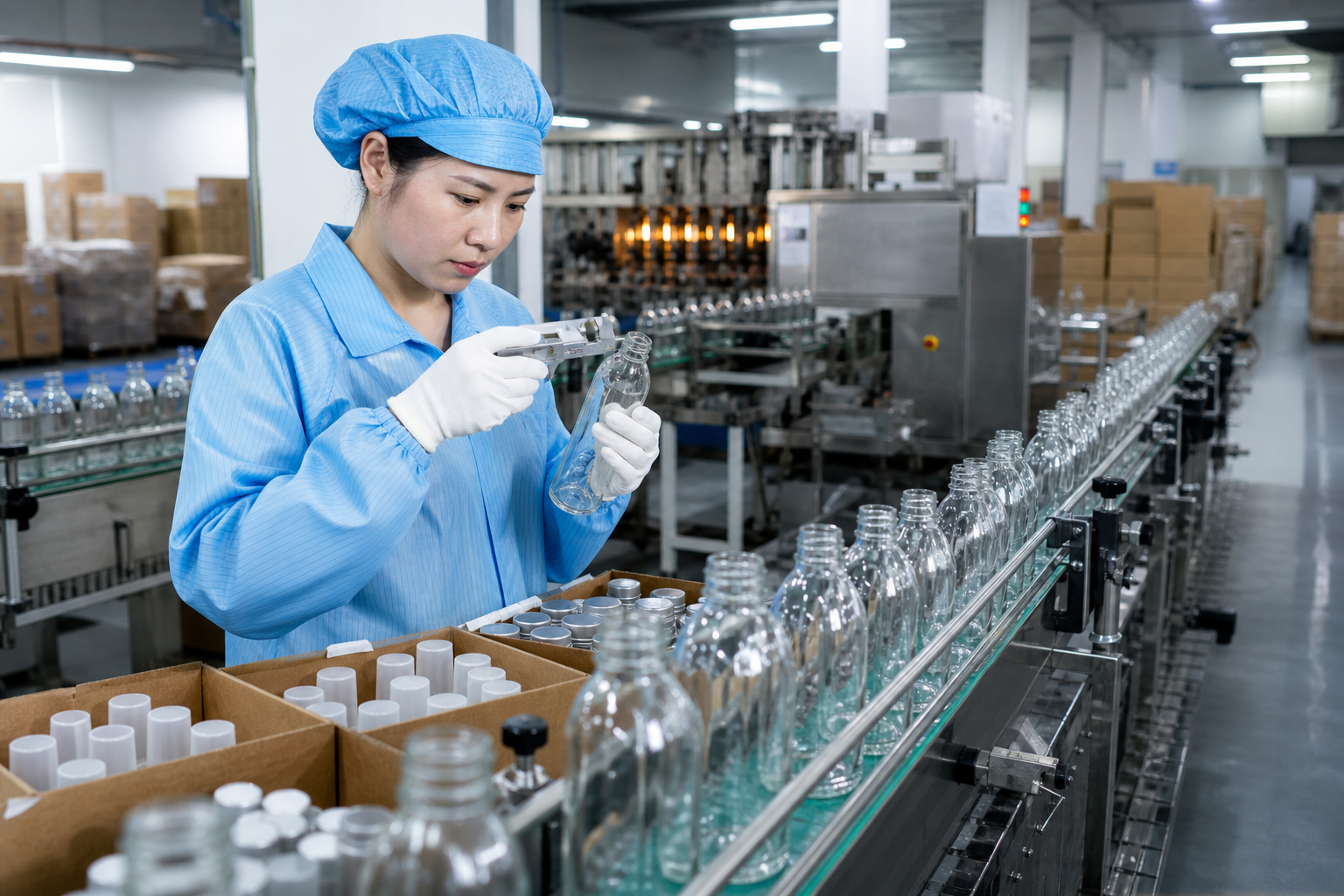
On the line, the checks are plain and fast. We look at bubble count, seed inclusions, shoulder symmetry, neck roundness, and bottom flatness. QC pulled one sample with a 1.2 mm base wobble last month; the carton looked fine, but the bottle rocked on the table. AQL 2.5 is common for consumer goods, yet for a premium gift set with a thin insert, we tighten the sampling. For a bulk glass water bottle shipment, ask for carton drop testing and a transit run. Most breakage comes from packing, not from the furnace.
A serious borosilicate glass bottle manufacturer in China will track the annealing curve, stack load, and cap torque. We run torque in N·cm, not by feel. If the cap is 3 N·cm too loose, leaks show up in dispatch; if it is 4 N·cm too tight, retail buyers flag it as hard to open. The math does not work if the spec is vague. A good spec sheet separates a real factory from a trading-only borosilicate glass bottle vendor, and we have seen that go sideways more than once when a PO typo changed the cap finish code.
Certificates matter, but the carton line and cap torque are usually where export headaches start.
MOQ, lead time, and real unit economics
Let’s talk numbers, because this is where most buyers lose time. A custom borosilicate glass bottle order usually starts at 3,000 pieces per design; if you want two lid colors or printed packaging, 5,000 pieces is more realistic. For repeat orders, we do run lower MOQ on stock shapes, but once you change the mold or add deep embossing, the floor jumps fast. We saw a buyer push back on 2,000 pcs, then the math failed on tooling amortization.
Typical timing from a Zhejiang factory is 7-10 days for sample development, 25-35 days for mass production after sample sign-off, and 5-10 days for export packing and booking. If a supplier says 10 days total on a fully customized glass water bottle, they are either pulling from stock or rushing the line. That is fine for a giveaway, not for a retail launch. QC pulled the sample on day 8 once because the neck finish was 1.2 mm off spec.
Cost moves with parts count. A plain 500 ml bottle with no sleeve and a basic cap may sit around USD 1.20-1.60 FOB. Add a bamboo lid, silicone sleeve, and gift box, and the same item can move to USD 2.50-3.80. Freight changes the picture too. A 20-foot container can take a lot of glass, but carton size decides whether you use the cube well. Ask for carton dimensions, master carton count, and pallet plan before you approve the PO; we ship better when the packing spec is locked, and a typo on the PO can turn one 500 ml item into the wrong insert size.
Choosing the right China supplier
There are borosilicate glass bottle suppliers in China, but a good share are trading companies with smooth email replies and no control over forming, annealing, or decoration. The real factory runs the line, and you can usually see it in the details: 24-hour kiln logs, mold shelves tagged by model, and a QC stamp on the report. You need to know who is on the other side before you send a PO.
Ask three direct questions: Where is the forming line? Who controls cap sourcing? Who signs the QC report? If the answers stay vague, walk away. A real borosilicate glass bottle factory in Zhejiang can usually show monthly capacity, for example 300,000 to 600,000 units per month depending on model mix, plus line photos, QC records, and export cases. We once had a buyer flag a PO typo on the bottle color code, and that same order would have gone sideways if the factory could not catch it at source.
If you are a borosilicate glass bottle distributor or brand owner in Europe or North America, ask about claim support too. Can the supplier print carton marks, FNSKU labels for Amazon, barcode placement, and master carton data? Can they pack for DDP or FOB? Can they support a distributor glass water bottle program with mixed SKUs? We ship mixed cartons all the time, but the math only works when the supplier can keep each SKU at the right quantity and label position. A factory that gives you a clean sample with a 0.3 mm logo tolerance and a correct carton spec is worth more than a fast promise.
Do not pick on price alone. Check defect tolerance, reply speed, and packaging discipline. A slightly higher quote from a stable Zhejiang supplier often beats a cheap offer with broken bottles and rework at the port. We have seen 2% breakage turn into a 12-day delay because the buyer pushed for the lowest number; that is the wrong question to ask.
How to brief a custom project
A clean briefing document keeps the project moving. Start with end use: hydration retail, wellness gifting, subscription box, or a borosilicate glass bottle promotional campaign. Then define the selling channel, because Amazon, boutique retail, and distributor programs need different packaging and labeling. A custom borosilicate glass bottle for e-commerce usually needs 5-layer carton protection, not the loose master carton we ship for a domestic warehouse pallet.
Your brief should include target market, annual forecast, color count, logo size, packaging artwork, and testing requirements. If you want a customized glass water bottle for Europe, mention REACH and any food-contact expectations. If you need a US retail launch, mention warehousing requirements, carton labeling, and any warehouse prep such as FNSKU application. We had a buyer flag a PO typo once: 10,000 pcs became 1,000 pcs, and the math did not work. This saves rounds of revision and keeps the factory from quoting a shape that cannot be packed efficiently.
For sustainable brands, ask whether the glass bottle can be paired with recycled paper packaging, FSC cartons, and plastic-free inserts. A customizable glass water bottle can still look premium without foam-heavy packaging. On our line in Zhejiang, QC pulled a 62 g paper insert sample and found the neck support was 3 mm short, so we changed the die-cut before mass production. Better to fix that early than add padding after the design is locked.
Use the brief to force decisions early. Once the mold is cut and printing film is made, every change costs time and money. That is standard in China, and experienced buyers lock the spec before they talk unit price. We have seen this go sideways on a 12-day sample lead time and an 18-day rework cycle from one missing logo measurement.
Request your borosilicate bottle quote today
Send your capacity, cap, and decoration spec. We will price the exact custom glass water bottle build, not a vague placeholder.
Frequently asked questions
What is the MOQ for a borosilicate glass bottle custom order?
For a true custom borosilicate glass bottle custom project, a normal MOQ is 3,000 pieces per design. If you add a special cap, sleeve, or multi-color print, the MOQ often moves to 5,000 pieces. Stock shapes can sometimes start at 1,000 pieces, but you lose flexibility on size and decoration. For repeat orders, many Zhejiang factories will support mixed cartons or staggered shipments once the mold is already in production.
How much does a custom glass water bottle cost FOB China?
A basic custom glass water bottle in borosilicate often starts around USD 1.20-1.80 FOB China for 500 ml with a simple cap and one-color print. Add a bamboo lid, silicone sleeve, or premium gift box and it can rise to USD 2.50-3.80. The exact price depends on bottle weight, decoration process, and carton spec. Freight and duty are separate, so always ask for landed cost planning, not just unit price.
Can I use borosilicate glass bottles for hot and cold drinks?
Yes, that is one of the main reasons buyers choose borosilicate. A well-made bottle can handle hot-fill and cold-fill use better than standard soda-lime glass, but the design still matters. Ask for thermal shock data, not just a material claim. A practical test range is often 120°C to 150°C depending on shape and wall thickness. Also confirm the cap liner and seal are suitable for the drink temperature you plan to sell.
What compliance documents should I request from a China supplier?
For Europe, ask for REACH-related material declarations and, if your market requires it, LFGB or food-contact support on caps and liners. For retail programs, also request carton specs, drop-test results, and an AQL inspection report. If you sell through Amazon or a similar channel, ask for barcode and carton-label support. A serious borosilicate glass bottle supplier in China should be able to prepare these documents without making it a major project.
How long does production take for customized borosilicate bottles?
Typical lead time is 25-35 days after sample approval for a standard customized borosilicate glass bottle order, plus 7-10 days for sampling before production. If the project includes a new mold, special packaging, or multiple decoration steps, add time. Export booking and packing can add another 5-10 days. If a supplier promises a finished custom run in under two weeks, double-check whether the bottle is truly custom or just existing stock.