Key Takeaways
- Most borosilicate glass bottle bulk orders start at 3,000-5,000 pcs, with factory lead time of 25-35 days in Zhejiang.
- A 500 ml custom glass water bottle usually uses 2.0-2.5 mm borosilicate wall thickness and a 20-24 mm neck finish.
- Decoration changes cost more than the glass: single-color silk screen is often USD 0.12-0.25 per unit, while laser engraving is higher.
- For Europe and North America, ask for REACH, LFGB, and drop/thermal-shock test data before you approve the first shipment.
If you are buying a borosilicate glass bottle customizable for wellness retail or a private-label launch, the hard part is not finding glass. The hard part is getting the right wall thickness, closure, decoration method, and test standard without turning a clean product into an expensive mistake. A lot of buyers start with a pretty sample and then discover the real questions later: does it pass thermal shock, can it survive a 1.2 m drop test, what is the MOQ for a custom logo, and who pays when the lid leaks?
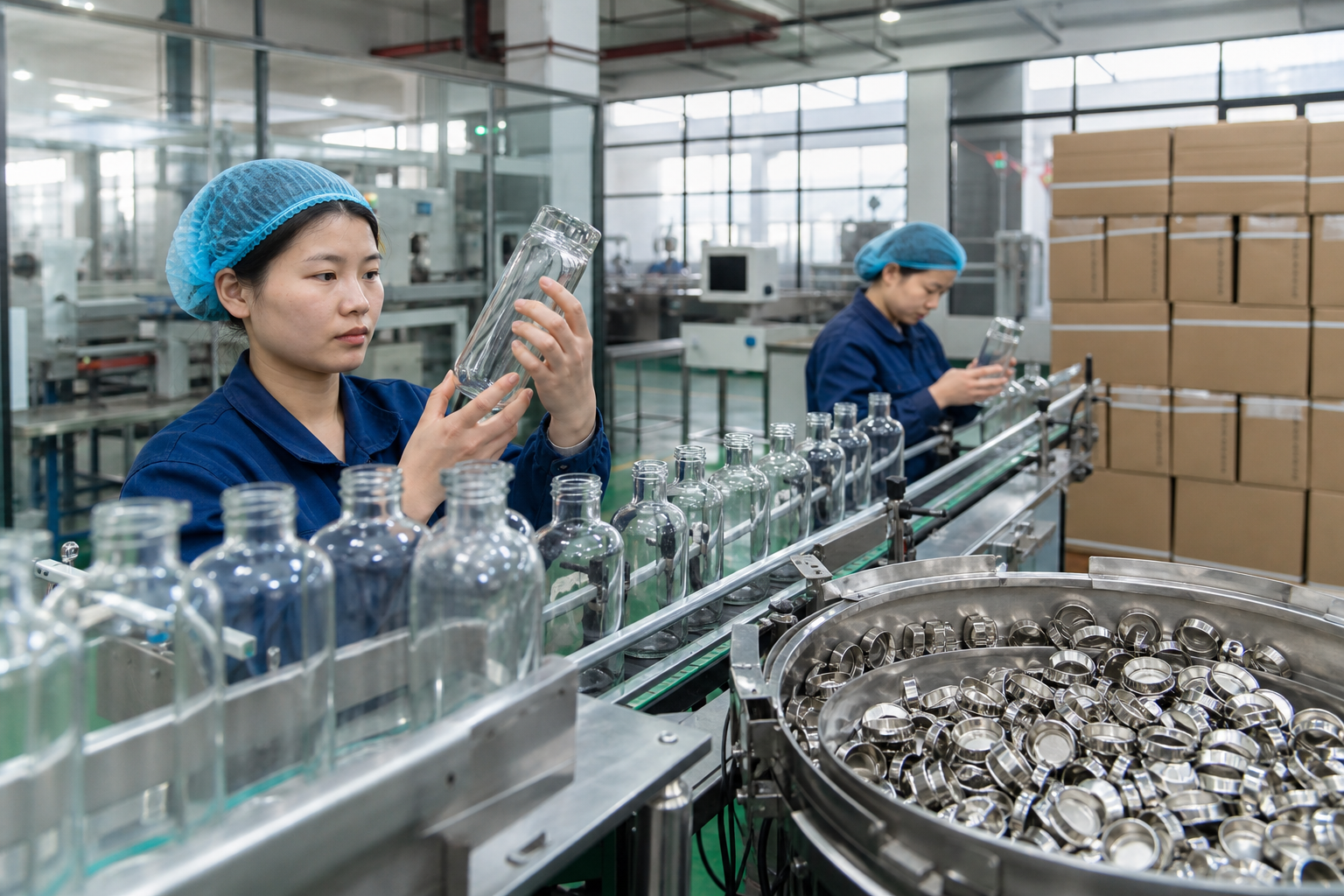
At BottleForge in Hangzhou, Zhejiang, we see this every week from Europe and North America. QC pulled a 380 ml sample yesterday and found a 0.6 mm neck variation, which is enough to make one cap fit loose on the line. A borosilicate glass bottle custom order is straightforward if you ask the right questions. The wrong question is, “Can you make it look like this?” Many suppliers quote the bottle shape and stop there, then the buyer flags missing cap specs, carton strength, or LFGB paperwork after the PO is already signed. If you want a customizable glass water bottle that actually sells, write the spec like a buyer, not like a shopper.
What Borosilicate Really Changes
Borosilicate glass is not a slogan. It is a glass formula with better thermal resistance and better chemical stability than soda-lime glass. For a wellness brand, that matters because customers pour in hot water, lemon slices, electrolyte powder, or tea, then rinse the bottle every day. A low-cost bottle can cloud, craze, or crack after one hot-cold swing. We’ve seen this go sideways on the line. A proper borosilicate glass bottle customizable order should start from use case, not from decoration.
On sourcing, ask for the glass grade, nominal wall thickness, and test limits. For a 350-500 ml custom borosilicate glass bottle, 2.0-2.5 mm wall thickness is common; for a 750 ml bottle, 2.5-3.0 mm makes more sense if you want a better hand feel and fewer breakages in packing. One buyer once sent a PO with “3500 pcs” typed as “350 pcs” — QC caught it before the carton label was printed. A capable borosilicate glass bottle factory will hold tolerance and keep clarity stable across a 10,000 pcs run. Zhejiang factories usually turn samples fast because mold work and packaging boxes are nearby, so a revision can move in 3-5 days instead of 12.
Ask for the finished bottle weight, not just the capacity. A 500 ml bottle at 280-330 g usually feels sturdier than a 220 g version, and the price gap is often small.
Choosing the Right Bottle Spec
Most mistakes happen before the line starts. A buyer approves the shape, then QC finds the neck finish does not match the closure, the silicone sleeve pushes the diameter out by 4 mm, or the bottle stands 12 mm too tall for the shelf. For a borosilicate glass bottle wholesale program, lock four items first: capacity, neck finish, lid type, and outer size. The rest comes later.
For wellness and sustainable retail, we ship 350 ml, 500 ml, and 750 ml more often than anything else. A 500 ml custom glass water bottle usually lands at 68-72 mm diameter and 220-240 mm height, depending on lid style. If you want a custom borosilicate glass bottle with a bamboo cap, the cap needs a food-safe seal and a replaceable gasket. If you want a steel lid, ask for 304 or 316 stainless steel and a torque spec; we had one PO typo on the lid code last month, and the buyer flagged it before sampling.
- Capacity tolerance: ±3% is normal for glass.
- Neck finish: common finishes are 28 mm, 38 mm, and 42 mm.
- Lid seal: silicone gasket thickness usually sits at 1.5-2.5 mm.
- Carton fit: test 6 pcs and 12 pcs packing before mass production.
If you are sourcing a customizable borosilicate glass bottle for promo gifting, do not chase the thinnest wall. That is the wrong question to ask. Promo orders get dragged through warehouses and event trucks, and a 1.8 mm wall can fail faster than a 2.2 mm wall when the carton stack goes to 8 layers. We run break tests on the line for this reason; a slightly heavier bottle costs less than a batch of claims.
Decoration That Actually Sells
Decoration is where a borosilicate glass bottle custom job turns into a brand piece. Clear glass works. One-color logo print works. Frosting works. We also run laser engraving on a metal cap when the buyer wants a cleaner lid. Each choice changes cost, lead time, and scrap rate. For premium wellness buyers, quiet decoration usually wins over loud graphics. A customized glass water bottle should sit calm on the shelf and still read from 1 meter away.
Silk screen printing is still the cheapest route for a borosilicate glass bottle promotional order. On 5,000 pcs, one-color print usually adds USD 0.12-0.25 per bottle, depending on coverage and curing time. Frosting costs more than basic print because masking and acid treatment add extra steps on the line. Laser engraving on a metal lid is clean and holds up well, but it does not carry the shelf message by itself if the logo must sell the bottle. In our Hangzhou, Zhejiang shop, we often ship a two-layer setup: logo on the bottle, cap kept simple. QC pulled the sample at 1.2 mm misalignment once, and the buyer flagged it before packing. That is the level that matters.
Decoration decisions by channel
- DTC retail: clean logo, small capacity marking, premium carton.
- Wholesale: durable print, lower breakage, simple SKU coding.
- Promotional: single Pantone logo and fast re-order capability.
If you are comparing borosilicate glass bottle vendors, ask for baked adhesion tests and dishwasher-cycle resistance. This is the wrong question to skip. A logo that looks fine on day one but washes off after 20 cycles is not a brand asset. We have seen that go sideways fast, and the math does not work when reprint cost lands on your next PO.
Pricing, MOQ, and Lead Time
For a borosilicate glass bottle manufacturer in China, price comes down to bottle weight, decoration, and packaging. A plain 500 ml clear bottle with a basic PP or bamboo lid usually sits around USD 1.05-1.80 FOB China at 3,000-5,000 pcs. Once you add printed logo, sleeve, and gift box, the number moves into the USD 1.80-3.20 range. We had one buyer ask why the quote jumped by 38%; the answer was simple: the sleeve alone added 28 grams, and the carton spec changed from 24 pcs to 12 pcs. Compare borosilicate glass bottle suppliers on the full landed spec, not just the bottle.
MOQ is where weak suppliers start talking in circles. A solid borosilicate glass bottle factory in Zhejiang will usually set MOQ by mold and decoration: 3,000 pcs for existing shapes, 5,000-10,000 pcs for a new mold, and lower if you accept stock shape with custom print. Lead time is usually 25-35 days for existing tooling and 35-50 days for new molds, if carton artwork and packaging files are approved on time. QC pulled the sample on a 2 mm lid gap once, and the buyer flagged it before we ran the line. If your distributor borosilicate glass bottle program needs fast restock, ask for monthly output capacity. At BottleForge, we ship more than 600,000 units per month across drinkware categories, so a first order that sells out in 11 days instead of 21 days does not break the plan.
Do not ignore freight. Glass is heavy and breakage-sensitive, so ocean freight is the sensible route for borosilicate glass bottle bulk orders. Air freight can wipe out the margin in one invoice. For North America and Europe, price from FOB Ningbo or FOB Shanghai, then add test, duty, and inland delivery costs before you quote retail. We saw a PO with “5000pcs” typed as “500 pcs” once; that kind of typo turns into a painful recheck, and the math does not work if the carton count is wrong.
Quality Checks You Should Demand
Quality is where a real borosilicate glass bottle supplier separates from a trading desk. We see it on the line fast. Ask for the glass composition declaration, then match it against the batch lot and furnace record. If they dodge that, the math does not work. We also want the thermal shock test, drop test, and leak test reports in hand, plus carton compression data and barcode placement checks if the bottles go to Amazon or a chain program.
For a custom glass water bottle, we normally inspect to AQL 2.5 for major defects and AQL 4.0 for minor defects unless the buyer has a tighter spec. Major issues are cracks, rim chips, print shift, and lid leakage. QC pulled the sample on a 120°C differential thermal-shock run before packing, and that is the right baseline for product validation. If the bottle will take hot fill or tea, ask for longer soak and cycle testing; a 10-minute dunk is not enough.
- Leak test: invert for 24 hours with water inside and torque-applied caps.
- Drop test: 1.0-1.2 m onto plywood or a carton-representative surface.
- Thermal shock: cold-to-hot and hot-to-cold cycle validation.
- Compliance: REACH for EU, LFGB where relevant, and FDA food-contact support for U.S. buyers.
If you buy from borosilicate glass bottle distributors, ask for third-party lab reports from the actual batch. Not a generic PDF from last year. We had a buyer flag a PO typo once because the lot number on the report did not match the carton label, and that caught a mix-up before shipment. That is a simple question, and it weeds out weak suppliers fast.
Wholesale Programs by Channel
A borosilicate glass bottle wholesale program should be set up by channel. Wellness brands want premium cartons, a clean color palette, and low return rates. Sustainable retailers ask for recyclable materials and re-order pricing that does not jump after the first PO. Distributors care about SKU simplicity, carton efficiency, and margin. If you are a borosilicate glass bottle distributor or a distributor glass water bottle buyer, the real issue is not just unit cost; it is whether you can move the same bottle across 5 or 10 accounts without asking the factory to redo artwork every month. We run this every week, and the first question is always the MOQ.
For retail shelves, a customized borosilicate glass bottle usually sells better with one or two accessory SKUs, like a silicone sleeve or an infuser insert. That gives the buyer something to upsell without turning the line into a parts mess. For promotional orders, keep the shape standard and put the money into logo clarity and ship date control. For subscription boxes, use a lighter carton and test the pack-out with 6 or 12 pcs per outer box; we once had a buyer flag a carton typo that changed the inner count on the PO, and the math did not work. A bad carton design can add 8-15% to logistics cost.
In China, buyers often search for borosilicate glass bottle vendors when they actually need a factory that can handle sampling, compliance, and shipping paperwork. If you want stable supply from Zhejiang, ask whether the factory can keep repeat production in the same mold cavity and whether it holds spare lids and gaskets for reorders. QC pulled the sample on one of our runs at 0.8 mm neck variation, and that is where the trouble starts. This is the wrong question to ask if you focus only on price; the real test is whether the wholesale program stays the same on the second and third order.
For sustainable retailers, a custom borosilicate glass bottle only supports a strong story if it is actually durable. A bottle that cracks on a warehouse drop test is not sustainable; it is waste with a nicer label. We have seen this go sideways on a 1.2 m drop test before, and the buyer came back asking why the “eco” bottle needed more replacement units than the standard one. That kind of product fails on the shelf, no matter how good the branding looks.
Request your custom glass bottle quotation today
Send your capacity, lid style, logo file, and target market. We will quote FOB China pricing, MOQ, and lead time within 24 hours.
Frequently asked questions
What is the usual MOQ for a borosilicate glass bottle customizable order?
For stock shapes with custom logo, MOQ is often 3,000 pcs. If you need a new mold or a special lid, expect 5,000-10,000 pcs. In Zhejiang, a good borosilicate glass bottle manufacturer can sometimes combine shapes or packaging to reduce risk, but the factory still needs enough volume to cover mold and setup costs. If you want a custom glass water bottle for retail, ask for a split MOQ by color, print, and carton so you can launch with fewer SKUs.
How much does a custom borosilicate glass bottle cost FOB China?
A plain 500 ml bottle with a basic lid may be USD 1.05-1.80 FOB China at 3,000-5,000 pcs. Add printing, frosting, sleeves, or premium packaging, and the price can reach USD 1.80-3.20. Freight is separate. For a borosilicate glass bottle bulk program, weight matters: every extra 50 g raises carton and ocean freight cost over a full container. Ask for a landed-cost sheet, not just the bottle price.
Which tests should I request before approving production?
Request thermal-shock testing, leak testing, drop testing, and carton compression checks. For Europe, ask for REACH support; for consumer retail, LFGB is often useful; for the U.S., food-contact documentation matters. A serious borosilicate glass bottle supplier should provide batch-linked reports, not generic certificates. For a customized glass water bottle, also ask for print adhesion testing after dishwasher cycles so your logo stays on the bottle after normal use.
Can borosilicate glass bottle distributors handle promotional orders?
Yes, but only if the distributor has factory backing and stable inventory. Promotional programs need short lead times, often 20-30 days, and clear packaging rules. A borosilicate glass bottle promotional order should use one shape, one print location, and minimal accessories. If the distributor borosilicate glass bottle quote includes too many options, lead time and error risk both go up. Keep the spec tight and the reorder path simple.
Is a customizable borosilicate glass bottle suitable for Amazon or DTC?
Yes, but packaging and breakage control matter more than on a retail shelf. For Amazon, you may need FNSKU labeling, carton drop resistance, and clean master carton counts. A custom glass water bottle should survive warehouse handling, not just factory inspection. If you plan FBA, ask your borosilicate glass bottle manufacturer for pack-out photos, barcode placement, and a carton that can survive long-distance fulfillment without high breakage rates.