Key Takeaways
- Typical MOQ for a custom borosilicate glass bottle starts at 3,000-5,000 pcs per SKU, with 35-45 days lead time after sample approval.
- A standard 500 ml bulk borosilicate glass bottle usually lands around USD 1.10-2.40 FOB China depending on lid, sleeve, and decoration.
- For export, insist on REACH, LFGB or FDA-relevant food-contact documentation, plus carton drop testing and AQL 2.5 inspection.
- A reliable borosilicate glass bottle factory in Zhejiang can often produce 80,000-150,000 units per month across multiple bottle lines.
If you are looking for a borosilicate glass bottle distributor, finding a name is easy. The real work is sorting out a borosilicate glass bottle factory from a trading desk that pads the price, adds 7 to 10 days, and gives you soft answers when you ask about breakage. For wellness brands and sustainable retailers, the math is simple: the bottle has to look premium, survive a 1.2 m drop test, and clear REACH plus food-contact checks in Europe and North America.
We run production in Zhejiang, China, and the same issues come up on the line. Buyers ask for a custom glass water bottle, then QC pulls the sample and checks wall thickness, thermal shock limit, lid torque, and decoration method. One buyer flagged a PO typo on a 5000 pcs order and nearly lost a week. A serious borosilicate glass bottle distributor gives numbers, not slogans: MOQ, FOB price, lead time, AQL 2.5, and the plan when the bottle cracks in transit. That is where the deal is won or lost.
What Borosilicate Means in Practice
“Borosilicate” is not a sales slogan. It means the glass recipe includes boron oxide, and that shifts the thermal shock performance far above ordinary soda-lime glass. For a custom glass water bottle, this matters on the line and in the warehouse: one buyer fills it with boiling tea at 95°C, another rinses it under cold water, and the QC team still has to pass the same bottle. A proper borosilicate glass bottle manufacturer should give you wall thickness, annealing curve, and test limits; “high quality glass” is lazy talk.
For most consumer bottles, wall thickness lands at 1.2-1.8 mm. Thinner than that, breakage climbs in carton drop tests. Thicker than that, the bottle feels bulky and the freight math gets ugly fast. A 500 ml borosilicate bottle usually weighs 220-320 g before the cap, and that range works for a distributor borosilicate glass bottle program built for wellness brands. We once had a buyer push back on 360 g because his retail team said it felt like a mason jar. He was right. You want clarity, a clean hand feel, and enough strength to survive a 1 m drop test in outer packaging.
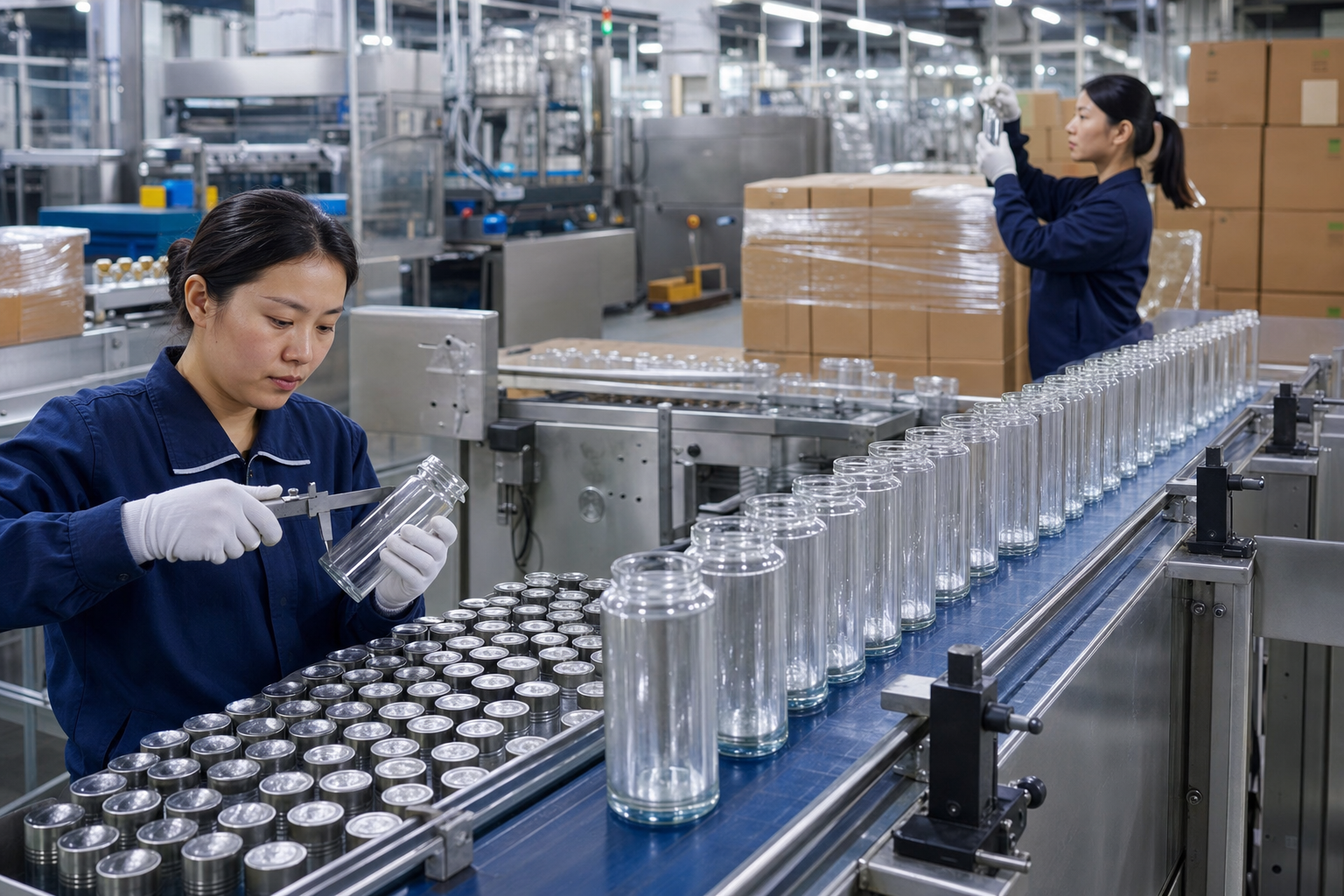
There is a real gap between a borosilicate glass bottle supplier and a borosilicate glass bottle vendor that shops the order around. If you need stable dimensions, matching neck finish, and repeat orders every quarter, factory-controlled production in Zhejiang or elsewhere in China is the safer route. A plant that runs its own melting furnace, forming line, and annealing lehr can hold tighter tolerances than a broker forwarding RFQs. QC pulled the sample and checked the mouth OD with calipers at 28.5 mm; that kind of detail is what keeps a PO from coming back with a typo on the neck finish.
Choose the Right Bottle Specification
The wrong spec causes more trouble than the wrong price. Before you place borosilicate glass bottle custom work, lock down the basics: capacity, neck finish, shape, color, and closure system. For wellness and sustainable retail, 350 ml, 500 ml, and 750 ml are the usual picks. We see 500 ml move best as a bulk glass water bottle because it sits well on retail shelves, fits gym bags, and packs cleanly in e-commerce cartons. On one line run, the buyer flagged a carton height error of 2 mm, and that small miss would have thrown off the whole pallet plan.
Give the closure proper attention. A stainless steel lid with silicone seal is common, but the thread has to match the neck finish exactly. If the lid torque is too loose, you get leaks. Too tight, and the customer complains on day one. For a custom borosilicate glass bottle, we keep the neck finish tolerance within about ±0.3 mm on critical dimensions. Sounds tiny, but it decides whether the lid line runs clean or jams every 20th unit. QC pulled the sample with a torque wrench at 0.45 N·m, and that test usually tells us more than a long email thread.
- Clear glass: best for premium hydration and tea bottles
- Frosted or tinted glass: useful for borosilicate glass bottle promotional projects
- Silicone sleeve: helps with grip and impact protection
- Infuser insert: better for tea and fruit water programs
If you are building a customizable glass water bottle range, keep the base mold simple. Decoration changes faster than a mold, and that is the right way to run it. We usually keep one 58 mm neck mold, then switch color, print, and packaging by market. A buyer once sent a PO with the SKU code wrong by one digit; the line caught it before molding, which saved a week. This is the wrong question to ask if you start with artwork first. Start with the bottle structure, then add the finishes.
Pricing, MOQ, and Lead Time
Let’s talk numbers. This is where buyers lose two weeks on email loops. For a basic borosilicate glass bottle wholesale order from China, MOQ usually starts at 3,000 pcs per design for stock tooling, or 5,000-10,000 pcs if you want a fully custom shape. On the line, that “custom” word changes everything. For a 500 ml bottle with a stainless lid, FOB China pricing often sits in the USD 1.10-2.40 range, depending on glass weight, sleeve, and print area. A custom logo package can add USD 0.08-0.35 per piece.
Lead time is usually 35-45 days after sample approval and deposit for standard production. If you need custom packaging, add 7-10 days. In our Zhejiang factory, the bottle itself is not the bottleneck; caps, cartons, and decoration are. QC pulled the sample last week and the cap color was off by 1.5 mm from the approved card. So ask for a production schedule by process, not a single promise date. The math does not work any other way.
Ask for this on day one:
- FOB port quotation, not just EXW
- MOQ per SKU and per color
- Sample lead time, usually 7-12 days
- Mass production lead time, usually 35-45 days
- Carton quantity, carton test standard, and pallet loading plan
For distributors borosilicate glass bottle programs, a realistic annual plan beats chasing the lowest unit price. We’ve seen this go sideways when a buyer pushed for a USD 0.12 saving, then lost it on breakage and rework. That small gap matters only when the yield stays stable and the breakage rate stays below 1.5% in packed goods. One PO typo on carton count can wipe out the savings fast.
Testing and Compliance You Should Demand
For Europe and North America, compliance is not optional. Your borosilicate glass bottle supplier should hand over food-contact documents that line up with REACH and LFGB for the EU, plus the FDA food-contact framework for the U.S. If the bottle has a silicone seal, straw, or plastic cap, each part needs its own material declaration. We once had a buyer flag a “general certificate” with no test reference number. That paper is useless.
For export cartons, ask for drop test and stacking data. A bottle can pass glass inspection and still break on the route because the pack-out is weak. We run 5-layer or 7-layer export cartons, with inner dividers or molded pulp trays based on the shape. For a 500 ml customized glass water bottle, AQL 2.5 for critical defects is standard, with 0 for food-contact contamination and sharp edge defects. QC pulled the sample and found one burr at the mouth; that is the kind of miss that kills a claim.
“If the factory cannot show you test reports, process controls, and packing specs, you are not buying a bottle. You are buying risk.”
Check thermal shock testing too. Borosilicate should beat soda-lime glass by a clear margin, but the result depends on wall thickness and annealing, often 2.0 mm versus 3.0 mm on the same line. Ask the borosilicate glass bottle manufacturer for the lab method and the temperature delta used; “heat resistant” is the wrong question to ask. We have seen that claim go sideways when the buyer shipped into the EU and the carton passed, but the bottle failed the hot-fill test.
Customization That Actually Sells
The best-selling borosilicate glass bottle we customize for wellness retail is usually the simple one. It looks premium on a 600 mm shelf, photographs clean, and does not raise breakage risk in transit. Logo placement, surface finish, and lid style do the heavy lifting. A custom borosilicate glass bottle with one-color print, laser engraving on the lid, and a plain kraft carton often outsells a crowded promo bottle with six messages. We run this test a lot, and the math does not lie.
Decoration options include silkscreen printing, decal firing, frosting, and laser marking on metal parts. For glass, silkscreen is the cost-efficient choice for 1-2 spot colors, and we keep the print area at least 35 mm high so the mark still reads after dishwashing and daily handling. If you need more detail, you can review our guide on silkscreen vs laser engraving. QC pulled the sample last week because the first logo sat too close to the shoulder, and the buyer flagged it before we packed 500 pcs.
What buyers usually overlook
They forget packaging. A customizable borosilicate glass bottle is not finished until the carton, insert, and barcode are ready. On one PO, the buyer typed UPC as UCP, and our line caught it before print, which saved a rework on 3,000 boxes. If you sell through Amazon or retail distribution, the outer carton should fit FNSKU or UPC labeling cleanly. If your channel includes marketplaces, our Amazon FBA drinkware sourcing notes will save you a few expensive mistakes.
For wellness brands, the best custom glass water bottle programs keep one mold and vary only finish and accessories. That is how you build a scalable line without locking money into too many SKUs. We have seen this go sideways when a buyer wanted 8 lid colors on a 1,200 MOQ order; the line slowed, stock got messy, and the margin disappeared. In Zhejiang, the factories that understand this move faster because tooling changes stay low and the same 25 mm neck finish can run across the full range.
How to Vet a Factory in China
Do not start with sample price. Start with output, kiln size, and who owns the tooling. Ask for monthly capacity in units, the kiln temperature curve, and whether the molds sit in-house or at a subcontractor. A real borosilicate glass bottle factory keeps repeat orders stable; if the neck finish drifts by 0.3 mm or the print shifts after the third run, we know the line is weak. At BottleForge in Zhejiang, we run 80,000-150,000 units per month, depending on bottle size and decoration load.
Then check the QC system. You want incoming glass checks, in-process inspection, and carton audit before loading. If a factory says “we inspect everything manually,” that is not a system. Ask for inspection sheets, reject photos, and the AQL 2.5 record. On one job, QC pulled the sample and found a 1.2 mm lip deviation before mass production; that saved the buyer from a full rework. A supplier borosilicate glass bottle program should lock bubble limits, finish marks, and dimensional tolerances before the first bulk run.
There is a commercial test too. A serious borosilicate glass bottle distributor gets Incoterms, payment terms, and reply time on paper. If a vendor takes 3 days to answer a sampling question, production will not improve. We have seen that go sideways. The buyer flagged one PO because “12,000 pcs” was typed as “120,000 pcs”; that typo would have blown the carton plan. In Zhejiang, a factory that answers fast and gives clear engineering feedback is worth more than a 3% cheaper quote from a plant that cannot keep the line straight.
Red flags: no factory address, no sample photos from the production floor, no explanation of breakage rate, and no written packing standard. If you see those, stop. We ran into one supplier who could not show a pallet spec or a drop-test result, and the math does not work.
Shipping, Packaging, and Reorder Strategy
Glass does not forgive bad packing. On a 10,000-unit borosilicate glass bottle order, we run inner dividers, foam corner pads, and a carton spec that matches the drop risk; if the buyer flags 400 gsm and wants lighter board, we push back. For sea freight to Europe or North America, moisture protection matters too. Poly bags, desiccant, and pallet wrap cost less than one claim. A 1% damage allowance sounds small, but that is 100 broken bottles, and the math gets ugly fast.
For reorder planning, do not wait until the shelf is empty. A custom borosilicate glass bottle program needs 60-75 days of buffer once you count production, export booking, customs, and inland delivery. We had one PO with “ship ASAP” typed in the remarks and no target week; QC pulled the sample, checked the mouth size at 28 mm, and we still had to ask the buyer for a real forecast. If sales are seasonal, place the next order when you still have 8-10 weeks of stock. That is the safer move for a borosilicate glass bottle wholesaler or a distributor borosilicate glass bottle channel that needs steady shelf fill.
If you plan to expand into related formats, compare the bottle line with our stainless thermos range and glass bottle product options. We usually tell buyers to pick one core custom glass water bottle and one add-on travel item, not four mold projects at once; otherwise the tooling cash gets tied up and the line sits idle.
For sustainable retailers, the strongest borosilicate glass bottle wholesale program is the one that keeps product story, carton weight, and freight cost in line. China still gives solid value here, but only if you buy to spec, not on hope. We have seen that go sideways more than once.
Request your custom borosilicate bottle quote
Send capacity, lid style, and target market. We will quote FOB, MOQ, and lead time within 24 hours from Zhejiang, China.
Frequently asked questions
What MOQ should I expect for a custom borosilicate glass bottle?
For a standard custom borosilicate glass bottle, expect MOQ around 3,000 pcs per SKU if the mold is existing, and 5,000-10,000 pcs if you need a new shape. Color changes or special caps can raise the MOQ. For borosilicate glass bottle bulk orders with simple print, a factory in Zhejiang may accept mixed packaging only after the first repeat order. Always confirm MOQ by bottle, lid, and carton version separately, because some borosilicate glass bottle manufacturers quote one number and then split charges later.
How much does a bulk glass water bottle cost from China?
A basic 500 ml bulk glass water bottle made from borosilicate glass usually costs about USD 1.10-2.40 FOB China. The price depends on wall thickness, bottle weight, lid material, and decoration. A silicone sleeve can add USD 0.18-0.45, while printing may add USD 0.08-0.35. If you need a customized glass water bottle with premium packaging, budget an extra USD 0.20-0.60 per set. Freight and duties are separate, so compare FOB offers from borosilicate glass bottle suppliers carefully.
What documents do I need for EU and U.S. sales?
For Europe, request REACH-related material declarations and food-contact compliance documents. For some buyers, LFGB test references are also important, especially for retail programs. For the U.S., ask for FDA-related food-contact support for the materials used. If your custom borosilicate glass bottle includes silicone, stainless steel, or plastic parts, each part needs its own declaration. A reliable borosilicate glass bottle supplier should also provide carton specs, packing list, and a test report number for traceability.
Is borosilicate really better than soda-lime glass?
For thermal shock, yes. Borosilicate handles temperature changes much better than ordinary glass, which is why it is widely used for tea bottles, labware, and premium drinkware. A typical borosilicate bottle with 1.2-1.8 mm wall thickness is less likely to crack when exposed to hot water after a cold rinse. That said, no glass is indestructible. You still need proper annealing, carton design, and drop testing. A borosilicate glass bottle manufacturer should explain the test method, not just say it is “heat resistant.”
How do I choose between a factory and a trading company?
If you need stable repeat orders, choose the borosilicate glass bottle factory whenever possible. A factory in Zhejiang or elsewhere in China can usually control molding, annealing, decoration, and packing more tightly. A trading company can be useful for mixed sourcing, but you may lose visibility on quality and lead time. Ask whether the borosilicate glass bottle distributor owns tooling, what monthly capacity they have, and how they handle AQL inspection. If they cannot answer clearly, you are probably dealing with a vendor rather than a true manufacturer.