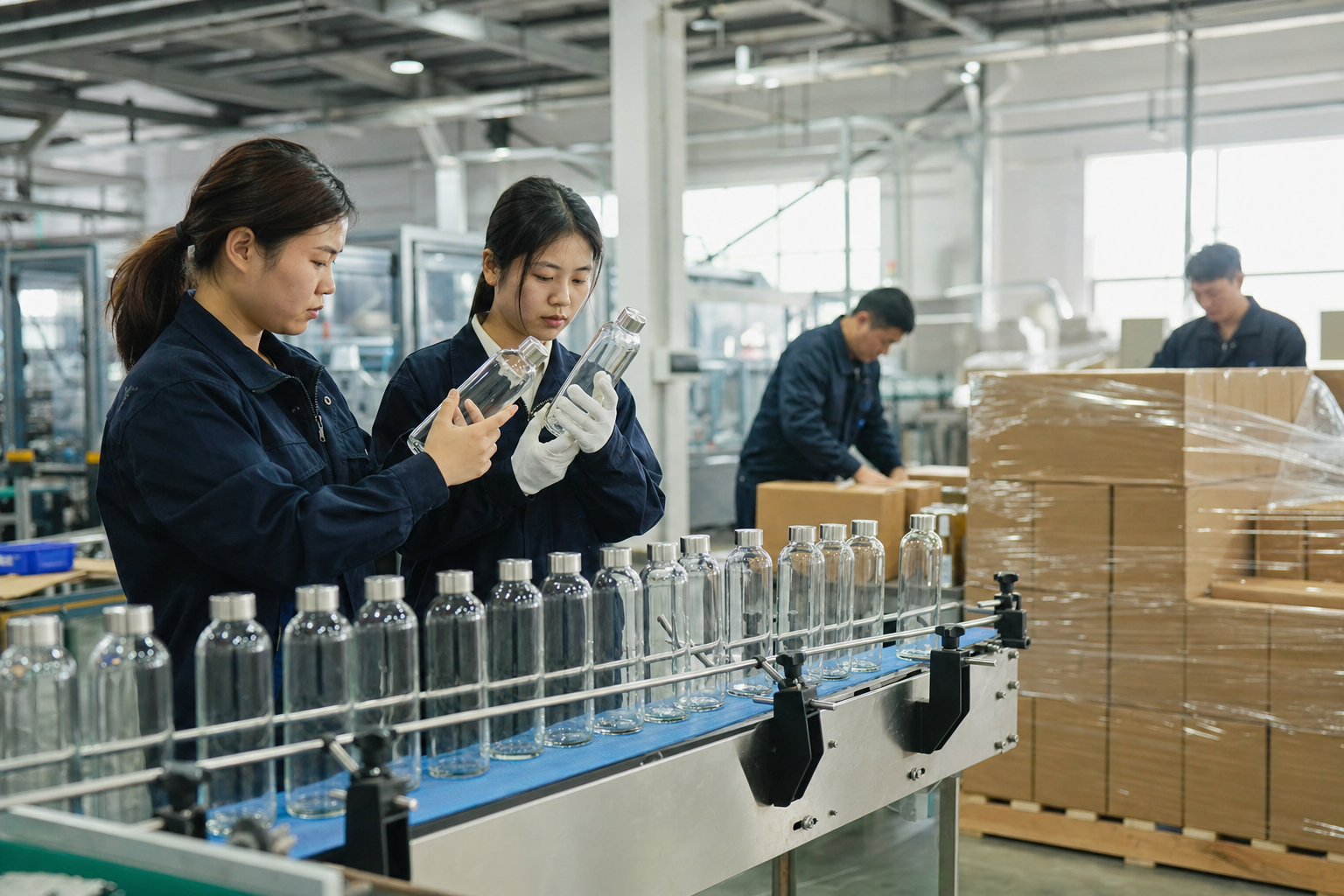
Key Takeaways
- Typical MOQ for a borosilicate glass bottle bulk program starts at 3,000 to 5,000 pcs per SKU, depending on mold and decoration.
- Standard lead time from a Zhejiang factory is usually 30-45 days after sample approval and deposit.
- For retail-ready quality, target a wall thickness of 1.8-2.2 mm and closure torque control within ±10% of spec.
- Ask for REACH, LFGB, and an AQL 2.5/4.0 inspection plan before you approve any customized glass water bottle order.
If you are sourcing for wellness brands or sustainable retailers, borosilicate glass bottle distributors do not win on price alone. You win when the bottle lands with the right wall thickness, closure fit, decoration quality, and compliance papers on the first pass. A 10,000-piece order that saves $0.08 per unit but fails REACH or leaks in transit is not a deal; it is a return-rate problem. We ran a 12-day vs 18-day dispatch test on 650 ml bottles, and the cheap carton spec came back with crushed corners at QC.
At BottleForge in Hangzhou, Zhejiang, we see buyers make the same mistake with custom glass water bottle programs: they treat glass like plastic. Borosilicate behaves differently. It holds up better under thermal shock, but it still needs correct annealing, neck tolerances, and packaging. The buyer flagged a 0.4 mm cap mismatch on one PO, and that sort of miss turns into noise on the line fast. If you are checking a borosilicate glass bottle factory in China, think in specs, not slogans.
What borosilicate buyers really pay for
When distributors buy a borosilicate glass bottle wholesale program, unit price is only the first line on the quote. You pay for glass stability, breakage control, print repeatability, and how the factory handles a reorder when the buyer flags a color drift. A real borosilicate glass bottle manufacturer should answer glass composition, annealing temp, and dimensional tolerance on the spot. If they stall, we know the line is loose.
Borosilicate glass earns its keep on hot-fill and thermal shock, but the money is in fewer claims. On a bulk glass water bottle order, 1% breakage versus 3% breakage can wipe out the margin on a 10,000 pcs shipment. We have seen this go sideways on a 42 cm pallet stack where the outer cartons crushed at the corner. A Zhejiang supplier should quote these items cleanly:
- Wall thickness: 1.8 mm, 2.0 mm, or 2.2 mm
- Neck finish tolerance: usually within ±0.2 mm
- MOQ: 3,000 pcs for standard SKUs, 5,000+ for custom molds
- Lead time: 30-45 days after sample sign-off
If you are comparing borosilicate glass bottle suppliers, ask for batch consistency data. QC pulled the sample from the line, and that tells you more than a sales pitch. One carton had a typo on the PO, and the buyer caught it before production; that kind of detail matters. A solid factory in China also talks straight about packing, because a good bottle still breaks if the divider spec, master carton strength, or pallet height is wrong.
Choosing a factory in China
For a borosilicate glass bottle factory, the first test is not the sales pitch. It is capacity, process control, and whether the plant can repeat the same bottle after 90 days. At BottleForge in Zhejiang, we run monthly output numbers, not vague promises, because serious buyers ask for hard data. A line that ships 600,000 units per month can usually cover staggered shipments, reserved stock for repeat orders, and mixed decoration runs without blowing up the schedule.
When you evaluate a borosilicate glass bottle vendor or borosilicate glass bottle vendor network, ask three direct questions:
- Do you own the mold, or is it shared across three accounts?
- Can you show the last AQL 2.5 inspection record?
- What drop test did the standard export carton pass, 60 cm or 80 cm?
A good distributor borosilicate glass bottle program depends on repeatable manufacturing, not a low FOB quote that looks good on paper. The math does not work if the factory cannot explain neck cracking, shoulder deformation, or print shift after annealing. We had one buyer flag a PO typo on the neck finish code, and that small mistake would have turned into a dead carton label at the port. In Zhejiang and other China production hubs, plenty of factories can make samples. Fewer can keep a retail program steady across three replenishment orders.
“A cheap sample is easy. A repeatable production run is the real test.”
For wellness brands, this matters because the bottle sits next to premium packaging and needs the same finish level. For sustainable retailers, it matters because a broken bottle is waste the customer can see. QC pulled the sample, found one 1.2 mm neck variation, and the run got held until the line corrected it.
Specs that prevent returns
A custom borosilicate glass bottle has to start with use case, not decoration. For cold brew or daily hydration, a straight-wall 500 ml body is easier to run, easier to pack, and less likely to crack in transit than an angled premium shape. If the order uses a bamboo lid or stainless cap, we check the cap seal and neck finish before tooling release—QC pulled a 38 mm sample once and the buyer flagged a 0.8 mm mismatch at the lip.
Here are the specs that matter most in a commercial order:
- Capacity tolerance: keep within ±5% unless your retail plan calls for tighter control; on a 500 ml bottle, that means 475-525 ml at fill line
- Thermal performance: borosilicate should handle about 150°C differential, but never promise that to consumers unless tested in your lab or a third-party report
- Decoration area: allow 10-15 mm clear space from the shoulder and base so the print does not warp on the curve
- Packaging: use individual inner boxes for DTC or Amazon FBA, or you will see scuffs and breakage on the line; we ship these in 12-piece inner cartons when the buyer wants shelf-ready packs
If you need a customizable glass water bottle or customizable borosilicate glass bottle, lock the logo method early: silk screen, laser, UV print, or frosted etch. Each one changes lead time and unit cost. A printed 500 ml bottle may add $0.18-$0.45 per unit; laser is cheaper, but the mark is subtle. For a customized glass water bottle in premium retail, the finish sells the item. We have seen buyers chase a low glass cost, then lose margin because the artwork looked weak on shelf.
In China, many buyers miss the bottle mouth finish. That is the wrong question to ask. A 28 mm or 38 mm finish changes closure sourcing, carton size, and how the bottle sits in a display tray. One PO came through with the cap code typed as “28MN”; the buyer meant 28 mm, and the whole sample set had to be reworked. A good borosilicate glass bottle customized program starts with the neck drawing, not the logo file.
Compliance for Europe and North America
If you sell into Europe or North America, compliance is not optional. A credible borosilicate glass bottle supplier should hand over food-contact declarations, material specs, and traceability records from the line. For EU shipments, ask for REACH-related declarations and, where needed, LFGB support. For North America, our buyers usually ask for FDA food-contact position papers or state packaging rules; that is the first file check, not the last.
Do not assume “glass” means compliant by default. Ink, coatings, caps, silicone rings, and printed cartons all sit in the same paper trail. We had one PO where the buyer flagged a carton typo on the country-of-origin line, and QC pulled the sample because the cap spec was missing. A borosilicate glass bottle distributor shipping to Amazon or retail chains should check:
- Glass test reports from an accredited lab
- Cap material declarations for PP, bamboo, or stainless steel components
- Carton compression and drop-test results
- Country of origin labeling and HS code accuracy
For wholesale buyers, AQL is the practical tool. For a retail run, AQL 2.5 major and 4.0 minor is a normal starting point, but if the pack-out has inserts, shrink wrap, and nested bottles, tighten the inspection plan. We run glass at 1.8 mm wall thickness on some SKUs, and one chip on a borosilicate glass bottle bulk order can turn into a claim fast. The math does not work if you leave it loose.
If you are importing a distributor glass water bottle line into the US or EU, make sure your factory in Zhejiang or elsewhere in China can reissue documents on repeat orders. Retailers ask for the same file set again and again. We keep the file pack tied to each SKU and carton version, because a 2024 PO can come back in 2025 with the same request and a new importer name.
MOQ, pricing, and margin math
Buyers often ask for a borosilicate glass bottle wholesale quote before they set a retail price. Wrong order. We run the numbers from landed cost first, then work back. On a standard 500 ml bottle with a simple lid and one-color logo, FOB usually sits around $1.05-$1.85, depending on shape, carton style, and order size. Once the buyer flags a new mold or upgraded gift box, the price jumps fast.
For a custom borosilicate glass bottle, the main cost drivers are simple enough to model on a calculator at the line:
- Tooling: $350-$1,500 for standard custom shapes, more for complex forms; our 12-cavity mold quote changes fast if the neck finish is non-standard
- MOQ: 3,000 pcs for decorated stock shape; 5,000-10,000 pcs for new mold projects
- Printing: one-color silk screen is the lowest-cost branding option; a two-color logo needs another plate and another setup
- Packaging: individual box can add $0.12-$0.40 per unit; a 350 gsm white box costs less than a printed mailer
For a borosilicate glass bottle promotional campaign, chasing the lowest unit price is the wrong question to ask. It only works when the run is short and the end buyer is easygoing. If you are building a repeat retail SKU, spend the extra cents on better packaging and a tighter inspection standard. We’ve seen this go sideways when cartons crack at 2% and the buyer expects retail-ready shrink wrap.
Distributors selling into wellness and sustainability channels should also watch reorder math. If the factory holds semi-finished stock, repeat lead time can drop from 40 days to 15-20 days. That is a real edge in China sourcing, not marketing talk. QC pulled the sample with a caliper at 0.5 mm tolerance, and the SKU moved faster on the second PO because the buyer had one typo fixed before production.
How to brief a factory correctly
Most sourcing problems start with a vague brief. A serious borosilicate glass bottle manufacturer needs a clean spec sheet before sampling. We had a buyer send only “500ml, blue cap” once; QC pulled the sample, and the neck finish was wrong by 1.5 mm. If you want a customized borosilicate glass bottle that can move into wholesale later, send the factory a drawing, target capacity, cap type, logo method, carton requirement, and target market. Skip one item and the sample can look fine, then fail on the line.
Use this order of operations:
- Confirm bottle volume, finish, and target retail channel
- Choose decoration method and print area
- Request sample and dimensional report
- Approve packaging with drop-test target
- Lock production sample before mass order
For a custom glass water bottle program, ask for at least one pre-production sample and one packed sample. The naked bottle can pass, but the packed version still fails if the carton is too loose; we ship cartons that way, and 3 mm of extra void space has broken bottles in transit. If you are working with borosilicate glass bottle distributors in Europe or North America, your retail team may want barcode placement, FNSKU sticker location, and shipper carton markings aligned before production starts. This is the wrong question to ask after you place the order.
We recommend requesting photos from the first 100 pcs off the line. It is a simple control step, and in a Chinese export shop it saves days. A disciplined borosilicate glass bottle supplier will not push back on that request. We run it on every new SKU.
When distributors should stock versus custom
Not every program needs a full mold. If you are testing a market, a stock shape with custom logo is usually the smarter move. Tooling stays low, reorders are cleaner, and the line can turn faster. For a first run, we often start with a bulk borosilicate glass bottle from a proven mold, then change the cap, sleeve, color, or carton. QC pulled the sample at 1.2 mm wall thickness and the buyer signed off after the logo placement was fixed.
Choose stock-plus-branding when:
- Your first order is under 5,000 pcs
- You need launch speed in under 45 days
- You want lower inventory risk
Choose full custom when:
- You need a unique shelf shape
- Your brand can commit to 10,000+ pcs per run
- You want a proprietary silhouette for retail protection
For a distributor borosilicate glass bottle program, stock shapes usually protect cash flow better. For a distributors borosilicate glass bottle procurement plan tied to premium wellness branding, a custom shape can earn its keep if the line has real volume behind it. We have seen this go sideways when the buyer wanted a special neck finish but could only take 3,000 pcs. The math doesn't work. If you go custom, your China supplier needs to hold repeat dimensions within a few tenths of a millimeter, or the cap fit and packing size start drifting.
At BottleForge in Hangzhou, Zhejiang, our export team sees the same pattern every season: the buyers who raise the hard questions early get fewer headaches later. One PO typo on a 28 mm neck finish once cost us a full day on the filling test, so we check those details before we ship.
Request your custom borosilicate quote today
Send your volume, finish, logo method, and target market. We will quote OEM options from our Hangzhou, Zhejiang factory with clear MOQ and lead time.
Frequently asked questions
What MOQ should I expect for borosilicate glass bottle bulk orders?
For standard stock shapes with one-color logo, a realistic MOQ is 3,000 to 5,000 pcs per SKU. If you want a new mold or special packaging, plan for 5,000 to 10,000 pcs. A small promotional run can go lower, but your unit price usually rises by 15% to 30%. In China, many factories will quote a lower sample MOQs, but that is not the same as a production MOQ.
How much does a custom glass water bottle cost from a factory in China?
A simple 500 ml custom glass water bottle with standard cap and basic print often lands around $1.05 to $1.85 FOB, depending on order size and packaging. Add $0.12 to $0.40 for an individual box, and $0.18 to $0.45 for print or decoration. A new mold can add $350 to $1,500 or more. Exact pricing depends on wall thickness, finish, and carton spec.
What tests should borosilicate glass bottle distributors ask for?
Ask for food-contact compliance documents, REACH-related declarations for EU shipments, and if needed LFGB support. You should also request drop-test results, carton compression data, and a clear AQL inspection plan. For retail orders, AQL 2.5 major and 4.0 minor is common. If the bottle includes a cap or silicone ring, request material declarations for those parts too.
How long is the lead time for a borosilicate glass bottle wholesale order?
For an existing mold and confirmed decoration, 30 to 45 days after sample approval and deposit is standard from a capable Zhejiang factory. If you need a new mold, add 10 to 20 days for tooling and sample correction. If the factory holds semi-finished stock, repeat orders can sometimes ship in 15 to 20 days, which helps distributors manage seasonal demand.
Can I order a customizable borosilicate glass bottle for Amazon FBA?
Yes, but you need to plan the pack-out carefully. Amazon FBA usually requires barcode placement, carton labeling, and a damage-resistant inner pack. A customizable borosilicate glass bottle for FBA should be packed with inner dividers or individual boxes, and your supplier should confirm carton dimensions before production. For glass, transit protection matters more than saving a few cents on packaging.