Key Takeaways
- Typical MOQ for a custom borosilicate glass bottle is 3,000-5,000 pcs per design, with 35-50 day production lead time.
- Good borosilicate glass bottle wholesale pricing usually starts around USD 1.20-2.80 per unit for simple 500 ml models, excluding freight.
- For retail-ready bulk glass water bottle projects, ask for AQL 2.5 inspection, drop-test reports, and REACH-compliant materials.
- A reliable factory in Zhejiang should offer 3+ decoration methods, 500,000+ units/month capacity, and stable export packing.
- Thermal shock resistance, lid gasket material, and carton testing matter more than a polished sample photo.
If you are sourcing from a borosilicate glass bottle factory, the first mistake is assuming every bottle handles the same job. It does not. A 2 mm soda-lime bottle may sit fine on a shelf, then crack under hot-fill, thermal shock, or the kind of rough retail handling that shows up after 3 days in transit. We have seen buyers learn that the hard way: broken necks, dented cartons, and a PO typo that turned 5,000 pcs into 50,000 pcs.
The better approach is to treat the order like a technical sourcing job. Check glass composition, wall thickness, lid sealing, print method, and carton drop performance before you talk about color or logo placement. A serious borosilicate glass bottle manufacturer in Zhejiang or elsewhere in China should give you MOQ, lead time, and test standards without guessing. If they cannot, that is the wrong factory for the line. QC pulled the sample, measured the wall at 2.8 mm, and found the cap liner was the weak point.
What makes borosilicate glass different
When you source from a borosilicate glass bottle factory, the glass formula comes first and the bottle shape comes second. Borosilicate glass has boron oxide in the mix, so it handles thermal shock better than soda-lime glass. We see the difference on the line: hot water, iced drinks, and dishwasher cycles without the same crack rate. For a wellness brand selling detox drinks, tea infusions, or cold brew, that is a cost question, not a styling one.
Ask for the material spec in writing. A real borosilicate glass bottle supplier should state the coefficient of thermal expansion, usually around 3.3 x 10^-6/K for standard borosilicate. If the factory cannot explain wall thickness, usually 1.8-2.2 mm for a 350-500 ml bottle, the buyer should pause there. We had a PO last quarter with “borosilicate” typed as “borosilicte”; QC pulled the sample, checked the caliper at 2.0 mm, and the buyer flagged it before production. In Zhejiang, the better factories answer these questions fast because export buyers ask them every day.
What you should verify
- Glass type: borosilicate, not generic high-white glass
- Wall thickness: 1.8 mm minimum for mainstream retail use
- Thermal shock test: at least 120°C delta if you expect hot-fill use
- Food contact compliance: REACH, LFGB, and applicable FDA declarations
Do not approve a custom borosilicate glass bottle based on appearance alone. We’ve seen that go sideways. The formula and the test report tell you whether the bottle will survive real use.
How to qualify the factory
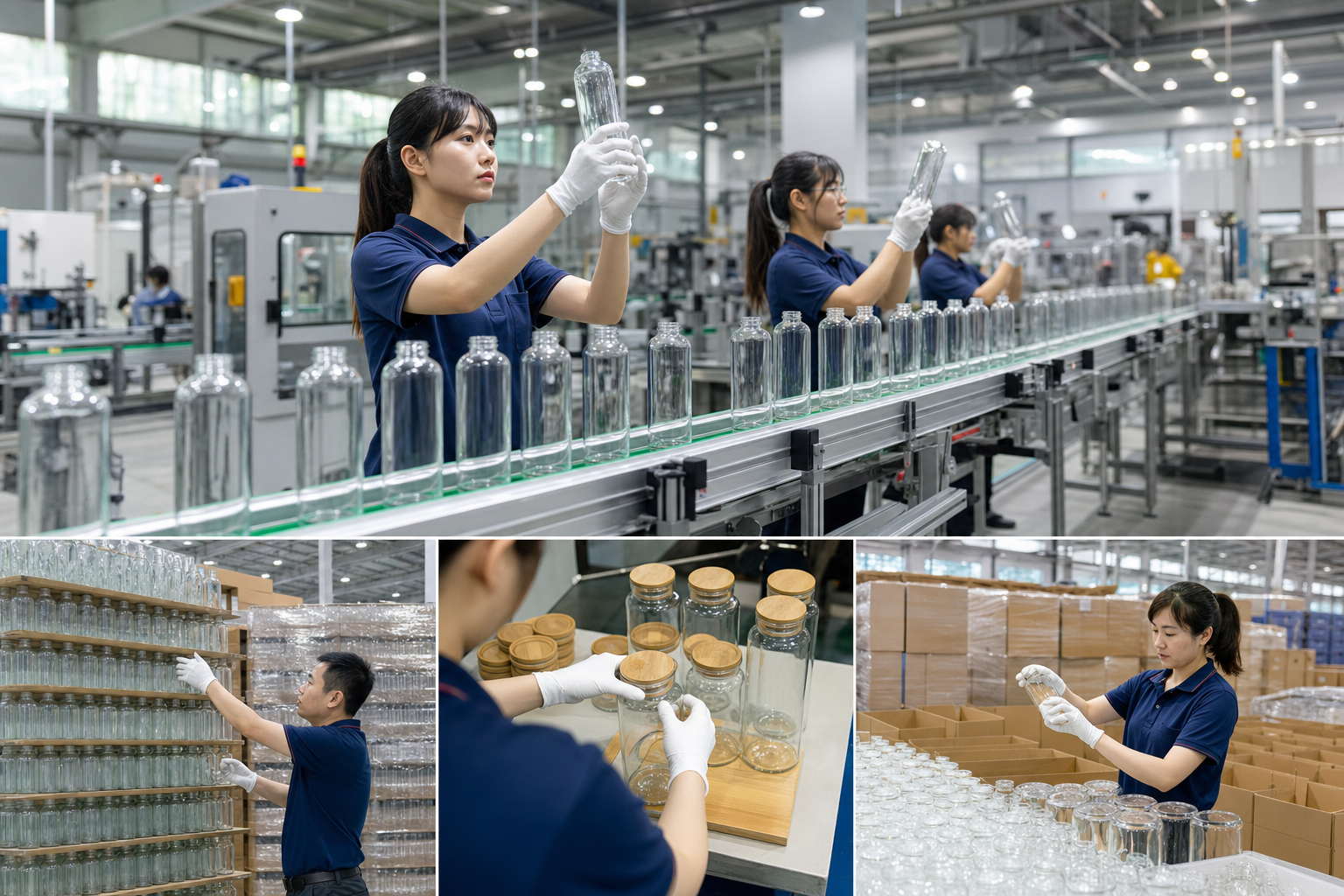
A borosilicate glass bottle factory should show more than a catalog. You want proof they run the line, keep QC records, and ship on schedule. In China, some trading companies will tell you they are the factory. We have seen that story go sideways. Ask for workshop photos, machine list, monthly output, and the inspection flow. A real borosilicate glass bottle manufacturer in Zhejiang will reply with numbers, not slogans.
A solid export plant can often turn out 500,000 to 800,000 units per month across glass bottle lines, with 35-50 days for custom orders after sample approval. If someone promises a custom borosilicate glass bottle in 12 days, the math does not work; mold work, print setup, and carton confirmation are still on the table. Ask if they are BSCI audited, whether they work to ISO 9001 procedures, and whether they can hold AQL 2.5 for cartons and appearance. QC pulled the sample, found one 1.2 mm print shift, and that told us more than a polished sales deck.
- Capacity: monthly output and number of lines
- Audit: BSCI, ISO 9001, Sedex, or equivalent
- QC: incoming raw materials, in-process checks, final AQL
- Export experience: EU and North America carton labeling, pallet standards
If you buy from a borosilicate glass bottle supplier for retail distribution, ask for container-loading photos and the drop-test packing spec. A distributor borosilicate glass bottle program lives or dies on damage rate, not on how the sample looked under studio lights. We usually ask for the carton size, gross weight, and a full pallet photo; one typo on a PO once changed the inner pack count from 12 to 120, and the buyer flagged it before the line started.
MOQ pricing and lead times
Most buyers ask for a borosilicate glass bottle wholesale price before they pin down the spec. That is the wrong question to ask. Price follows volume, mold structure, lid material, decoration, and how the carton is packed. We quoted a 500 ml clear bottle with a bamboo lid and one-color logo at USD 1.20-1.80 for 3,000 pcs; once the buyer added a silicone sleeve, UV print, and a double-wall profile, the number jumped to USD 2.20-3.50. A carton gift box with barcodes adds more. QC pulled one sample with a 1.5 mm lid gap, and the buyer flagged it right away.
For custom borosilicate glass bottle projects, the MOQ is usually 3,000-5,000 pcs per design if we run an existing mold. If you want a new shape, the floor needs 5,000-10,000 pcs because mold setup and line changeover have to be paid back. Lead time normally breaks into 7-12 days for sample development, 15-20 days for artwork and sample sign-off, and 20-30 days for production. A seasonal launch needs 90 days of runway. Thirty days is too tight, and we have seen that go sideways when the PO had the lid color typed as "bambbo" and nobody caught it until pre-production.
Typical sourcing ranges
- Simple 350 ml bottle: USD 0.95-1.40 FOB China
- 500 ml custom bottle: USD 1.20-2.80 FOB China
- Premium promotional set: USD 2.80-4.50 FOB China
These numbers are normal for a borosilicate glass bottle customizable program from Zhejiang or another export hub in China. If someone offers half those prices without a clear spec sheet, the math does not work. We ship to buyers who want the 304 stainless lid, the 2 mm wall thickness, and the correct carton count; when that spec is missing, the factory usually cuts glass weight or weakens the pack. A cheap quote with no drawing attached is a warning sign.
Customization that actually sells
Most borosilicate glass bottle custom projects go wrong because the buyer piles on decoration and forgets how the bottle gets used. People want something easy to wash, easy to grip, and clean on shelf. We see the same issue on the line every week. A custom glass water bottle for wellness retail should hit three points: clear branding, solid sealing, and day-to-day use. That means a clean logo, a lid that stays tight after repeated opening, and a body shape that still works in a cup holder or on a fridge shelf.
There are several decoration methods, and the cost stack is not the same. Silk screen printing is usually the lowest-cost choice for a borosilicate glass bottle wholesale order. Laser engraving suits bamboo lids or stainless parts; it is weak as the main decoration on glass. UV printing gives strong color, but if curing is off by even 10 seconds, scratch resistance drops fast. QC pulled the sample and saw it. For a borosilicate glass bottle promotional run, one-color print is often enough. For a premium borosilicate glass bottle customized program, etching or a frosted gradient can support a higher shelf price.
Practical customization choices
- Capacity: 350 ml, 500 ml, and 750 ml are the safest retail sizes
- Lid: bamboo, stainless steel, PP, or glass-over-cap combinations
- Seal: food-grade silicone gasket, preferably 70A hardness or similar
- Branding: one-color silk screen, laser on lid, or full-wrap label
If you want a customizable glass water bottle for gift sets, ask the factory to mock up sleeve, carton, and insert together. We had a buyer flag a PO because the insert height was 3 mm off and the bottle rattled in transit. Pretty bottle, poor protection. That is the wrong question to ask if the set will ship by the carton.
Testing and compliance you should demand
A borosilicate glass bottle manufacturer should not ask you to “trust the quality” without paper. We ship to Europe and North America, so the bottle has to clear product checks and packaging checks before it leaves the line. Ask for food-contact declarations, REACH compliance for the material set, and FDA-related documents if your market needs them. For lids, check the silicone or PP grade first. The glass is usually fine. The closure is where we see trouble.
Ask for three test packs: appearance inspection, functional testing, and transport testing. Appearance should follow an agreed AQL plan, usually AQL 2.5 for major defects and 4.0 for minor defects. Functional testing should cover leak checks, lid torque where there is a threaded cap, and thermal shock for hot-fill use. Transport testing should include carton compression, 1.0 m drop tests, and pallet stability. If you are buying a customized glass water bottle for Amazon or retail distribution, add barcode verification and carton mark review. We had a buyer flag a simple PO typo on the carton count, and it held the receipt for 12 days. Bad labels do that.
One more point: borosilicate is strong, but it is still glass. Do not spec a bottle for microwave use or boiling water if your customer only fills it with cold water. The math does not work, and we have seen it go sideways in after-sales claims. A good borosilicate glass bottle supplier will pin down the real use case, then set the test plan around that. QC pulled the sample, checked the wall thickness at 1.8 mm, and that told us more than any sales pitch.
Choosing packaging for export
Packaging decides whether your bulk glass water bottle shipment lands sellable or arrives as shards. We ship plenty of 280-420 g bottles, and single-wall cartons fail fast once the line starts stacking pallets for sea freight to Europe or North America. One buyer once sent a PO with “1000 pcs/carton” typed twice by mistake, and the math did not work. A borosilicate glass bottle wholesale order needs inner protection matched to bottle weight, lid style, and carton strength.
For retail and distribution, build the pack around the channel, not around habit. A distributor glass water bottle program for brick-and-mortar stores may run 24 pcs per master carton, while Amazon FBA usually wants individual polybags, suffocation warnings, and FNSKU labels. If you are buying from borosilicate glass bottle distributors, ask for shelf-ready cartons, PDQ trays, or master case packing, then pick one. We’ve seen this go sideways when the buyer copied a supermarket pack spec into FBA and got hit with repacking fees.
- Inner packing: molded pulp, EVA, or partitioned carton dividers
- Outer carton: 5-ply or 7-ply depending on bottle weight
- Palletizing: export-grade wrap, corner boards, and pallet height control
Factories in Zhejiang usually know export cartons better than small inland plants, but do not guess. QC pulled the sample, dropped it from 76 cm, and the corner scuffed through the sleeve on the second hit. Ask for that video and a carton compression number before you place the order. That one check filters out a lot of weak borosilicate glass bottle vendors.
Working with distributors and private label buyers
If you are a borosilicate glass bottle distributor, your priorities are different from a startup brand. You need repeatability, low breakage, and a steady reorder flow. A distributor borosilicate glass bottle program usually cares less about fancy custom shapes and more about predictable SKUs that can come back every 30-60 days. We run that line with fixed molds, replaceable lids, and color chips kept against Pantone cards. The product should be plain. That is the point.
For a borosilicate glass bottle distributor or wholesale buyer, private label means controlling the story and cutting weak claims. You do not need a complicated pitch. “Reusable,” “BPA-free lid,” “heat-resistant borosilicate,” and “dishwasher-safe bottle body” are enough if they are true. That sells better than glossy sustainability copy, and we have seen buyers get pushed back by retailers when the label overpromises. A sustainable retailer wants fewer complaints and fewer replacements, not marketing poetry. On the line, QC pulled the sample with a lid torque issue at 0.8 N·m, and that one detail saved a headache later.
Private label buyers should lock in spare parts from day one. Ask for extra lids, gaskets, and replacement cartons in the first contract, especially for custom borosilicate glass bottle programs shipped to 3 warehouses or more. We ship replenishment, not a one-shot order. A PO typo on carton size can turn into a 12-day delay versus an 18-day fix if the buyer flags it late. Keep 2% extra cartons and a spare gasket lot in reserve. That is the supplier you keep for next season.
Get a factory quote for your bottle project
Send your target volume, lid style, and market. We will give you a real FOB price, MOQ, and packaging plan from Zhejiang.
Frequently asked questions
What is the usual MOQ for a custom borosilicate glass bottle?
For an existing mold, the usual MOQ is 3,000-5,000 pcs per design. If you want a new shape or a special lid, expect 5,000-10,000 pcs. Most factories in China need that volume to cover setup, QC, and packaging. For a simple 500 ml custom glass water bottle with one-color print, the first order often lands at 3,000 pcs because that balances price and risk. If a supplier offers 500 pcs, check whether they are a real manufacturer or only reselling stock.
How much does a borosilicate glass bottle cost FOB China?
A plain 350 ml bottle can start around USD 0.95-1.40 FOB China. A 500 ml custom borosilicate glass bottle with a bamboo lid and one-color logo often lands at USD 1.20-2.80. Add sleeve, gift box, or premium decoration and pricing can reach USD 3.50-4.50. Freight, import duty, and fulfillment are separate. If you are comparing borosilicate glass bottle wholesale quotes, make sure every quote includes the same lid, gasket, carton, and print method.
Can borosilicate glass bottles handle hot water safely?
Yes, if the design and testing are correct. Standard borosilicate glass is much better at thermal shock than ordinary glass, and many bottles handle hot water, tea, or dishwasher use. The factory should specify thermal shock testing, often with a 120°C temperature delta or a controlled hot-cold cycle. The lid and seal matter too, because leaks usually come from closures, not the glass. Do not assume every customized glass water bottle is safe for boiling water unless the supplier states it clearly in writing.
What compliance documents should I ask for?
At minimum, ask for food-contact declarations, REACH-related material declarations for Europe, and any applicable FDA support documents for North America. For the lid, request silicone or PP material specs. For larger retail programs, ask for AQL inspection records, drop-test results, and carton compression data. A serious borosilicate glass bottle manufacturer in Zhejiang or elsewhere in China should provide these without delay. If they hesitate, that is usually a sign they have weak documentation or outsourced production.
How long does production take for a customized glass water bottle?
For a standard custom borosilicate glass bottle using an existing mold, sample development usually takes 7-12 days, artwork confirmation another 3-7 days, and production 20-30 days after approval. Total time is often 35-50 days before shipping. If you need a new mold, add 15-25 days depending on complexity. For seasonal wellness launches, you should plan 90 days ahead. That buffer matters more in China because export schedules, carton printing, and consolidation can add time at the end.