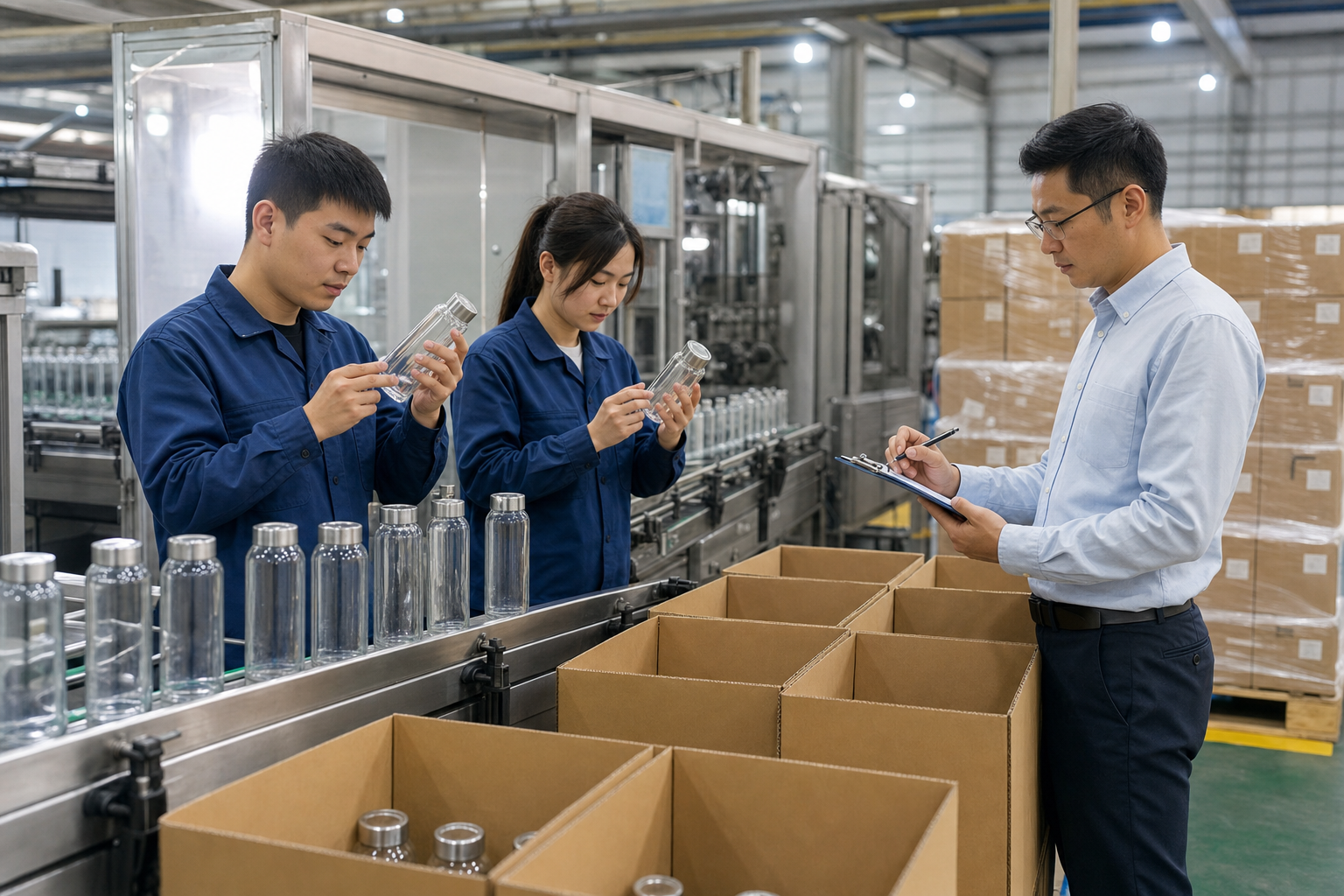
Key Takeaways
- A 500 ml borosilicate glass bottle often lands at USD 1.35-2.40 FOB depending on lid, coating, and decoration
- Typical MOQ from a serious borosilicate glass bottle factory starts at 3,000-5,000 pcs per SKU
- Lead time is usually 25-35 days after sample approval, not counting transit
- Ask for AQL 2.5 major / 4.0 minor, REACH, and thermal shock test data before you confirm bulk order
If you are sourcing from a borosilicate glass bottle manufacturer, the first mistake is treating glass like a commodity. It is not. Wall thickness, thermal shock resistance, closure fit, and decoration method all hit your landed cost, breakage rate, and buyer complaints. We ran a 500 ml sample last month; it looked fine on the table, then the cap started weeping after 3 drops in transit testing and the carton held only 5.2 kg before the corner crushed.
For wellness brands and sustainable retailers, the buying call comes down to appearance, safety, and a supply line that repeats month after month. Here in Zhejiang, the better factories are selling controlled production, test data, and export packaging that survives the trip. We ship borosilicate glass bottle custom orders every week, and the buyer usually flags the same thing first: the PO says 500 ml, but the artwork file has 550 ml. That typo alone can blow up the quote. Ask the right questions before you price the first FOB order. The math does not work otherwise.
What borosilicate glass really changes
Borosilicate glass is not a sales buzzword. It has a lower thermal expansion rate than soda-lime glass, so it takes hot-and-cold swings with less drama and usually feels cleaner in the hand. We run this on the line every week: a 500 ml bottle filled with 5°C water, then rinsed with 90°C water, and the cheaper glass starts showing stress near the shoulder. For a custom borosilicate glass bottle, that difference shows up in cracked returns and customer emails.
Ask the borosilicate glass bottle manufacturer for the composition range, wall thickness, and annealing curve. For a 350-500 ml bottle, 1.8-2.2 mm is the working range we ship; below that, the weight drops a few grams, then breakage climbs, and above that freight starts eating margin fast. QC pulled the sample and checked it with a micrometer at 1.96 mm on the body, which is the kind of number buyers want to see. If the factory cannot explain thermal shock test results in degrees Celsius, the math does not work.
- Wall thickness: 1.8-2.2 mm is a practical export range
- Thermal shock test: ask for at least 120°C differential on the body spec, where applicable
- Surface finish: inspect for bubbles, cords, and striae under bright light
How to compare bottle structures
Buyers usually start with print and lid color. Wrong order. Structure decides whether the bottle works on a desk, in a cup holder, or through a 5,000-piece retail run. We check capacity tolerance, mouth diameter, base stability, and whether the body is straight-wall or slightly tapered. A 500 ml bottle with a 55 mm mouth fits a tea infuser cap; a 45 mm mouth keeps the profile slimmer for carry. If you are sourcing a bulk borosilicate glass bottle for retail shelves, the silhouette also has to fit carton packing and shelf facings.
Ask your borosilicate glass bottle supplier for a dimension sheet with tolerance bands. We run standard molds at ±1.5 mm on height and ±1.0 mm on mouth diameter. That is tight enough for repeat packing. For a promotional borosilicate glass bottle, the buyer flagged a curved shoulder once, but the math did not work: new mold development usually lands at USD 2,000-6,000, and stable samples need 30-45 days. On our line in Zhejiang, factories that keep their own mold polishing tools and spare inserts usually stay more consistent than a borosilicate glass bottle vendor passing work through a middle layer.
Practical structure checks
- Base ring should sit flat with no rocking on a glass table; QC pulled the sample with a 0.2 mm feeler gauge
- Cap threads must match the gasket compression line, not just the visual fit; a PO once came in with the thread callout typed as 52 mm instead of 55 mm
- Any silicone sleeve must not trap moisture or hide bubbles; we have seen that go sideways in carton inspection
Decoration that survives export
Most buyers ask for a borosilicate glass bottle with logo print, measurement marks, or a color wash. Fine, but the decoration has to survive packing, carton rub, and dishwashing. Screen print is still the workhorse on the line because it holds up and stays cost-effective at volume, usually USD 0.08-0.25 per color at scale. We run 120-150 mesh for clean edges. Laser engraving can look sharp on metal caps or some glass areas, but for a full logo on clear glass, the math does not always work.
If you want a custom glass water bottle for wellness retail, keep the print away from the grip zone. I usually push a single-color print on the back panel or a frosted band that stops short of the full body. For a borosilicate glass bottle wholesale program, the decoration must stay stable across reruns. QC pulled the sample under daylight and warm LED, and the buyer flagged a shift that was invisible under the factory lights. Ask for a pre-production sample and a golden sample seal before mass production starts. We've seen that shortcut go sideways.
Do not approve decoration from a JPEG mockup alone. Approve on a physical sample, then lock the Pantone, size, and print position.
MOQ, pricing, and lead time
Buyers often ask for a borosilicate glass bottle wholesale quote with no specs. That is the wrong question to ask. On our line, a PO with “500 ml bottle” and nothing else gets sent back twice. Give capacity, cap type, color, logo method, packaging, and annual forecast, then we can price it cleanly. A plain 500 ml bulk glass water bottle with bamboo lid and one-color print starts around USD 1.35-1.80 FOB China at 3,000 pcs. Add a stainless lid, silicone sleeve, or custom gift box and the number moves to USD 1.90-2.40 FOB fast.
Most borosilicate glass bottle factory orders in Zhejiang sit at MOQ 3,000 pcs per color, and 5,000 pcs if the buyer wants new mold work. We run a 12-day sample cycle only for stock parts; full custom needs more time. Lead time is usually 25-35 days after sample approval and deposit. QC pulled the sample last week and found a 1.2 mm lid gap, so we held the batch. If someone promises 7 days for a fully customized borosilicate glass bottle, the math does not work. For seasonal programs, leave 15-20 days of buffer before ocean booking, especially for North America or Europe in peak freight months.
- Stock-style customization: MOQ 1,000-3,000 pcs
- New mold project: MOQ 5,000 pcs or more
- Payment term: 30% deposit, 70% before shipment is common
Quality control you should actually ask for
A pretty bottle that leaks is a bad product. QC has to start at incoming material and keep going through forming, annealing, printing, packing, and carton drop test. For a borosilicate glass bottle manufacturer, ask for AQL in the PO, not after the first claim lands. We usually quote AQL 2.5 for major defects and 4.0 for minor defects on export drinkware. If your bottle goes into wellness retail, a leak or crack is not cosmetic. Class it as major or critical. The buyer flagged that point on a 12,000 pcs order last month, and he was right.
Ask for REACH papers for anything touching the consumer, plus the food-contact declaration your market needs. We run internal breakage targets below 1.5% in process on mature SKUs, though the packed rate shifts with neck shape, cap style, and carton insert. A factory in Zhejiang should show you the batch record, not just send a PDF by WeChat. QC pulled the sample from the line at 10:20, checked the heel crack rate, and that record is what your retailer will ask for when the shipment gets opened.
QC checkpoints worth paying for
- Leak test at inverted angle with filled water for each batch lot
- Cap torque and gasket compression verification
- Carton drop test at 60-80 cm depending on shipper spec
- Visual inspection under 800-1,000 lux lighting
Packaging for retail and e-commerce
Packaging is where a lot of bulk borosilicate glass bottle programs go wrong. The bottle can pass QC, then a weak inner tray or a carton that is 15 mm too loose starts breaking necks in transit. For a custom glass water bottle sold through retail or FBA, the pack has to match the channel, not just sit neatly on the factory shelf. If you ship to Amazon, the line needs barcode placement, a suffocation warning if the SKU calls for it, and carton sizes that keep dimensional weight down. For a distributor borosilicate glass bottle program, pallet count matters too, and the buyer will ask for the cube math on day one.
For a typical 500 ml bottle, a good inner box can cut damage by 30-40% versus loose packing. Paper pulp trays often beat thick foam on sustainability, but only if they clamp the neck and base with enough tension. We have seen 2 mm of extra play turn into chipped rims after a 1.2 m drop test. If you want a customized glass water bottle with gift appeal, go with a rigid paper box, a molded insert, and ink that does not scuff when the cartons rub in the truck. A borosilicate glass bottle promotional kit should land looking clean in New York or Berlin, not like a sample pulled from the back room. Some suppliers miss that by a mile.
Ask your factory to run carton compression and drop tests with the same master carton you will ship. We use the same corrugated spec, not a nicer test box, because the math does not work if you switch materials later. A carton that survives local courier handling can still fail when stacked 7-high in a sea container, and we have seen that go sideways after the buyer flagged a typo on the PO carton code.
How to choose the right partner in China
There are plenty of borosilicate glass bottle suppliers, but only a smaller group are actual producers with stable output, mold control, and export discipline. If you are buying from Zhejiang or elsewhere in China, check whether the factory runs its own forming lines, annealing ovens, and decoration team. A trading-only borosilicate glass bottle vendor can work for a 500-piece test order, but you will pay margin twice and lose speed when the buyer flags a cap fit issue.
Look for a factory that can prove monthly capacity, not just talk about it. At BottleForge Industrial in Hangzhou, a standard drinkware line can hit 300,000-500,000 units per month depending on SKU mix, with sampling in 5-7 days and mass production usually 25-35 days after approval. That number matters because a wellness brand cannot wait 18 days for a reorder when the shelf is empty. We run the line with a mold room on site, and QC pulled the sample on a 0.8 mm wall check before release. If you work with borosilicate glass bottle distributors, ask who holds the mold, who signs the QC sheet, and who books the vessel. If they dodge that question, the math does not work.
Choose the supplier that can answer technical questions without hesitation. If they know the annealing curve, the gasket material, and the carton drop test results, you are likely dealing with a real borosilicate glass bottle factory. If they only talk about “best quality” and “cheap price,” stop there. We once found a PO typo on a neck finish code, and that small error turned into a 12-day delay at packing.
Get a factory quote that matches your spec
Send your capacity, cap style, print method, and target market. We will quote MOQ, lead time, and packaging for your next borosilicate program.
Frequently asked questions
What is a normal MOQ for a custom borosilicate glass bottle?
For a standard shape with logo printing, MOQ is usually 3,000 pcs per SKU. If you need a new mold or a highly customized lid, 5,000 pcs is more realistic. Some factories in Zhejiang can do 1,000 pcs for stock shapes, but pricing is usually 15-25% higher. If you want mixed colors, ask whether the MOQ applies per color or per total order. That detail changes your cost fast.
How much does a bulk borosilicate glass bottle cost FOB China?
A plain 500 ml bulk borosilicate glass bottle with basic cap packaging often starts around USD 1.35-1.80 FOB. Add one-color print, bamboo lid, or premium gift box and you can move to USD 1.90-2.40 FOB. New mold fees are separate, usually USD 2,000-6,000 depending on shape. Freight, duties, and domestic trucking are not included in FOB pricing, so always ask for a full landed estimate.
Can borosilicate glass bottles handle hot and cold liquids?
Yes, that is one of the main reasons buyers choose borosilicate glass. It handles thermal shock better than ordinary glass because of its lower thermal expansion. Still, you should not assume every design is equally strong. Wall thickness, annealing quality, and base geometry matter. Ask your supplier for thermal shock test data and use a conservative filling guide in your product instructions, especially if the bottle has a silicone sleeve or a complex closure.
What documents should I request from a borosilicate glass bottle manufacturer?
Ask for food-contact declaration, REACH-related material documents for your market, production photos, packing spec, and a QC report with AQL standards. If you are selling into retail chains, request carton drop test results and leak test records too. For private label programs, a golden sample approval sheet is important. A good factory in China should be able to provide these without delay.
What is the typical lead time for a customized glass water bottle order?
For an existing mold with logo or color changes, lead time is usually 25-35 days after sample approval and deposit. If a new mold is required, add 30-45 days for tooling and sample correction. Shipping to Europe or North America can add 20-40 days by sea, depending on port and season. If you are launching a retail program, build the total timeline around 60-90 days, not just production days.