Key Takeaways
- Most borosilicate glass bottle bulk orders start at 3,000 to 5,000 pcs, with FOB China pricing often around USD 0.85 to 2.40 depending on lid and decoration.
- A good custom borosilicate glass bottle should specify 1.2 mm to 2.0 mm wall thickness, heat resistance up to 150°C, and drop-test packaging.
- For wellness brands, REACH, LFGB, and food-contact declarations matter more than a pretty sample photo.
- A reliable borosilicate glass bottle supplier in Zhejiang should quote lead time clearly: 7 to 10 days for samples, 25 to 35 days for production, and 98%+ on-time dispatch.
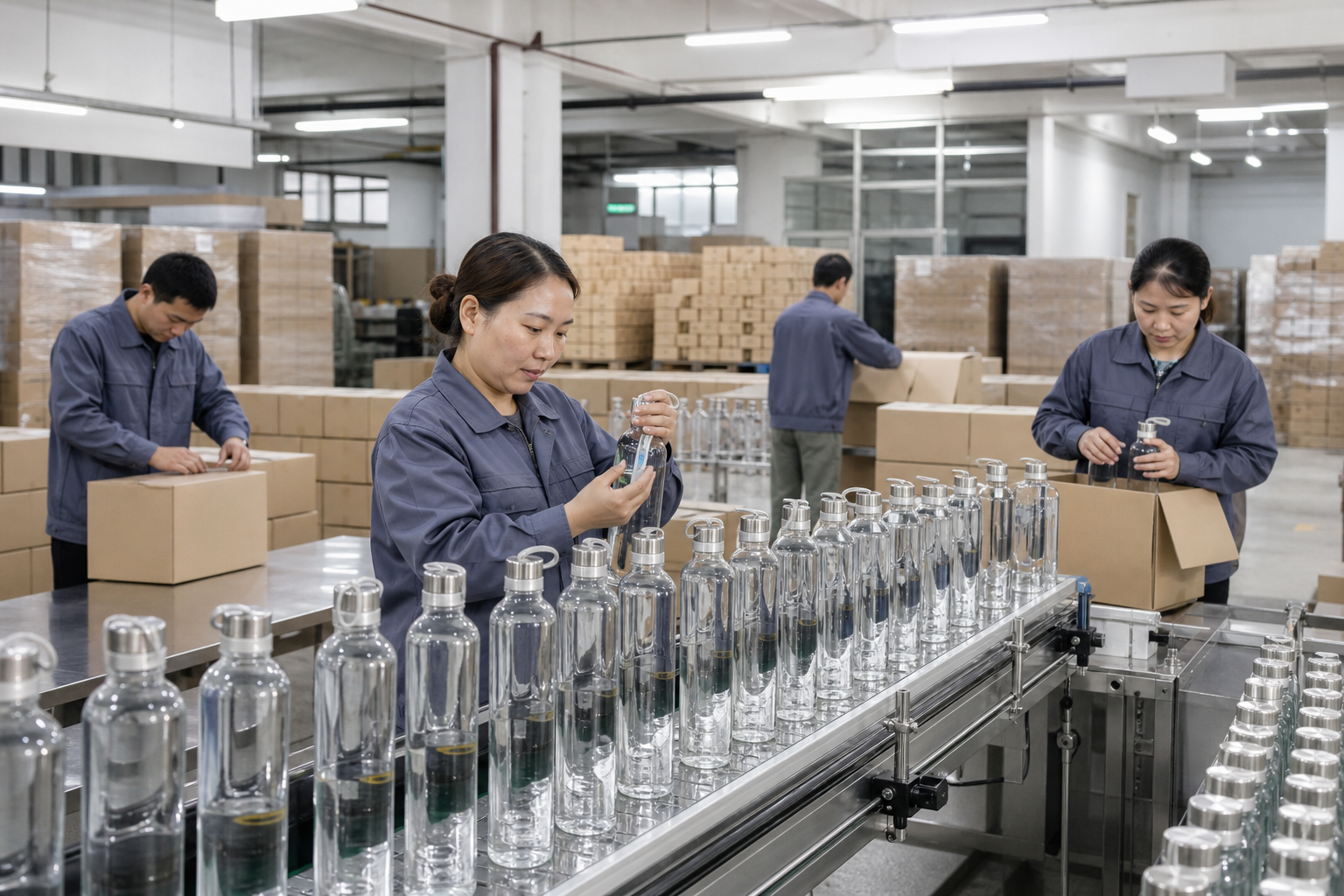
If you are sourcing a borosilicate glass bottle supplier, do not treat glass like a commodity. A 2 mm wall bottle can pass one drop and fail the next if the annealing is off, and we have seen that go sideways on the line more than once. The bottle must take thermal shock, clear food-contact checks, ship in bulk without breakage, and still look sharp on a wellness shelf. So judge the borosilicate glass bottle factory, not just the unit price.
From Zhejiang and other China production hubs, you will see borosilicate glass bottle manufacturers quoting USD 0.85 to 2.40 per unit. The gap sits in wall thickness, annealing quality, closure fit, and the carton spec. Last month, QC pulled a sample with a 1.5 mm neck variance, and the buyer flagged it before we ran the full order. If you are buying a custom glass water bottle for retail or promo use, ask whether the supplier can run MOQ 3,000 to 5,000 pcs and hold 25 to 35 days for standard custom runs. A solid partner keeps AQL inspection tight and ships with packaging that survives bulk freight. The math does not work any other way.
What borosilicate buyers should verify
Start with the facts that matter in use, not the sales copy. Borosilicate glass takes temperature swings better than soda-lime glass, but the bottle still lives or dies on composition, annealing, and wall control. Ask for the glass composition range, the annealing curve, and the thickness at the thinnest point. For a wellness-focused custom glass water bottle, we usually ask for 1.5 mm or thicker on the body, and the neck has to stay even or the cap leaks after a few cycles.
Ask for a borosilicate glass bottle custom spec sheet with dimensions, weight, lid material, and decoration method. A real borosilicate glass bottle manufacturer can talk about thermal shock in plain terms, like hot-fill after 4°C storage or 50 dishwasher cycles, not just say “heat resistant.” We had a buyer flag a neck finish typo on a PO once—0.2 mm off, and the cap no longer seated right. If the reply stays vague, you are dealing with a trader, not a line that controls the process. In Zhejiang, the better factories will send sample photos, a test report, and the production record for the same mold family.
What to ask in the first email
- Can you support a 500 ml customizable glass water bottle with bamboo, PP, or stainless lid?
- What is your MOQ for borosilicate glass bottle wholesale orders?
- Can you send REACH, LFGB, or FDA food-contact documents?
- What is your standard carton drop-test method?
MOQ, price, and lead time reality
Buyers ask for a price first, then send a sketch three days later. That wastes a week. For borosilicate glass bottle wholesale sourcing, unit cost comes from capacity, lid type, decoration, and packing. A plain 500 ml clear bottle with a basic screw cap usually lands around USD 0.85 to 1.20 FOB China at 5,000 pcs. Add a bamboo lid, screen print, or silicone sleeve and you move to USD 1.35 to 2.40. If you need a custom borosilicate glass bottle with a logo, color coating, or gift box, budget another USD 0.20 to 0.80. We had a buyer flag a PO typo on “5000 pcs” versus “500 pcs,” and the math broke right there.
Lead time is where quotes get tested. A borosilicate glass bottle factory in Zhejiang should give you 7 to 10 days for samples, then 25 to 35 days for bulk production after artwork and the purchase order are locked. If the order includes a new mold, add 12 to 18 days. A supplier saying they can finish a first run in 10 days is skipping steps, or they are planning to fix problems later on the line. We run QC with a caliper and a 2.0 mm wall check before packing, because one missed inspection can turn into broken bottles at destination. For seasonal retail programs, I would take a slightly higher unit price and a firm dispatch plan over a cheap quote with no discipline.
Practical rule: if the supplier cannot explain how MOQ changes with decoration method, they are not ready for export work.
Customization options that sell
A borosilicate glass bottle for retail does not need extra fuss. It needs one clear use case. We usually see wellness buyers ask for a clean cylindrical profile, 400 ml to 750 ml capacity, and a lid that looks premium without turning the sourcing into a headache. A 28 mm neck and a 2 mm wall thickness are common starting points. For bulk runs, a simpler mold keeps the line moving and avoids color-match issues. For gift or promo orders, the decoration should stay tight: one-color screen print, laser logo on the lid, or a small debossed mark. We’ve seen buyers try to pack too many graphics onto a 50 mm print area, and the result looks crowded.
A customized borosilicate glass bottle can come in clear body, frosted finish, tinted glass, single-wall, or double-wall. The cap choice should match the channel. E-commerce needs leak resistance, and we test that with an inverted 24-hour water check before packing. Retail shelves care about the carton finish. Corporate giveaways care about logo visibility. The buyer flagged it when we sent a matte-finish sample with a shiny cap; that mismatch looked off on camera. Good borosilicate glass bottle suppliers in China will send 3D mockups before sampling and tell you what can change without opening a new mold. That is the right question to ask, because the math does not work if you keep paying for revision after revision.
- Logo methods: screen print, decal, laser engraving, UV transfer
- Body options: clear, frosted, colored, silicone sleeve
- Cap options: bamboo, stainless steel, PP, wood-grain
- Packing: brown box, color box, gift tube, PDQ display
Factory checks that prevent claims
You do not need a perfect factory; you need one that catches defects before they leave Zhejiang. Start with the inspection standard. A borosilicate glass bottle supplier worth working with should accept AQL 2.5 for major defects and AQL 4.0 for minor ones, with pre-shipment photos and carton count records. We run this on the line every week. Ask how they handle bubbles, neck cracks, ovality, lid mismatch, and print misalignment. Glass is unforgiving. A 1 mm neck deviation can turn into a closure leak after 300 km of truck vibration.
For a bulk glass water bottle program, I also want to know how the factory packs cartons. Inner dividers, molded pulp trays, or honeycomb inserts cut breakage more than generic foam, and the math does not lie. Ask for the carton drop-test result and confirm whether the factory has in-house or third-party testing. On one 550 ml run, QC pulled the sample and found a corner split after the 76 cm drop test. A good borosilicate glass bottle manufacturer should provide at least these documents:
- Food-contact compliance declaration
- REACH or equivalent material statement
- Carton drop-test report
- Pre-shipment inspection photos
If you are working with a borosilicate glass bottle distributor instead of a factory, verify who actually makes the bottle. A lot of borosilicate glass bottle distributors can quote fast, but the control sits elsewhere. That is the wrong question to ask if you still want factory accountability. We saw this go sideways on a PO where the buyer flagged “304 stainles” in the notes, and the seller had to confirm the mold owner in another city. Fine if you know the chain. Not fine if you think you are buying direct from a borosilicate glass bottle manufacturer.
Choosing the right supplier type
There is a clear gap between a borosilicate glass bottle vendor, a borosilicate glass bottle supplier, and a borosilicate glass bottle factory. The vendor usually handles trading, design coordination, and export paperwork. The supplier may be factory-direct or a trading shop with a warehouse. The factory is where we run the molds and the annealing line. If you are buying a custom borosilicate glass bottle for a brand launch, direct factory sourcing gives you tighter control over tooling and lead time. If you are managing 18 SKUs and one buyer keeps changing the PO, a trading partner can keep the order sheet cleaner.
For a distributor borosilicate glass bottle program, lock one base mold and change only the lid, print, or packaging. That gives you one SKU family you can reorder fast. A distributor glass water bottle line should not carry 6 tiny variants; glass inventory ties up cash and breakage goes up. If you are a borosilicate glass bottle distributor serving retail chains in Europe or North America, ask for carton counts and pallet dimensions before you discuss price. Freight wins the deal. A 20-foot container can carry roughly 28,000 to 34,000 pieces depending on the tray and carton spec, and that matters more than a 5-cent unit discount. We had a buyer flag a PO typo on carton size once, and the whole load shifted on paper before QC pulled the sample.
For wellness brands, I push for one hero bottle size, one backup size, and one packaging format. Simple. That keeps the supply chain manageable and gives you room to press for better borosilicate glass bottle wholesale pricing on the next run. The math works because a 500 ml bottle plus one spare mold is easier to book than three sizes and two cap types. We've seen this go sideways when a brand tried to launch 4 colors at once.
How to source from China without surprises
Sourcing in China stays clean when the RFQ is written like a shop drawing. Put down capacity, target price, lid material, logo method, carton requirement, destination market, and the compliance standard. If you are working with a borosilicate glass bottle supplier in Zhejiang, send the spec in millimeters, not marketing words. Say 500 ml, 72 mm diameter, 230 mm height, 1.6 mm wall thickness, matte finish, bamboo lid, one-color logo, 12 pcs per carton. QC can quote that without guessing.
Ask for pre-production samples before you sign off the bulk order. For a custom borosilicate glass bottle, sample approval needs to cover appearance, lid fit, sealing test, and packaging drop test. We also push a pilot run of 50 to 100 pcs before the full order; on one PO the buyer wrote “bamboo lead” instead of “bamboo lid,” and the line caught it before we cut cartons. That kind of slip is easy money lost. If a supplier dodges sample approval, the math doesn't work.
At BottleForge Industrial in Hangzhou, Zhejiang, we run monthly capacity above 300,000 units across multiple drinkware lines, and the same rule applies to glass work: clear specs, confirmed artwork, and inspection before shipment. On glass, QC pulled the sample with a 0.5 mm lid gap and we stopped the run until the mold insert was corrected. That is what keeps a custom glass water bottle program from turning into a complaint file.
Request a borosilicate glass bottle quote today
Send your capacity, logo, lid, and target price. We will turn it into a factory-ready spec and a clear FOB quotation from Zhejiang, China.
Frequently asked questions
How do I know if I am dealing with a real factory or a trading company?
Ask for the factory address, production photos, machine list, and export record. A genuine borosilicate glass bottle factory should know mold timelines, daily output, and packing methods without hesitation. Trading companies can still be useful, but they usually cannot answer detailed process questions on the spot. Ask who owns the mold, where the annealing is done, and who performs final inspection. If you are in China or sourcing through Zhejiang, a real factory will often invite third-party inspection and will quote lead times more precisely, usually 25 to 35 days for repeat custom runs.