Key Takeaways
- Borosilicate glass bottles are usually specified at 1.0 mm to 2.0 mm wall thickness, with 1.2 mm common for retail drinkware.
- A practical MOQ for a custom borosilicate glass bottle starts around 3,000 to 5,000 pcs per design, depending on mold and decoration.
- Typical FOB China pricing for a bulk borosilicate glass bottle ranges from USD 1.20 to 3.80 per unit based on capacity, cap, and print.
- For export programs, ask for AQL 2.5/4.0 inspection, REACH documents, and carton drop-test data before you approve production.
If you are sourcing a custom glass water bottle for a wellness brand or a sustainable retail line, do not treat every glass bottle as the same. Borosilicate handles thermal shock better than soda-lime glass, stays clearer after repeated washing, and cuts down the “my bottle cracked after a hot rinse” emails we see from buyers. That is why serious buyers look for borosilicate glass bottle suppliers, not generic glass bottle vendors.
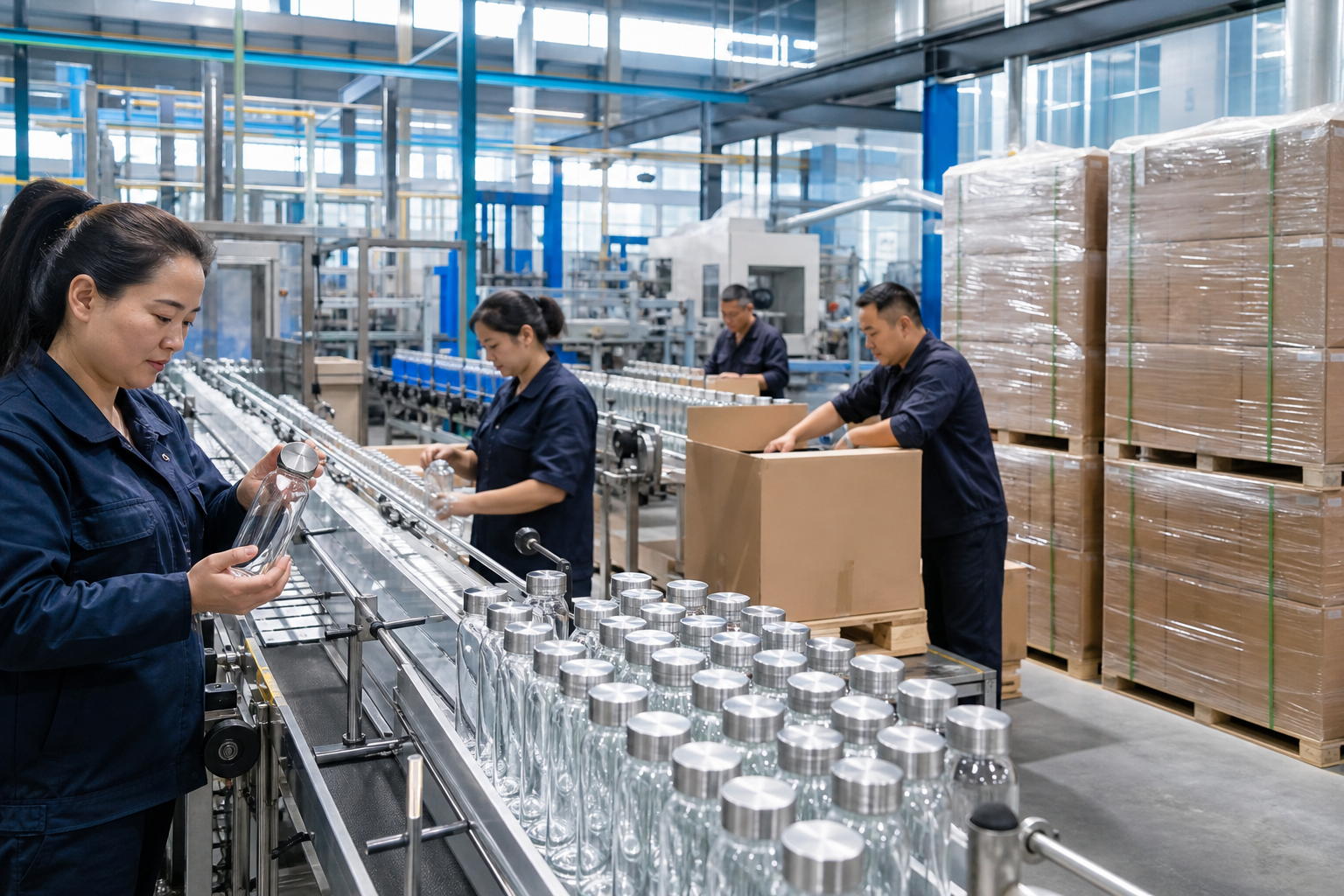
The hard part is not finding a borosilicate glass bottle manufacturer in China. Zhejiang has enough factories to flood your inbox in 7 days. The real work is sorting out the right borosilicate glass bottle factory: one that holds a 1.5 mm wall spec, passes REACH and food-contact checks, and still gives you an MOQ that fits the program. At BottleForge in Hangzhou, we run a 300,000-unit/month line for glass drinkware, and we have seen a 2 mm neck drawing on a PO turn into a full week of back-and-forth with the buyer before QC even pulled the sample.
What borosilicate really changes
Buyers order a custom glass water bottle, then the sample cracks in a warm rinse. That is usually where the glass choice starts to matter. Borosilicate glass bottle suppliers give you lower thermal expansion than standard soda-lime glass, so hot tea, a 45°C wash, or a cold warehouse shelf-to-fill change is less likely to trigger a split. The line sees this difference fast: borosilicate moves less under heat, so the bottle handles temperature swing better.
It still breaks. Glass is glass. But a well-made custom borosilicate glass bottle beats a cheap spec when the wall thickness is controlled and the annealing curve is right. We usually run 1.2 mm to 1.5 mm walls for 350 ml to 500 ml bottles, then 1.8 mm on larger 750 ml pieces. If a supplier cannot give cavity-by-cavity wall data, the math does not work. QC pulled the sample, measured the shoulder at 1.3 mm, and that was enough to spot a weak run before shipment.
- Thermal shock resistance: better than standard glass, but annealing quality still decides the final result.
- Typical retail weight: 220 g to 420 g depending on capacity and design.
- Best use cases: wellness, hydration, tea infusers, office gifting, premium retail.
How to screen suppliers fast
There are plenty of borosilicate glass bottle manufacturers in China, but you need to cut the list fast. Start with three documents: business license, export history, and test reports. If a borosilicate glass bottle supplier cannot show REACH, LFGB if needed for your market, and basic food-contact declarations, move on. For North America, ask how they handle California Proposition 65 material declarations when your buyer asks for them. For Europe, ask for batch traceability and whether the decoration ink holds up for repeated use. We had one supplier send a neat PDF, then QC pulled the sample and the ink failed a 60°C wash test.
Then look at factory realities, not sales talk. A real borosilicate glass bottle factory should know furnace capacity, daily output, and rejection rates. Ask for monthly output in units, not vague claims like “large capacity.” If the answer is around 200,000 to 500,000 units per month for glass bottles, that is plausible for a mid-sized China producer. If the supplier is also a borosilicate glass bottle distributor, pin down whether they own production or are trading through multiple vendors. Trading is not a problem by itself, but it changes lead time, QC, and traceability. We once saw a PO typo add one extra digit to the MOQ, and the line stopped for a day while everyone checked the carton count.
Questions worth asking on the first call
- What is your MOQ for a borosilicate glass bottle bulk order with one-color print?
- Can you support a customized borosilicate glass bottle with silicone sleeve, bamboo lid, or stainless cap?
- What is your standard lead time after sample approval: 25 days, 35 days, or longer?
- Do you inspect to AQL 2.5 for critical defects and 4.0 for minor defects?
In Zhejiang, good factories are usually direct. If they dodge these questions, the process control is not there, and the math does not work for a serious order. We run with a 3-step reply on the first call: MOQ, lead time, then QC standard. If they cannot answer those in two minutes, that is your answer.
Specs that affect price
Buyers often line up borosilicate glass bottle wholesale quotes and compare the wrong numbers. A 500 ml bottle at USD 1.45 and another at USD 2.10 are not the same job unless the spec sheet matches line by line. We run this every week. Price shifts with glass wall thickness, bottle shape, lid material, decoration method, carton spec, and mold cavity count. A plain round bottle with a PP cap and one-color silk screen print will always land below a customized glass water bottle with a bamboo lid, laser logo, silicone sleeve, and color box.
Here is the practical range we usually see for FOB China on bulk glass water bottle programs:
- Simple 350 ml bottle: USD 1.20 to 1.80
- 500 ml retail bottle: USD 1.40 to 2.40
- Premium 750 ml bottle with lid and sleeve: USD 2.40 to 3.80
The mold cost sits on a separate line, and the buyer flagged it in one PO because they missed the tooling note. A new custom borosilicate glass bottle mold often runs USD 600 to USD 1,800, depending on cavity count and shape detail. If you want a borosilicate glass bottle customizable with a unique shoulder, base embossing, or special neck finish, tooling goes up fast. We saw a 2-cavity mold save 6 cents per piece on paper, then the math fell apart at 5,000 pcs because the upfront charge was higher. Calculate total landed cost over 5,000 or 10,000 pcs, not just the sample quotation.
Do not approve a quote until you know whether it includes inner cartons, master cartons, testing, and export packing. Those details can swing your true cost by 8% to 15%. QC pulled the sample, and the carton drop test told the story.
Decoration and branding choices
A custom borosilicate glass bottle lives or dies on branding. We ship plenty of calm, premium SKUs for wellness brands, and we also run jobs for sustainable retailers who want the bottle to look durable enough to keep on a shelf for 2 years, not 2 weeks. The decoration has to fit the buyer’s use case and the wash cycle. For a borosilicate glass bottle promotional item, one-color silk screen is usually the cheapest and most stable option. It works for logos and short brand names. It does not work for a gradient.
If the buyer wants a higher-end feel, laser engraving on a stainless lid or bamboo surface is common. On glass, print usually beats engraving. Frosting, UV print, and decal firing each age differently. We had one buyer flag a 0.2 mm line crack after 30 dishwasher cycles, so we now ask for abrasion testing and chemical resistance before we release the artwork. A good borosilicate glass bottle manufacturer should tell you whether the decoration still holds after 50 to 100 wash cycles under normal use.
For brands launching a customizable glass water bottle line, the cleanest path is usually this:
- Start with one bottle shape and one lid style.
- Lock the logo area and print size.
- Check Pantone against daylight and warehouse lighting.
- Only then expand to a customized glass water bottle range with multiple SKUs.
If you are working with borosilicate glass bottle distributors instead of a direct factory, make sure the actual producer controls artwork approval. We have seen this go sideways when a PO typo changed the logo width from 28 mm to 38 mm, and the launch slipped 12 days while everyone waited for a new PDF. That is the wrong question to ask the sales rep; the line needs one owner from proof to sample sign-off.
MOQ, lead time, and sampling
Most buyers think glass factories will bend on MOQ. They usually do not. For a standard bulk borosilicate glass bottle, 3,000 pcs per SKU is the floor if the mold is already in house. For a full custom borosilicate glass bottle, 5,000 pcs is the number we run, especially when the order also needs a new lid, sleeve, or printed carton. If you are testing a market, some borosilicate glass bottle vendors will take 1,000 to 2,000 pcs, but the unit price jumps and the freight math gets ugly fast. We had one buyer push for 800 pcs on a 550 ml bottle, and the quote came back 28% higher than their target. That is the wrong question to ask if you want a real factory price.
Sampling needs a hard schedule, not guesses. A glass sample takes 7 to 15 days when the mold exists. New mold sampling usually needs 20 to 30 days, and neck finish or base thickness changes add time because the line has to cool, trim, and recheck dimensions. On one run, QC pulled the sample at 1.6 mm base thickness instead of the 1.8 mm called out on the drawing, so we had to remake it before approval. Once you sign off the golden sample, typical wholesale lead time is 25 to 40 days, plus 5 to 10 days for export packing and booking. If your launch is seasonal, count backward from the ship date, not from the PO date.
A good supplier will give you a clean sample-to-mass-production flow and batch number traceability. Ask for the first-pass approval rate and rework rate in plain numbers. If they dodge that question, you are probably talking to a trading layer, not a real borosilicate glass bottle factory. We ship enough orders to know the difference, and the invoice typo on a fake factory PO shows up fast.
Quality checks that matter
For Europe and North America, quality is not about a shiny sample. It is about holding the same spec across 10,000 units. When we audit borosilicate glass bottle suppliers, we ask how they check wall thickness, dimensional tolerance, lid fit, and impact resistance. A practical tolerance is ±1.0 mm on overall height and ±0.5 mm on neck diameter, depending on the design. If the supplier says every bottle looks identical to the eye, that is not a QC system. That is marketing. We once had a buyer flag a 1.2 mm neck drift on a 500 ml bottle, and the caps started sitting crooked.
A useful inspection plan for a borosilicate glass bottle wholesale order looks like this:
- Incoming material check: glass composition and cap materials
- In-line inspection: bubbles, stones, deformation, and seal defects
- Final inspection: AQL 2.5 major, 4.0 minor
- Packaging test: carton drop test from 60 cm to 80 cm
For export buyers, this matters because damage usually happens in transit, not at the factory. We ship a bulk glass water bottle order with weak dividers, and 2% to 5% of units can be gone before the cartons hit the warehouse. Ask for photos of the carton layout, not only finished samples. If your buyer runs a distributor glass water bottle program, that packaging detail matters even more because the box gets judged before the bottle does. QC pulled the sample once on our line and found one corner carton crushed after a 70 cm drop, so we changed the inner tray thickness to 3 mm.
In China, the better factories in Zhejiang usually welcome third-party inspection from SGS, Intertek, or Bureau Veritas. That is a good sign. Refusal is not. If a supplier pushes back on an external audit, the math does not work. We have seen that go sideways on a 12,000-piece order when the PO had a typo on the cap color code and nobody caught it until pre-shipment check.
Build a repeatable sourcing program
The best brands do not place a one-off order. They run a repeat program with one borosilicate glass bottle manufacturer, one spec sheet, and a forecast the line can actually build. If you want a stable SKU, treat it like a factory file: fixed bottle spec, controlled decoration, and just 2 or 3 lid and carton options. That cuts re-approval work. It also saves us from chasing the same PO typo twice.
For a wellness brand or sustainable retailer, a borosilicate glass bottle distributor can help with local stock and smaller top-up orders, but only if the base bottle stays the same. We’ve seen this go sideways when the buyer keeps changing the cap color after QC pulled the sample at 12 g and the carton size was already locked. Pick the lane early: promo item, premium shelf SKU, or private label range with 18-month continuity. That choice changes MOQ, carton count, and freight math.
If you are comparing borosilicate glass bottle suppliers, use a scorecard: response time, sample match, test reports, price hold, and revision handling. The cheapest quote is usually the wrong question to ask. The suppliers worth keeping can repeat the same 500 ml customized glass water bottle six months later with no drift in weight, print position, or lid fit. We check the caliper on the neck finish, and that is what keeps replenishment profitable in Europe and North America.
Request a factory quote and spec check
Send your target capacity, lid type, print method, and annual volume. We will confirm MOQ, lead time, and pricing from Hangzhou, Zhejiang.
Frequently asked questions
What is a realistic MOQ for a custom borosilicate glass bottle?
For an existing mold, 3,000 pcs per SKU is a realistic starting point. For a fully custom borosilicate glass bottle with new tooling, plan on 5,000 pcs or more. If you need extra decoration, a special lid, or printed retail cartons, some factories in China will ask for 8,000 pcs to keep unit pricing stable. Lower MOQs exist, but they often push the unit cost up by 15% to 30%.
How much does a bulk borosilicate glass bottle cost FOB China?
For a simple 350 ml to 500 ml bulk borosilicate glass bottle, FOB China pricing often lands between USD 1.20 and USD 2.40. A premium custom glass water bottle with sleeve, bamboo lid, or multi-step decoration can reach USD 2.40 to USD 3.80. Mold cost is separate and usually ranges from USD 600 to USD 1,800. Always confirm whether packaging and testing are included.
How long does production take after sample approval?
If the mold already exists, production usually takes 25 to 40 days after sample approval. New mold sampling can take 20 to 30 days before that. Add 5 to 10 days for packing, booking, and export readiness. If your order is going to Europe or North America during a peak season, build in an extra 7 days so you are not forced into expensive air freight.
What tests should I request from borosilicate glass bottle suppliers?
Ask for food-contact declarations, REACH documentation for Europe, and any LFGB support if your market requires it. For quality, request AQL 2.5 major and 4.0 minor inspection, wall-thickness checks, lid-fit tests, and carton drop-test photos. If the bottle is a promotional or retail item, ask about dishwasher durability and decoration resistance after 50 to 100 wash cycles.
Is borosilicate glass better for sustainable retail programs?
Usually yes, if your buyers care about durability and reuse. Borosilicate glass is clearer, handles temperature changes better, and supports a premium reusable positioning. It is still fragile, so packaging and fulfillment matter. A well-designed customized borosilicate glass bottle can reduce replacement complaints and support a higher retail price, often in the USD 12 to 24 range in branded channels, depending on lid and packaging.