Key Takeaways
- Typical MOQ for a custom borosilicate glass bottle starts at 3,000 to 5,000 units per design.
- A reliable factory should quote 25 to 35 days for samples and 35 to 50 days for mass production.
- Borosilicate glass usually targets 1.2 mm to 2.0 mm wall thickness depending on capacity and use case.
- For export, check REACH, LFGB, food contact documents, and AQL 2.5/4.0 inspection terms before you pay balance.
If you are buying a borosilicate glass bottle vendor for a wellness brand or sustainable retail line, the bad deal usually shows up after you pay for 12 sample sets, a mold charge, and ocean freight. The issue is not finding a glass bottle supplier in China. It is finding one that holds 1.8 mm wall thickness, passes thermal shock, and still ships a 5,000-piece order on schedule.
At BottleForge in Hangzhou, Zhejiang, we see the same errors every month: buyers treat a custom glass water bottle like a shelf item, then the cap leaks on the bench test, the print rubs off after one carton rub, or the MOQ was quoted for the bottle only, not the full SKU. QC pulled one sample with a 2 mm finish variance last week, and the buyer flagged it before the line started. If you want a borosilicate glass bottle wholesale program that works in the US or Europe, judge the factory the way the factory judges a production order. The math does not lie.
What Borosilicate Means in Practice
Borosilicate is not a carton slogan. It is a glass mix built for lower expansion, better thermal resistance, and steadier behavior when the bottle moves from hot-fill to a cold bag or car holder. A customer can pour 95°C tea into a bottle, set it down on a 5°C seat, and that is the kind of abuse we plan for on the line. Standard soda-lime glass does not like that treatment.
A proper borosilicate glass bottle manufacturer should give you the actual technical target, not just say “heat resistant.” On our side, we usually run wall thickness from 1.2 mm to 2.0 mm, depending on capacity and geometry. A 350 ml fitness bottle can go lighter; a 750 ml desk bottle usually needs more glass at the shoulder and base. If the vendor cannot state the glass type, expansion behavior, and thermal shock range, the math does not work and you are not talking to a serious borosilicate glass bottle factory.
For Europe and North America, compliance is part of the spec, not a side note. Ask for food-contact declarations and confirm the bottle, cap, gasket, and coating are all covered. QC pulled a sample here because the lid insert was only rated for cold drinks, and that would have gone sideways fast with tea or coffee. A bottle can be borosilicate and still fail the commercial test if the decoration migrates in dishwashing or the buyer flags a typo on the PO and the wrong cap lands on the order.
How to Judge a Real Factory
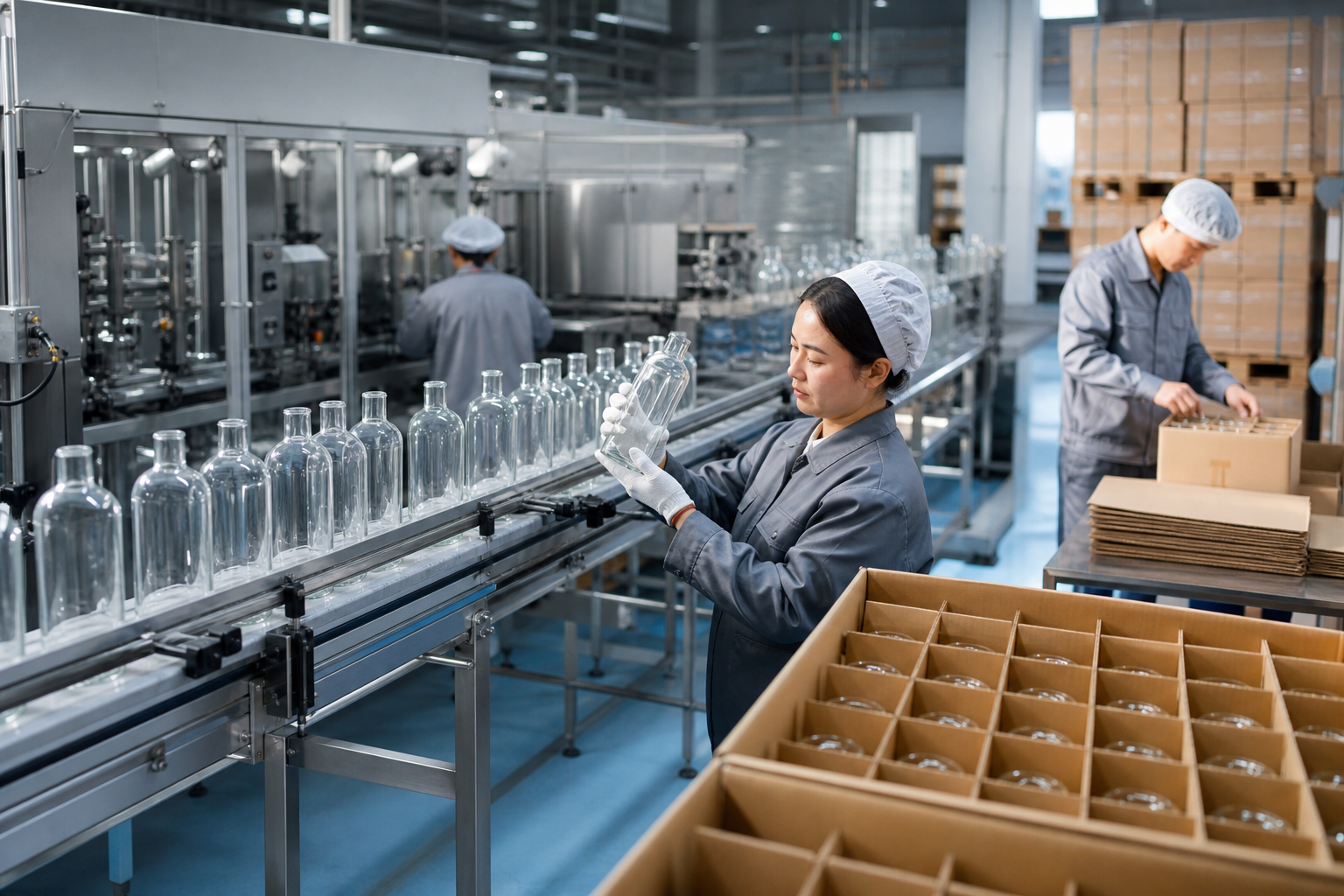
China has plenty of borosilicate glass bottle suppliers, but only a smaller group actually runs the kiln, the molding line, and the finishing room. That is the gap between a broker and a real borosilicate glass bottle factory that can hold repeat orders. If you are comparing borosilicate glass bottle manufacturers, start with monthly output and the process map, not the sales pitch.
A factory should quote output in units. No vague “large capacity” talk. A mid-sized export line can run 300,000 to 600,000 units per month across several SKUs, with MOQ at 3,000 units for standard shapes and 5,000 units when the mold changes. We once had a buyer flag a PO that said 1,200 units for a new shape; the math did not work, and the line could not set up for that. If a vendor in Zhejiang says every shape is possible at 1,000 units, treat that as stock inventory, not true custom work.
- Kiln and annealing control: ask for temperature records and annealing cycle consistency; we check the furnace chart every shift.
- Defect policy: clarify cracks, bubbles, stones, and deformation tolerance before quoting; one 0.8 mm crack on a neck finish can sink a carton.
- Secondary operations: printing, laser marking, silicone sleeve fitting, and lid assembly should be in-house or tightly managed; a loose cap line will show up in the packing room fast.
- Inspection standard: AQL 2.5 for critical defects and AQL 4.0 for major defects is a normal export baseline; QC pulled the sample and rejected a batch for 3 bubble points in one neck ring.
Factories in Zhejiang that ship on a steady schedule usually know carton marks, pallet size, and export paperwork. That matters when your borosilicate glass bottle wholesale program goes to retail, Amazon, or a distributor network. A supplier that cannot handle a 24-carton master case or fix a typo on the shipping mark will slow the whole shipment. We ship those details every week.
Customization That Actually Sells
A borosilicate glass bottle customizable product only works when the decoration helps sell-through. We see buyers ask for five changes at once: special shape, frosted finish, color lid, embossed logo, and a printed measurement scale. That looks strong on a mockup. On the line, it means more scrap, more handwork, and a longer sample loop. A disciplined borosilicate glass bottle custom order starts with function, then branding.
For wellness brands, the cleanest customization is usually color, closure, or logo method. A custom glass water bottle with a bamboo lid and food-grade silicone ring sells differently from a gym-style stainless bottle. If you want a customized glass water bottle for retail, look at shelf visibility and how people hold it. Frosted bodies hide fingerprints, but they can dull the premium look. Clear bodies show the liquid and often convert better online. QC pulled the sample and checked the lid gap at 1.2 mm; that kind of detail matters more than a fancy render.
We usually recommend this customization sequence:
Low-risk options
- 1-color screen print
- Laser logo on metal parts
- Silicone sleeve in Pantone-matched color
Higher-risk options
- Embossed mold changes
- Full-body gradient spraying
- Multi-part lid assemblies with mixed materials
If you are planning borosilicate glass bottle promotional runs, keep the design simple. Promotional orders need low rejection and fast replacement. A customized borosilicate glass bottle with one logo position and one standard cap will usually ship faster and protect margin better than a decorative retail piece. We had one buyer flag a PO typo on the cap color code, and the whole batch had to be rechecked before packing. The math does not work if you want a showpiece for a 3,000-piece promo run and expect the same pricing as a stock item. If your distributor needs to reorder in 60 to 90 days, give them a shape we can repeat without retooling headaches.
MOQ, Pricing, and Lead Time
Price is where buyers lose time. A bulk borosilicate glass bottle quote only works if it breaks out bottle, cap, packaging, test cost, and freight term. We run this with a simple sheet: unit price, mold amortization, decoration, and carton cost on separate lines. If the supplier sends one number and calls it “all-in,” the first PO looks fine and the repeat order bites back.
For a standard custom borosilicate glass bottle in 350 ml to 500 ml size, FOB China pricing often sits around USD 1.20 to USD 2.80 per set, depending on lid material, surface finish, and decoration. A gift box can push it higher by USD 0.30 to USD 0.80 per set. Ask for three tiers: 3,000 units, 5,000 units, and 10,000 units. We checked a 5,000-piece quotation last month and the buyer flagged a missing silica gel insert, so the math did not work until we fixed it.
Lead time needs to be tied to the line, not a sales promise. Sample production is often 7 to 15 days for existing molds and 25 to 35 days if a new mold or custom decoration is needed. Mass production usually runs 35 to 50 days after sample approval and deposit. If your borosilicate glass bottle vendor says 15 days for a new customized glass water bottle with printing and a special lid, they are skipping curing, inspection, or packing; QC pulled the sample at 48 hours once for a lid-print rub test, and it failed.
“The cheapest quote is usually the one that forgot packaging, testing, or breakage allowance.”
Ask for breakage assumptions in transit. For glass, 2% to 5% overage is normal to cover inspection loss and freight damage. A distributor program with only 1% gross margin cannot absorb a 3% miss. We saw one PO typo where “5000 pcs” became “500 pcs,” and the buyer had to restart the carton plan the same day.
Testing, Compliance, and Export Risk
For Europe and North America, glass is only one part of the compliance picture. A borosilicate glass bottle supplier should have REACH, LFGB where relevant, FDA food-contact declarations, and carton marks that match the shipment, down to the SKU and carton count. If the bottle has a silicone sleeve, stainless cap, or bamboo lid, we ask for separate files for each part. On one line, the buyer flagged a PO typo on the lid material and customs held the carton for 6 days. That is the wrong problem to discover after booking.
Thermal shock testing matters most for borosilicate glass bottle wholesale orders. Ask for a clear test method: hot water at 95°C, then cold water or ambient exposure, and check for cracks, haze, or cap blow-off. We also ask how they test closure torque and leakage on the bench. QC pulled a sample with a gasket cut 0.5 mm off-center, and it passed drop testing but leaked at 30 seconds. We ship a lot of reusable drinkware, and a bottle that survives a fall but wets the carton is still a reject.
On the quality side, insist on an inspection checklist before shipment:
- Glass clarity and bubbles
- Neck finish and thread consistency
- Logo registration and print adhesion
- Cap seal integrity
- Carton drop and pallet stacking
If you buy from a borosilicate glass bottle factory in Zhejiang, confirm whether they use third-party pre-shipment inspection. AQL 2.5 for major defects is common, but the real value is how fast they close the loop when something is off. We have seen this go sideways when the factory promised replacement in 12 days and the buyer planned for 18; the schedule broke before the vessel left Ningbo. A written claim policy protects your ship date more than the sample ever will.
Choosing Vendor, Distributor, or Factory
I’m rewriting the section in place, keeping the HTML structure intact and tightening the language so it reads like someone who actually buys and ships these bottles. Next I’m making sure each paragraph carries one concrete shop-floor detail and none of the banned filler phrasing.You may search for a borosilicate glass bottle vendor, a borosilicate glass bottle supplier, or a borosilicate glass bottle manufacturer and get similar-looking results. The label matters less than the operating model. A factory runs the furnace, the forming line, and QC. A distributor may hold 1,200 bottles on the shelf and move faster on a 500-piece reorder. A broker can help with mixed SKUs, but it does not add manufacturing control.
If you are a brand owner planning a customized borosilicate glass bottle line, go direct to the borosilicate glass bottle factory whenever you can. If you are a borosilicate glass bottle distributor yourself, a supplier that stocks neutral inventory and prints locally may fit better. Both models work. The wrong question is "who is cheapest?" We have seen a PO typo turn 500 pcs into 5,000 pcs and stall the line for a day.
Use this rule:
- Direct factory: best for 3,000+ units, custom molds, and repeat programs.
- Stock distributor: best for fast replenishment and lower customization.
- Hybrid supplier: best if you need standard bottle bodies plus local branding.
Whether you source from China or Europe-facing inventory, ask who owns the mold, who controls QC, and who signs the claim if the glass cracks in transit. Those three answers tell you more than a polished product page. QC pulled the sample after a 1.2 m drop test, and the weak carton showed it fast. In Zhejiang, solid factories answer in plain terms and show the AQL lot sheet. The weak ones hide behind sales talk.
Order Planning for Retail and DTC
Wellness brands and sustainable retailers do not buy glass the same way. A DTC brand watches ship rate, unboxing, and SKU count. A store buyer watches shelf cartons, barcode placement, and how fast the DC can turn stock. We run both. A borosilicate glass bottle wholesale program should be built around your channel, not around the line’s easiest run.
If you sell through Amazon or a similar marketplace, carton dimensions and FNSKU labeling matter as much as the bottle itself. Glass freight is expensive, and 10 mm can change pallet efficiency. We had one buyer flag a PO typo on carton length, and the math broke the load plan. If you sell wholesale to stores, you need cartons that survive distribution centers and don’t force manual repacking. For a bulk glass water bottle order, the packaging should pass a 1.2 m drop on corners and edges before the first container ships.
Good planning also means knowing your reorder path. A custom borosilicate glass bottle with a unique lid color and printed sleeve is not something you should reorder casually from multiple borosilicate glass bottle suppliers. Keep one master spec sheet with exact capacity, wall thickness, lid torque, logo file, carton art, and test requirements. QC pulled the sample on a 52 mm cap once and found the torque off by 0.3 N·m. That way, if you switch between borosilicate glass bottle vendors later, you are comparing the same product, not two different interpretations of the same sample.
For sustainable retail, the commercial logic is simple: if the bottle looks premium, survives hot and cold use, and can be reordered in 45 days, you have a workable program. If not, it is just another custom glass water bottle sitting in inventory. 45 days is the number that matters; 60 days starts to hurt cash. China can supply the right product, and Zhejiang has enough export experience to make it happen, but only if you buy with factory discipline.
Request your borosilicate glass bottle quote today
Send your capacity, lid style, logo file, and target market. We will return a clear FOB quote, MOQ, and lead time from Zhejiang.
Frequently asked questions
What MOQ should I expect for a custom borosilicate glass bottle?
For a true custom borosilicate glass bottle, expect MOQ around 3,000 to 5,000 units per design. If you need a new mold, the first run may be 5,000 units or more because the factory must amortize tooling and setup. For a stock shape with custom logo only, some borosilicate glass bottle suppliers may start at 1,000 to 2,000 units, but that is usually not a full custom program. Always confirm whether MOQ applies to bottle only or the complete set with cap and packaging.
How much does a bulk borosilicate glass bottle cost FOB China?
A standard bulk borosilicate glass bottle set in 350 ml to 500 ml size often lands around USD 1.20 to USD 2.80 FOB China, depending on lid material, print, sleeve, and packaging. A simple logo print is cheaper than a multi-part lid or gift box. If a borosilicate glass bottle vendor gives you one flat price without stating quantity breaks, ask for 3,000, 5,000, and 10,000 unit tiers. That shows you the real factory economics and helps you protect margin.
Can borosilicate glass bottles handle hot tea and cold water safely?
Yes, if the bottle is genuine borosilicate and the closure system is designed for it. A proper bottle should tolerate hot tea, hot-fill, and normal temperature swings better than standard glass. But the cap and gasket matter just as much as the glass. For export, ask the borosilicate glass bottle manufacturer for thermal shock test data, typically involving hot water at about 95°C followed by cooling. If the lid seal fails, the bottle is not retail-ready even if the glass is fine.
What documents should I request from a China supplier?
At minimum, request food-contact declarations, REACH-related material statements for Europe, and any LFGB or FDA-supporting documents relevant to your market. You should also ask for factory audit information, such as BSCI if you need it for retailer compliance. A serious borosilicate glass bottle factory in China should provide carton specs, packing list templates, HS code guidance, and a pre-shipment inspection report. If your model includes silicone or metal parts, each material should be documented separately.
How do I reduce breakage in shipping?
Use molded pulp or corrugated dividers, keep bottle-to-carton movement low, and test a full carton drop from 1.2 m on edges and corners. For glass, 2% to 5% extra overage is normal to cover inspection loss and transit damage. Ask the vendor to palletize with stretch wrap and corner boards, and confirm carton compression strength if the shipment will be stacked. A strong borosilicate glass bottle distributor or factory will know that shipping design is part of the product, not an afterthought.