Key Takeaways
- Typical MOQ for a borosilicate glass bottle wholesale order is 3,000–5,000 units per SKU, with 35–45 days lead time after sample approval.
- A 2.0–2.5 mm wall thickness is common for retail-ready custom glass water bottle projects; anything thinner raises breakage risk in transit.
- For export, ask for REACH, LFGB, and food-contact declarations; many buyers also request drop-test and thermal shock data at 120°C.
- A Zhejiang borosilicate glass bottle factory can usually support 60,000–120,000 units/month across multiple molds, but customization slots fill fast.
If you are sourcing a custom glass water bottle for a wellness brand or a sustainable retail line, borosilicate glass bottle vendors will talk about “quality” and “customization.” The real test is simpler: does the bottle survive shipping, pass compliance, and still leave margin on a 5,000-piece order. In Zhejiang, we see buyers lose 2 to 3 weeks because they request samples too late or sign off artwork before checking wall thickness, closure fit, and carton pack-out. QC pulled one sample at 1.8 mm and the buyer flagged it on the spot.
Borosilicate is not just “glass.” It is a lower-expansion material used for thermal resistance, cleaner taste, and better heat-shock performance than ordinary soda-lime glass. But not every borosilicate glass bottle manufacturer runs the same line, and not every borosilicate glass bottle supplier can keep repeat bulk glass water bottle production stable. If you want a borosilicate glass bottle custom program that ships on time and lands at the right landed cost, audit the factory, not the brochure. We’ve seen this go sideways when the PO said 500 ml and the carton spec still showed 450 ml.
What borosilicate actually buys you
Borosilicate is the right call when the bottle has to take hot fills, cold-chain runs, or repeated washing without turning cloudy after a few months. The low thermal expansion is the point: on our line, QC checks hot-water to ice-water shock because ordinary soda-lime glass starts to look tired fast. For a wellness brand selling tea, lemon water, or infused drinks, this is not a luxury spec. It protects the premium feel and cuts the kind of breakage that turns into complaints.
In sourcing terms, you are not buying “glass.” You are buying a packaging part with a defined process window. A serious borosilicate glass bottle manufacturer will give you wall thickness, annealing details, and a clear answer on hot-fill, freezer use, or room-temperature service. If the vendor cannot state the annealing range or the thermal shock delta, the math does not work. We have seen buyers approve a nice-looking sample, then the PO arrives with a typo on the closure spec and the first carton fails in transit. In Zhejiang and across China, plenty of factories can shape a clean bottle, but only the better borosilicate glass bottle suppliers put test data behind it.
- Common wall thickness: 2.0 mm, 2.2 mm, or 2.5 mm
- Typical hot-fill tolerance: up to 100°C for the glass body, depending on closure system
- Commercial use: tea, functional water, cold brew, wellness shots, and gift sets
Check the factory before the design
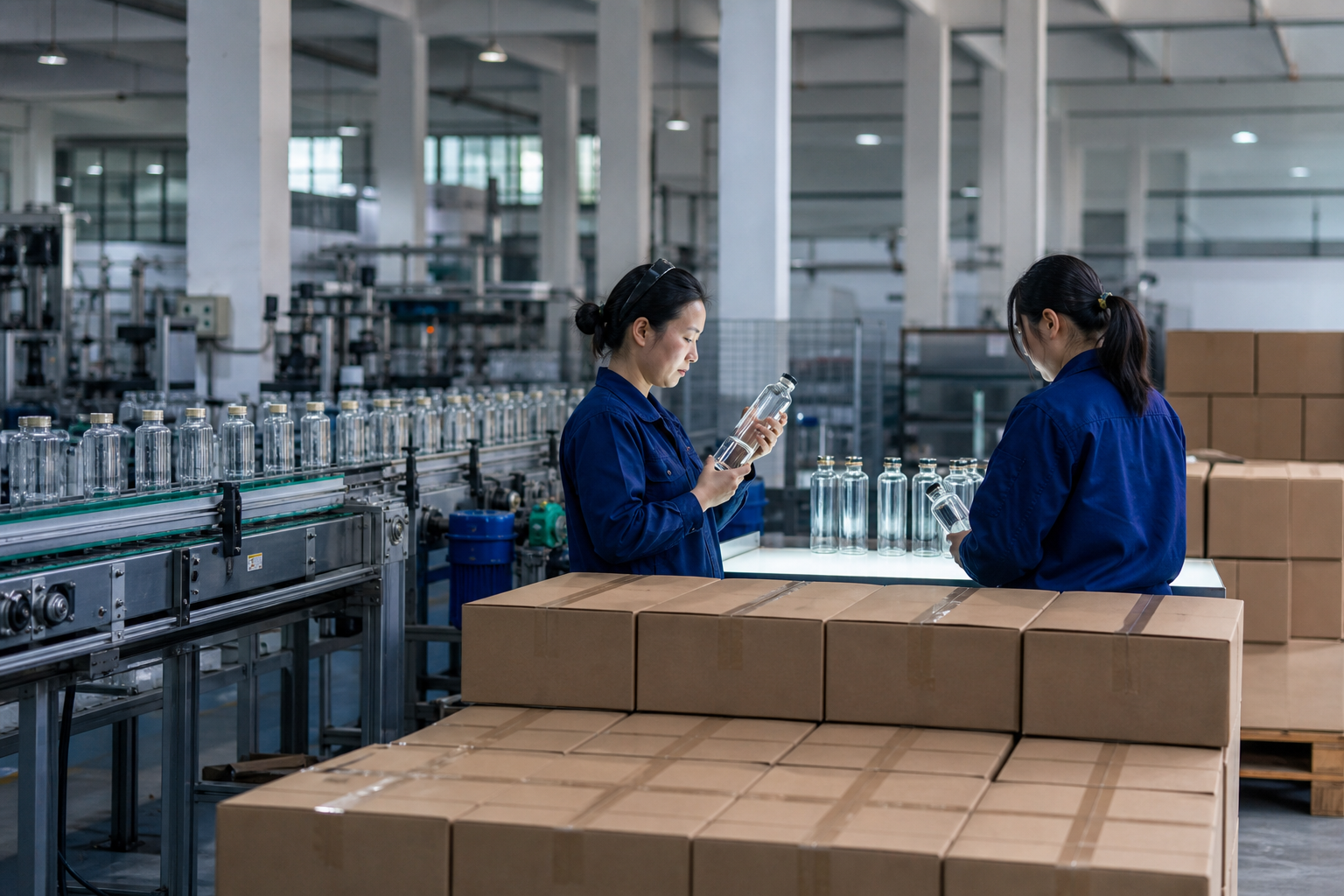
I’m rewriting the section in place, keeping the HTML structure fixed and tightening the language so it reads like a factory-side sourcing note rather than marketing copy.Before you sign off on a custom borosilicate glass bottle, audit the borosilicate glass bottle factory the same way you would check any packaging line. Ask how many molding sets they run, how many furnaces are hot, and what they ship per month. In Zhejiang, a solid shop should show 60,000 to 120,000 units a month across standard bottle SKUs, plus a sample room for logo checks and closure fit. We use calipers on the neck finish and a 38 mm gauge on the lid. If the answer stays vague, the capacity is not there.
You also need to know whether the vendor is a real borosilicate glass bottle manufacturer or a trading company selling someone else’s line. That is not a moral issue, it is a control issue. A distributor borosilicate glass bottle program fits a small test order, but a distributor glass water bottle offer usually gives you less control over lead time, mold ownership, and carton print. We have seen this go sideways on a 1,000-piece reorder when the buyer flagged a PO typo on the carton size and the packing plan had to be rebuilt. For repeat orders, go direct to the factory or work with a tightly managed borosilicate glass bottle vendor that can show you the production board.
Ask for these before you send artwork: mold status, MOQ per color, lead time after deposit, packaging spec, and whether the closure is stocked or custom-made.
On a first project, 3,000 units is a sane MOQ for one shape with one print location. If you want a customized borosilicate glass bottle with two-color printing, bamboo lid, silicone sleeve, and gift box, expect the MOQ to move toward 5,000 units or more. The math does not work any other way. We run those jobs on the line, not from a spreadsheet.
Design choices that affect unit cost
Buyers often stare at logo placement and miss the cost drivers sitting in the spec sheet. Shape is the first one. A straight-wall custom glass water bottle is easier to blow, cool, stack, and pack than a curved body or double-shoulder design. We run fewer rejects on straight forms, and the gap shows up on the line fast. A curved bottle can add 3% to 8% scrap before QC even signs off. Closure style is next. A stainless-steel cap, bamboo lid, or glass stopper changes the bill of materials, the seal test, and the failure rate. One buyer once flagged a PO with “bamboo top” but no liner spec; we had to stop the run because the torque test failed at 18 N·cm.
For borosilicate glass bottle bulk programs, the pricing math is simple. A clear 500 ml bottle with one-color silk-screen print and a standard PP or stainless lid may start around USD 1.80 to 2.60 FOB China at 3,000 units. Add a silicone sleeve and custom gift box, and the number moves to USD 3.20 to 4.80. If you want a borosilicate glass bottle promotional run with full-wrap decoration, special tint, or custom embossing, the mold fee and decoration charge matter more than the glass itself. We shipped one 5,000-piece job with amber tint and embossing last quarter; the mold cost alone was nearly 30% of the first order value. The buyer pushed back, and the math did not work if he wanted “premium look” at standard clear-bottle pricing.
What pushes pricing up
- Colored glass or sprayed finish; a 0.3 mm coating layer adds one more oven pass
- Custom mold ownership; most new molds run USD 1,200 to 3,500 depending on cavity count
- Laser engraving or multi-pass printing; QC pulled the sample twice on a 2-color job because the registration was off by 1.2 mm
- Extra carton testing for e-commerce or FBA use; drop-test cartons cost more than plain export cartons by 8% to 15%
Do not let a borosilicate glass bottle vendor hide these costs in a vague “all-in” quote. Ask for the mold charge, sample charge, packaging charge, and per-unit FOB price as separate lines. That is the only clean way to compare borosilicate glass bottle wholesale offers. We have seen this go sideways when a PO says “white box” but the artwork file calls for full-color printing; the buyer gets a nice surprise, and not the good kind.
Customization without wrecking usability
A borosilicate glass bottle custom project should improve the bottle, not just dress it up. We run 350 ml, 500 ml, and 750 ml bottles for a reason: they fit retail shelves, gift boxes, and subscription kits without forcing the carton to grow to 12 cm or 18 cm. Easy to fill. Easy to wash. Stable on a desk.
Logo method changes the whole job. Screen printing is the cheaper route for flat artwork on a custom borosilicate glass bottle, and laser engraving gives a cleaner premium look, but it usually means no color. If the buyer wants gradients or fine graphics, we check whether the line can handle underglaze or high-temperature decoration without touching food-contact rules. QC pulled a sample once with a 1.2 mm print shift, and the buyer flagged it immediately. Keep the decoration outside the drinking zone and ask for dishwasher resistance testing if the bottles will be reused in volume.
Neck finish and thread standard decide whether the bottle ships clean or comes back as a headache. A pretty customizable borosilicate glass bottle is useless if the cap leaks after a 22-day ocean move to Rotterdam or Chicago. We ask for torque testing, inversion leakage testing, and closure matching before artwork approval. One PO came in with the wrong thread callout, and the math did not work. That is where first-time buyers lose money.
Compliance buyers should not skip
For Europe and North America, compliance is not optional. We ask every borosilicate glass bottle supplier for food-contact declarations, material breakdowns, and a REACH statement before we move past sample stage. If you sell into Germany, France, or the Nordics, LFGB paperwork is usually on the buyer’s checklist. For the U.S., brands often want migration data or a third-party lab report for their own file; a 2 mm logo change on the art proof does not change that requirement.
Do not assume every borosilicate glass bottle manufacturer has the right folder ready. Some can send samples in 5 days and still fail a retail audit. A proper borosilicate glass bottle distributor or factory should show incoming inspection, in-process checks, and final inspection records. We run this with a receiving gauge, line checks every 2 hours, and a final AQL record. ISO 9001 is common, and BSCI often comes up with chain retailers, but it does not replace product testing. One buyer once sent a PO with the wrong email domain and missed the test report link for a week. The math does not work if the paper trail is weak.
For quality control, set the AQL to match the risk. On a standard bulk glass water bottle order, we usually see buyers inspect at AQL 2.5 for major defects and 4.0 for minor defects, with close checks on leaks, cracks, and print registration. If you are launching a premium wellness line, tighten the lot check and ask for photos of drop testing, carton compression testing, and sample retention from each production run in Zhejiang or elsewhere in China. QC pulled the sample on a 24-bottle lot once and found a 1.5 mm chip at the rim; that is the kind of miss that turns into a chargeback later.
Packaging and freight decisions
Glass breaks when packaging is treated as a line item instead of part of the product. We have seen a borosilicate glass bottle wholesale order look cheap at the factory gate, then turn costly after 3% breakage, a pallet lean, and an air shipment the buyer never planned for. The carton spec has to match bottle weight, closure type, and the route, whether we ship to a warehouse or straight to a doorstep. For e-commerce, we run a 1.2 m drop test on the master carton and add inner pads that hold up under parcel sorting.
Ask the vendor for carton dimensions, net weight, gross weight, and units per master carton. A 500 ml bottle with lid and sleeve may weigh 380–520 g depending on thickness and accessories. QC pulled the sample at 2.8 kg per case on one run, and the buyer flagged a PO typo on the carton count before we moved the line. If you push a distributor borosilicate glass bottle program into an FBA flow, get FNSKU labels, carton marks, and case pack planning locked before production starts. Fixing that in Zhejiang is cheap. Fixing it after the cargo leaves China is not.
FOB China is usually the cleanest quote structure for comparing borosilicate glass bottle vendors. If you need DDP, the supplier has to understand destination duties, carton limits, and the real landed cost, or the quote is noise. We shipped one lot on a 1100 x 1100 mm pallet stack and the buyer pushed back hard when the outer carton crushed at the corners. The math does not work if palletization is weak and breakage goes above 2%.
How to shortlist the right vendor
Shortlisting borosilicate glass bottle vendors should feel dull. Good. Start with three filters: production capacity, paperwork, and reply speed. We ask for numbers from the first email: MOQ, lead time, and test standard. If a supplier cannot answer with real figures, not sales copy, they are not ready for a retail program.
Ask for a sample against your target wall thickness and closure type. Then check whether the line can handle your print method and carton size. QC pulled one sample last month and found a 0.3 mm mismatch on the neck finish, which would have turned into a carton of rejects. Send a pro forma invoice request that shows mold charge, unit price, and production lead time, usually 35–45 days after sample approval for a normal order. If they dodge who owns the mold, that is a problem. A 12-month reorder plan lives or dies on tooling maintenance, and the math does not work if the first-order discount is only 2%.
A Zhejiang vendor usually turns samples faster because the mold shop, print line, and packing area sit in one compound. We run projects that way for a reason. The sample can move from caliper check to print test to carton fit in the same morning, and the buyer sees the result before lunch. Buyers keep asking for one factory split across three cities. That is the wrong question. Fewer handoffs mean fewer missed specs and fewer surprises in the first shipment.
Request a factory quote with full specs
Send your target size, artwork, closure choice, and annual volume. We will map the right borosilicate glass bottle custom plan for China sourcing.
Frequently asked questions
How do I compare borosilicate glass bottle suppliers fairly?
Compare them on the same basis: MOQ, FOB price, wall thickness, carton spec, test data, and lead time. A quote for a customized glass water bottle is not meaningful if one supplier includes a custom lid and another does not. Ask for one spec sheet with the bottle capacity, glass thickness, closure material, print method, and carton count. Then compare sample quality after 3 to 5 cycles of opening, filling, and shipping simulation. The best borosilicate glass bottle suppliers will answer technical questions quickly and give you consistent measurements, not just photos.