Key Takeaways
- Borosilicate glass drinkware bulk usually starts at 1,000-3,000 pcs per SKU, with FOB China pricing often from USD 1.20-3.80 depending on size and decoration.
- A 1.8 mm wall is acceptable for many drinking vessels, but 2.0-2.2 mm is safer for wholesale growler, canteen wholesale, and hospitality use.
- Ask for AQL 2.5 for critical defects and AQL 4.0 for minor cosmetic issues; do not accept vague ‘factory standard’ inspection terms.
- For branded orders, silk screen, laser engraving, and decal firing all change cost, decoration lead time, and dishwasher resistance.
- Zhejiang suppliers with proper annealing, REACH material control, and export carton testing reduce breakage far more than the cheapest glass quote.
If you are sourcing borosilicate glass drinkware bulk, do not treat it like a simple bottle order. It is not. Glass wall thickness, annealing, logo method, and carton spec all change breakage rates, landed cost, and whether the buyer reorders. We have seen a quote look cheap on paper, then 3% breakage and weak cartons wipe out the margin. One PO even came in with “borosliciate” typed in the description. QC caught it before we ran the line.
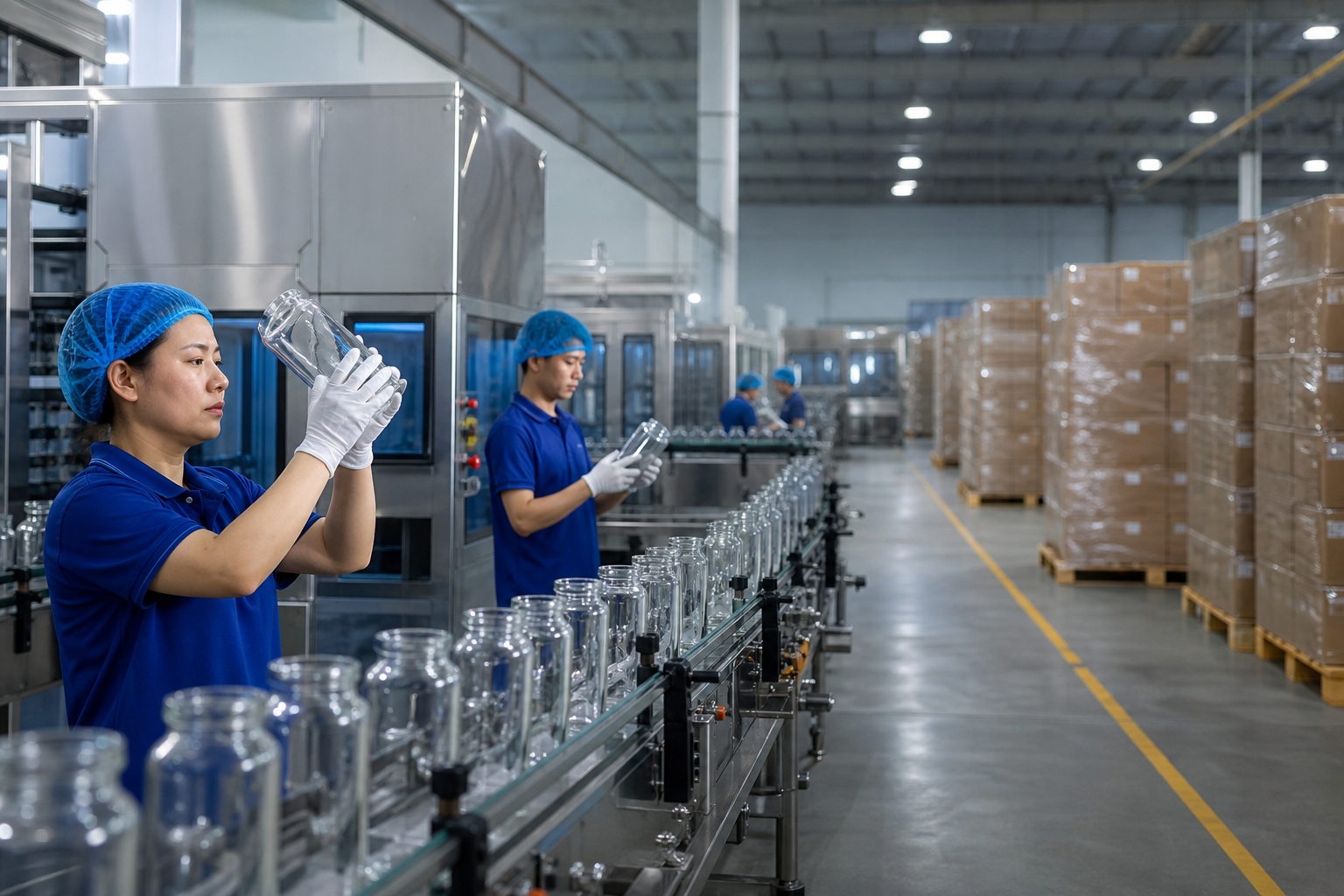
In China, especially Zhejiang, the factories that do this well think in process control, not just unit price. At BottleForge Industrial in Hangzhou, we run borosilicate lines at 50,000 units/month and usually ship standard bulk drinkware orders in 7-15 days, depending on decoration and packing. For a retail buyer, Amazon seller, hotel chain, or promo client, this is the wrong question to ask: “What is the lowest unit price?” The math does not work if the carton drops at 65 cm on export testing and the buyer flags it on arrival.
What makes borosilicate different
Borosilicate glass is not a slogan. It uses more silica and boron, so it handles thermal shock better than soda-lime glass. We ship bottles from a 5°C warehouse to a 60°C rinse line, and the cheaper glass starts cracking first. For buyers of drinkware bulk for cafes, premium retail, or gift programs, that difference shows up before the carton is even opened.
For standard wholesale drinkware, I ask for a wall thickness of 1.8-2.2 mm, depending on the shape. Below 1.5 mm, the glass feels light, but the packing loss climbs fast; QC pulled a tray of 24 bottles and found 3 chips at the shoulder after a 1.2 m drop test. A Zhejiang factory should show annealing curve data from the furnace, not just a clean sample on the table. If they cannot talk about cooling time and lehr settings, you are buying a look, not a product that survives carton-to-carton handling. For bulk drinkware that gets filled, boxed, and re-shipped, that is the wrong place to cut cost.
Write the RFQ like you know what the line needs. If you need a best wholesale drink bottle for cold brew, tea, or water, say the fill temperature and closure type, not just “nice bottle.” If you need a bulk canteen or canteen wholesale program for retail, spell out capacity, neck finish, and cap torque; we had one PO where the buyer typed “28mm” as “82mm,” and the caps did not fit. If you need a bulk growler or wholesale growler, the math is simple: closure seal and impact resistance matter more than shape. We have seen that go sideways fast.
Set the spec before quoting
Most price disputes start with a vague RFQ. The buyer writes “borosilicate bottle,” the factory quotes the cheapest version on the line, and QC pulled the sample with a caliper before anyone noticed the wall spec was missing. That is the wrong way to buy. Set capacity, dimensions, wall thickness, glass color, logo placement, closure, packaging, test standard, and carton count up front. For borosilicate glass drinkware bulk, a complete RFQ can cut back-and-forth by 50%.
Here is the minimum spec sheet we run before quoting:
- Capacity: 350 ml, 500 ml, 750 ml, or 1,000 ml
- Material: borosilicate glass, REACH-compliant, lead-free
- Wall thickness: 1.8 mm, 2.0 mm, or 2.2 mm
- Decoration: silk screen, laser, or fired decal
- Packaging: 1 pc/color box, 24 pcs/master carton, drop-test target 80 cm
- Inspection: AQL 2.5 critical, 4.0 major/minor
For alcohol flask bulk or alcohol flask in bulk, say whether you want a true glass flask, a hybrid flask with sleeve, or a gift item. We saw a buyer flag this after a PO typo sent the job to the wrong mold family in the tool room. The same logic applies to beer tumbler bulk, beer tumbler wholesale, and beer tumbler wholesale bulk. Small wording changes can move tooling cost by USD 300-1,500. The math does not work if the spec is fuzzy.
Price, MOQ, and landed cost
For China sourcing, a realistic MOQ for standard borosilicate drinking items is usually 1,000 pcs per SKU. For custom shapes or new molds, plan for 3,000-5,000 pcs if you want sane unit pricing. If a supplier says 300 pcs with full customization, the math does not work. On the line, we run the same check every time: if the mold is not already in production, the cost gets pushed somewhere else, and QC will see it in the finish or wall thickness.
Typical FOB China ranges for standard stock-style products look like this:
- 500 ml borosilicate bottle: USD 1.20-2.10
- 500 ml with logo and box: USD 1.65-2.90
- 750 ml beer growler bulk version: USD 2.20-3.80
- wholesale canteen with lid: USD 1.90-3.40
Those are factory-side numbers, not landed cost. Add ocean freight, inland trucking, duties, warehouse receiving, and a 1%-3% breakage allowance. For Amazon and retail chains, I would still carry a 5%-8% buffer stock. We shipped a 20-foot container last quarter where one carton had a 4 mm corner crush, and that single point would have turned into claims if the buyer had skipped the buffer. If you are buying drinkware wholesale for more than one channel, compare quoted price by packed unit, not loose unit.
One useful rule: for growler wholesale and beer growler wholesale bulk, packaging can add 12%-20% to factory cost, but it usually pays back in fewer claims. We have seen buyers delete the inserts and divider cartons to win the PO, then eat damage on the first 500 cartons. That is the wrong question to ask. A carton that saves USD 0.08 and doubles breakage costs more in the end.
Quality checks that matter
Glass looks fine right up to the first complaint. Then the carton is open and the buyer is sending photos. You need measurable acceptance criteria, not a promise on WeChat. We ask for incoming material control, furnace records, annealing logs, and finished-goods inspection sheets. If a supplier cannot show those, you are buying on hope. For borosilicate glass drinkware bulk, this is the checklist we run:
- Dimensional tolerance: ±1.5 mm on height for standard bottles
- Weight tolerance: ±5% for each lot
- Thermal shock: 120°C differential for many borosilicate items, subject to design
- Drop test: packed carton drop from 80 cm, 6 faces
- Visual defects: bubbles, stones, cord marks, sharp edges
AQL matters too. Use AQL 2.5 for cracks, sealing failures, and lid mismatch. Use AQL 4.0 for small print variation. For bulk canteen or canteen bulk items, check the cap liner and run a leakage angle test; we had one buyer flag a 2 mm liner offset on a 48 mm cap, and that one line issue would have turned into a claims file. For alcohol flask wholesale bulk, confirm closure torque and odor retention. A decorative flask that leaks alcohol is a mess.
“If the supplier cannot show you a repeatable inspection plan, the sample means very little.”
In Zhejiang, better factories will let you appoint a third-party inspector and accept a pre-shipment report from SGS, Intertek, or BV. That is not sales talk. It is how you separate a real line from a polished sample table. QC pulled the sample, checked the 0.8 mm neck ring, and the order moved only after the report matched the PO.
Decoration and branding choices
Branding is where a lot of buyers trip up. Borosilicate glass takes several decoration methods, but the result changes fast. Silk screen is the lowest-cost option for flat logos on large runs, and we run it a lot on 50,000 pcs orders. Laser engraving looks clean and holds up well, yet it costs more and gives you no color. Fired decal brings stronger color and better wash resistance, but you pay for the extra print pass and kiln time.
If you are ordering beer growler wholesale or wholesale growler, a one-color logo usually makes more sense than a full wrap graphic. For beer tumbler wholesale and beer tumbler wholesale bulk, print position has to match the fill line and shelf view. We had a buyer flag a logo that sat too low; once the cup was filled, nobody saw it. That was a waste of artwork.
Lead time shifts with decoration. A plain stock item may ship in 7-10 days, while a decorated order with custom packaging can take 15-25 days. If the promo date is fixed or Amazon inbound is booked, put that into the plan from day one. For alcohol flask wholesale programs, ask for artwork proof on the actual dieline, not a flat JPG. We saw a PO once with the logo size written as 38mm on one line and 83mm on another; QC pulled the sample and the math did not work. The stronger suppliers in China can usually turn a pre-production sample in 5-7 days if the mold is already ready.
Packaging for export and retail
Packaging is part of the product. We see good bottles fail on a 1.2 m drop because the carton spec was weak, not because the glass was bad. For export from China, we run inner dividers, 5-ply outer cartons, and a drop-tested master pack. If the shipment goes to Europe or North America, ask for compression test data at the pallet height you plan to stack; 12 days of transit is not the place to find out the box caves in at 18 layers.
For drinkware wholesale orders, retail-ready packaging matters when you need shelf appeal and barcode control. On Amazon, the buyer flagged mismatched carton labels more than once, so we now check FNSKU labeling, suffocation warning where required, and inbound carton marks against the PO. If you are ordering bulk growler or beer growler in bulk, neck protection is the first thing we look at, because that top impact zone takes the hit when the case gets tossed on the line.
Here is the practical packaging logic:
- Plain bulk shipper: lowest cost, best for B2B redistribution
- Color box: best for retail and gifting
- Inner tray + master carton: best for fragile glass and export
- Master carton with palletizing plan: best for warehouse efficiency
If your order includes bulk canteen or canteen wholesale items, check whether the lid ships separately or pre-assembled. A pre-assembled unit saves labor, but if the gasket is off by 0.5 mm the math does not work and leakage starts. We’ve seen that go sideways, so our QC pulled the sample after final packing, not just the empty bottle, and checked the seal under pressure.
How to choose the right supplier
The lowest quote is usually the expensive one. We have seen a 10,000-unit order hold steady only when the factory can repeat the same wall thickness, finish, and packing standard after the first 10 samples pass. When you check a borosilicate supplier in China, ask for export records, BSCI or a similar social audit if your retail customer requires it, plus proof for REACH and the food-contact rules that apply to your market. For North America, many buyers also ask for testing against FDA food-contact expectations. If you sell into Europe, the file set needs to stay clean and current. QC pulled the sample from the line, not from a showroom shelf.
Capacity matters just as much. Ask how many kilns, how many lines, and how many units per month the plant actually runs. If the answer is “unlimited,” the buyer should push back. At BottleForge Industrial in Hangzhou, we quote capacity in units/month because it changes priority, lead time, and changeover planning; a job that ships in 12 days on a quiet week can slip to 18 days when the annealing oven and packing line are both full. That is normal in Zhejiang when you work with export accounts that place real volume.
For wholesale drinkware and wholesale canteen programs, request:
- Business license and export scope
- Material declaration and test reports
- Previous inspection reports
- Sample approval procedure
- Incoterms: FOB Ningbo or FOB Shanghai, clearly stated
If the supplier cannot answer basic questions about mold ownership, carton testing, or defect acceptance, move on. We have seen this go sideways fast when a buyer flagged a PO typo on the carton mark and the factory had no process to catch it. There are enough capable factories in Zhejiang and across China that you do not need to gamble on vague promises.
Request a borosilicate quote today
Send your capacity, logo, and packaging spec. We will quote FOB China with MOQ, lead time, and export-ready packing details.
Frequently asked questions
What MOQ should I expect for borosilicate glass drinkware bulk?
For standard shapes, expect 1,000 pcs per SKU as a realistic MOQ. For custom molds or special closures, 3,000-5,000 pcs is more normal if you want reasonable FOB pricing. A factory quoting 200-300 pcs with full branding is usually charging a high premium or using stock parts. For bulk canteen, bulk growler, or beer tumbler wholesale bulk orders, MOQ also depends on packaging and decoration. Ask whether the MOQ is per color, per print, or per size, because those are not the same thing.
What price range is normal for wholesale borosilicate drinkware?
For China FOB pricing, a plain 500 ml borosilicate bottle may fall around USD 1.20-2.10. Once you add one-color logo, retail box, and quality dividers, you may land at USD 1.65-2.90. Larger or heavier pieces such as growler wholesale or beer growler wholesale bulk items often run USD 2.20-3.80 depending on wall thickness and closure. Packaging and breakage reserve can add another 15%-25% to your true landed cost.
Is borosilicate glass safe for hot and cold use?
Yes, when the formula and annealing are correct. Borosilicate handles thermal shock better than ordinary glass, which is why it is used for premium drinkware and laboratory items. That said, design still matters. A 2.0 mm wall with proper annealing is safer than a thin 1.2 mm wall with poor cooling control. Always ask for thermal shock test data, especially if your product will be used for tea, cold brew, or dishwasher cycles. Safety also depends on caps, seals, and decoration chemicals.
What quality tests should I request before shipment?
At minimum, ask for dimensional checks, visual defect inspection, leakage or seal tests where relevant, and carton drop testing. Use AQL 2.5 for critical defects and AQL 4.0 for minor cosmetic issues. For export to Europe, ask for REACH-related material declarations. If the product is for North America, keep food-contact documentation ready. For wholesale growler or alcohol flask wholesale bulk orders, also request closure torque and odor retention checks if the closure is part of the performance spec.
How long does production take for custom drinkware wholesale orders?
Standard stock items can ship in 7-10 days after order confirmation, especially if the supplier has inventory or existing molds. Custom logo, special packaging, or new tooling usually extends lead time to 15-25 days. If the mold is new, add another 10-20 days depending on complexity. If you are buying drinkware wholesale for a launch date, work backward from the ship date, not the purchase order date. In China, factory scheduling is often tighter near holiday periods, so book early.