Key Takeaways
- Borosilicate 3.3 glass typically handles 120 C thermal shock and works best at 1.5-2.0 mm wall thickness.
- A practical MOQ from a Zhejiang factory is often 3,000 pcs for stock shapes and 5,000-10,000 pcs for custom molds.
- Plan on 25-35 days for production after sample approval, with 7-10 days for prototype samples.
- For EU and US sales, ask for REACH, LFGB, food-contact declarations, and AQL 2.5/4.0 inspection records.
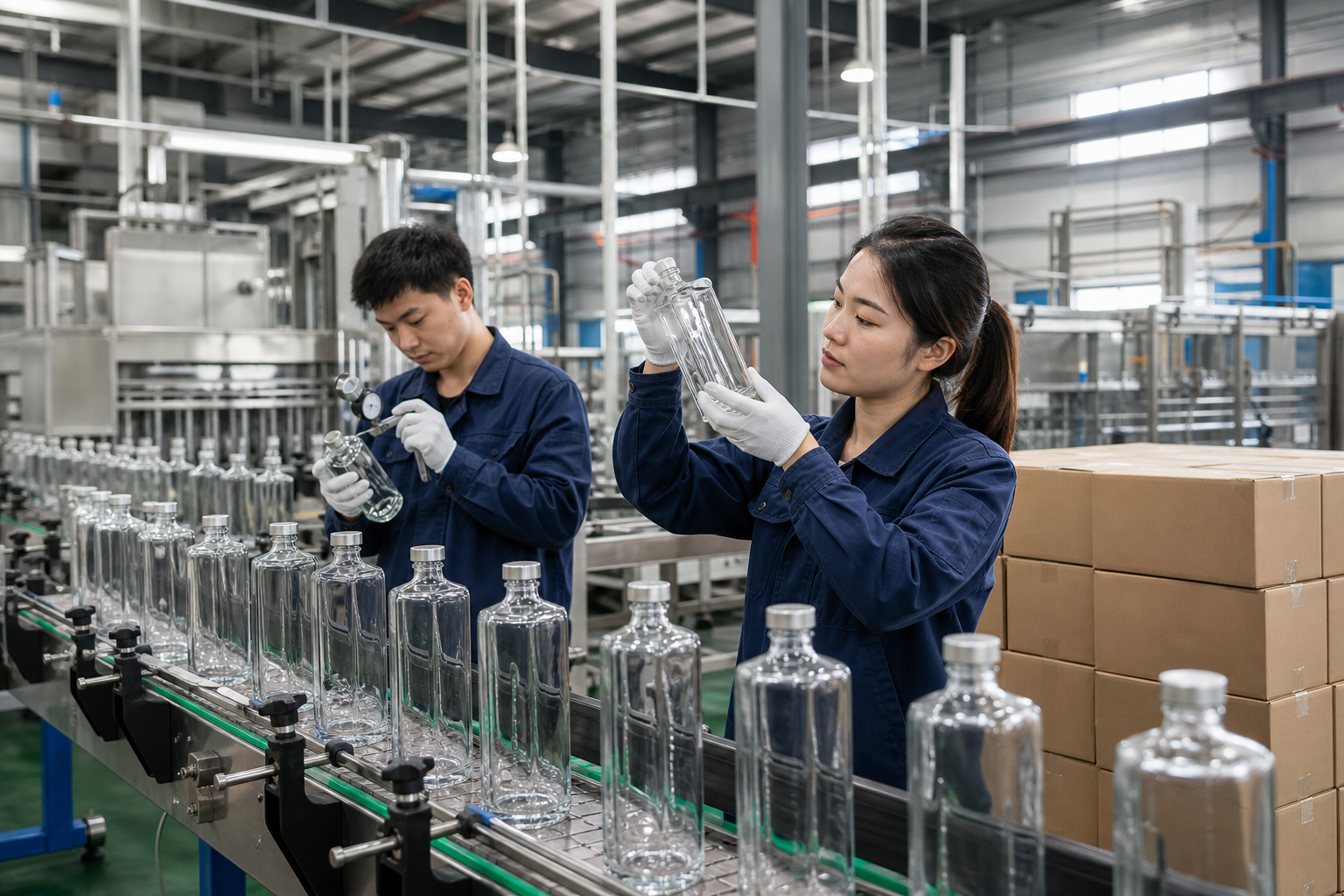
Borosilicate glass drinkware custom work is not the same as printing on a generic tumbler. The glass is lighter, clearer, and holds heat better, but weak forming, poor annealing, and sloppy packing will show up fast. We run these jobs on the line every week. If you buy for retail, hospitality, or e-commerce, you need a supplier that can hold dimensions, pass thermal shock checks, and repeat a logo job without warping the wall or neck finish.
In Zhejiang and across China, the better factories treat glass like an engineered part, not a commodity. That matters when you need a 300 ml bottle for retail, a 1 L growler for promotions, or a distributor line with mixed lids and cartons. QC pulled the sample last Tuesday and checked a 1.2 mm wall spec against the PO; the buyer had typed 1200 ml as 1000 ml, and that typo would have blown the carton plan. The math does not work if the run looks cheap but comes back in pieces.
Why Borosilicate Wins
Borosilicate glass is the right call when the buyer wants a clean look, stable performance, and a premium feel without plastic taste. Its low coefficient of thermal expansion handles hot-fill, cold storage, and sharp temperature swings better than soda-lime glass. We’ve seen 300 ml tea bottles come off the line, go from 95°C fill to 4°C storage, and still pass QC with fewer cracks. That matters.
For borosilicate glass drinkware custom programs, the buying logic is simple: pick the shape first, then lock the thermal spec and carton design before you talk decoration. A 300 ml tea bottle, a 500 ml hydration bottle, and a 1 L custom growler all start from the same raw material, but geometry changes the whole job. Tall, narrow bottles need tighter wall control at 1.8 mm to 2.2 mm. Wide-mouth designs need stronger bead formation and a cap that seals every time. The buyer flagged a leak risk once because the PO said “wide mouth” and the neck finish was never defined. The math doesn’t work if that part is vague.
- Best for premium retail sets, tea bottles, infuser bottles, and clear branded gift programs.
- Usually produced in borosilicate 3.3 or equivalent lab-grade soda-lime alternatives, depending on the price target.
- Better than ordinary glass when you need heat resistance, but still dependent on proper annealing and packaging.
If you are building custom drinkware for a marketplace launch, the transparency helps sell the product online. Buyers can see the liquid color, infuser, and wall clarity in photos, which lifts conversion fast. One distributor sent us a sample photo set with a 2 mm scratch on the base, and the listing team spotted it in five minutes. That is why some canteen programs and drinkware catalogs keep a borosilicate line beside stainless steel.
Specs You Must Lock First
The biggest mistake buyers make is asking for a sample before the spec is locked. For borosilicate glass drinkware custom orders, write down capacity, weight, wall thickness, neck finish, lid type, and decoration area before we quote. If those numbers are missing, every price is a moving target. We see that go sideways fast.
Start with the numbers the line can measure. Capacity should show net fill and brimful capacity. On a retail bottle, wall thickness usually lands at 1.5 mm to 2.0 mm. Put the tolerance in writing, too. A diameter tolerance of +/-2 mm and a weight tolerance of +/-5% is a workable starting point. For lids, confirm thread pitch, gasket material, and whether the cap is PP, bamboo, stainless steel, or a mixed assembly. QC pulled a sample last week and the buyer flagged the cap mismatch because the gasket spec was never written.
Ask for these in the RFQ
- Material grade and glass composition
- Capacity, mouth diameter, and overall height
- Wall thickness, base thickness, and weight
- Artwork size, Pantone references, and firing method
- Carton count, inner protection, and drop-test target
Do not let a canteen manufacturer or canteen supplier hand you a nice render and skip the engineering detail. The same point applies if the same factory also sells canteen customizable models, customized drinkware, or a custom canteen line. Loose spec, loose shipment. We ship enough cartons to know the math does not work any other way. A disciplined buyer in China gets better repeatability, lower scrap, and fewer fights on PO 2.
Decoration That Survives Use
Decoration is where a lot of borosilicate projects fail. Glass looks easy on the quote sheet. On the line, it is not. Durability comes down to the artwork method, firing temperature, and how much handling the cup sees after printing. For most custom drinkware programs, the safest move is a one- or two-color silk screen fired correctly onto a clean cylindrical surface with a 120-mesh screen. Laser engraving works on coated parts or metal components, but on clear glass you usually want a mark that still reads after 50 dishwasher cycles, not just on the first sample.
If you are planning canteen promotional items or a customized growler for a distributor drinkware program, keep the art simple. A fine-line logo that looks sharp in PDF can vanish on curved glass or crack after firing. We have seen 0.25 mm strokes disappear after the kiln. Solid shapes, controlled line weight, and enough blank space around the mark give better yield. For canteen custom projects, the same rule holds: the more complex the graphic, the more registration drift and rework you buy. That is the wrong question to ask if you care about shipped units.
Practical rule: if the logo needs more than two firing passes to look right, simplify it before production.
Ask the factory for a decoration proof on the exact glass model, not on a random sample. Then check color match under a D65 light box, print edge sharpness, and resistance to dishwasher cycles. Our QC pulled a sample last month because the PO said Pantone 286C and the art file showed 287C. A good canteen distributor or custom growler buyer should also ask for a rub test and a dishwasher test if the product is sold as reusable daily drinkware. That matters when the order is headed for retail shelves in Europe or North America, where the customer expects the print to survive normal use, not a one-day photo shoot.
MOQ, Lead Time, Packaging
MOQ is not one number in China. It changes with a stock mold, a modified mold, or a full custom shape. For a Zhejiang canteen factory running about 300,000 units a month, a stock borosilicate bottle may start at 3,000 pcs. A new mold or a special closure can lift the floor to 5,000-10,000 pcs. That is normal. We run the math on scrap and changeover, and the cheap-looking option often costs more once returns start. A buyer once flagged a typo on the PO for a closure size, and that mismatch would have killed the run.
Lead time tracks the process. After artwork approval and deposit, a standard run usually needs 25-35 days. If a new mold is involved, add time for tooling, testing, and first article correction. Samples often take 7-10 days when the shape already exists; a new neck finish or accessory set can push that to 12-18 days. If a vendor says every custom job ships in two weeks, they are skipping testing or packaging control. QC pulled the sample, checked the neck with a caliper, and sent it back when the thread missed spec by 0.3 mm.
Packaging is where glass gets punished. Ask for 5-ply master cartons, dividers or molded pulp inserts, and a drop test target that matches your route. For Amazon FBA, confirm FNSKU labeling, carton marks, and pallet height before we run the line. A distributor growler program needs a different pack-out from a retail bottle, even when the glass looks the same. For canteen distributors, mixed-SKU cartons can cut freight, but only if the inner packs stay clean and readable. We have seen this go sideways after one faint barcode print and two pallets of rework.
Quality Checks That Save Margin
Good borosilicate glass drinkware custom sourcing starts with QC discipline. We run samples that look clean all day; the problem shows up when the line has to repeat the same cup 5,000 or 20,000 pcs in a row. One 0.3 mm wall-thickness drift can turn into a claim fast. That is why inspection records beat sales talk.
Ask for an AQL plan before mass production. For general appearance, AQL 2.5 is common. For cracks, chips, or leakage, zero tolerance is the right call on obvious glass damage. We ask for incoming material checks, in-process inspection, and final inspection records. If the factory has ISO 9001, BSCI, and traceability logs, good. For Europe, the product file should include REACH and LFGB-related declarations or migration test support where required. The buyer flagged a PO once because “borosilicate” was typed as “borosilicat” on the carton artwork, and that kind of slip tells you the file control is weak.
- Check rim smoothness with bare-hand inspection and light ring checks.
- Test thermal shock with boiling water and cold-water transfer if the design claims heat resistance.
- Verify cap seal by inversion and shake testing for 30 seconds.
- Audit carton crush resistance and internal divider fit before shipment.
If you also source customized canteen models, a custom canteen line, or a customized growler program, do not use the same QC sheet for glass. Glass needs tighter visual criteria, stricter breakage control, and more careful pallet loading. We have seen this go sideways when a buyer treated glass like stainless steel. The best canteen manufacturer is the one that writes the difference into the inspection plan and checks carton stacking at 1.2 m, not after the truck is sealed.
Choosing The Right Supplier
The right supplier is not always the cheapest one. For borosilicate glass drinkware custom orders, we want a factory that can show the furnace, forming line, inspection area, and packing station without changing the story between samples and mass production. A real canteen factory or canteen suppliers network should explain where the glass is made, where the decoration happens, and who signs off on the packing standard. We run the line every day; if a supplier cannot point to a 5 mm print tolerance or a 12-day sample lead time, the math does not work.
When you compare canteen vendor options, ask for four things: a measured spec sheet, a decorated sample on the final glass, a packing mockup, and a production schedule with dates. If the supplier also handles custom drinkware, custom growler, or canteen promotional programs, ask how they keep SKUs apart. QC pulled the sample once and found one carton with two logo placements. Good factories in Zhejiang use line discipline and batch labels. Weak factories do it with memory and luck.
Here is a workable buyer checklist:
- Can they quote FOB Ningbo or Shanghai with clear carton counts?
- Do they show monthly capacity, not just yearly promises?
- Can they support a re-order without changing the logo size or carton art?
- Do they understand distributor canteen programs, distributor drinkware, and seasonal retail timelines?
If your business model depends on repeat orders, supplier reliability matters more than a one-time low price. We have seen this go sideways when a buyer chose the lowest quote and then the PO had a typo on the carton size. A factory in Zhejiang with disciplined documentation and a stable line will usually beat a middleman who talks flexibility but cannot control the glass, the print, or the packing.
Build Your Borosilicate Program Now
Send your target size, artwork, and carton spec. We will quote the right glass, confirm MOQ, and map the safest China production plan.
Frequently asked questions
What MOQ should I expect for borosilicate glass drinkware custom?
For stock shapes, a practical MOQ is often 3,000 pcs. If you need a new mold, a special lid, or a full artwork change, expect 5,000-10,000 pcs. A strong Zhejiang factory with stable output can still be flexible on mixed cartons or repeat runs, but the first order usually needs enough volume to cover setup, decoration, and breakage control. If the supplier says 500 pcs for every custom project, check whether they are quoting a stock item with a new print, not a true custom shape.
Can a logo on borosilicate glass survive daily washing?
Yes, if the decoration method is right. Fired silk screen is the usual choice for durable glass logos, and a 1-2 color design with proper curing will hold up far better than a rushed low-temperature print. Ask for a dishwasher test and a rub test on the exact model you plan to buy. For retail and distributor drinkware, I would not approve artwork until the supplier shows a decorated sample and confirms the logo still reads clearly after at least 50 dishwasher cycles in-house.
Is borosilicate glass safe for hot and cold drinks?
It is the better choice when you need thermal resistance. Good borosilicate 3.3 glass can handle rapid temperature changes far better than ordinary soda-lime glass, but you still need proper annealing and sane use instructions. A typical product spec may claim thermal shock resistance around 120 C, depending on shape and wall thickness. Do not oversell it as indestructible. The lid, gasket, and base design still matter, especially for hot-fill tea bottles and any custom growler program with pressure or sealing requirements.
What compliance documents do I need for the EU and US?
For Europe, ask for REACH-related support, LFGB or migration test evidence where relevant, and a food-contact declaration. For the US, make sure the supplier provides a clear material declaration and can support buyer-side compliance files. If the product is for kids, add the relevant child-safety review. You should also keep carton data, country of origin, and batch traceability. A serious China supplier will not just send a certificate PDF; they will be able to explain which material, ink, and gasket are covered by each test report.
How long does sampling and mass production usually take?
If the shape already exists, a sample can often be ready in 7-10 days. For mass production, 25-35 days after sample approval and deposit is a realistic range for most borosilicate glass drinkware custom orders. Add time if you need a new mold, custom packaging, or a complex lid assembly. If the project also includes canteen customized packaging or Amazon prep, build another week into the schedule so the factory can finish carton labeling, FNSKU application, and final inspection without rushing.