Key Takeaways
- Borosilicate glass typically handles 150°C thermal shock better than soda-lime, but you should still ask for test reports, not assumptions.
- A practical MOQ for a custom borosilicate bottle is often 3,000 to 5,000 units per SKU, with 30 to 45 days lead time after sample approval.
- For decorated custom drinkware, screen print, decal, and laser engraving all change cost, breakage risk, and packing density.
- A real canteen factory in Zhejiang should be able to show BSCI or similar social compliance, AQL inspection standards, and monthly output above 300,000 units.
If you are buying custom drinkware for retail, hospitality, or promotions, borosilicate glass looks simple right up until the PO lands. The gap between a sellable bottle and a headache is often one line on the spec sheet: 1.5 mm wall thickness versus 2.0 mm, 25% thermal shock tolerance versus 3%, or a 3,000-piece MOQ versus 10,000.
We run this line in Hangzhou, Zhejiang, and we see the same problem every week. A buyer asks for a custom canteen, custom growler, or a canteen promotional program, then the glass grade, finish, carton spec, and test standard are still open. QC pulled a sample last week with a 1 mm rim mismatch, and the buyer flagged it on the first photo. If you want a canteen supplier that ships from China on schedule, do not judge the factory by a low FOB quote. Check the line, the inspection records, and the way they handle a typo on the PO. That is the right question to ask.
How to evaluate a factory
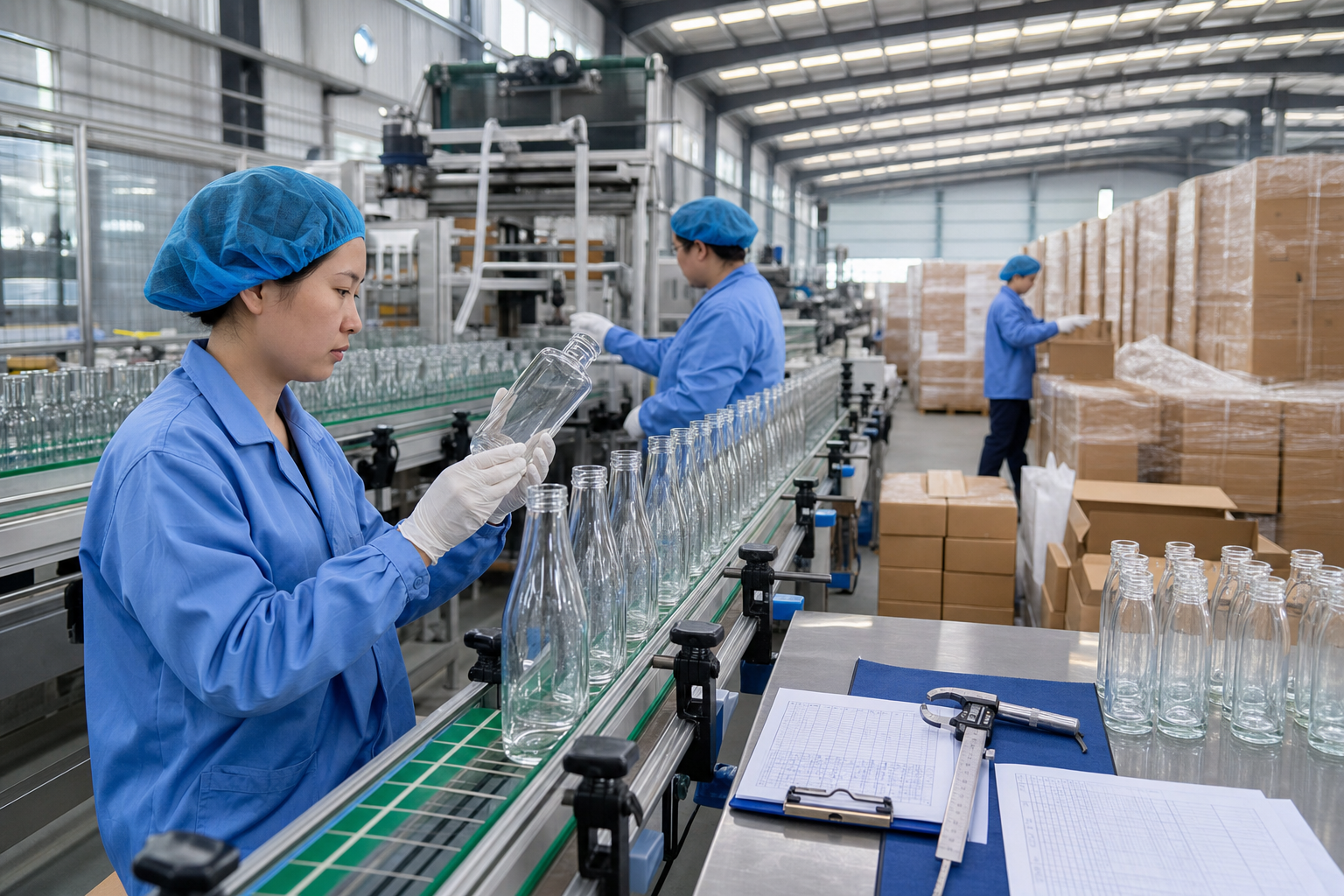
You do not need to be a materials scientist to pick a supplier, but you do need to ask sharper questions. A real borosilicate glass drinkware manufacturer should show line speed, daily output, sample room control, and defect tracking from the actual line, not a sales sheet. If the answer stays generic, you are probably talking to a trading layer, not a factory that runs its own kiln schedule and checks breakage at the annealing lehr.
Start with three checks. First, ask for monthly production capacity by product line; a credible plant can show 300,000 to 800,000 units per month across multiple SKUs, not one rounded number for everything. Second, ask for sample lead time and mold lead time separately; a sample can move in 7 days, while a mold might need 18 days, and those are different jobs on the floor. Third, ask who handles QC at each stage and what acceptance standard they use. BSCI or a similar audit still matters if you sell to retailers with compliance paperwork, but it does not replace product testing. QC pulled the sample, measured the rim at 1.2 mm, and rejected it if the mouth finish drifted.
Then compare how the supplier answers, not just how fast they reply. A good canteen manufacturer will ask for capacity, cap style, decoration method, shipping market, and target price. A weak canteen vendor will say yes to everything and hope the PO fixes itself later; we have seen a buyer flag a lid color typo on the purchase order after 5,000 pieces were already queued. If you need canteen manufacturers for a multi-country rollout, ask for a pilot order of 1,000 to 2,000 units with final packaging before you scale to 10,000. The math does not work any other way, and fixing artwork or carton marks at container scale costs more than the first mold revision.
When you work with a Zhejiang supplier that knows export, you should get clear Incoterms, sample approvals, and timing that matches the line. China can produce good glass at scale, but only if the buyer gives the factory enough detail to hold the process steady. We run better when the spec says wall thickness, logo position, and carton count; otherwise the team spends time guessing, and the shipment slips by 3 to 5 days for no good reason.
Request a factory quote with real specs
Send capacity, capacity shape, decoration, and target market. We will quote your custom drinkware program with MOQ, lead time, and packing details.
Frequently asked questions
What is the usual MOQ for a custom borosilicate glass bottle?
For a new custom drinkware project, a common MOQ is 3,000 to 5,000 pieces per SKU or per decoration setup. If you add multiple colors, special caps, or gift packaging, the effective MOQ can rise to 8,000 units or more. For repeat orders, some canteen suppliers will reduce MOQ to 2,000 pieces if the mold and print setup already exist. Always separate sample MOQ from mass production MOQ, because sample units are usually hand-finished and priced differently.
How much does a customized borosilicate canteen cost FOB China?
A simple 500 ml customized canteen can start around USD 1.20 to USD 1.80 FOB China in larger volumes. Add a silicone sleeve, premium closure, decal decoration, or gift box, and you may see USD 2.50 to USD 3.80 or higher. A custom growler with thicker glass and more complex packaging can cost more. Exact pricing depends on unit weight, decoration colors, carton spec, and your order size. A Zhejiang factory should quote by full spec, not guesswork.
Can borosilicate glass handle hot and cold drinks safely?
Yes, borosilicate is designed for better thermal resistance than ordinary soda-lime glass. In practice, many suppliers test against a 120°C to 150°C thermal shock range, but you should ask for the actual report for your model. Safe use also depends on glass thickness, annealing quality, and whether the lid and gasket are compatible with hot filling. For export, request food-contact documentation and leakage testing, especially if the bottle will be used as a customized drinkware item for tea or coffee.
What documents should a canteen distributor request before shipment?
At minimum, ask for a commercial invoice, packing list, product photos, material declaration, and any relevant REACH or food-contact test reports. If you are shipping through retail or Amazon channels, also request carton dimensions, gross weight, batch code format, and barcode label placement. For larger distributor drinkware orders, ask for pre-shipment inspection photos and AQL results. If the factory can provide third-party lab reports and inspection records, that is a strong sign the canteen manufacturer is export-ready.
How do I choose between screen print and decal decoration?
Choose screen print if you want one or two solid colors, lower cost, and faster lead time. Choose decal if you need detailed artwork, gradients, or a more premium shelf appearance. On borosilicate glass, a good decal can handle many wash cycles if it is kiln-cured correctly. Screen print is usually cheaper and simpler for canteen promotional orders, while decal is better for retail canteen customizable projects. Ask the supplier for a wash-test expectation before you approve final artwork.