Key Takeaways
- Borosilicate glass is the right choice when you need 120°C thermal shock resistance and a premium retail price point.
- For stock borosilicate drinkware, a practical MOQ is 3,000 pcs; custom molds usually start at 5,000-10,000 pcs.
- A real wholesale quote should include FOB China, packing spec, wall thickness, and AQL 2.5 inspection terms.
- For Europe and North America, ask for REACH, LFGB where applicable, and third-party thermal shock or lead/cadmium test reports.
If you are buying borosilicate glass drinkware wholesale, do not treat it like soda-lime glass. It is a different job. Borosilicate takes thermal shock better, keeps wall weight down at the same thickness, and gives your brand a cleaner story for retail, hotel, or promo work. The trouble starts on the line: 1.8 mm cups come in at 2.3 mm, annealing is off by a few degrees, cartons get crushed at export packing, and the test file fails when customs asks for it.
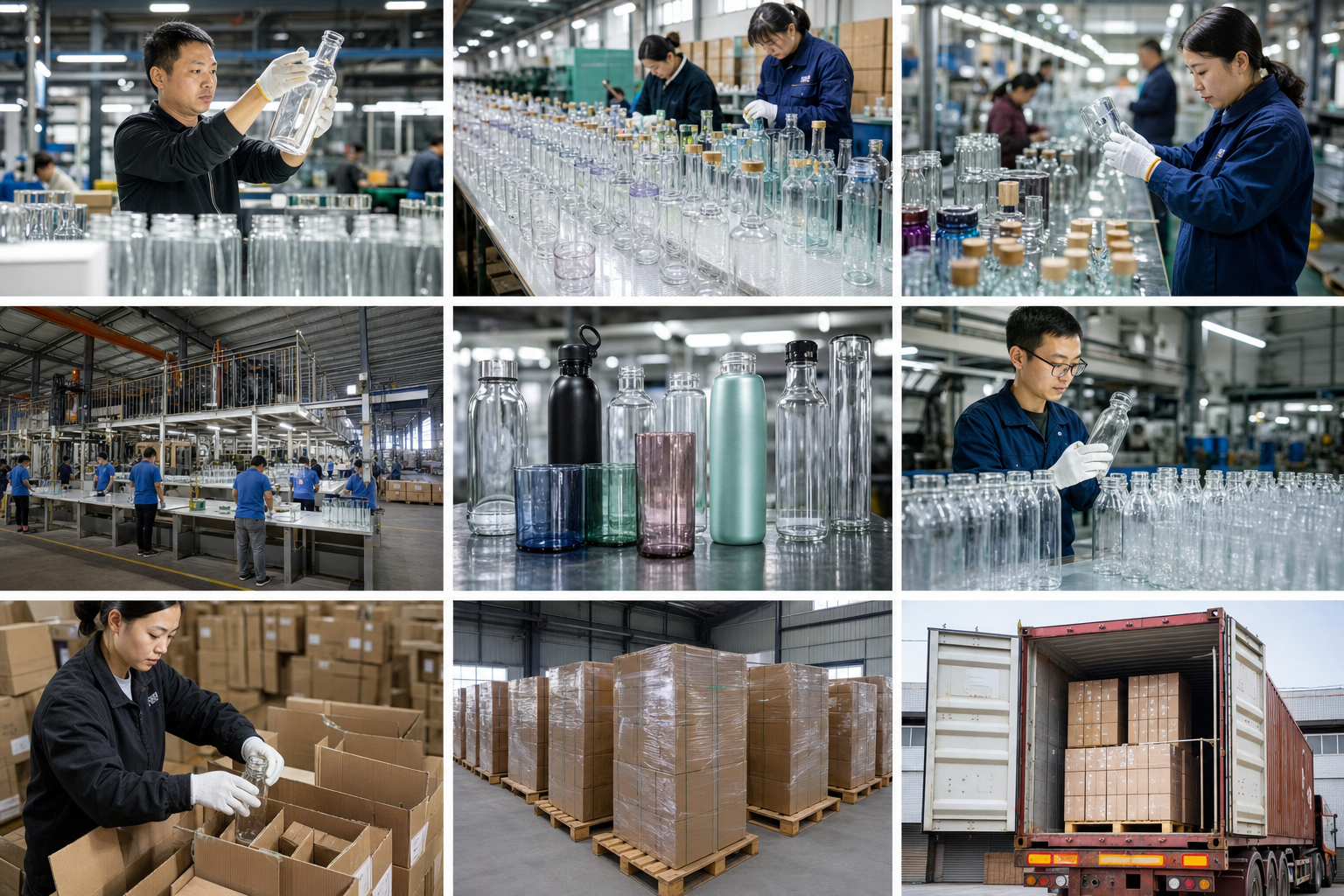
We manufacture in Zhejiang, China, and the buying pattern is familiar. You want stable quality, a MOQ you can live with, and a unit price that still leaves margin after freight, duty, and a 3% damage allowance. That is the math. BottleForge runs 300,000 units per month across glass and drinkware lines, with typical MOQ starting at 3,000 pcs for stock shapes and 5,000-10,000 pcs for custom decoration. QC pulled the sample on a 12-day batch once because the buyer flagged a PO typo on the finish spec. If you know what to specify, borosilicate glass drinkware wholesale stays manageable; if you do not, it turns expensive fast.
What borosilicate really buys you
Borosilicate is not a brochure word. In wholesale drinkware, it means the glass holds up better under a fast temperature swing than soda-lime glass. That matters when a café pours boiling water into a mug, when a cold brew bottle gets ice, or when the line runs hot-and-cold reuse in hospitality. For B2B buyers, the math is simple: fewer breakage claims, a cleaner premium story, and less pushback from the buyer when the first carton lands.
Do not pay extra for a vague label. Ask for the material declaration, and ask for COE or a composition range. We’ve had buyers flag a PO because someone wrote “borosilicate glass” on one line and “heat resistant glass” on another. That typo turns into a week of email back-and-forth. Good suppliers in Zhejiang and elsewhere can tell you whether it is true borosilicate or a borosilicate-style beverage glass. The difference shows in use, not in the sales sheet. For café, restaurant, or Amazon orders, ask for real test data: 120°C thermal shock is a common target, and annealing quality matters more than glossy photos.
For wholesale drinkware, this is where pricing starts to make sense. A 350 ml borosilicate cup sells on a different shelf than a 500 ml bulk canteen or a 750 ml bulk growler. Same material, different buyer, different margin. We run that calculation on every quote, and the buyer who asks only about the glass grade is asking the wrong question.
Pick the right product format
Borosilicate glass drinkware wholesale covers more than most buyers expect. We ship bottles, tumblers, infusers, canteens, and growlers off the same production floor, but each format has its own failure point. A narrow-neck bottle lives or dies on thread consistency and cap fit. A double-wall tumbler needs a steady wall gap, usually within 1.5 mm. A bulk canteen or wholesale canteen needs a thicker base for shelf stability. A wholesale growler for beer is more sensitive to closure integrity and neck finish than decorative printing.
- Beer growler bulk: focus on closure torque, neck diameter, and carton cushioning.
- Beer tumbler wholesale: check lip finish and dishwasher durability; we had a buyer flag a 0.8 mm chip on the rim before packing.
- Alcohol flask bulk: check seal compatibility and glass thickness near the shoulder.
- Best wholesale drink bottle: the answer depends on whether your buyer wants heat resistance, branding space, or leakage protection.
If you are comparing canteen bulk and canteen wholesale offers, ask for the actual net weight per piece. A 450 ml bottle can come in 20-40 g apart between factories, and that gap usually tells you how much glass is really in the part. We’ve seen this go sideways when a PO had “450ml” typed twice and no target gram weight, then the buyer wondered why one carton felt light. Order samples in two or three shapes, then compare fill lines, cap fit, and breakage after drop testing. Do not let a catalog pick the product for you.
One practical note from China sourcing: the same factory that does well on a glass bottle may not be the right plant for beer growler wholesale bulk if the kiln and finishing line are set up for lighter packaging. QC pulled the sample at 18.2 kg per carton when the buyer wanted 16 kg max, and the packing pass rate dropped. Pick the line that fits the use case.
What a real wholesale quote includes
If a supplier gives you only a unit price, you do not have a quote yet. For borosilicate glass drinkware wholesale, a usable offer should spell out FOB port, mold or setup cost, decoration cost, packing detail, carton size, and lead time. We also want to see whether the price is based on plain glass, one-color silkscreen, decal, or laser engraving. A drinkware bulk quote with no packing detail is not complete.
Typical stock borosilicate drinkware from China lands around USD 0.85-2.40 per piece FOB, depending on capacity, thickness, and cap complexity. Custom printed versions usually add USD 0.12-0.35 per color, while gift-box packaging can add USD 0.25-0.80. If you are buying alcohol flask wholesale bulk or beer tumbler wholesale bulk, the closure and secondary packaging matter as much as the glass body. We run fragile glass every week, and a 20-foot container can fit well over 10,000 small units, but carton layout can decide whether the shipment makes money or arrives with chips.
Ask for a quote that names the product, the finish, the packing, and the delivery term. If the supplier cannot tell you carton dimensions and gross weight, the price is not real.
From our Zhejiang factory floor, the buyer questions that save time are plain ones: How many pcs per master carton? What is the breakage allowance in transit? What is the lead time after sample approval? QC pulled the sample on a 48 mm tumbler once and found the buyer's PO typo had changed the cap color code, so we stopped the line before packing. For stock items, 15-25 days is common. For custom glass and decoration, 30-45 days is more realistic.
Compliance and test papers matter
For Europe and North America, compliance is not optional. A borosilicate glass drinkware wholesale order should leave with the paper set ready before the truck books. We ask for a material declaration, a food contact statement, and recent test reports at minimum. Depending on the market and use, that means REACH, LFGB, FDA-related food contact support, and heavy metal testing for decoration. If the order has a lid, sleeve, or gasket, QC pulls those parts for their own review, not as a side note.
Do not treat every glass item the same. A plain borosilicate bottle is one thing; a decorated beer growler wholesale item with a coated cap or a printed alcohol flask in bulk is another. Ink, decals, and silicone parts usually carry the real risk. We have seen a buyer flag a cap print typo on the PO, then the whole batch needed relabeling. For retail buyers, I would check whether the factory can run AQL 2.5 final inspection and keep batch traceability by lot number. If a shipment goes sideways, that is the only way to isolate it fast.
When you buy from China, ask for samples from the exact production pack, not a loose showroom piece. A supplier in Zhejiang should show thermal shock, dishwasher cycle, or drop test results under a named method, with the test sheet beside the carton spec. If they cannot name the standard, stop there. We run into this a lot, and the math does not work if the test basis is fuzzy.
For larger programs, some buyers also ask for ISO 9001 system evidence, BSCI audit status, and a written incoming inspection procedure. These do not replace product testing. They just give you a cleaner line to manage a wholesale drinkware program, especially when the MOQ is 5,000 pcs and the buyer wants one failure report by lot within 24 hours.
MOQ, lead time, and factory capacity
Most procurement mistakes start when buyers chase a low price and never ask what the line can actually run. We ship borosilicate glass in Zhejiang, and a factory should give you monthly capacity, line type, and a lead time that matches the SKU. BottleForge runs 300,000 units per month across two lines, but that number only works when the cup size, print method, and packing spec fit the schedule. A stock borosilicate cup can leave in 12 days; a custom beer tumbler bulk order with new packaging can sit in pre-production for 18 days or more. QC pulled the sample on a 68 mm rim once, and the buyer still wanted a faster date. The math did not work.
For canteen wholesale or wholesale growler programs, I usually tell buyers to plan around this:
- Stock items: MOQ 3,000 pcs, 15-25 days production
- Custom logo print: MOQ 5,000 pcs, 25-35 days production
- New shape or mold: MOQ 8,000-10,000 pcs, 35-45 days production
If a supplier says yes to a 1,000 pcs MOQ on a custom borosilicate shape, be careful. That quote usually misses real material loss, or the factory plans to make it back somewhere else. We saw this go sideways on a PO with a typo: the buyer wrote 500 ml, then changed to 550 ml after pre-production, and the carton count had to be redone. Solid drinkware wholesale suppliers in China tell you what is stock, what is semi-custom, and what needs tooling before you send the deposit.
For brand owners, split the program. Start with a stock shape and test sell-through, then move into custom canteen bulk or growler wholesale designs once the numbers come back. That cuts inventory risk and keeps the first shipment manageable. One line can run 2,000 pcs a day on a simple cup, while a new mold slows the schedule fast. We ship cleaner when the buyer starts with a smaller test order, then scales after the first 30 days of sales.
How to cut risk on your first order
Your first borosilicate glass drinkware wholesale order should be a controlled test, not a full bet. Ask for 2 or 3 samples from the exact line, not a showroom piece, then check weight, wall thickness, clarity, and closure fit. We run this check with a caliper and a 0.1 g scale; a 2 mm wall that drifts to 2.6 mm on one carton is where margin starts leaking. A clean spec sheet with dimensions, tolerance, and packing rules cuts most disputes before the PO lands.
I recommend checking these points before you approve production:
- Wall thickness target, often 1.8-2.2 mm for lighter drinkware and 2.5-3.0 mm for heavier bottles
- Cap or closure torque for bottles and flasks
- Drop test from 1.0 m on packed cartons
- Carton compression strength for export stacking
- AQL sample plan, typically 2.5 major and 4.0 minor for finished goods
If you are buying alcohol flask wholesale, beer growler wholesale, or beer tumbler wholesale bulk, the carton spec matters more than the headline glass price. A USD 0.10 saving on the unit gets wiped out if the carton bursts in transit or the print scuffs; we have seen a buyer lose a whole 20GP on that math. QC pulled the sample, and the buyer flagged it because the outer box was 5 mm short on height and the insert crushed the necks.
Use your first order to lock in a supplier process, not just a product. Once the factory in Zhejiang knows your spec and your label typo on the PO is fixed before we print, repeat orders move faster and you can press harder on drinkware wholesale pricing without giving up control. That is the right way to do it.
Request a borosilicate quote with real specs
Send your target volume, packaging, and market. We will quote FOB China, confirm MOQ, and map the fastest path from sample to shipment.
Frequently asked questions
What is the usual MOQ for borosilicate glass drinkware wholesale?
For stock borosilicate shapes, MOQ is often 3,000 pcs. For custom print or packaging, 5,000 pcs is more realistic. If you want a new mold, expect 8,000-10,000 pcs. In Zhejiang and other China supply hubs, factories that quote 1,000 pcs on custom glass usually make the unit economics unstable. You can sometimes mix SKUs for a drinkware bulk program, but ask whether the MOQ is per shape or per decoration. That detail changes the offer more than the unit price does.
How much should I budget per piece FOB China?
For plain borosilicate drinkware wholesale, many stock items fall around USD 0.85-2.40 FOB depending on size, wall thickness, and closure type. Add USD 0.12-0.35 per color for print, and USD 0.25-0.80 for gift box packaging. A beer growler wholesale bulk item or alcohol flask wholesale bulk item usually costs more because of the closure, heavier glass, and stronger packing. Freight can add a lot, so compare landed cost, not just FOB. A low unit price with weak cartons is not a win.
What documents should I request for Europe and North America?
Request material declaration, food contact statement, REACH support for Europe, and test reports for any decoration or lid materials. If the market requires it, ask for LFGB and relevant FDA food-contact support. For wholesale drinkware, I also want batch traceability and an AQL 2.5 inspection plan. If you sell on Amazon or into retail chains, keep the exact test reports tied to the PO number. That makes customs clearance and any later claim handling much easier.
Can borosilicate glass be used for beer growlers and canteens?
Yes, and it is often a good fit when the buyer wants a premium feel and better thermal resistance. For beer growler bulk or wholesale growler programs, check neck finish, closure torque, and carton cushioning. For canteen bulk or wholesale canteen orders, focus on the base thickness and whether the bottle stands well on shelf. A typical wall thickness range is 1.8-3.0 mm depending on the design. Glass is still fragile, so packaging and handling matter more than the material name alone.
How do I reduce breakage in transit?
Start with the carton spec. Use inner dividers, sufficient edge protection, and a drop-tested master carton. Ask for the gross weight, carton size, and pallet pattern before shipment. For drinkware wholesale programs, we usually recommend a packed drop test from 1.0 m and a sample of production cartons, not showroom samples. If you are importing beer tumbler wholesale bulk or alcohol flask in bulk, pay attention to cap protection and spacing. In many cases, an extra USD 0.05-0.15 in packaging saves far more in claims.