Key Takeaways
- Borosilicate liners typically start at 1.5-2.0 mm wall thickness; thinner glass increases breakage risk in thermos bulk shipping.
- A workable MOQ for a customized thermos program is usually 500-1,000 units per color, with 25-35 days lead time after sample approval.
- For export, ask for REACH, LFGB, and drop-test documentation; AQL 2.5 for critical defects is a sensible baseline.
- A stainless outer shell can be 18/8 stainless steel with 0.35-0.5 mm wall gauge, while glass thermos models rely more on cap sealing and carton design.
- FOB Ningbo or Shanghai pricing for promotional thermos programs often starts around USD 2.80-6.50 depending on capacity, decoration, and packaging.
If you are sourcing borosilicate glass thermos bulk, the real question is not “Can the factory make it?” It is whether the thermos survives retail handling, branding, and long-distance freight without turning into a claims problem. Glass-lined drinkware looks premium, but the wrong wall thickness, cap seal, or carton spec can wipe out your margin fast.
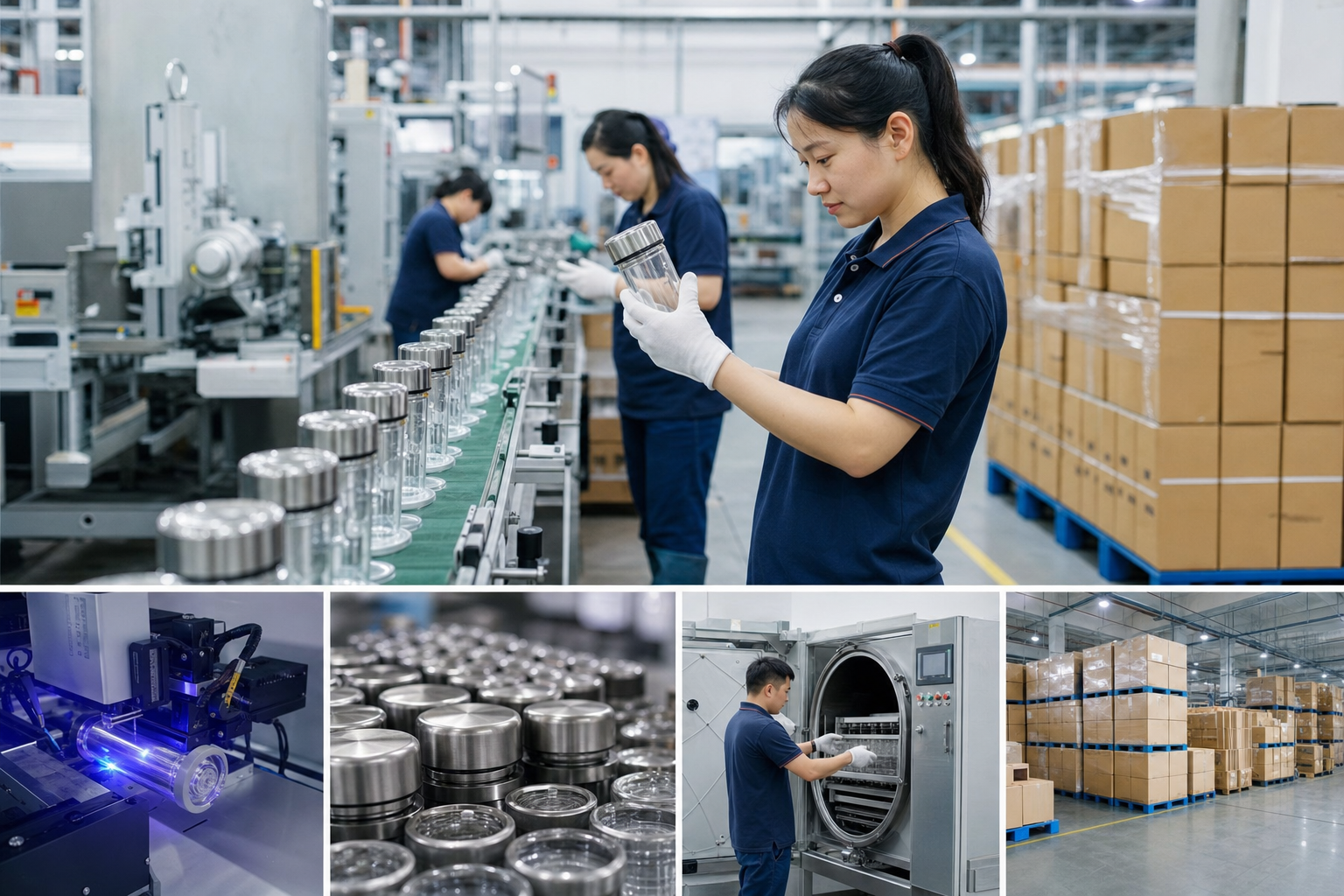
We build in Zhejiang, China, and we see the same mistake every season: buyers choose by sample appearance, then discover the shipping breakage rate, decoration limits, and lead time after the PO is signed. A practical bulk thermos program needs measurable specs, not pretty photos. On the line, we check the glass body at 1.2 mm, watch the torque on the cap, and QC pulled the sample after a carton drop test at 80 cm. If you want a custom thermos that can actually move through distributors, retail shelves, or promotions, start with the engineering, then talk color and logo.
What borosilicate really changes
Borosilicate glass is not a label you can wave away. It changes how the liner handles thermal shock, odor, staining, and wash-up. Compared with soda-lime glass, it takes a hot pour into a cold bottle with less drama. We’ve seen buyers switch after one broken lot on the line.
That does not make it bulletproof. The weak spots sit at the neck finish, the vacuum seal assembly, and the fit between liner and outer shell. One buyer once flagged a 0.3 mm neck tolerance on the PO, and that saved the run. In Zhejiang, a proper thermos factory will lock down glass thickness, annealing temperature, and assembly tolerance, not just the capacity. If a supplier says “food-grade glass” but cannot state the wall thickness in millimeters, that is the wrong question to avoid.
- Typical liner wall thickness: 1.5-2.0 mm
- Common capacities: 350 ml, 500 ml, 750 ml, 1000 ml
- Temperature retention target: 6-12 hours, depending on cap and insulation structure
For a bulk thermos order, ask for the exact glass spec sheet. A serious factory thermos program should also show the glass soaking or thermal shock test method used during production validation. QC pulled the sample at 90°C water and a 5°C pre-chill, and that is the kind of data buyers actually use.
When glass beats stainless
Most buyers start with stainless because it sounds safer, and for commute cups or sports bottles that call is usually right. We run enough samples to know the difference. A borosilicate liner earns its keep in a few channels: it holds flavor better, looks cleaner in a gift box, and works for tea, herbal drinks, or office sets where one mint tea should not haunt the next coffee. If you sell through a distributor thermos program for premium gifting, that point lands fast.
Glass loses on abuse tolerance. No drama there. If the users are hikers, field crews, or warehouse staff, stainless wins. If the buyer is a beverage brand, wellness promo house, or office distributor, a customized thermos with a borosilicate liner can move because the “clean taste” pitch is simple and the box looks sharper on the shelf. QC pulled the sample on a 500 ml unit last week and the cap passed, but the buyer flagged the wrong question: they wanted outdoor toughness from a glass liner. The math does not work if the packaging and lid are not built for that job.
We usually tell buyers this: choose borosilicate for taste, presentation, and gift value; choose stainless for impact resistance and sport use.
If you need both, split the line. Use glass for promotional thermos kits and premium corporate gifts, then keep a stainless line for volume retail. We ship that way for a reason. It is cleaner than forcing one structure to cover every channel, and we have seen that go sideways when a PO says “outdoor” but the product spec is a 304 stainless shell with a glass insert.
Specs buyers should lock first
Before you ask for logo options, lock the mechanical spec first. That is where most supplier thermos mistakes start. For borosilicate glass thermos bulk, confirm capacity, neck size, lid material, sealing method, carton count, and whether the bottle is for hot-only or hot-and-cold use. If it is going into a distributor thermos channel, the buyer will care more about 1.5% breakage on arrival than a decorative lid. We have seen that argument go sideways on the line.
Here is the minimum spec sheet I would want on my desk:
- Capacity: 350/500/750/1000 ml
- Liner: borosilicate glass, 1.5-2.0 mm
- Outer shell: optional PP, stainless steel, or insulated case
- Lid seal: silicone gasket, food-contact grade
- Drop requirement: 80 cm to carton corner, if packed for retail export
- Certification: REACH for EU, LFGB if required by the buyer, FDA-style food-contact declaration for North America
Print area needs a number too. On one 500 ml model, we run a 35 x 60 mm logo panel; a full-wrap print gets cut back by seam position and curvature, and the buyer flagged it after the first sample. If a thermos factory cannot tell you that before sampling, the project is still not ready. We once caught a PO typo on the carton count, 12 pcs changed to 24 pcs, and QC pulled the sample before it reached packing. The math does not work when people guess.
Customization that survives production
Customization is where buyers lose margin fast. A customizable thermos looks simple on paper until the artwork moves from screen print to heat transfer, or the cap color change pushes the MOQ from 3,000 to 6,000. For borosilicate glass thermos bulk, we keep decoration tied to what the line can repeat. If you buy as a thermos supplier or thermos vendor for retail, repeatability beats fancy effects every time.
We run one-color silk screen, laser marking on metal parts, matte spray on the outer shell, and gift-box customization. For promotional thermos orders, variable data printing and insert cards for campaign codes work too. Every extra process adds one more setup, one more check, and more days on the schedule. QC pulled the sample on a 0.3 mm logo shift last week, and that was enough to stop the pack-out.
What usually stays stable
- Logo print on cap or outer shell
- One PMS color for lid or sleeve
- Custom retail carton with barcode and SKU
- Laser marking on stainless components
What pushes cost up fast
- Multi-color wrap graphics
- Soft-touch coatings
- Specialty molded caps
- Low-MOQ mixed-color sets
A thermos customized for export should start with one core SKU and one or two decoration variants. We had a buyer flag a PO typo on lid code B-17 instead of B-71, and the rework ate two shifts. If you want five lid colors and three logo types in one order, the math does not work. The factory thermos side slows down, scrap goes up, and your landing cost climbs. Keep the line simple, then build from there.
MOQ, price, and lead time reality
Buyers often ask for a “small test order,” then expect wholesale pricing, free tooling, and a custom carton. That is not how we run the line. In Zhejiang, most established drinkware plants work on booked batches, so MOQ sets the schedule. For borosilicate glass thermos bulk, the usual MOQ is 500-1,000 pieces per design or color. Mixed color only works when the lids, sleeves, or liners are already in stock.
For FOB China pricing, a plain 500 ml glass thermos with a one-color logo and standard kraft box usually lands around USD 2.80-4.20. Add a gift tube, metallic print, or upgraded insert, and the number moves to USD 4.50-6.50 or more. A stainless outer shell version costs more because the metal body needs extra forming and polishing. It can cut breakage claims in transit. The buyer flagged the carton first on one order, but the real issue was the inner tray: 35 mm too loose, and the math did not work.
Typical lead time after sample approval is 25-35 days for a standard custom thermos order. If a new cap needs tooling, add 15-20 days. If you want pre-shipment inspection, leave 5 extra days for QC and recheck. A serious manufacturer thermos program should state monthly output clearly. One mid-size plant in Hangzhou can run 150,000-300,000 units per month across mixed drinkware lines, but your slot still depends on bottles, caps, and season. We had a PO last quarter with the word “silver” typed as “silvrr”; that kind of typo slows the whole sheet.
Do not let price alone drive the decision. A thermos customized to save USD 0.18 per unit can cost far more if breakage rises by 2% or if carton compression fails in ocean freight. We’ve seen this go sideways on a 12-day sailing test versus an 18-day route. Cheap is not the win.
Testing and compliance that matter
If you sell into Europe or North America, compliance is not optional. For glass-lined products, get the supplier paperwork before you place volume. Ask for food-contact declarations, material breakdowns, and test reports tied to the actual SKU, not a random family item. We’ve seen buyers accept a “same series” report and then the buyer flagged it at customs. For Europe, REACH and LFGB come up first; for the US market, buyers want food-contact proof and clean traceability.
On the QC side, I would keep the plan simple and tight. QC pulled the sample on the line, checked the lid fit twice, and that saved one 5,000-piece order from a useless rework loop.
- AQL: 2.5 major, 4.0 minor for retail drinkware
- Vacuum or seal check: every batch
- Drop test: carton-level validation before shipment
- Leak test: inverted hold test for lid assemblies
- Odor test: random sample after washing
For borosilicate glass thermos bulk, the packaging test matters as much as the bottle test. A distributor thermos order can look clean at packing, then fail after 12 days in transit because the inner tray shifts or the corrugate compression is too low. Ask for B flute or stronger where needed, and specify carton burst strength if the freight route is rough. The math does not work if you save 0.08 USD on a weak carton and eat 3% breakage later. In Zhejiang, the better plants keep transit damage records from prior export runs, and we ship against those numbers.
How to source without getting burned
The safe way to source is to treat it like an engineering buy, not a catalog click. Shortlist a thermos supplier or thermos manufacturer that can show line photos, QC records, and export paperwork. Ask for one pre-production sample and one packed sample. They are not the same thing. We have seen a cup pass a bench test at 20°C and fail after boxing, because the insert shifted and the lid took a knock in transit.
When you compare suppliers thermos options, check four points: assembly experience, bottle breakage rate, print consistency, and reply speed. If sales comes back in 10 minutes and engineering never shows up, that is a red flag. A solid thermos factory in China will tell you what can be changed, what needs tooling, and what the extra cost is. That answer saves money. Cheap quotes do not.
For outdoor retailers and promotional brands, split the program this way:
- Tier 1: premium customized thermos for gift and corporate channels
- Tier 2: bulk thermos for retail promotion and seasonal campaigns
- Tier 3: stainless travel line for rougher use cases
This gives you pricing room and cuts risk. It also helps when we run the forecast at the Zhejiang plant, because carton counts, lid colors, and spare seals are easier to plan. One buyer pushed back on MOQ 3,000, then changed the PO twice after the logo size moved by 2 mm. That kind of drift burns time. If you want a custom thermos that scales, the sourcing process has to stay as tight as the product.
Request a factory quote and spec sheet
Send your capacity, artwork, target MOQ, and destination port. We will match the right borosilicate or stainless structure for your market.
Frequently asked questions
Is borosilicate glass thermos bulk safe for hot water every day?
Yes, if the liner is real borosilicate and the cap seal is good. In practice, I would want 1.5-2.0 mm glass wall thickness, a silicone gasket, and a validated thermal shock test. For daily hot water use, the product should pass repeated fill cycles without cracking or odor transfer. If you are selling in Europe, ask for REACH or LFGB-related food-contact documentation tied to the exact SKU. For retail programs, a carton drop test and inverted leak test are more useful than glossy photos.
What MOQ should I expect for a custom thermos order?
For borosilicate glass thermos bulk, a normal MOQ is 500-1,000 pieces per design or color. If you want special printing, a custom lid, or a new gift box, the MOQ may rise to 2,000 pieces because the factory has to allocate setup time and packaging materials. In Zhejiang and other parts of China, some suppliers will quote lower, but that usually means they are using stock parts and limiting your customization. If you need a real custom thermos, assume the lower MOQ will cost more per unit.
Can I add my logo to a glass thermos without damaging the finish?
Yes. The safest choices are one-color silk screen on the shell or cap, laser marking on stainless parts, and printed packaging. For a promotional thermos order, keep the artwork simple and avoid too many colors if you want consistent registration. A typical logo panel might be 35 x 60 mm, but that depends on the bottle shape and seam position. If you need a thermos customized for retail, confirm the artwork area on the drawing before sampling. That saves time and rework.
How long does production take for borosilicate glass thermos bulk?
After sample approval, a standard order usually takes 25-35 days. If you need tooling for a new cap or a special carton, add another 15-20 days. Freight to Europe or North America adds time depending on the route, and peak season can delay booking by a week or more. A good manufacturer thermos partner should tell you the exact schedule for bottleneck items such as caps, liners, and printed boxes. If the answer is vague, expect delays later.
Should I choose a glass thermos or stainless thermos for outdoor retail?
If the product will face rough handling, stainless is the safer choice. If the channel values taste, tea presentation, or premium gifting, borosilicate glass can perform well. For outdoor retailers, I usually suggest using glass for display, office, and promotional thermos programs, and stainless for high-abuse use cases. The commercial decision is simple: glass sells a cleaner story, but stainless reduces claims. If your audience is distributors thermos buyers, give them both options and let the channel dictate the structure.