Key Takeaways
- Borosilicate glass thermos custom orders usually start at 3,000 units per style, with 35-45 days lead time after sample approval.
- For retail programs, double-wall borosilicate with PP or stainless outer shell typically holds 60-70°C water after 6 hours in controlled tests.
- AQL 2.5 major / 4.0 minor is standard for bulk thermos inspection; do not skip drop, seal, and dishwasher checks.
- Decoration choices change risk: laser and firing are more durable than simple pad print on a customized thermos.
If you are sourcing a borosilicate glass thermos custom program, you are not just buying a bottle. You are buying a heat-retention claim, a decoration surface, a packaging plan, and a supplier that can repeat the same result for 5,000 or 50,000 units without drifting. That is where a lot of outdoor retailers and promotional brands get burned. The sample looks clean, then the bulk shipment lands with weak lids, loose seals, or artwork that starts flaking after 3 wash cycles. We have seen a PO typo on lid color turn a 12-day approval into an 18-day delay.
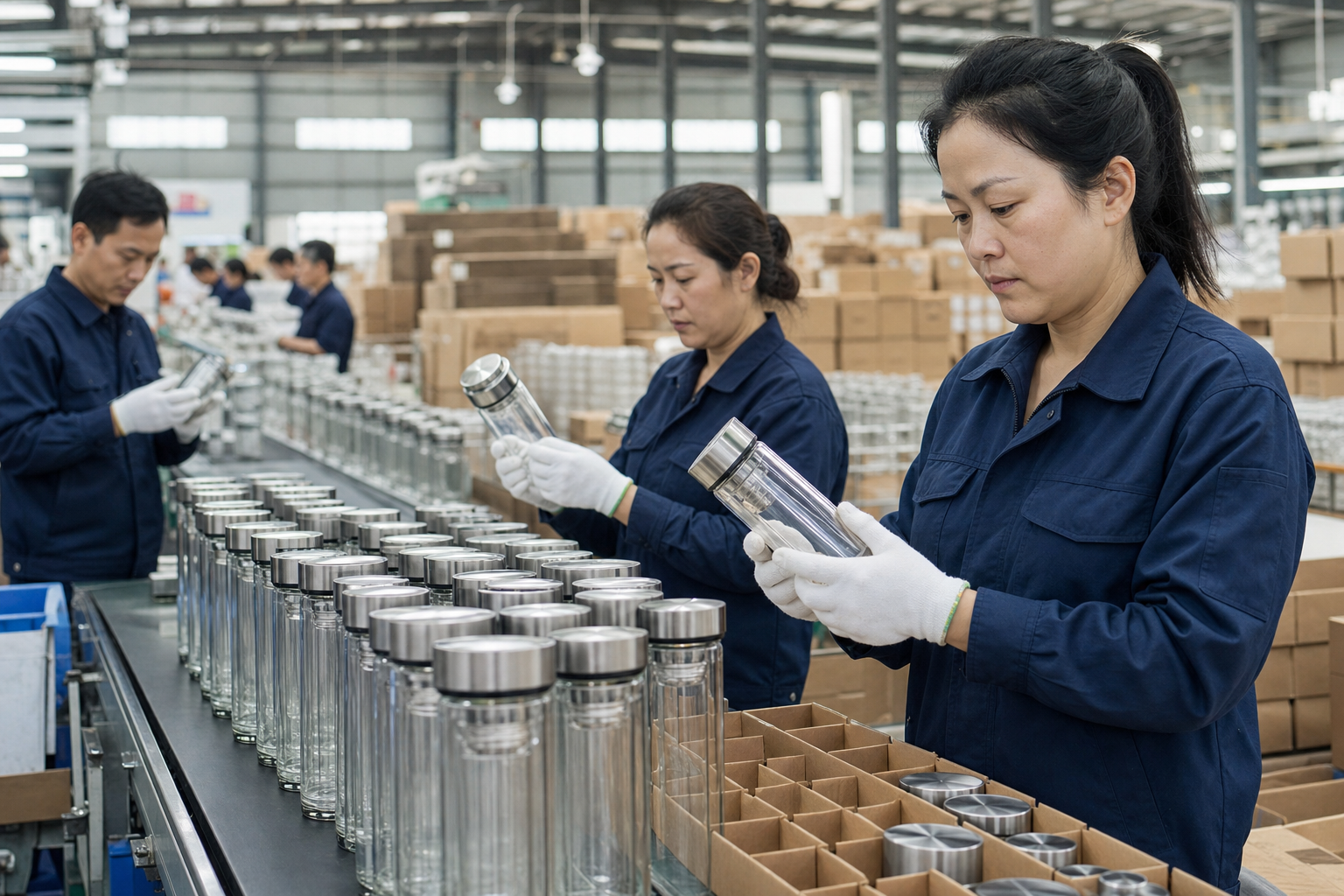
At BottleForge in Zhejiang, we treat this as an engineering decision, not a catalog pick. A good borosilicate glass thermos is more fragile than stainless, yes, but with the right wall thickness, usually 2.6 mm to 3.0 mm, it gives a cleaner drink feel and a stronger retail position. QC pulled the sample on one run because the silicone ring sat 0.4 mm off-center; that kind of miss shows up fast on the line. If you want a custom thermos that survives real distribution, you need to think like a buyer, not a fan of the sample. The details below are the ones that matter in China sourcing.
Why borosilicate wins for premium programs
Borosilicate glass thermos custom projects make sense when the buyer wants a premium drinking feel, cleaner taste perception, and a product story that sells itself on shelf. Borosilicate has low thermal expansion, so it handles hot-fill and cooling cycles better than ordinary soda-lime glass. We run this spec for 350 ml and 500 ml bodies most often. Still glass, though. We never pitch it like a stainless steel tank.
For outdoor retailers and promo brands, the best fit is a giftable, desk-friendly thermos with clean branding space. A 350 ml or 500 ml format is usually the sweet spot; at 700 ml, weight climbs and breakage risk jumps. QC pulled a 500 ml sample after a 95°C to room-temp cycle, and the neck held, but the buyer flagged the box as too soft. If you need a thermos promotional item for an event, borosilicate gives a premium look without paying for full stainless construction.
Here is the blunt part: borosilicate is not the right choice for every distributor thermos program. If the bottles will travel in boxes, trucks, and e-commerce parcels all week, you need better secondary packaging than you would for stainless. We’ve seen this go sideways on a PO with a typo in the carton qty, 3,000 shipped as 300, and the claim came fast. In Zhejiang, we usually recommend a molded pulp tray or EPE insert plus a 3-layer master carton for North American distribution. That adds cost, and the math still works better than paying for breakage later.
Specs that decide the real price
The first factory quote is rarely the number that matters. For a borosilicate glass thermos custom job, wall thickness, lid structure, decoration method, and packing decide the real bill. A standard double-wall borosilicate inner body usually sits at 1.2-1.8 mm. We check it with a micrometer on the line. Go thinner and breakage climbs fast. Go thicker and the unit price rises, plus the bottle feels heavy in hand.
For a 500 ml custom thermos, Zhejiang factory pricing often starts around USD 2.20-3.60 FOB, depending on the lid and print. Add a 316 stainless outer cap, laser logo, and gift box, and you are quickly in the USD 4.20-6.80 FOB band. That is normal. The buyer flagged a USD 2.00 landed target on one PO, and the math did not work unless we cut packaging, decoration life, or test scope.
Check the lid stack closely. A polypropylene lid is cheap and easy to mold on a 2-cavity tool, but it does not always pass as a retail piece. A stainless lid with a silicone seal gives a better shelf feel, yet it adds grams, tooling steps, and cost. If you are sourcing thermos bulk for chains or distributors, ask for the exact gasket material, usually food-grade silicone meeting LFGB or FDA expectations, and confirm the mouth finish tolerance before you release the mold. We have seen this go sideways when the PO typo said 54 mm and the sample drawing was 56 mm.
| Spec | Typical range | Buyer note |
|---|---|---|
| Capacity | 350 ml / 500 ml / 600 ml | 500 ml is the safest retail default |
| Glass wall | 1.2-1.8 mm | Thinner saves cost, thicker improves durability |
| MOQ | 3,000 pcs | Lower MOQs usually mean fewer options |
| Lead time | 35-45 days | After sample sign-off and deposit |
Decoration choices that survive shipment
For a custom thermos, decoration is not a sample-room question. It is whether the mark survives carton vibration, warehouse knocks, and the brush marks from distributor thermos programs. On borosilicate glass, a one-color silkscreen can work, but only when the ink system matches the surface and the cure is controlled. We run a 180°C cure on the line for some jobs; miss that, and QC pulls the sample fast. A fired decal holds up better and gives a cleaner retail finish, but you pay for the extra kiln step and the lead time moves.
If you are building a customized thermos for a promotional brand, keep the art simple and place it where the eye lands first. Curved glass does not forgive a busy layout. Two-color logos can work, but each extra color adds registration risk, and the math gets ugly fast. For premium campaigns, laser marking on a stainless cap or outer sleeve gives a sharper look and keeps stress off the glass body. We have seen buyers push for full-wrap artwork, then come back after the PO typo says 2 colors instead of 1.
We tell buyers in China and Europe the same thing: if the decoration must survive dishwashing, talk process, not artwork. Ask for 50-cycle dishwasher testing under realistic conditions. If the supplier says “yes” on the spot and has no test data, that is a red flag. A serious thermos supplier will show adhesion notes, curing parameters, and sample photos after abrasion testing. On one batch, the buyer flagged a 0.3 mm edge lift after tape test, and that was enough to hold shipment.
For glass, decoration failure often starts at the edges. If the supplier cannot explain ink cure temperature, tape test results, and wash-cycle performance, you do not have a finished specification.
Testing and compliance buyers should demand
For Europe and North America, the compliance file decides whether a custom thermos order moves fast or gets stuck in back-and-forth. For borosilicate glass thermos custom shipments, ask for material declarations, REACH papers, food-contact statements, and, where needed, LFGB or FDA evidence for the drinking-contact parts. If the cap or infuser is stainless, we want the metal tied to the stated grade, usually 304 or 316. We had one buyer flag a PO typo on “316L” versus “316,” and the lab report had to be matched line by line before we could ship.
Factory thermos testing should go past a simple leak check. Ask for a controlled thermal retention test, drop test, and lid torque verification, with the torque wrench reading recorded in N·m. A practical drop spec is 1 meter onto a wooden surface from packed-carton condition, then another test from product-only condition. If you sell through Amazon or DTC, the carton has to survive the sort center, not just the showroom. We run a 12-day thermal check against an 18-day reference on some builds, and the buyer usually stops arguing once they see the curve.
For inspection, AQL 2.5 major and 4.0 minor is common for bulk thermos orders. That is a starting point, not a shield. If the artwork is premium or the retail price is above USD 20, tighten the defect criteria. Ask for lot traceability by production date and line number. A solid Zhejiang thermos line should hold 20,000-40,000 units per month and still keep batch tags clean; QC pulled the sample from line 3 with the carton code printed wrong once, and that small miss would have turned into a claim later.
MOQ, tooling, and lead time realities
Most buyers ask for a thermos customizable solution, then expect the factory to eat every change. That is not how we run it. If you want a new lid, new body shape, or a special infuser basket, you are paying for tooling. A new cap mold in Zhejiang usually lands at USD 1,500-4,000, and a body mold can go higher. We had one buyer flag a 0.8 mm wall change on the drawing; that small tweak still meant a new sample trial. If you only change color and print, you can skip mold cost, but the sample round still happens.
A realistic MOQ for a borosilicate glass thermos custom order is often 3,000 pieces per design, and 5,000 is common when the lid has more parts or the decoration has extra steps. If you are a distributor thermos buyer and need three logo versions, splitting into tiny runs makes the math worse. We see this go sideways all the time. Better to keep one body spec, one lid spec, and change only the outer box by market. On our line, a PO typo on the carton size once forced a full relabel check before QC could release the lot.
Lead time is where new buyers get surprised. A standard custom thermos order takes 35-45 days after sample confirmation and deposit. Add 7-10 days for freight booking and document prep. Order near peak season, and you should add another 10 days. China production moves fast, but the factory still needs time for glass forming, assembly, curing, testing, and packing. QC pulled the sample from a 304 stainless run at AQL 2.5, and the buyer still wanted a 12-day ship date; that ask was never going to hold. Good thermos manufacturers say the schedule early, not after the PO is signed.
When stainless thermos is the better choice
Even if you are looking at borosilicate glass thermos custom options, stainless is the smarter commercial call in a lot of orders. For outdoor retailers, trail programs, school fundraisers, and gift sets that get tossed in a trunk, a double-wall stainless thermos holds up better. It takes knocks, cuts breakage claims, and lets us pack tighter; on one 40HQ, that difference shaved freight cost by 12%.
As a thermos manufacturer, we push stainless when the buyer wants a promotional thermos with long shelf life and less after-sales trouble. We run laser engraving, powder coating, and vacuum checks on the line, and stainless gives more room to work with each one. If your customer cares more about durability than the glass tea feel, stainless is the safer bulk thermos choice. We’ve seen this go sideways when a buyer tried to force glass into a hiking promo; the breakage rate came back at AQL 2.5 and the math did not work.
That is why a good supplier thermos partner should segment the line cleanly. Use borosilicate for office, tea, and gift programs. Use stainless for outdoor, travel, and rough retail. If the order volume is real, putting both through one Zhejiang factory can cut sourcing back-and-forth, keep QC pulled samples in one place, and avoid shipping mistakes like the PO typo we caught on a 5,000-piece order.
How to brief a China supplier correctly
If you want a serious quote from a thermos vendor, send a spec sheet that reads like a purchasing document, not a mood board. State capacity, material, wall thickness, lid style, decoration method, packaging, target market, and compliance requirements. Include whether you need FOB Ningbo, FOB Shanghai, or a delivered quotation. Buyers who leave out these details get vague pricing and slow samples.
For a China source, clarity saves money. A proper brief should say whether you need a custom thermos for Amazon, a retail-ready distributor thermos line, or a promotional giveaway. Those are three different products. The first needs carton durability and FNSKU labeling. The second needs margin control and repeatable color. The third needs low unit cost and fast turnaround. If you are buying from Zhejiang, you should expect the factory to ask these questions immediately; that is a good sign, not a nuisance.
At BottleForge, our monthly output for drinkware programs is above 300,000 units across multiple lines, and our standard glass order MOQ starts at 3,000 pieces. That scale matters because it gives you stable color matching, predictable assembly, and less batching risk. Still, no factory is perfect. What matters is whether your manufacturer thermos partner tells you the truth before PO, not after the shipment is already on the water.
Send your thermos spec for a fast quote
We’ll check MOQ, decoration, and packaging against your market, then give you an honest FOB price from Zhejiang within one working day.
Frequently asked questions
What is the usual MOQ for borosilicate glass thermos custom orders?
For most factory thermos programs, MOQ starts at 3,000 pieces per design. If you want a special lid, unique mold, or premium gift box, 5,000 pieces is more realistic. Smaller trial runs are possible, but unit price rises by 15-30% because setup and packing costs do not disappear. For China sourcing, ask whether the MOQ applies per color, per logo version, or per carton configuration. That detail matters more than buyers expect.
How much does a custom borosilicate thermos cost FOB China?
A basic 350-500 ml borosilicate glass thermos custom order can start around USD 2.20-3.60 FOB depending on lid and print. If you add a stainless cap, better packaging, or fired decoration, the range often moves to USD 4.20-6.80 FOB. Freight, duties, and carton testing are extra. Zhejiang factories usually quote faster when you specify capacity, decoration method, and target market.
Can a customized thermos survive dishwasher use?
Yes, but only if you choose the right decoration and ask for testing. Fired decal and well-cured silkscreen are much better than cheap surface print. A serious supplier should show 30-50 wash cycles or at least a documented tape test and abrasion check. The glass body itself may be fine, but the logo often fails first. If dishwasher durability matters, put that in writing before sampling.
Should I choose glass or stainless for outdoor retail?
For true outdoor use, stainless is usually the safer choice. It handles drops, packing stress, and repeated transport better than glass. Borosilicate glass works better for tea, gifting, and premium office use where appearance and taste perception matter more than abuse resistance. Many distributors thermos buyers split the line: stainless for outdoor channels, glass for premium or hospitality programs. That reduces claims and improves margin control.
What compliance documents do I need for Europe and North America?
At minimum, request material declarations for glass, silicone, and any metal parts, plus food-contact statements where applicable. For Europe, REACH-related documentation is often requested, and LFGB evidence is helpful for premium retail buyers. For North America, many buyers expect FDA-related food-contact assurance. If the product is going through Amazon FBA, make sure labeling, carton marks, and FNSKU handling are defined before shipment.