Key Takeaways
- 304 stainless steel is the default for a reliable custom thermos; 316 costs 12-20% more and is used when corrosion resistance matters.
- For a printed promotional thermos, expect MOQ from 1,000 to 3,000 units depending on decoration and lid tooling.
- A good vacuum-insulated bottle should hold 60°C+ after 12 hours and 45°C+ after 24 hours under standard test conditions.
- If you need retail-ready packing, add 7-10 days for labeling, carton optimization, and barcode verification.
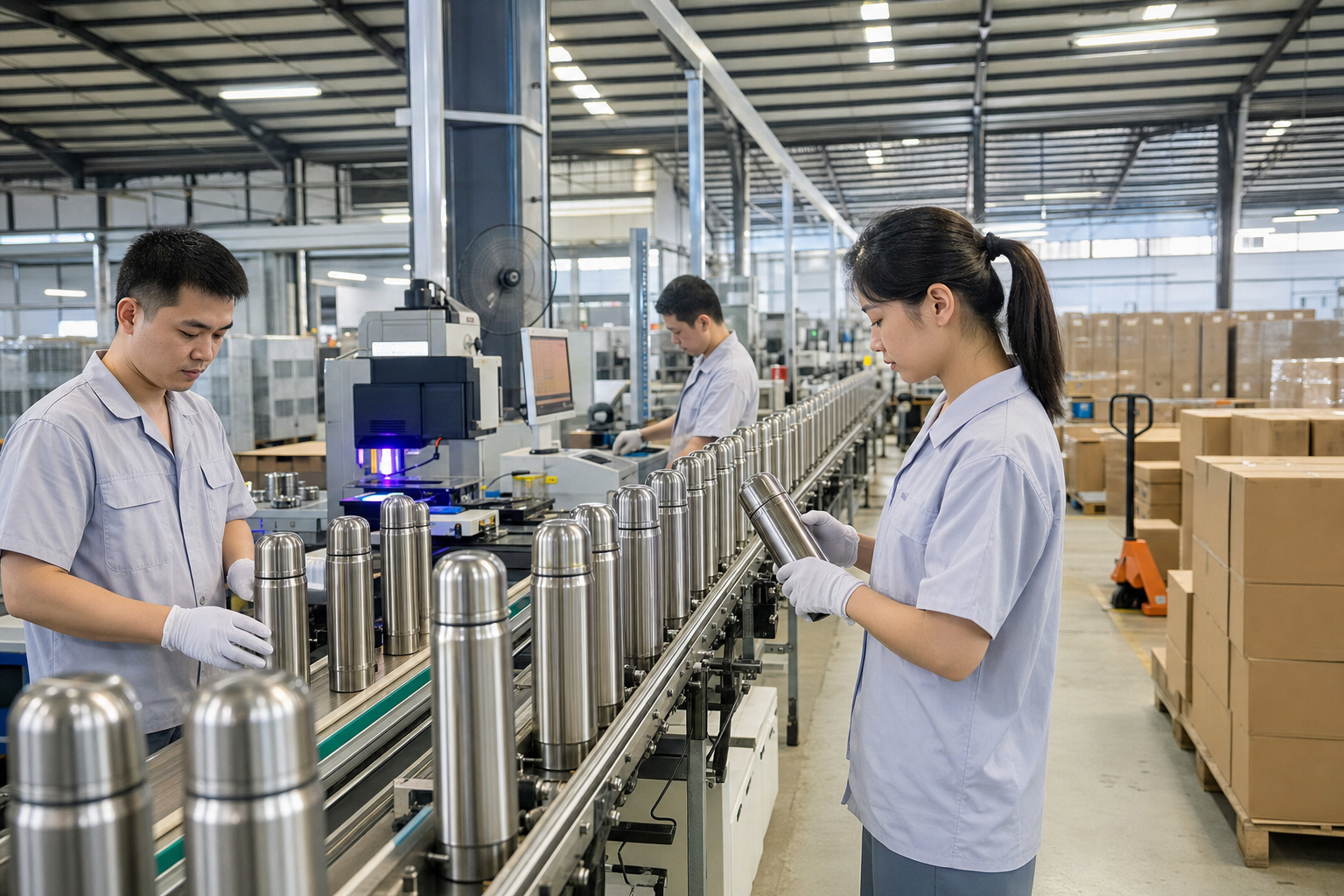
If you are buying a custom stainless thermos for outdoor retail or a promo run, the factory matters more than the logo on the lid. We run borosilicate glass lines in Zhejiang, and that same process discipline carries over to stainless builds: 18/8 steel, vacuum retention, lid seal, print rub test, and tolerance control across a bulk thermos order. A buyer once sent us a PO with the lid size in cm and the bottle size in mm on the same line. The math did not work.
Most buyers start with price and end up paying for leaks, weak insulation, coating peel, and cartons that miss FNSKU or retail barcodes. We see it all the time. A serious thermos manufacturer should give you a clear MOQ, a real 30-45 day lead time, and proof of AQL inspections plus REACH-ready materials. At BottleForge in Hangzhou, Zhejiang, we ship up to 600,000 units a month, so we are set up for steady production, not a sample-room promise. QC pulled one test lot last month and found a 0.3 mm lid gasket mismatch on the line; that is the kind of thing you want caught before shipment.
Why glass factories still make sense
It sounds odd to source a stainless product from a borosilicate glass thermos factory, but in China that setup is common. A factory that runs the vacuum line every day already knows sealing geometry, shell forming, and leak control. That matters more than the outer material. We have seen glass factories switch to stainless without starting from zero.
The better question is not “Do they only make glass?” It is “Can they run a dependable thermos system?” Ask for 304 or 316 stainless certificates, vacuum leak-rate testing, and lid torque checks. On our line, QC pulled a sample at 0.15 MPa and the buyer flagged a loose cap before shipment; that is the kind of issue you want found in-house. In Zhejiang, a lot of factories run glass-lined models, stainless models, and promo thermos orders for distributors. That mix gives you room when one buyer wants outdoor retail and another wants corporate gifting. A real supplier will tell you where the bottle is weak, not just where it looks clean.
- 304 stainless: standard, cost-effective, food-contact friendly.
- 316 stainless: better for salty or acidic use, usually 12-20% higher cost.
- Borosilicate glass: still useful for temperature retention demos and premium home lines.
Choose the right steel and wall build
Stainless thermos buyers often fixate on capacity and skip the tube stack inside. That is the wrong question to ask. If you want a custom thermos that survives pallet drops and store handling, lock the shell, inner wall, and finish before you talk artwork. For a 500 ml customizable thermos, we usually run 0.4-0.5 mm 304 inner and outer wall thickness with a copper-plated vacuum layer. On the line, 0.4 mm dents faster when the buyer's carton spec is loose; 0.5 mm costs more and adds weight, but it holds shape better.
The cap does the real work. A cheap lid wipes out a good bottle. For hot-fill use, specify silicone sealing rings that are BPA-free and tested for repeated compression. If you need a thermos custom order for hiking or field use, ask for a one-hand push lid or threaded leakproof cap with a spill test at 45 degrees for 2 hours. We had a buyer flag a PO once because they wrote “lid closed tight” and nothing else; that sort of note gets you nowhere. Ask for test data: 6 hours at 95°C fill, ambient 23°C, target 60°C after 12 hours gives the factory a clear target and keeps QC honest.
Practical rule: if the lid is the cheapest part of the bottle, your warranty claim rate usually proves it.
For bulk thermos programs, one small design change can move cost by USD 0.20-0.60 per unit. The math does not work any other way. Lock the lid structure first, then decoration, then carton layout. We ship mixed lid sets every month, and the carton die-cut on a 12-bottle pack can save more than a shiny print ever will.
MOQ, pricing, and lead time
For a custom thermos, price only makes sense beside MOQ and ship date. A 500 ml stainless steel model usually sits at USD 2.10-3.80 FOB Ningbo or Shanghai for a plain brushed finish, and the quote moves with wall thickness, lid structure, and carton spec. We run a 0.35 mm shell on some lines; that one adds cost fast. Single-color silkscreen is usually USD 0.15-0.40, laser engraving USD 0.25-0.70, and powder coat or gradient spray runs higher. If the buyer wants a gift box for promo use, add another USD 0.20-0.55. The math does not lie.
MOQ is where buyers get caught. A factory thermos line can often take 1,000 units for stock colors, but custom models with special lids, molded caps, or PMS paint usually start at 3,000 units. One buyer once sent a PO with the color code typed wrong by one digit, and QC pulled the sample before the line started. For distributor programs, 3,000 is normal. For a one-off retail test, it stings, but tooling does not care about wishful thinking. Lead time is usually 25-35 days for stock components and 35-45 days if we need new molds or a coating line reset.
Ask your thermos supplier for three quotes:
- Sample run: 3-7 days, usually USD 30-80 for freighted samples.
- Bulk production: 25-45 days depending on decoration.
- Retail packing: add 7-10 days if you need barcode, carton, or FNSKU-ready labeling.
If a thermos maker promises fast delivery on custom tooling and keeps the same price, they are leaving something out. We have seen that go sideways on the first inspection, usually on lid fit or print registration.
Decoration that survives field use
Outdoor retailers and promo brands need decoration that still looks clean after 60 days in a trunk or warehouse bin. That is the whole point. Silk screen works for 1- or 2-color logos on powder-coated bodies. Laser engraving gives a cleaner look for premium distributor thermos programs, and it holds up better against scuffing. Heat transfer and full-wrap printing can look strong on day one, but if the bottle goes to North America or Europe, we run abrasion and dishwasher checks before we say yes.
A buyer should ask for decoration on the exact substrate, not on a different sample bottle. Stainless and glass do not behave the same. On a borosilicate glass thermos factory line, the print team may nail glass decals with a 0.2 mm edge line and still need a fresh setup for steel coatings or laser depth. We have seen that go sideways. The real test is repeatability across 500 units, not one perfect sample pulled by QC.
For promotional thermos orders, keep the logo area tight. A 60 x 40 mm print zone is usually enough for a retail mark and keeps registration stable on the line. If you want a full wrap, the reject rate goes up and the inspection gets stricter. Standard checks should include AQL 2.5 major / 4.0 minor, adhesion testing, and rub testing after 24 hours curing. If a supplier says artwork is “free,” ask where the cost moved; proofing, color matching, and plate fees often show up on the PO with a typo or a surprise line item.
Quality checks your buyer file needs
The fastest way to separate a reliable thermos factory from a risky one is to ask for the test sheet before the quotation starts looking good. We ship enough samples to know this: a shiny photo tells you nothing. A serious supplier thermos file should show material specs, vacuum test results, drop-test data, and packaging checks. For a stainless bottle sold in Europe or North America, ask for REACH material declarations and the right food-contact statement for the target market. QC pulled a sample last week with a 0.3 mm dent at the base ring; the buyer flagged it before we even moved to cartons.
For a standard bulk thermos order, these are the checks that matter most. No drama.
- Leak test: inverted for 24 hours, no seepage.
- Vacuum performance: temperature retention verified at 6, 12, and 24 hours.
- Drop test: 1 meter on carton-corner and flat-face samples.
- Odor check: lid and gasket must pass after hot-water soak.
- Carton compression: especially important for distributor thermos shipments by sea.
In Zhejiang, the better factories will also show how they control incoming steel gauge and gasket hardness. That is the file you want from a factory thermos partner. If they cannot talk about durometer, weld seam control, or vacuum chamber cycle time, the math does not work. They are selling a product, not a process. We had one PO with a typo on the carton mark—“24pcs” printed as “42pcs”—and the buyer pushed back hard. For an outdoor retailer, that sort of slip is what drives returns.
How to brief the factory properly
Most custom thermos projects go wrong at the briefing stage, not on the line. Give your thermos vendor one document that answers five points: capacity, insulation target, finish, decoration, and pack-out. If you buy for a distributor thermos program, add the channel details too: shelf-ready packaging, master carton strength, barcode type, and whether FNSKU goes on the inner box or the outer carton. A clean brief cuts back-and-forth fast.
A solid brief needs exact dimensions, target weight, lid preference, and whether you need a handle, straw, or tea filter. We once saw a PO typo change 350 ml to 3500 ml; QC pulled the sample and caught it before mold prep. If you compare thermos manufacturers, send each one the same spec sheet. Then compare the same steel grade, coating thickness, carton count, and inspection standard. Otherwise the lowest quote is usually just a thinner wall and a weak lid.
For promotional brands, keep the design realistic. A thermos promotional program with 4-color wrap art and special pantone paint can be done, but it adds cost and stretches the schedule from 12 days to 18 days on sample work. If your first order is 5,000 units, a simpler spec often gives better landed cost and fewer defects. We have seen buyers push for a mirror finish, then complain about fingerprints at receipt. The math does not work. A reliable supplier in China should tell you where you can save USD 0.15 and where you should spend USD 0.25 to avoid claims later. That advice beats another pretty rendering from a thermos supplier in Zhejiang.
Request your custom thermos quote today
Send your capacity, logo, and pack-out needs. We will quote MOQ, FOB price, and lead time from our Zhejiang factory team within 24 hours.
Frequently asked questions
Can a borosilicate glass thermos factory really make stainless thermos products well?
Yes, if the factory has separate stainless forming and vacuum lines. The glass side proves they understand sealing, thermal performance, and breakage control, but you still need to verify steel handling. Ask for 304 or 316 certificates, leak tests, and a 12-hour retention report. A good Chinese factory should also show AQL records and at least one 1,000-unit production history for stainless. In Zhejiang, mixed-material factories are common, and many export both glass and stainless successfully.
What MOQ should I expect for a custom thermos order?
For a plain stainless custom thermos, MOQ is often 1,000 units if the factory uses stock lids and standard colors. For customized thermos orders with new coatings, molded lids, or full-wrap graphics, 3,000 units is more realistic. Promotional thermos programs with gift boxes or retail inserts can push MOQ higher if packaging needs custom printing. If someone offers 300 units with full customization and a very low price, check whether they are actually reselling stock, not manufacturing it.
What is a fair FOB price for stainless thermos bulk orders?
For a 500 ml model, a fair FOB China range is roughly USD 2.10-3.80 depending on wall thickness, finish, and lid complexity. Laser engraving usually adds USD 0.25-0.70 per unit. Powder coating, gift boxing, and special lids can push the total higher. If you need 316 stainless, budget 12-20% more than 304. Your final landed cost also depends on freight, duties, and whether you ship by sea or air. A thermos supplier should quote all of that separately.
How long does production take in China?
For standard bulk thermos orders with stock components, plan on 25-35 days. If you need new molds, custom paint, or a special cap, lead time is usually 35-45 days. Add 7-10 days if your distributor thermos program requires barcode labeling, master carton testing, or retail-ready packing. Sample approval usually takes 3-7 days, but serious buyers should allow time for one revision round. In Zhejiang, factories with high monthly output can move faster, but only if you approve artwork and specs quickly.
What certifications should I ask for before placing the order?
At minimum, ask for material declarations, food-contact compliance documents for your market, and inspection records. For Europe, REACH awareness is important, and for North America you should ask about FDA food-contact suitability claims where applicable. Also request factory audit evidence such as BSCI or similar social compliance if your retailer requires it. On the quality side, ask for AQL 2.5 major / 4.0 minor inspection standards, vacuum testing data, and packaging drop-test records. A serious thermos manufacturer should provide these without hesitation.