Key Takeaways
- Borosilicate glass is typically specified at 1.5-2.0 mm wall thickness for stable thermal performance and lower breakage risk.
- A practical custom thermos MOQ for China sourcing is often 1,000-3,000 units, with 25-35 days lead time after sample approval.
- For promotional thermos orders, expect USD 3.20-6.80 FOB depending on material, lid, and decoration method.
- Ask for REACH, food-contact testing, and AQL 2.5 inspection before you approve mass production.
If you are sourcing a borosilicate glass thermos supplier, you are usually balancing two buyer demands at once: a clean, premium look for retail shelves and a price that still works on bulk thermos orders. That is where projects slip. Buyers ask for a custom thermos, but they leave out wall thickness, lid structure, leak test standard, or decoration method, then act surprised when the sample passes eye check and the line fails on production consistency.
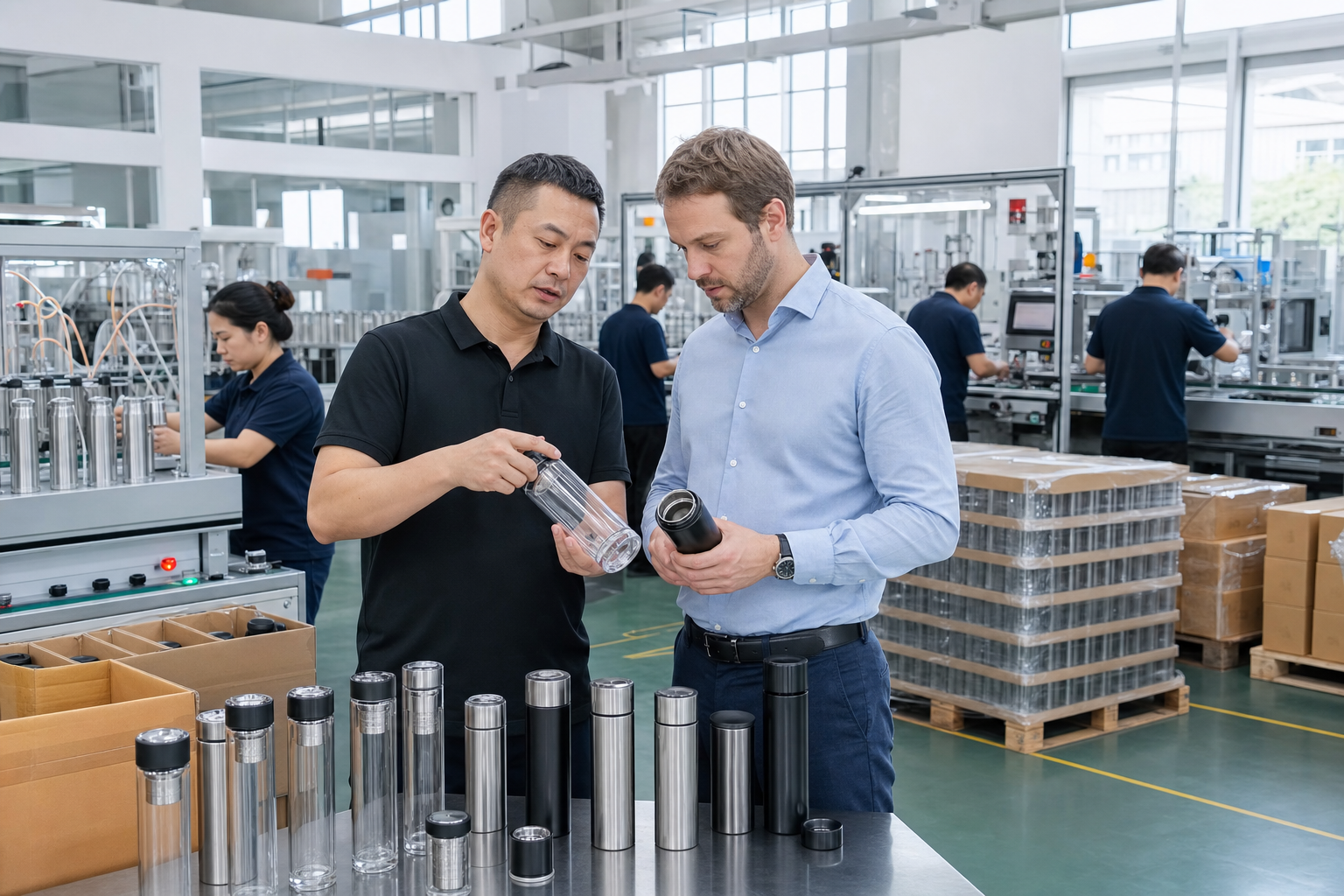
From our Hangzhou, Zhejiang factory, we see the same issue every week. The right supplier thermos partner is not the one with the longest catalog. It is the one who can explain why borosilicate glass handles thermal shock better in a 95°C hot-fill test, when 304 stainless is the safer call, and how to set a realistic MOQ of 1,000 to 3,000 units with a 25 to 35 day lead time. QC pulled the sample yesterday, and the buyer flagged a 0.8 mm lid gap on one PO typo; that kind of detail is the difference between a clean run and a messy one. If you are buying for outdoor retail or a promo program, you need factory thermos specs, not sales talk.
Why buyers still ask for borosilicate
Borosilicate glass keeps turning up in sourcing briefs because it gives a premium drinking feel without pushing packaging cost through the roof. It is chemically stable, clear, and easy for retail buyers to merchandize when they want the tea or fruit inside the cup. For a borosilicate glass thermos supplier, the job is not just making it look clean. We run the glass spec, the vacuum wall if the model has one, and the lid fit so the unit survives carton vibration and shelf handling. On our line, a 0.2 mm lid gap is enough to trigger a recheck.
For hot tea, fruit infusions, and office use, borosilicate glass usually beats a stainless body on presentation. For hikers, campsite buyers, or commuters who toss bottles into bags, stainless is the safer factory thermos call. That is not a knock on glass. It just has a narrower lane. We had one buyer flag a PO that said “outdoor gift set” but asked for glass; the math does not work. A good supplier in China or Zhejiang will say so straight away instead of pretending one build suits every channel.
For buyers, match the material to the channel:
- Retail gift sets: borosilicate glass gives strong shelf appeal and supports higher margins.
- Promo campaigns: glass works when the order stays in controlled distribution and the carton spec is tight.
- Outdoor retail: stainless steel is often the better manufacturer thermos choice for impact resistance.
If a thermos supplier says borosilicate is “unbreakable,” walk away. It is not. QC pulled the sample, dropped it from 80 cm, and the base chipped on the second hit. A serious thermos manufacturer talks about impact limits, carton inserts, and drop-test results instead.
Glass or stainless for your channel
You do not choose by trend. You choose by channel risk. A custom thermos for a promo run may go out by the pallet to distributors, then get handed to end users who do not expect lifetime abuse. A customized thermos for outdoor retail gets set next to stainless samples and judged on drop survival, not looks. We’ve seen the wrong build get rejected in one afternoon. That changes the sourcing call.
Borosilicate glass thermos products usually win on clear body view, clean taste, and a premium look on shelf. Stainless models win on drop resistance, heat hold, and field use. On our line, a 304 stainless sample with a 0.4-0.6 mm outer wall passed a 1.2 m drop check; the glass version chipped at the rim after one fall. If your buyers need a distributor thermos for warehouse and retail handling, stainless is the safer base. If they want a promo thermos with a printed logo and gift box, glass can give better margin.
What we tell buyers in Zhejiang
We normally ask three questions before quoting:
- Will the product be sold as a retail item or used as a giveaway?
- Is the end user expected to carry it daily, or use it at desk or home?
- Do you need a thermos bulk price, or a higher perceived value at a lower unit count?
Last week QC pulled the sample and found a 2 mm print shift on the carton, and the buyer flagged it before we shipped. The answers decide whether we suggest borosilicate glass, stainless steel, or a hybrid build with a glass inner and protective outer shell. Good suppliers in China do not push one construction onto every order. They build around channel behavior, and that is the right question to ask.
Specs that protect your margin
Most sourcing mistakes start here: the buyer signs off a sample, then never pins down the measurable spec sheet. A borosilicate glass thermos supplier should quote exact numbers, not “good quality” talk. We want a drawing with capacity, wall thickness, lid material, seal type, and test criteria. If the supplier cannot put those on paper, the line will make the decision later.
For borosilicate glass, the usual commercial sizes are 300 ml, 500 ml, and 750 ml. Wall thickness sits around 1.5-2.0 mm, depending on the bottle shape and the neck finish. Lids are often PP, Tritan, or stainless steel with silicone seals. For stainless versions, 304 stainless is the standard for inner and outer contact areas, while 316 is for higher-end or special-use jobs. If you want a custom thermos with a powder-coated shell, ask for coating thickness and adhesion test data; color chips alone do not protect margin. We once had a buyer flag a PO typo on “0.15 mm” instead of “1.5 mm” coating spec, and that kind of miss gets expensive fast.
Useful buyer checklist:
- Leak test: 1 meter inversion test for 5-10 minutes
- Temperature retention: 6 hours hot and 12 hours cold, tested with fixed fill volume
- Drop test: 1.0 meter on three faces for promotional thermos cartons
- Food-contact compliance: REACH for EU, FDA-style declaration for North America where required
- Inspection standard: AQL 2.5 for major defects, 4.0 for minor defects
These numbers matter because they turn a thermos custom project into a repeatable order. Without them, every re-order becomes a new argument. We run 100% leak checks on the line for some export SKUs, and QC pulled a sample with a loose silicone ring before shipment; that saved a 2,000-piece headache.
MOQ, pricing, and lead times
Buyers often ask for a distributor thermos price before they define the decoration method. That order is backwards. A laser logo, one-color silk screen, full-wrap CMYK sleeve, or engraved stainless mark all change cost and yield. On the line, a 0.3 mm logo shift can scrap a whole tray, and the buyer usually spots it only after QC pulls the sample. For China sourcing, a realistic MOQ for a basic customized thermos is often 1,000 units per color, while complex gift packaging may push the MOQ to 3,000 units or more. For very simple stock items, some suppliers can go lower, but you usually pay through setup and packaging fees.
At our Hangzhou, Zhejiang factory, we run about 300,000 units a month across stainless and glass drinkware lines, with standard thermos lead times of 25-35 days after sample sign-off. That is normal for a factory thermos order where you need printing, carton work, and final inspection. Last month a buyer flagged a PO typo on the lid color code, and we caught it before molding. If a thermos vendor promises 7 days for a fully customized thermos with imported decoration and custom packaging, the math does not work. You are buying an exception, not a stable production plan.
FOB pricing for bulk thermos orders can sit around USD 3.20-6.80 for simpler stainless or glass builds, and move higher with double-wall vacuum construction, premium lids, or gift packaging. What matters is not the lowest quote. It is whether the quote includes carton drop testing, extra gaskets, and spare parts. We saw this go sideways once on a 1,200-piece Europe order: no spare gasket, then 18 days lost on claims. Those small items protect margin when you ship to Europe or North America and deal with after-sales issues.
Customization that does not slow production
“Custom thermos” can mean three different jobs, and this is where projects go off track. A buyer may mean a logo print and a color box. On our side, it can mean new mold work, a lid change, or a packing layout that adds 8 seconds per unit on the line. Decide what to change before you ask for a quote.
The fastest route is to stay on existing molds. A borosilicate glass thermos supplier can run logo printing, sleeve color changes, strap adds, and carton artwork without opening new tooling. If you want a new body shape, plan on 25-45 days for tooling plus samples, and the first order will cost more. For a promo run, that is usually the wrong question to ask. Keep the body standard and put the money into print sharpness and carton fit.
High-impact custom options
- Laser engraving on stainless caps for a clean mark that does not rub off
- Silkscreen printing for 1-3 color logos, with the print area held to 1.5 mm alignment
- Full-color wrap labels for seasonal promotions and short runs
- Gift boxes with EVA inserts for retail display and drop protection
- Serialized cartons for distributor thermos programs and lot tracking
We have seen buyers ask for five custom points, then wonder why the line slows down. Last month QC pulled the sample because the cap logo was 2 mm off-center, and the buyer flagged it before packing started. The better factories say yes only when the tolerance holds. That is what separates a one-off order from a steady thermos supplier relationship.
How to qualify a real supplier
A real borosilicate glass thermos supplier should answer technical and commercial questions in the same call. If they only quote price, they are a trader. If they only talk material and stay silent on export compliance, they do not run the whole job. You need a thermos partner who can handle both without passing the buck.
Ask for these before you place a bulk thermos order:
- Recent BSCI or equivalent social audit if your retail channel requires it
- REACH or relevant food-contact reports for Europe
- Production photos from the line, not staged samples in a showroom
- Sample lead time, mass production lead time, and spare-part policy
- Defect handling terms under AQL 2.5
When we check distributor thermos inquiries, we also look at carton compression. A good bottle can still arrive cracked if the export carton is too thin. For a 500 ml glass item, we usually specify a 5-ply master carton with inner dividers and a drop-tested mailer for e-commerce. We have seen 3-ply cartons fail in transit on a 12 kg outer case, and the buyer flagged it on the first receipt. North American fulfillment does not forgive weak packing.
“The quote is only the starting point. The carton, seal, and test standard decide whether your margin survives the shipment.”
If your team wants a long-term thermos manufacturer in Zhejiang or elsewhere in China, ask for process control records, not a polished sample table. QC pulled the sample, checked the neck finish with a caliper, and that tells you more than a sales deck. This is the wrong question to ask: who is cheapest? The better question is who can ship the same spec on PO 2407 with audit trail and no excuses.
Request a factory quote with real specs
Send your capacity, logo method, target MOQ, and destination market. We will quote a borosilicate glass thermos supplier or stainless build in 24 hours.
Frequently asked questions
What MOQ should I expect for a custom thermos order from China?
For a standard custom thermos with logo printing and stock packaging, MOQ is usually 1,000 units per color. If you want custom molds, premium gift boxes, or mixed finishes, 3,000 units is more realistic. In Zhejiang, some factories can sample in 7-10 days and start mass production after approval, but the full order still needs 25-35 days. Ask whether the MOQ applies per model, per color, or per decoration method, because those are not the same thing.
Is borosilicate glass safe for hot beverages and export retail?
Yes, if the glass is true borosilicate and the structure is designed correctly. The material is stable under normal hot beverage use and offers good taste neutrality. For export, you still need the right tests: food-contact compliance, drop testing, and packaging validation. A borosilicate glass thermos supplier should provide clear specs such as 1.5-2.0 mm wall thickness, seal material, and leak-test results. It is safe for retail when the channel is controlled, but it is not the best choice for rough outdoor abuse.
How much does a promotional thermos cost FOB China?
A simple promotional thermos can start around USD 3.20-4.20 FOB for basic stainless or glass builds with one-color printing. Better lids, powder coating, or gift packaging can move it to USD 4.80-6.80 FOB. Complex customized thermos projects can go higher. The real pricing question is not the base price alone. You should also ask about carton cost, spare gasket cost, inspection fees, and whether the quote includes testing and export packing.
What compliance documents should I request from a thermos supplier?
For Europe, ask for REACH-related declarations and relevant food-contact test reports. For North America, request documentation that supports food contact suitability and any state-level requirements your customer needs. Also ask for a factory audit such as BSCI if your retail customer requires it. A serious thermos supplier in China should be able to provide AQL inspection terms, packing lists, product drawings, and sample approval records. If they cannot produce those, your risk is high.
Should I choose stainless steel or borosilicate glass for outdoor retail?
For outdoor retail, stainless steel is usually the safer choice. A 304 stainless body with 0.4-0.6 mm walls handles drops, bag pressure, and repeated travel better than glass. Borosilicate works better for desk use, tea, and gift-driven retail where appearance matters more than impact resistance. If your buyers want a premium look but still need durability, you can ask for a hybrid structure or a protected sleeve design. That is often a better manufacturer thermos solution than forcing pure glass into a rough channel.