Key Takeaways
- Typical MOQ for a borosilicate glass thermos custom order starts at 3,000 pcs per SKU, with 25–35 days lead time after sample approval.
- FOB China pricing for a 450–500 ml borosilicate glass thermos bottle wholesale order often lands at USD 2.10–4.80 depending on lid, sleeve, and decoration.
- For export to Europe and North America, ask for REACH, food-contact declarations, and drop-test data before you approve bulk production.
- A good borosilicate glass thermos flask private label program usually needs 1.8–2.2 mm glass wall thickness and a lid torque target that stays consistent within 10%.
If you are sourcing a borosilicate glass thermos wholesale, the first mistake is assuming every “glass thermos” fits the same job. It does not. We’ve seen 500 ml gift units that look fine on a table fail after a 1.2 m drop test, while hot-fill models with thicker walls ship clean. The difference shows up in breakage rates, lid leaks, and warranty claims.
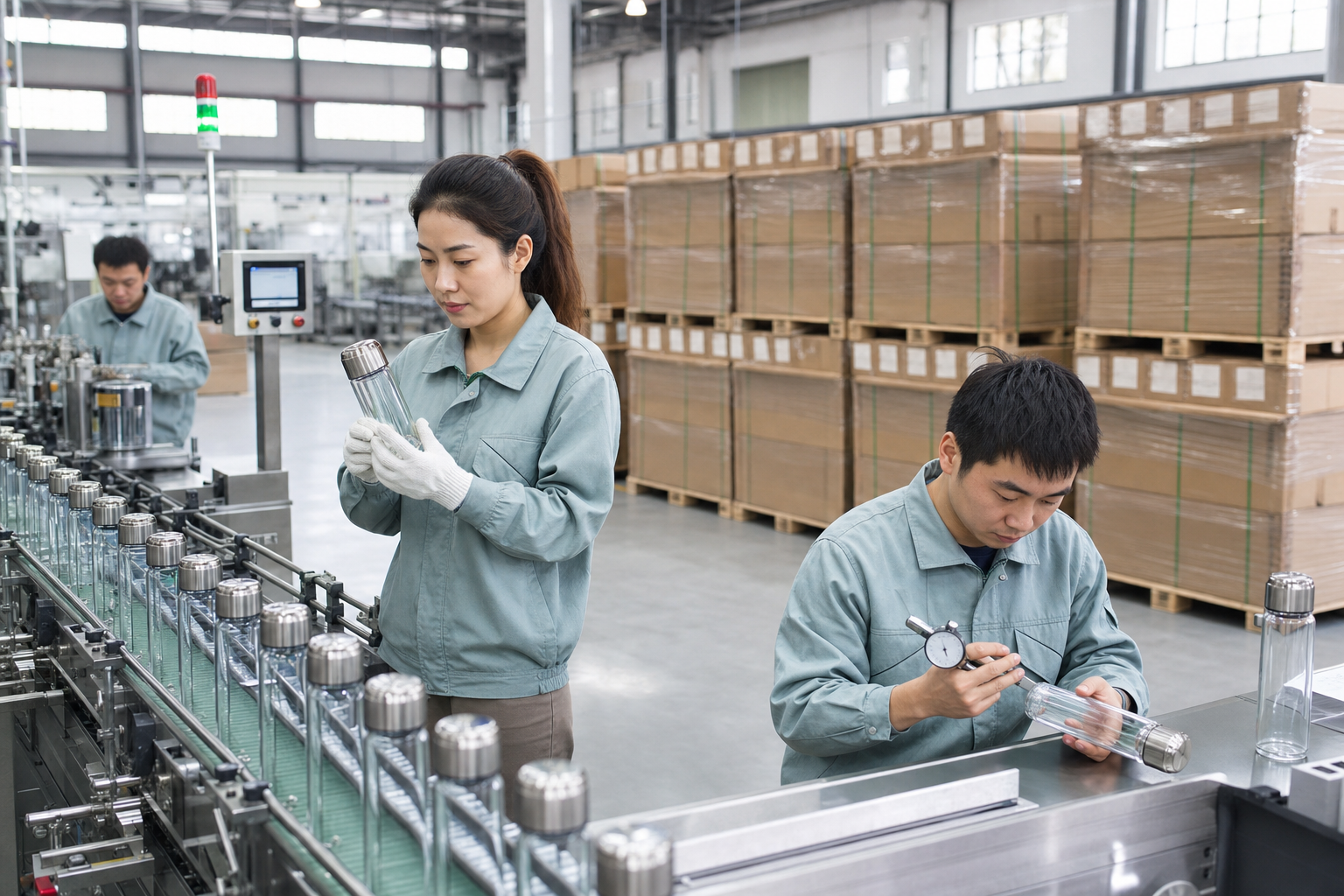
At BottleForge in Hangzhou, Zhejiang, buyers often come in with a stainless thermos brief and then switch to glass-lined or full glass after they compare taste neutrality, product visibility, and private-label margin. That switch is normal. If you are buying from a borosilicate glass thermos manufacturer in China, judge the factory on mold control, glass thickness, closure fit, and export compliance, not on a polished sample photo. We run the line with a caliper on wall thickness, and a serious borosilicate glass thermos factory should quote MOQ, lead time, and AQL 2.5 without dodging the question.
What borosilicate glass changes
Borosilicate glass is not marketing fluff. It is a lower-expansion glass that handles thermal shock better than soda-lime glass. We see the difference on the line: a hot fill, then a cold rinse, and the cheap glass starts to complain. For a borosilicate glass thermos bottle, that matters because the buyer wants a premium reusable item that behaves the same on day 1 and day 30. No cloudy liner. No metallic taste. No bottle that looks good in photos and fails after one rough wash cycle.
In China, plenty of factories can source borosilicate tube or molded glass, but only a borosilicate glass thermos bottle manufacturer with export discipline will hold the wall thickness and annealing right. Our normal retail build sits at 1.8 mm to 2.2 mm. The math is simple: too thin saves a few cents and raises breakage, too thick adds weight, freight cost, and a clumsy hand feel. A buyer once pushed back on a 2.4 mm sample because it felt like a brick. He was right. If the bottle goes in bags, bikes, or camp kits, specify a sleeve or silicone bumper from the start.
- Thermal shock resistance is why buyers pick borosilicate, and why QC keeps the sample near the hot-fill test bench.
- Wall thickness should be written on the spec sheet, not left for the factory to guess.
- Annealing control drives crack rates during export and retail handling; we have seen a loose anneal turn into a PO dispute fast.
What wholesale buyers actually pay
Buyers ask for one number. We usually give a range. For borosilicate glass thermos wholesale, a 350–500 ml order on FOB China often lands at USD 2.10 for a plain single-wall body with a PP lid, then climbs to USD 4.80 or more when the spec adds a vacuum-style outer shell, bamboo parts, or a gift box. One-color logo printing or laser marking usually adds USD 0.08–0.25 per unit. QC pulled a sample last week and found a lid insert mismatch on a 5,000-piece run; that kind of small miss is where the math starts to move.
Freight can flip the quote. A carton that looks cheap in Zhejiang stops looking cheap once it is packed for ocean or air. Double-wall paper inserts, molded pulp trays, and ISTA-friendly carton strength all change landed cost. If you are buying borosilicate glass thermos bulk for Amazon or a distributor network, ask for EXW, FOB Ningbo or Shanghai, and the carton count per master case. We ship these all the time, and the buyer usually pushes back on one point: the box size. A 2 mm change in tray thickness can save a lot or add dead weight, so this is the wrong question to ask if you only stare at unit price.
Rule of thumb: if a quote sits 20% below the market and the supplier cannot explain the glass source, lid tooling, or packaging structure, you are not getting a bargain. You are buying risk.
How the factory controls quality
A borosilicate glass thermos factory should treat quality control as a process, not a final inspection ritual. We run incoming glass checks, annealing checks, lid fit, seal compression, logo adhesion, and carton drop tests before the goods leave the line. For export programs, we use AQL 2.5 for major defects and 4.0 for minor defects on finished goods, with lid leakage and chips on the mouth rim getting extra eyes from QC. A cracked rim is not a cosmetic issue; it turns into a safety claim and a returns headache.
Factories in Zhejiang and across China can make solid product, but the buyer still has to ask direct questions. What is the monthly output? At BottleForge, our drinkware lines can support 300,000 units per month across multiple SKUs, and that matters when a retailer bumps the forecast at the last minute. What is the lead time? Standard borosilicate glass thermos custom work usually takes 25–35 days after sample sign-off, and new packaging or molded inserts can add another 7–12 days. Ask for a pre-production sample, then a golden sample sealed and labeled for reference. We once saw a PO with the lid color typed as “sliver” instead of silver; the buyer flagged it, and that typo would have gone straight into mass production if we had not checked the proof against the carton spec.
Tests worth asking for
- Hot-water fill and 24-hour leak test
- Drop test from 80 cm to 100 cm on carton-packed units
- Logo rub test with alcohol or detergent
- Food-contact declaration and REACH documentation for Europe
Private label and OEM choices
If you are building a borosilicate glass thermos private label range, decide early whether you want a standard catalog shape or a fully bespoke mold. A catalog body with custom color, lid, and logo moves faster and keeps tooling low; a true borosilicate glass thermos oem or borosilicate glass thermos odm project lets you control silhouette, closure, sleeve, and packaging, but it adds mold cost and sampling time. We have shipped both paths. For one 5,000-piece outdoor order, the buyer wanted a new collar but kept the stock bottle, and that saved 18 days versus opening a new mold. For many outdoor retailers, the smart move is a hybrid: use an existing bottle shape and customize the cap, print, and gift box.
Private label buyers should care about the lid more than the bottle. That is where most returns start. A borosilicate glass thermos flask private label order can go sideways if the gasket groove is sloppy or if closure torque changes between production lots. QC pulled the sample on a torque tester at 0.35 N·m and the buyer flagged it before packing. We check thread engagement, gasket compression, and seal rebound because those details decide whether the bottle survives truck vibration and daily use. If you want a premium story, go with matte spray, silk-screen logo, laser engraving on a metal band, or a bamboo-accent lid. Each one changes cost and scrap rate, so ask for separate line items. That is how a borosilicate glass thermos bottle custom project stays profitable instead of turning into an expensive prototype exercise.
For brands selling in North America, line up carton labels, UPC placement, and FNSKU planning before mass production. We had one PO where the buyer typed the FNSKU one digit off, and the whole carton run had to be relabeled by hand. A factory that knows retail compliance saves you repacking cost later. Ask the shipping team to confirm outer carton marks at 10 a.m., not after the line is full.
Packaging for retail and e-commerce
Glass does not forgive rough transit. If you are selling borosilicate glass thermos flask wholesale into retail, Amazon, or distributor channels, packaging is part of the product, not an afterthought. A proper borosilicate glass thermos bottle wholesale carton needs compression strength, tight internal fit, and clean stackability. We have seen the same failure on the line more than once: the bottle clears factory QC, then lands with chipped rims because the inner tray lets it move a few millimeters under vibration.
For e-commerce, we run molded pulp or EPE inserts with at least 3 contact points on the bottle body. For retail shelves, a printed window box can work, but only if the corrugate and insert keep the bottle centered. We usually suggest a 3-ply or 5-ply outer carton based on unit weight and whether you ship full containers or mixed pallets. A buyer once flagged a PO typo on carton size, and the math did not work in the loading plan. If your target is borosilicate glass thermos flask supplier talks in Europe, ask for humidity-resistant cartons and clear case markings. China-to-Europe ocean freight will expose weak packaging fast, and winter condensation makes the weak box fail first.
Good packaging cuts claims. We have tracked shipments where moving from loose paper wrap to shaped pulp reduced transit damage by 30% to 50% on glass drinkware. That is margin, plain and simple. QC pulled the sample after a drop test at 80 cm, and the carton held; without that change, we know this has gone sideways before.
Picking the right supplier in China
China has plenty of factories that can ship a sample. Fewer can run a repeat program as a borosilicate glass thermos supplier with stable lead times, clean compliance files, and export-ready cartons. We usually ask for one hard number first: daily output, such as 3,000 pcs or 8,000 pcs, because that tells you more than a shiny brochure. If the sales team cannot tell you where the glass comes from, how the lid is assembled, or what happens when the line finds chips, walk away.
Because you are buying from China, check the basics before you talk price. BSCI matters if your retail chain asks for social compliance, and you still need food-contact statements for the target market plus clear Incoterms. FOB is the usual starting point for borosilicate glass thermos flask wholesale, and DDP can work for a 500-piece test order if the landed cost is written out. We have seen buyers get burned by a PO that said “packaging TBD”; the math does not work. Zhejiang has solid drinkware exporters, but location is not the point. You need a factory that quotes straight, ships on time, and can handle a 1,000-piece replenishment inside 20 days without making excuses. That is a supplier. The rest is just a contact list.
If you compare factories, send the same brief to each one: capacity, wall thickness, lid type, packaging, and test requirements. Ask for the exact spec, not “good quality.” Then compare the replies line by line. QC pulled the sample, checked the neck finish at 0.3 mm tolerance, and the buyer flagged the missing carton mark on one quote. That sort of detail tells you who is real.
Request a borosilicate glass quote today
Send your target size, logo method, and packaging spec. We will give you a clean FOB China quote with MOQ and lead time.
Frequently asked questions
What is the typical MOQ for borosilicate glass thermos wholesale?
For a standard borosilicate glass thermos wholesale order, MOQ is usually 3,000 pcs per SKU for custom color or logo work. If you want a fully new lid or mold, the factory may ask for 5,000 to 10,000 pcs because tooling and setup costs need to be spread out. For mixed designs, some China suppliers will allow 1,500 pcs per color if the bottle body stays the same, but you should expect a higher unit price. At BottleForge, our practical planning target is 25–35 days after sample approval, depending on packaging and decoration.
How much does a borosilicate glass thermos bottle cost at FOB?
A basic borosilicate glass thermos bottle wholesale quote often starts around USD 2.10 to 2.80 FOB China for a simple body, standard lid, and plain carton. Mid-range private label versions usually land at USD 3.20 to 4.20, especially if you add a bamboo lid, sleeve, or gift box. Premium builds can go above USD 4.80. Your final price changes with capacity, wall thickness, lid material, print method, and carton spec. Always ask for a line-by-line quote so you can see what each upgrade costs.
Is borosilicate glass safe for hot drinks and export markets?
Yes, borosilicate glass is widely used for hot beverages because it handles thermal shock better than ordinary glass. For export, safety is not only about the glass itself. You also need food-contact declarations, REACH compliance for Europe, and clear material specs for lid and gasket components. Ask the borosilicate glass thermos manufacturer for test reports covering leakage, thermal stress, and any coating or print ink used. If the product has a silicone sleeve, confirm it is food-grade and odor-controlled. Buyers in North America often also request ASTM-related testing from their own labs.
What wall thickness should I specify for a custom order?
For a borosilicate glass thermos custom project, 1.8 mm to 2.2 mm wall thickness is a practical range for most retail sizes. Thinner walls can lower cost and weight but increase breakage risk during packing and retail handling. Thicker walls feel more robust but push freight and can make the bottle feel heavy in the hand. If you are targeting outdoor retail or gift channels, ask the borosilicate glass thermos factory to send sectional drawings and a sample with measured wall thickness. Do not approve based on appearance alone.
What should I check before choosing a borosilicate glass thermos supplier in China?
Check production capacity, QA process, export documentation, and packaging strength. A reliable borosilicate glass thermos supplier in China should state monthly output, typical lead time, and defect handling procedure without hesitation. Ask for AQL targets, leak-test method, and whether they can support BSCI or similar social compliance if needed. Also confirm whether they are a direct borosilicate glass thermos bottle manufacturer or just a trading company. Direct factories in Zhejiang often give you better control over samples, better cost transparency, and faster issue resolution when you need a second run.