Key Takeaways
- Typical MOQ starts at 500 pcs for stock bodies and 1,000 pcs for fully custom colors.
- FOB China pricing for promo bottles usually lands around USD 1.20-4.80 per unit, depending on material and print.
- Standard lead time is 20-35 days after sample approval; molded custom jobs can take 45 days.
- For export, ask for REACH, food-contact declarations, and AQL 2.5/4.0 inspection terms.
Buyers usually spot the trap too late: the sample looks fine, the quote is low, then the cartons land late, scratched, or dead on arrival for resale. We see it on the line. A promo bottle is not just a container. It needs a workable unit price, a decoration method that survives transit, and packaging that fits the channel without extra touch labor.
For procurement teams, distributors, and brand owners, the job is matching the bottle to the campaign. Water bottles for business gifts, water bottles for events, and water bottles for employees each call for different specs. At BottleForge in Zhejiang, China, we pull the same mistake every month: buyers pick color first and skip lid torque, wall thickness, and print rub resistance. QC pulled one sample last week with a 0.3 mm cap gap. That is where margin leaks out.
Choose the right bottle type
Buyers looking for water bottles for promotional gifts usually start by asking for the lowest price that still looks giftable. That is the wrong question to ask. The bottle has to match the use case and the time it stays in circulation, or the logo disappears into a drawer. For water bottles for companies and water bottles for business events, 304 stainless steel or Tritan gives a better hand feel than thin PET, and it survives trucking and retail handling better. We’ve had buyers flag a 0.4 mm PET wall as “too cheap” after one carton test.
For mass giveaways, a 500 ml PP or PET bottle works when the campaign is short and the audience is broad. For water bottles for employees, schools, or sports programs, I’d point to 650-750 ml capacity, a leak-proof cap, and at least 0.8 mm wall thickness on plastic bodies. For water bottles for gym, fitness, athletes, runners, cyclists, and hiking, the lid matters more than the body. A one-hand flip lid or sports cap beats an extra 50 ml every time. QC pulled a sample with a loose cap at 3 drops, and the buyer killed that model on the spot.
- Promotional giveaway: 400-600 ml, low-cost PP or PET, MOQ 1,000 pcs
- Corporate gift: 500-750 ml, stainless steel or Tritan, MOQ 500 pcs
- School or kids program: BPA-free plastic, rounded edges, easy-open lid
In Zhejiang and across China, factories ship plenty of water bottles for sale online, but the catalog photo hides the real issue: the bottle has to fit the job, not the keyword. We once saw a PO typo that changed 500 ml to 50 ml. The math doesn’t work.
Match decoration to the budget
Decoration is where a lot of promo bottle orders go sideways. A logo that looks clean on a screen can break on a curved bottle, especially with thin strokes or gradients. We check the artwork on a wrapped template before print. The usual choices are silk screen, pad print, UV print, laser engraving, and heat transfer, and each one lands in a different cost bracket and wear level.
For water bottles for swag and water bottles for giveaways, single-color silk screen is usually the best value at USD 0.08-0.25 per print position, depending on size and setup. A buyer once sent a PO with “logo size normal” and the line had to stop until we got the artwork width in mm; that kind of typo burns time fast. Laser engraving on stainless steel gives a stronger premium look and holds up better, but the unit cost is usually USD 0.30-0.80 higher. UV printing works for complex logos and small runs, but it needs a clean surface and proper curing. If you want a full-color wrap for water bottles for marketing campaigns, ask for print area dimensions in millimeters, not “around the bottle.”
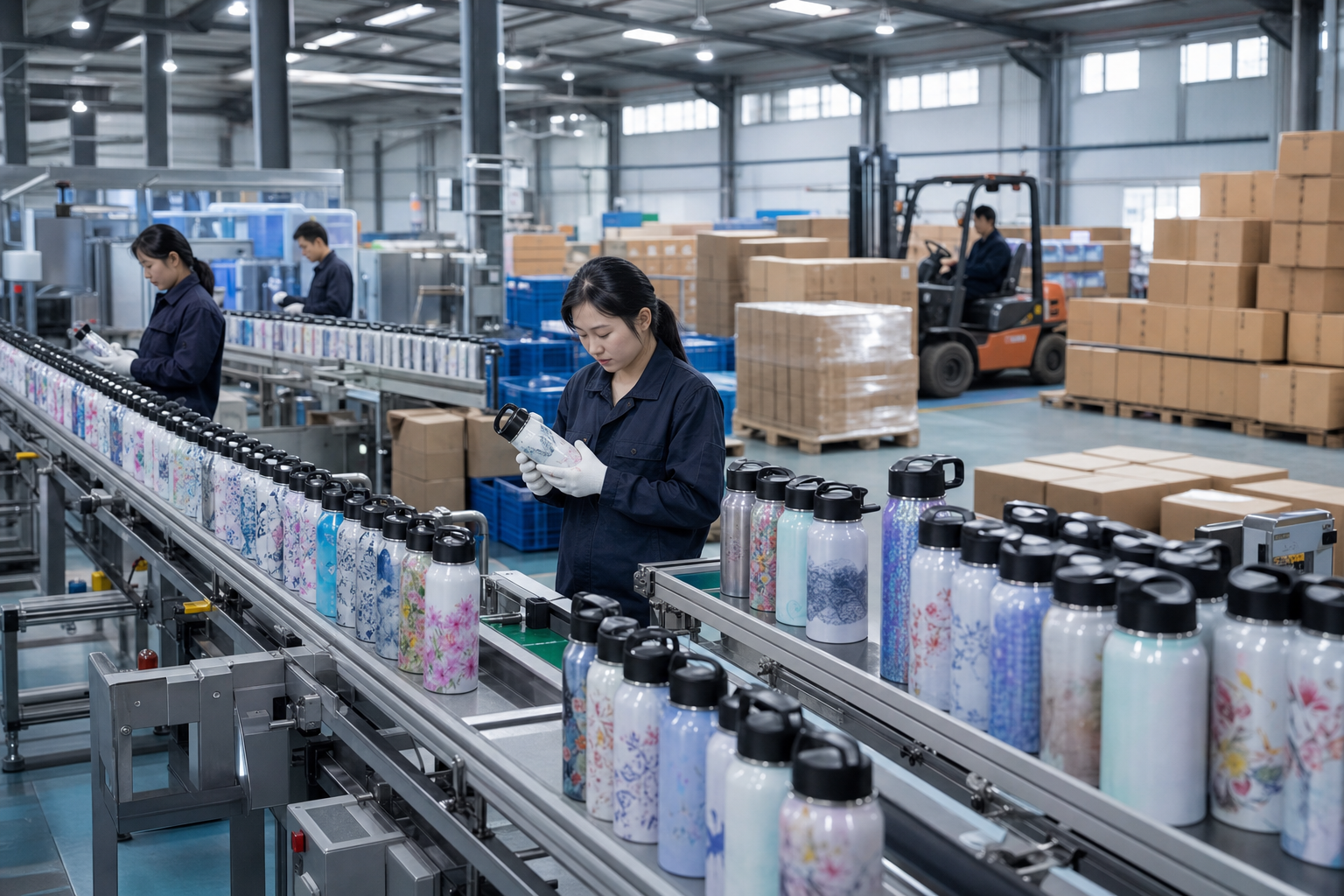
Practical rule: if the bottle will be handled daily, pick a decoration method that survives 200+ washes or cold-chain use. If it is for one-off conferences or water bottles for events, speed and lower cost matter more than long-life decoration. This is the wrong question to ask if you only look at unit price; the math changes once QC pulls a scratched sample after the 48-hour rub test. At our Hangzhou facility in Zhejiang, we run monthly output above 300,000 units across multiple lines, so we see the gap between quick promo specs and retail-grade finishing every day.
Use specs buyers can approve fast
Procurement slows fast when the spec sheet is fuzzy. Put the bottle body, lid, color, coating, print method, carton pack, and testing standard in writing. For water bottles for businesses and water bottles for companies, ask the supplier for a one-page spec with capacity tolerance, weight, and carton dimensions. A 500 ml bottle with a tolerance of ±5% is normal. If the supplier cannot state that, the quote is not ready.
For stainless steel, name the grade and gauge if the factory can give it. We run 304 inner wall with 0.4-0.5 mm stainless gauge on a lot of promo-grade tumblers and insulated bottles. For plastic, ask for BPA-free material declarations and food-contact compliance for your target market. If you sell in Europe or North America, ask for REACH and FDA-related material documents, plus an inspection standard. AQL 2.5 for critical defects and 4.0 for major defects is a clean starting point for most promotional orders. QC pulled a sample once and found a 1.2 mm lid gap; that batch stayed on hold.
Do not approve a quote until you know the exact lid model, print area, and carton count. The buyer flagged a PO typo on carton count once, and the price changed after the first sample. That is where hidden costs show up.
Water bottles for restaurants, cafes, hotels, and conferences often need the same color on repeat orders. If brand consistency matters, ask for Pantone references and a Delta E under 2.0 for coated finishes. We had one hotel chain reject a re-order because the second run came back a shade off under the light booth, and the math did not work.
Price the order by channel, not by bottle
The same bottle can land on very different numbers once the channel changes. Water bottles for ecommerce need a stronger mailer and tighter color control because buyers judge from photos and parcel corners. Water bottles for trade shows can use simpler packing, but the logo and Pantone shade still have to hold up under hall lights. Water bottles for schools or students usually need a lower unit cost and fewer SKUs, while water bottles for children need a safer lid and a lighter body. We ship these with a 38 mm cap or a 28 mm flip-top, depending on who is buying.
Here is the cost structure you should expect for FOB China quotes:
- Basic PP/PET promo bottle: USD 0.70-1.40
- Tritan or better plastic bottle: USD 1.30-2.80
- Single-wall stainless steel: USD 1.80-3.50
- Double-wall insulated bottle: USD 3.20-6.50
Packaging adds USD 0.10-0.60 per unit, depending on a printed box, hangtag, mailer, or retail sleeve. For a launch campaign, the box often carries as much weight as the bottle itself. We had a buyer flag a 2 mm box crease on a 500-piece sample run; QC pulled the sample, and the whole batch got reworked. For athletes, runners, or cyclists, a lighter bottle with a secure cap usually beats a fancy spec sheet. That extra USD 0.15 is cheaper than 300 angry emails.
From Zhejiang, China, we price the landed cost, not the factory price. A bottle that is USD 0.20 cheaper at the line can end up costlier after carton upgrades, freight volume, and a reprint because the PO typo put the logo 5 mm too low. We've seen this go sideways more than once. A quote that looks sharp on paper can lose the margin after the first carton check.
Avoid the mistakes that kill margins
The biggest margin losses in promotional drinkware are rarely dramatic. They come from small misses repeated across 5,000 or 50,000 units. A logo too close to the seam will warp on the line. A matte finish can rub through in transit. A lid that passes a quick leak check can still fail after a 1-meter carton drop. If you are sourcing water bottles for promotional gifts across multiple markets, one bad spec turns into returns fast.
These are the failures we run into most:
- Wrong neck size: the cap looks fine, but the seal slips on fill and capper checks.
- Overcomplicated artwork: gradients and tiny text get lost on a curved body.
- Underpacked cartons: the bottle lands scratched or dented after a 3-layer ship test.
- No validation sample: production starts before QC pulls the pre-production sample.
Ask for a pre-production sample, not a blank sample. You need the final color, print, lid, and carton mockup in hand. We ship repeat orders for water bottles for cafes, hotels, or restaurants every 3-6 months, and the setup has to hold. For water bottles for marketing or water bottles for conferences, the job is speed and repeatability, not clever engineering. The buyer flagged a lid color typo on a PO last month; that kind of miss costs a week.
One simple rule: if your buyer team cannot describe the product in 60 seconds, the brief is weak. Fix that before you place the PO. The math does not work otherwise.
Build a repeat order system
Water bottles for promotional gifts should not be treated as a one-off buy. We run them as repeat SKUs with locked specs, saved artwork, and a packing standard the warehouse can follow without guessing. That is how water bottles for businesses stay a controlled spend instead of a fresh sourcing job every quarter.
Build the order file with product code, capacity, material, lid model, decoration method, carton pack, test standard, and the reorder trigger. A 500 ml Tritan bottle with one-color silk print, 50 pcs per carton, and a 20-day lead time is easy to repeat. A special molded bottle with a custom handle and dual-color body often needs 45 days and an MOQ of 3,000 pcs or more. QC pulled the sample last week and found a 1.2 mm gap on the cap ring; that kind of detail is why we keep the spec sheet tight. If you sell water bottles for babies, water bottles for kids, or water bottles for children, write the safety claims and age range on the file, because the carton text can sink a shipment faster than the bottle body.
Repeat ordering helps cash flow. We usually keep one base bottle in stock and change only the print for each campaign. That works for water bottles for swag, water bottles for employees, and water bottles for events. It also fits buyers in China and Europe, where a 12-day launch beats an 18-day launch every time. The buyer flagged a PO typo on one run: 5,000 pcs turned into 500 pcs, and the math did not work. Ask the supplier how many units they ship per month, not how many SKUs sit on their website.
Request a custom quote for your next bottle run
Send your capacity, material, logo, and target market. We will return a practical spec, FOB price, and lead time from Zhejiang, China.
Frequently asked questions
What MOQ should I expect for water bottles for promotional gifts?
For stock shapes, a realistic MOQ is 500 pcs for stainless steel or 1,000 pcs for plastic promo bottles. If you want custom color, custom lid, or molded branding, expect 3,000 pcs or more. At BottleForge in Zhejiang, China, we can usually move faster on repeat colors and standard lids than on new tooling. The key is to separate body customization from print customization, because a simple logo run can save 2-3 weeks.
How much do water bottles for promo cost FOB China?
Most promo bottles fall between USD 0.70 and USD 6.50 FOB China, depending on material and insulation. Basic PET or PP starts near USD 0.70-1.40. Tritan or better plastic is usually USD 1.30-2.80. Single-wall stainless steel often sits at USD 1.80-3.50, while double-wall insulated models go higher. Print, cartons, and inserts can add USD 0.10-0.60 per unit.
Which decoration method lasts longest on promo bottles?
Laser engraving is usually the most durable on stainless steel because the logo becomes part of the surface. For plastic bottles, UV print and high-quality silk screen are common, but durability depends on coating and washing frequency. If the bottle will be used daily by water bottles for employees or water bottles for fitness, ask for wash resistance data or at least a 200-cycle practical test. For one-time events, durability matters less than speed and cost.
What compliance documents should I ask for?
For Europe and North America, ask for food-contact declarations, REACH-related material confirmation, and if needed FDA-related statements for the materials used. Also request the factory QC plan, AQL terms, and carton drop-test information. If you are buying water bottles for schools or water bottles for children, safety documentation becomes even more important. A serious supplier in China should provide these without hesitation, along with sample photos and batch traceability.
How long is production lead time for custom orders?
Standard lead time is usually 20-35 days after sample approval and deposit. If you need custom molding, special coating, or complex packaging, plan for 35-45 days. Seasonal peaks can add time. For water bottles for conferences or water bottles for marketing campaigns, I strongly suggest placing the PO at least 6 weeks ahead of ship date. If you need air freight, confirm carton size and gross weight early because packaging can change the shipping cost by 10-20%.