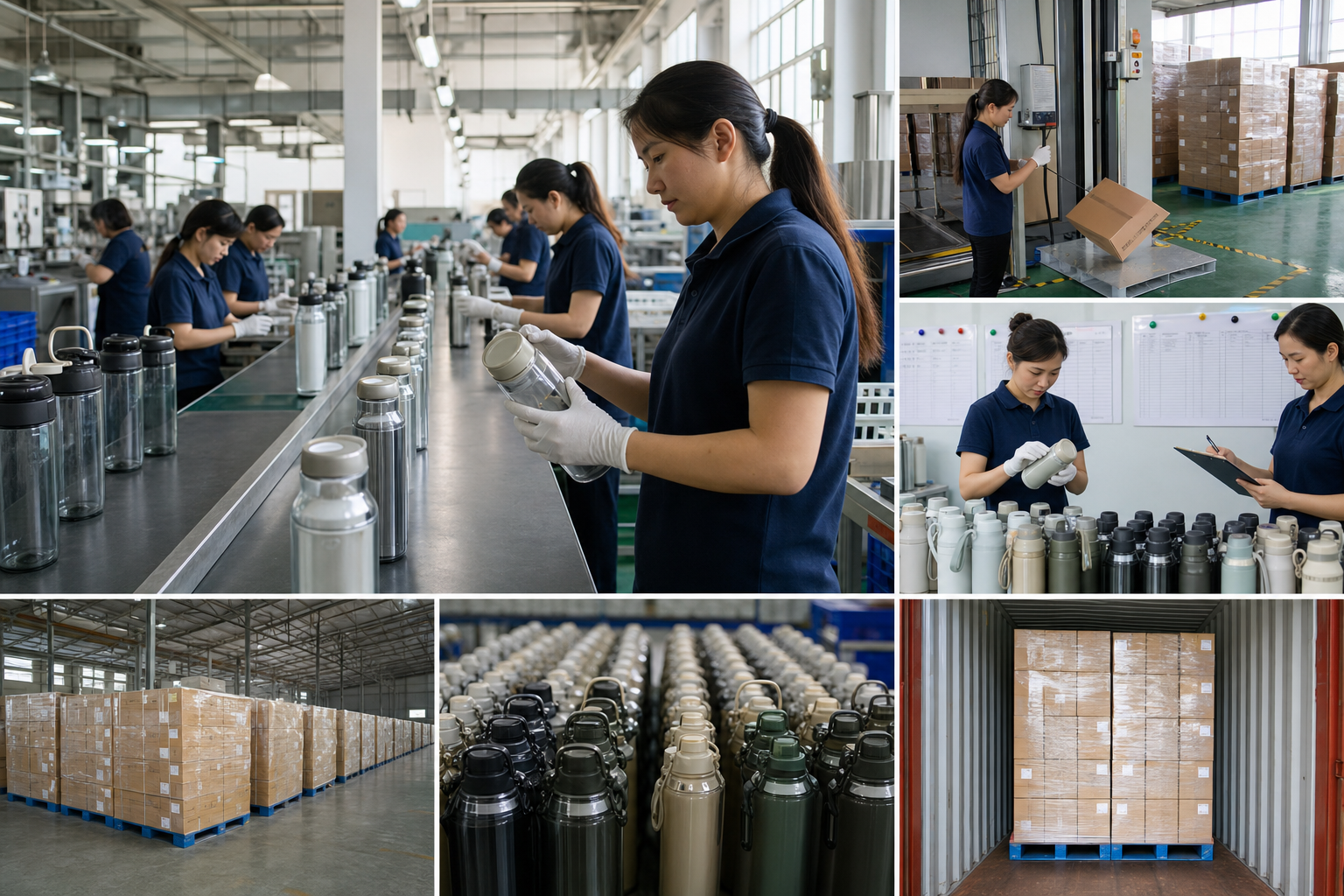
Key Takeaways
- Most borosilicate glass vacuum insulated bottle wholesale orders start at 1,000-3,000 pcs per SKU in China.
- A practical factory lead time is 25-35 days after sample approval and deposit.
- Expect OEM/ODM sample development to take 7-12 days, especially for custom lids or sleeves.
- For retail programs, ask for ASTM or ISO-style thermal and leakage testing plus carton drop tests at AQL 2.5.
If you are sourcing a borosilicate glass vacuum insulated bottle wholesale program for retail, promo, or e-commerce, the hard part is not finding a supplier. The hard part is telling a real borosilicate glass vacuum insulated bottle manufacturer from a trading middleman, then checking whether the bottle survives shipping, filling, and daily use. A pretty sample means little if the vacuum gives up after 3 drops or the lid starts leaking at 60°C.
At BottleForge in Hangzhou, Zhejiang, we see this mistake all the time: buyers ask for “glass vacuum bottles” and think the structure is simple. It is not. Glass wall thickness, vacuum integrity, lid liner, and carton compression all matter. On one line check, QC pulled a sample with a 1.2 mm wall that looked fine on the bench but failed after carton drop testing, and the buyer flagged it on the spot. If you want a borosilicate glass vacuum insulated bottle custom program that lands on shelf without returns, buy like a commercial engineer, not a consumer. China has plenty of factories; Zhejiang has the better organized ones. The math shows up in MOQ, lead time, and test discipline.
What borosilicate vacuum bottles are
A borosilicate glass vacuum insulated bottle is not the same as a stainless thermos, even if buyers lump them together during sourcing. The inner liner is glass, usually borosilicate 3.3 or a similar low-expansion formula, with a vacuum gap to slow heat transfer. Clean taste is the selling point. We see this on tea and coffee orders all the time, and the buyer flags odor carryover fast if the bottle has any plastic smell.
The real issue is breakage. Borosilicate handles thermal shock better than soda-lime glass, but it is still glass. You plan for more damage than with stainless steel. On one 500 ml run, QC pulled the sample after drop testing at 1.2 m and found a cracked inner liner at the carton corner, so the carton insert had to be changed. This is the wrong question to ask if someone says “can we pack it like a steel bottle?” The math doesn’t work. For a borosilicate glass vacuum bottle wholesale order, divider quality, carton compression, and transit testing matter from day one. If your channel is outdoor retail or gift sets, the clear body and taste story sell. If your channel is rugged camping, you need thicker glass and tighter QC.
- Typical capacity range: 350 ml, 500 ml, 750 ml
- Common wall spec: 1.2-1.8 mm glass thickness depending on design
- Typical thermal claim: 6-12 hours hot, 12-24 hours cold, depending on lid and vacuum quality
When a borosilicate glass vacuum bottle factory gives you a sample, ask which standard they used, the test time in hours, and whether the result came from a lab report or a sales sheet. We’ve seen PO typos on this point, with “12 hours” printed where the buyer approved “6 hours,” and that causes trouble at shipment.
How to judge a real factory
Buyers often search for a borosilicate glass vacuum insulated bottle manufacturer, but the name on the card means nothing by itself. A real borosilicate glass vacuum insulated bottle factory can talk through glass sourcing, vacuum sealing, lid assembly, and the packing line without hand-waving. If the sales rep cannot explain the gap between an annealing crack and a lid liner leak, you are probably talking to a trader. We’ve seen that go sideways fast.
In Zhejiang, a solid factory shows three things early: output, sample turn time, and test records. At BottleForge, monthly output for mixed drinkware runs reaches 1.2 million units, and custom glass vacuum bottle jobs are planned around 25-35 days after sample approval. That is the number to compare against. A factory promising 5 days for a custom glass program is cutting corners or hiding the line. QC pulled the sample; the tester found it.
What to ask first
- Can you handle borosilicate glass vacuum insulated bottle OEM and ODM?
- What is your MOQ for one color, one logo, and one packaging version?
- Do you run leakage tests on 100% of lids or only on samples?
- What AQL level do you use for final inspection: 2.5 or 4.0?
Ask for REACH, LFGB for contact parts, and packaging drop test data. A real borosilicate glass vacuum insulated bottle supplier in China will not bristle when you ask for paperwork. They deal with it every day. We ship with those files because the buyer flagged a 2 mm carton dent on a prior PO, and the math does not work if the documents are missing.
MOQ and price structure
The straight answer is that borosilicate glass vacuum insulated bottle wholesale pricing is driven more by the lid and packaging than most buyers expect. We run a basic bottle with a PP lid and one-color print at about USD 2.10-3.20 per piece at 1,000 pcs. Add a bamboo cap, stainless lid trim, a silicone sleeve, or a gift box, and the number jumps to USD 3.60-5.80 per piece fast. Custom molds push it further. Last week QC pulled a sample with a 1.2 mm lid gap and the buyer flagged it immediately. That is the wrong place to squeeze.
For a borosilicate glass vacuum insulated bottle bulk order, MOQ usually sits at 1,000 pcs for stock bodies and 3,000 pcs or more for custom colors or private label packaging. A borosilicate glass vacuum flask wholesale program often needs separate MOQs for bottle, lid, sleeve, and printed carton. If you want a borosilicate glass vacuum bottle private label run for Amazon or retail chains, the carton spec matters as much as the product itself, because a 60 cm drop test failure will eat margin faster than a lower unit price. We have seen this go sideways on a PO with the wrong inner carton size.
Smart buyers do not negotiate only on FOB price. They negotiate on landed cost, breakage rate, and defect allowance.
In China, especially Zhejiang, factories price in tiers: stock item, light customization, and full borosilicate glass vacuum bottle custom development. Ask for pricing at 1,000, 3,000, and 5,000 pcs so you can see where the curve flattens. On our line, the break usually shows up when the print plate is paid off and packing moves from a plain brown box to a 3-layer export carton. Do not guess. Ask for the actual math.
Custom branding that actually sells
A borosilicate glass vacuum insulated bottle custom project should start with the channel, not the logo. The same 18 mm mark that looks clean in a showroom can disappear on a marketplace thumbnail or get cut off by a sleeve. For a 3,000 pcs run, we ask buyers to choose early between silk screen, laser marking, decal firing, or a printed sleeve; each one behaves differently on glass, and QC pulled the sample after a 30-minute dishwasher test when the white ink lifted. For a clean premium look, one-color silk screen is still the workhorse. If the line needs branding that holds up, laser on the lid or the stainless accent usually beats printing on the bottle body.
If you need a borosilicate glass vacuum bottle custom shape, the vacuum cavity limits the drawing more than a steel thermos does. Neck diameter, wall thickness, and the shoulder transition need a safety margin; we usually keep 1.8-2.2 mm at the critical section, or the oven cycle will punish the line. The wrong question is whether it can look smaller. The real question is whether the body can survive the drop test and still hold vacuum. That is why a borosilicate glass vacuum flask manufacturer will usually start from an existing body and customize the lid, sleeve, and finish first. It saves money and cuts development by 2-3 weeks.
- Best low-risk customization: logo, color lid, 30 mm sleeve, carton
- Medium-risk customization: glass tint, grip band, accessory set
- Highest-risk customization: new mold, new neck geometry, new closure
For outdoor retailers, I usually recommend a borosilicate glass vacuum insulated bottle private label program with one strong color, one accent material, and a retail-ready insert card. That gives you control without turning the item into a custom engineering project. On a 1,000 pcs MOQ, this mix ships cleanly, and the buyer does not come back asking why the PO says "bottel" on line 4. We've seen that go sideways fast.
Testing you should require
Glass vacuum products live or die on testing. If your borosilicate glass vacuum bottle supplier says “it is okay” but cannot show numbers, keep looking. We run this on the line with a stopwatch and a 2 m drop frame, not with guesses. At minimum, require thermal retention testing, lid leak testing, vacuum retention verification, and drop testing on packed cartons. A serious borosilicate glass vacuum flask supplier will also test after temperature cycling, because a bottle can pass a room-temperature leak test and still fail after 5 hot-cold swings.
Useful checks include:
- Hot fill performance at 95°C for 6-12 hours retention claims
- Cold fill performance at 4°C for 12-24 hours claims
- Leak test at inverted position for 30 minutes
- Carton drop test from 60-100 cm depending on export route
- Random sampling at AQL 2.5 for major defects
For exports into Europe and North America, ask for REACH compliance on all contact materials and documentation for any silicone or plastic parts. If the product uses a bamboo lid, check adhesive and coating content as well. QC pulled a sample last month with a lid screw ring that missed the PO by 1.5 mm, and the buyer flagged it before we shipped. A borosilicate glass vacuum flask factory in China should know this. If they do not, they are not export-ready.
One practical point: glass breakage is often a packaging issue, not a glass issue. A good carton spec can cut transit damage by 30-50% in real shipments. The math does not work any other way. We’ve seen 5-ply outer cartons hold fine on short domestic runs, then crack open in export lanes because the inner tray was loose by 3 mm.
Choosing China suppliers wisely
There are plenty of borosilicate glass vacuum insulated bottle suppliers in China, but they do not serve the same buyer. Some run stock lots and answer quotes in 2 hours. Others are proper borosilicate glass vacuum insulated bottle factories with tooling and QC on the floor, but their reply time is slower. Match the supplier to the channel. If you need fast promotional stock, pick a seller with real inventory and carton specs locked at 12 pcs per case. If you are building a retail line, work with a factory that can repeat production and keep color within one Pantone step across batches.
Zhejiang is still a practical base. Packaging plants, cap suppliers, silk-screen shops, and freight forwarders sit close together, so we can move samples without wasting 3 days on courier delays. That said, the nicest showroom tells you little. The real test is whether the factory holds tolerance. Ask for three sample rounds. If the second and third samples drift in logo position by more than 2 mm, the line is not ready for volume.
Check whether the factory can handle borosilicate glass vacuum insulated bottle odm projects. ODM works when you want a market-tested body with new branding and retail packing. In one project, full custom tooling was quoted at 45 days and a higher mold cost, while ODM cut development spend by 15-25%. That math makes sense for many distributors and outdoor retailers. The buyer flagged a 1 mm lid gap on the first pilot, and we stopped the run before it turned into a carton of returns.
If your program is seasonal, press for a reorder plan that actually holds. A good borosilicate glass vacuum flask bulk supplier in China should repeat the same spec six months later, with the lid fit staying within 0.5 mm and the print density unchanged. We once saw a PO typo change the lid color code from black to navy; QC pulled the sample, caught it at the packing table, and saved the shipment. This is the wrong question to ask: not whether the supplier can make one perfect sample, but whether they can ship batch 2 with the same result.
Shipping, packaging, and after-sales
With glass, freight math matters more than it does on steel. A borosilicate glass vacuum bottle wholesale shipment can lose margin on breakage, not on unit price. We ran one 12,000-piece lot where a 2 mm gap in the inner tray pushed the claim rate up fast. So pallet layout, inner box strength, and master carton compression belong in sourcing, not in a handoff to logistics. If you ship to Europe or North America, get carton dimensions before sample approval; dimensional weight can add 8-15% to air freight and still cut into ocean container load efficiency.
For retail-ready programs, use a barcode system that matches your internal SKU, and if you sell through Amazon, confirm FNSKU labeling, suffocation warnings, and prep services before the PO is signed. A borosilicate glass vacuum flask private label order usually needs stronger carton art than product art. The buyer flagged a carton typo on one run—wrong UPC on the master box—and we had to reprint 3,000 sleeves. Stores and DCs see the box first.
After-sales terms need to be set early. A serious borosilicate glass vacuum insulated bottle supplier will spell out defect tolerance, photo claim windows, and spare-part policy from day one. QC pulled the sample and found a lid gasket fit issue at 0.3 mm; that is the kind of thing you want caught before shipment, not after the vessel lands. If a gasket fails, you want a replacement plan, not a back-and-forth. For B2B buyers, that discipline is what keeps one order from turning into a repeat program.
If you are building a borosilicate glass vacuum bottle bulk assortment, ask for a packing test on your exact ship-to route. China export assumptions are not enough; your final leg may include transfer hubs, cold warehouses, or 18 days of dwell time instead of 12. We ship that test on the line, same carton, same inserts, same tape spec. The math does not work any other way.
Request a factory quote with your target spec
Send capacity, logo method, carton requirements, and target MOQ. We will quote from Hangzhou, Zhejiang with clear FOB pricing and sample timing.
Frequently asked questions
What is the usual MOQ for borosilicate glass vacuum insulated bottle wholesale orders?
For stock bodies, MOQ is commonly 1,000 pcs per SKU. If you want custom color, private label packaging, or a new lid, 3,000 pcs is a more realistic starting point. For full custom mold work, some borosilicate glass vacuum insulated bottle factories ask for 5,000 pcs or higher because tooling and setup costs must be spread across volume. The right MOQ also depends on whether you want one logo color or multiple SKUs. In Zhejiang and other parts of China, factories usually quote lower MOQ on repeat items and higher MOQ on new structures.
How much should I budget per piece?
For a basic borosilicate glass vacuum bottle wholesale program, budget around USD 2.10-3.20 per piece at 1,000 pcs. If you add a premium lid, sleeve, or gift box, pricing often moves to USD 3.60-5.80. A borosilicate glass vacuum flask wholesale order with full private label packaging can land higher, especially if you require a retail carton, insert card, and barcode labeling. Freight, duties, and breakage reserve are separate. A smart landed-cost plan usually adds 12-25% above FOB depending on route and carton efficiency.
How long does production usually take in China?
For a standard borosilicate glass vacuum insulated bottle custom order, expect 25-35 days after sample approval and deposit. If you need new printing, color matching, or a custom lid, add 7-12 days for sampling and adjustment. A borosilicate glass vacuum bottle factory in Zhejiang with a stable line can sometimes move faster on repeat orders, but the vacuum sealing and curing steps should not be rushed. If someone promises a full custom glass program in under 15 days, they are likely cutting corners or shipping stock that was not built for your spec.
What compliance documents should I ask for?
At minimum, ask for REACH compliance on contact materials, plus LFGB or equivalent food-contact declarations if you sell into Europe. For North America, many buyers also request material declarations and, where relevant, FDA contact compliance statements for lid components. If the product includes silicone, plastic, or coated parts, ask for those separately. A reliable borosilicate glass vacuum insulated bottle manufacturer should also provide internal test reports for leakage, thermal retention, and carton drop tests. If your retailer asks for vendor files, keep them organized by SKU and batch.
Should I choose OEM or ODM for this product?
Choose ODM if you want to move fast with a proven body and customize logo, lid color, packaging, or accessories. Choose OEM if you need a unique shape, special dimensions, or a distinctive retail story that cannot be copied from stock. For most distributors and outdoor retailers, borosilicate glass vacuum insulated bottle ODM is the better cost-to-speed ratio. OEM only makes sense when your projected volume is strong enough to justify tooling and the longer development cycle. In China, that usually means you are planning repeat orders, not one-off imports.