Key Takeaways
- Borosilicate typically carries a much lower thermal expansion rate, around 3.3 x10^-6/K, versus about 8-9 x10^-6/K for soda-lime glass.
- A well-made borosilicate glass water bottle can handle rapid temperature swings far better, but rim chips and point impacts still cause failures.
- For a 500 ml bottle, expect borosilicate to add about USD 0.20-0.60 per piece at factory level, depending on wall thickness and decoration.
- A Zhejiang glass factory running 300,000 units/month can usually offer 3,000 pcs MOQ and 25-35 day lead time if the mold is already proven.
A wellness brand can look clean on the shelf and still land in trouble after one support ticket. We saw it with a 550 ml bottle: boiling rinse, then cold juice, then a cracked base on the counter. The style was fine. The math was not. The real call is whether you need a borosilicate glass water bottle or a lower-cost soda-lime build that can handle normal use without failing under thermal stress.
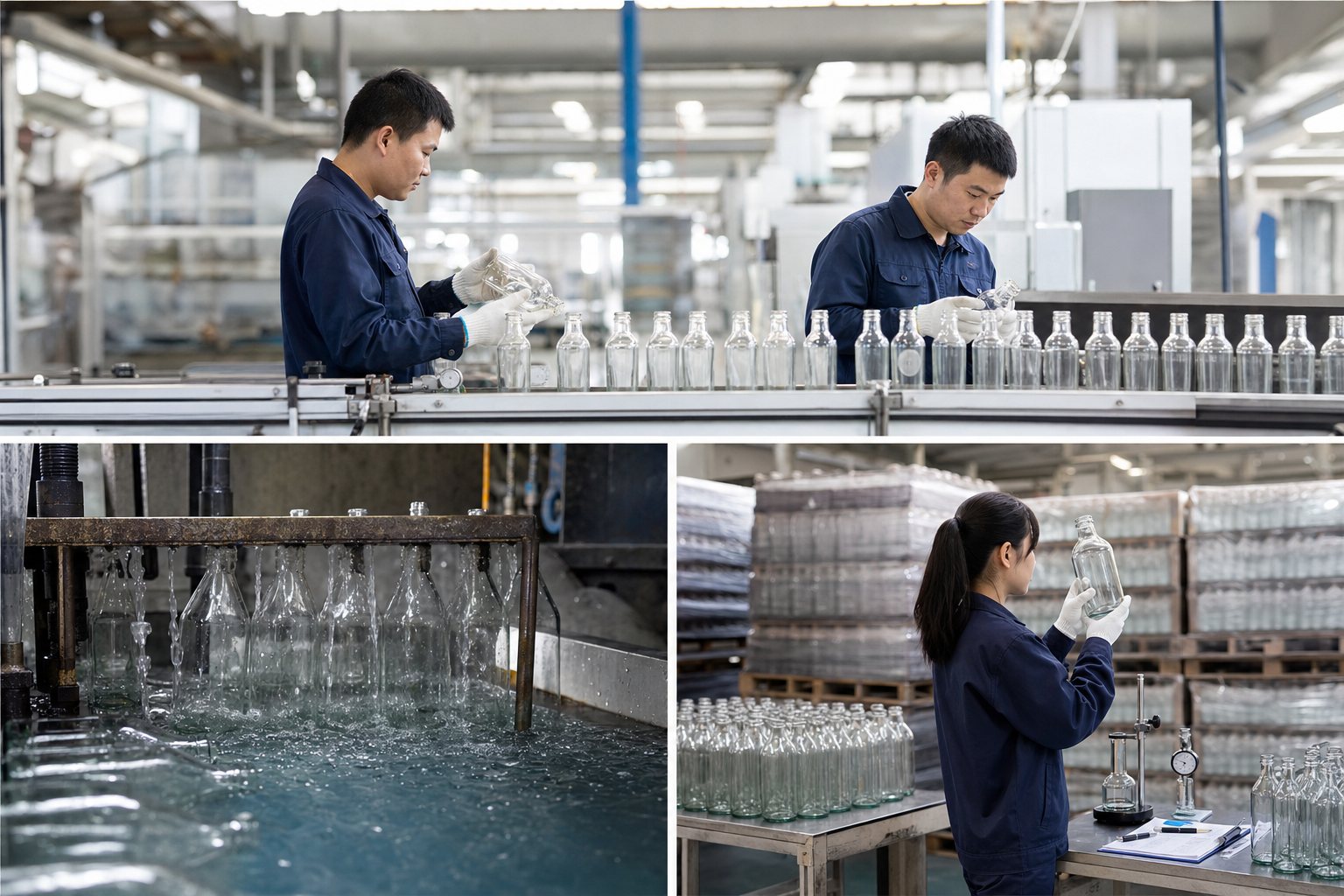
Both can be lead-free glass and both can sit in a premium carton. The gap shows up in heat shock resistance, wall thickness, annealing, and the kind of abuse your buyer actually puts into the sample test. On our line in Zhejiang, we run a hot-water to ice-water check at 80°C to 20°C before cartons move, and QC pulled a cracked sample once because the annealing curve was off by 12 minutes. This is not a branding question.
What Changes Inside The Glass
Chemistry is the first thing buyers should check. Borosilicate glass uses boron oxide in the melt, which lowers thermal expansion and gives better heat shock resistance. Soda-lime glass is the workhorse for mass-market glass drinkware. It is cheaper to melt, easier to form, and fine for cold-fill or room-temperature use, but it expands more when heated and shrinks more when cooled. Last week QC pulled a sample from the annealing lehr and the difference showed up fast.
That expansion gap matters because glass hates tensile stress. Pour 95 C water into a 20 C bottle and the inner surface heats first while the outer wall lags behind. The glass wants to bend; the temperature gradient fights it. Borosilicate handles that mismatch better. The wrong question is whether it is "safe" in the abstract. The real question is whether your bottle can survive the buyer's hot-fill test without a crack on cycle 8.
Typical numbers make the choice clear. Borosilicate often sits near 3.3 x10^-6/K for thermal expansion; soda-lime is roughly three times higher. That is why borosilicate is the better pick for tea bottles, insulated sleeves, lab-style infuser bottles, or any line that moves between boiling water, tap water, and a fridge. On a 2.0 mm wall, that gap matters; at 1.5 mm, the line gets touchy. If the bottle only sees cold water, the extra material cost is usually wasted.
Lead-free glass is a separate requirement. It tells you the formula is not using lead, but it says nothing about thermal shock. We can ship lead-free soda-lime or lead-free borosilicate out of the same furnace. One ICP report can pass while the hot-water test fails on the next pallet. The process choice decides how the bottle behaves; the label does not.
Where Bottles Actually Fail
Most bottle failures are not dramatic. They start with a 0.2 mm rim chip, a scratch from a metal basket, or stress left behind after a weak annealing cycle. We pulled a cracked lot last month and the fracture always started at the same point. Once hot water goes in, the crack runs.
Common failure points
- Shoulder and neck transition: the geometry steps down here, so stress piles up fast.
- Rim chips: the lip is thin, gets handled all day, and is usually the first place to crack after thermal cycling.
- Base defects: a seed or stone inclusion can become the crack starter during a hot-fill test at 90°C.
- Threaded or closure areas: if the cap bites down too hard, local stress climbs as the bottle heats.
Soda-lime failures often look harsher because the thermal margin is used up faster. Borosilicate gives you more warning, but impact still wins. A bottle dropped from 1 meter onto tile does not care about the glass recipe. Heat shock resistance is not impact resistance. QC pulled the sample and the rim was already chipped.
One practical lesson: customers blame boiling water when the real problem is poor edge finishing. This is the wrong question to ask. A polished rim, wall thickness held within 0.3 mm, and a decent annealing curve matter as much as the raw glass. We run this check in Hangzhou first on the lip, then the base, then the wall gauge. That order saves time.
What Lab Tests Actually Prove
For a buyer, a thermal claim only matters if the lab can repeat it. Ask for the test method, the pass/fail criteria, and the sample count. “Heat resistant” means nothing by itself. We once saw a PO with “heat proof bottle” typed on it, and the buyer flagged it the same day.
For this category, we ask for three checks: a thermal shock cycle, a wall-thickness check, and a visual inspection to AQL 2.5 for critical defects. If the bottle goes to Europe, ask for REACH and LFGB paperwork. If it ships to North America, the file should cover FDA food-contact expectations and any decoration ink limits. BSCI still matters for brand owners, because one failed audit can hold a 20,000 pcs shipment at port.
Lab language has to be specific. A 500 ml borosilicate bottle may survive repeated transfers between near-boiling water and room-temperature water with no visible cracking. A soda-lime bottle may pass a gentler cycle and then crack when the delta gets too sharp. Do not accept one pass/fail line. Ask for the number of cycles, the temperature gap, and the crack origin. QC pulled the sample, measured the wall at 2.8 mm with a caliper, and that detail explained why one lot held up better than another.
Good glass sourcing is not about the cheapest bottle that survives one test. It is about the bottle that survives the customer you actually have.
If your buyers include tea drinkers, office users, and people who run bottles through dishwashers, build the spec around repeated thermal cycling, not a one-time demo. We ship bottles that get opened, rinsed, filled with 95 C water, and closed again the next morning. That is the real test.
Cost, MOQ, and Production Reality
The price gap shows up fast. On a standard 500 ml bottle, soda-lime usually lands around USD 0.45-0.90 FOB, while borosilicate sits closer to USD 0.70-1.50 FOB, depending on mold complexity. We had a buyer push back on a 12-cent upcharge for a thicker base, then QC pulled the sample and found the wall off by 0.4 mm. Decoration, sleeve parts, and closure upgrades can move both numbers up fast. If your margin model only survives a 10 cent difference, the math does not work.
Production reality matters just as much as raw cost. A capable factory in Zhejiang or broader China can run around 300,000 units per month across multiple glass lines, but each line has its own annealing curve and wall-tolerance limit. We run some jobs with a 24-cavity mold, and if the tool is mature, MOQ may be 3,000 pcs with 25-35 days lead time. New molds, custom colors, or special closures can push that to 40-50 days. We have seen this go sideways when a buyer asked for borosilicate, matte spray, and a new cap in one shot.
For wellness brand owners, this is where sourcing discipline pays off. Ask straight: does the supplier own the mold, do they do in-house decoration, and will the bottle survive automated packing at 1,200 pcs per carton line? A cheap bottle that fractures in shipment is not cheap. Carton breakage, claims, and replacement stock erase the savings quickly.
China has the scale advantage, but only if you give the factory a clean brief: target temperature delta, target wall thickness, logo method, cap torque, carton drop standard, and your acceptance criteria. We once caught a PO typo that changed the wall spec from 2.0 mm to 0.2 mm, and the line stopped before we wasted a shift. The more precise the spec, the less you pay for interpretation.
Which Bottle Fits Your Brand
If your brand sells tea infusers, hot-and-cold wellness sets, or premium direct-to-consumer glass drinkware, borosilicate is the safer call. We see it on the line all the time: a 95 C fill, then a cold rinse, and soda-lime starts drawing pushback after QC pulls the sample. Borosilicate gives you better heat shock resistance, a cleaner technical story, and fewer service tickets when the buyer tests it hard. That matters in Europe and North America, where retail pricing needs room for margin.
If your product is mostly cold water, flavored water, or desk use, soda-lime can win the math. Unit cost stays lower, sourcing is simpler, and you can still ship a clean, lead-free glass bottle if the formulation and QC stay tight. We had a buyer flag a PO typo once—“dishwasher safe” was listed for a soda-lime SKU—and the sample failed after three cycles at 65 C. Soda-lime is not a bad material. It is just less forgiving when hot fill or quick temperature swings enter the picture.
A practical rule we use: if the customer might pour in water hotter than 70 C, move to borosilicate. If the bottle will live in a dishwasher, check the glass and the closure system, because the weak point is often the cap, gasket, or printed sleeve, not the body. A silicone sleeve can cut breakage from minor knocks, but it will not save a poor glass spec. This is the wrong question to ask if the bottle design is already marginal.
For a wellness brand, the better move is a narrow product line with clear use instructions, not a vague one-bottle-fits-all pitch. Pick the glass that matches the use case, then write the care label as if the customer will skip half of it. We ship a lot of 500 ml bottles this way, and the brands that stay out of trouble are the ones that keep the spec simple and the warning text blunt.
Specify the right glass before you print the carton
Send the use case, target temperature range, and MOQ. We can match the glass, test plan, and decoration method to your launch.
Frequently asked questions
Is a borosilicate glass water bottle always better than soda-lime?
No. Borosilicate is better when heat shock resistance matters, especially for hot tea, boiling rinses, or fast transitions between hot and cold water. It usually handles a much larger temperature delta because its thermal expansion is around 3.3 x10^-6/K, versus roughly 8-9 x10^-6/K for soda-lime. But if your bottle is strictly for cold water or desk use, soda-lime can be a better commercial choice. It is cheaper, easier to source in high volume, and can still be made as lead-free glass. For a 500 ml bottle, the cost difference can be USD 0.20-0.60 per piece before decoration.
Can soda-lime glass survive hot water at all?
Yes, but the margin is narrower and the result depends on wall thickness, annealing, and geometry. A thick, well-annealed soda-lime bottle may tolerate warm water or moderate temperature changes, but it is less forgiving than borosilicate when you pour in near-boiling water. The failure usually starts at the shoulder, rim, or base if there is a chip or residual stress. If your customer behavior includes boiling water, dishwasher cycles, or fridge-to-hot use, soda-lime is the riskier choice. For that use case, borosilicate is the safer spec even if the unit price rises by 20% to 40%.
What does lead-free glass actually mean?
It means the formulation does not use lead as part of the glass recipe. That is important for food-contact products and for compliance in Europe and North America, but it does not tell you whether the bottle is borosilicate or soda-lime. Both can be lead-free. Buyers sometimes treat 'lead-free' as a heat-performance claim, which is wrong. Heat shock resistance comes from the glass chemistry, wall design, and annealing quality. When you source from China, ask for the material declaration, REACH or LFGB documents where relevant, and the test data for the finished bottle, not just the raw material.
How should I test thermal shock before ordering 10,000 units?
Ask the supplier for a real cycle test on finished samples, not just a marketing claim. A practical setup is repeated transfer between near-boiling water and room-temperature or chilled water, then inspection for cracks, haze, or rim failure. Request the temperature delta, the number of cycles, and the sample count. I would also check wall thickness, base flatness, and edge finish, because those often predict failure better than raw material alone. For a wellness brand, one broken prototype is not proof. You want a repeatable pass rate and a clear AQL target for production.
What MOQ and lead time should I expect from a Chinese factory?
For a mature glass bottle mold in Zhejiang or broader China, a realistic MOQ is often 3,000 pcs, with lead time around 25-35 days after sample approval and deposit. Custom colors, printed logos, or new closures can extend that to 40-50 days. A factory with a 300,000 units/month capacity can still be busy, so plan around calendar congestion and packaging schedules. If you need Amazon FBA or retail-ready packing, add time for carton labeling, FNSKU application, and final QC. The cheapest quote is not the fastest quote, and not always the safest one.