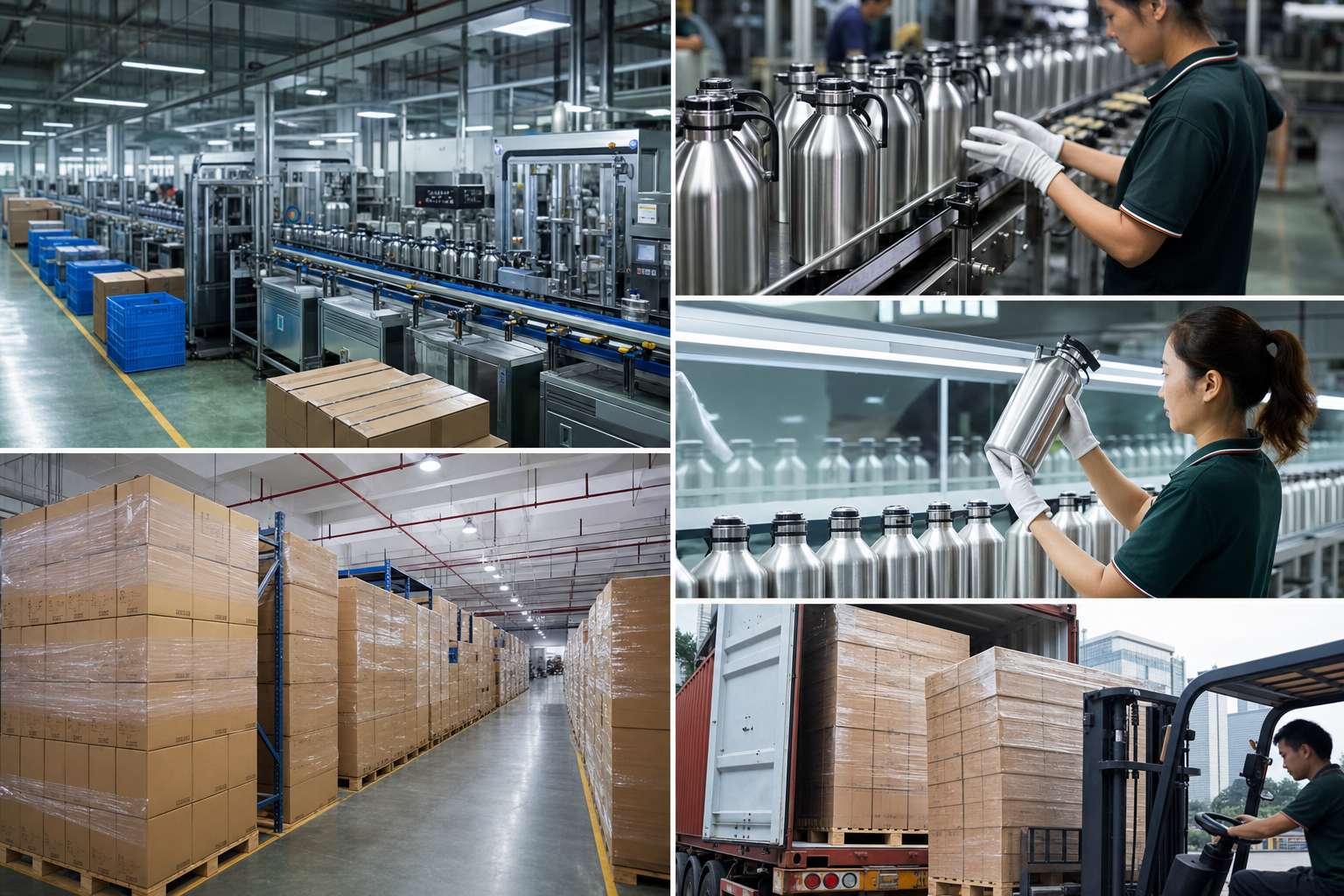
Key Takeaways
- A bulk beer growler should be specified by steel grade, wall structure, lid type, and finish before you ask for price.
- For decorated orders, expect FOB China pricing to shift by USD 0.25-1.20 per unit depending on coating and logo method.
- A practical MOQ for custom wholesale growler programs is often 1,000 pcs per SKU, not 100 pcs.
- For export, ask for AQL 2.5/4.0 inspection, REACH documentation, and carton drop-test data before booking shipment.
If you are sourcing a bulk beer growler for retail, taproom merchandising, or corporate gifting, price is not the first trap. The real problem is a container that looks clean in photos but starts failing on coating adhesion, leak rate, or carton efficiency once it hits your warehouse. We see this every week in Zhejiang. Buyers chase a low unit price, then eat rework, extra freight, and claim tickets.
A decent growler program starts with a spec sheet that leaves no room for guesswork. For stainless steel, 18/8 or 304 is the normal base; for a lighter promo run, you still need to choose between double-wall and single-wall based on weight, insulation, and print method. On our Hangzhou line, one 35 mm carton setup error once pushed a PO from 12 days to 18 days because the buyer flagged the pallet count after QC pulled the sample. We run 600,000 units a month, MOQ is 1,000 pcs per SKU, and standard lead time is 25-35 days after sample approval. That is the level of detail a real supplier should put on the table.
Start with the right growler spec
Most procurement headaches start with loose wording like bulk growler or beer growler wholesale. That is not a spec. We need capacity, material, lid system, and finish before we price anything. For beer growler bulk runs, 32 oz, 64 oz, and 128 oz are the standard sizes. For North America, 64 oz usually wins because it matches the common fill expectation and leaves enough print space for a brand message.
Material choice changes the whole quote. 304 stainless steel is the export baseline for a bulk beer growler; 201 steel can cut unit cost, but the buyer usually ends up arguing about rust marks and weak shelf appeal later. We’ve seen that go sideways. For the body structure, single-wall is lighter and cheaper, while double-wall vacuum construction gives better heat retention and a more premium hand feel. A 64 oz single-wall growler usually comes in around 420-520 g, while a double-wall version often sits closer to 650-850 g, depending on gauge and base design. QC pulled a sample at 0.35 mm once, and the line had to reset the draw depth.
If you are also comparing wholesale growler, wholesale drinkware, or bulk canteen programs, keep the choice tight:
- Single-wall for promo orders and lower freight cost
- Double-wall vacuum for retail, taproom, or gifting
- Powder coat if you need grip and abrasion resistance
- Brush polish if you want bare metal with fewer coating variables
From our Zhejiang factory side, the fastest way to get a clean quote is to send capacity, target lid, logo method, and packaging requirement in one message. We run 18 mm lid necks on most beer growler jobs, and a PO typo on the closure type can turn into a 2-day delay. If those details are missing, the low price you get is useless. The math doesn't work.
Price drivers you can actually control
Buyers ask for bulk drinkware pricing and compare the sample quote alone. That is the wrong question. On a beer growler order, the price moves with steel grade, body thickness, lid assembly, decoration, packaging, and whether you need export cartons with barcode labels. A plain stainless 64 oz growler usually starts around USD 2.60-3.40 FOB China in high volume. Add powder coating, and the number shifts to USD 3.10-4.20. Add laser engraving, a colored gift box, and individual polybags, and the same unit can land at USD 4.50-6.80. We ran one job where the PO said “giftbox” and forgot the insert size; QC pulled the sample, then the buyer flagged the mismatch before packing.
Cost levers are the part you can actually control. A 0.4 mm wall uses less steel than 0.5 mm, but the canteen-style body feels light and dents easier on a 1.2-meter drop test. A screw lid costs less than a swing-top closure, yet a loose gasket creates leakage claims fast. If you are sourcing beer growler wholesale bulk for a chain store or taproom, carton count matters too: a clean master carton layout can cut volumetric freight by 8-15% versus badly nested packaging. We have seen this go sideways when a buyer pushed for “same carton size” across two SKUs; the math does not work.
Ask the supplier for three quotes side by side.
- Entry spec: single-wall, 0.4 mm, standard lid
- Core spec: 304 steel, 0.5 mm, branded lid
- Premium spec: double-wall vacuum, powder coat, gift box
That is the clean way to compare beer growler wholesale offers. A cheap-looking sample can turn expensive once breakage, rework, and ocean freight are in the file.
Decoration and branding that survive use
Decoration is not a cosmetic detail. It decides whether your wholesale growler still looks sharp after 90 days on a busy bar back or starts looking beaten up after one weekend. For stainless steel, we run silk screen, laser engraving, heat transfer, and powder coat with one-color print. If the artwork is simple and the MOQ is large, silk screen stays the lowest-cost option. If the buyer wants a mark that holds up in beer retail, hospitality, or outdoor sales, laser engraving is cleaner and does not depend on ink staying put.
Pricing moves fast once you change the process. A one-color silk screen logo may add USD 0.12-0.30 per piece on large runs. Laser engraving often adds USD 0.20-0.45. Full-wrap UV print or multi-color decoration can jump higher once setup time and fixture time are counted. We had one buyer send artwork built for beer tumbler bulk and beer tumbler wholesale bulk; the PO had the wrong wrap width, and the line had to cut a new jig because the growler body curve was different. That is the wrong question to ask if the artwork can be copied as-is.
Brand owners should watch abrasion from day one. A powder-coated bottle with a weak cure cycle will chip at the base and shoulder, and QC pulled the sample on that in a 1,000-piece test because the cross-hatch failed after wet rub. Ask for adhesion test data, ask for a rubbed sample, and check the logo placement against the hand grip. If the growler is going into alcohol service, alcohol flask wholesale and alcohol flask bulk jobs follow the same rule: keep the print simple, keep tiny text out, and put the mark where dishwasher cycles will not wipe it out.
Practical note: if the logo has to survive retail handling and bar back use, laser engraving on 304 stainless beats low-cost ink on a coated body.
Compliance and testing for export
If you are buying from China for Europe or North America, compliance is not optional. Ask for material declarations, REACH paperwork for coating and inks, and a supplier quality plan that names the inspection standard. A solid Zhejiang factory will hand over stainless composition reports, BPA-free lid reports when the lid is part of the build, and carton specs with thickness in mm and drop limits. For food-contact drinkware, migration documents may also be needed, depending on the market and the bottle structure.
The inspection language has to be tight. We run AQL 2.5 for major defects and AQL 4.0 for minor defects as a starting point, then spell out what counts as a leak, a scratch, or a logo print miss. Leave it vague and the buyer flags it later. If your bulk beer growler is going into retail, ask for drop-test and lid-cycle data too. A lid that survives 500 opens and closes in a sample test tells you more than a polished sales photo ever will.
For North American programs, some buyers also ask for ASTM-based references or in-house lab methods, especially for coating wear and carton strength. For European orders, REACH and sometimes LFGB come up, depending on the exact product and sales channel. If you are buying canteen wholesale or wholesale canteen alongside growlers, keep one document pack for all SKUs. We ship faster that way, and the factory does not start rewriting paperwork on the night shift because one PO has a typo.
The hard truth is simple: if a factory in China cannot show test records, it is not ready for export volume. We have seen this go sideways on a 20,000-piece order when the supplier “promised” the reports after deposit. The stronger Zhejiang suppliers answer in one email and attach the files. The weak ones stall, and your peak-season slot disappears before the line even starts.
MOQ, sampling, and lead time realities
Timing runs the whole plan. If your bulk beer growler program is for summer retail, start sampling 60 days before the ship date. One sample round is rarely enough. We usually see 7-12 days for the first sample, 3-5 days for artwork proofing, then another 7-10 days if the buyer flags the lid or coating. That is normal. QC pulled the sample on the line, checked the 1.2 mm rim, and the clock still kept moving.
MOQ is the gatekeeper on custom work. At BottleForge in Hangzhou, our standard MOQ is 1,000 pcs per SKU because setup, coating line changeover, and packaging prep all carry hard costs. Some simple items can run at 500 pcs, but once you want custom color, logo, and retail packaging, the math does not work below 1,000-3,000 pcs. We see the same pattern on drinkware wholesale, canteen bulk, and alcohol flask wholesale bulk orders. One PO typo on carton count can turn a small run into a headache fast.
Lead time beats a USD 0.10 discount. A 25-35 day production window after sample approval works for most importers. If someone asks for a 15-day rush, they are asking for overtime, shorter inspection, or both. That is where defects slip through. We've seen it go sideways on a 304 stainless run when the buyer pushed too hard on schedule. For seasonal launches, book space early and get the timeline in writing: material receipt, line production, internal QC, packing. A supplier that cannot give those milestones is not ready.
If you split the buy across product types, such as beer tumbler wholesale and beer growler wholesale bulk, keep the carton standard and print method aligned where you can. That cuts validation time and keeps warehouse teams from mixing SKUs at destination. We ship cleaner when the outer carton size stays within 2 mm across both items, and the receiving side notices.
How to choose the right supplier in China
Choosing a supplier for bulk beer growler programs is not about chasing the lowest quote. We run 20,000 pieces through the line, and the real test is whether the neck finish, powder coat, and logo position stay the same on carton 1 and carton 200. In Zhejiang, plenty of plants can make a clean sample. Fewer can hold ±0.5 mm on the lid fit and keep the surface free of scratches across a full container.
Ask straight questions. What is monthly output? How much powder is lost in coating, 3% or 8%? Do they make the mold in-house or just assemble parts? Can they show incoming inspection records for steel sheets and lids? If the answer drifts, stop there. A supplier that באמת handles wholesale drinkware and drinkware bulk orders talks in numbers, not sales talk. We had one buyer flag a PO typo on lid color code, and the plant caught it only because they checked the order against the sample card.
Look for these signals:
- Factory capacity: 300,000-600,000 units per month for an export plant that can hold schedules
- QC structure: incoming inspection, in-process checks, and final inspection with AQL 2.5
- Documentation: REACH, material traceability, carton specs, and inspection reports
- Commercial clarity: FOB price, sample cost, lead time, and packaging method in writing
If you need a broader assortment, the same supplier may also support bulk canteen, wholesale canteen, or best wholesale drink bottle programs. That can help you consolidate sourcing, but only if the plant can keep each SKU under control. We’ve seen this go sideways when one line tries to cover too much and QC pulls the sample for the wrong cap size. One good factory beats three cheap ones every time.
Send your growler spec for a fast quote
Share capacity, material, logo method, and target market. We will quote your bulk beer growler program with clear MOQ, lead time, and FOB pricing.
Frequently asked questions
What is a realistic MOQ for a custom bulk beer growler order?
For custom bulk beer growler projects, a realistic MOQ is usually 1,000 pcs per SKU. If you want custom color, logo, and retail packaging, 1,000-3,000 pcs is more typical. Simple stock-style versions may start lower, but the price usually climbs because setup costs are spread across fewer units. For a factory in Zhejiang, MOQ is tied to line changeover, coating batch size, and packaging prep. If a supplier offers 200 pcs with full customization, check whether they are quoting a trial run rather than a true production order.
How much does a beer growler in bulk cost FOB China?
A plain stainless beer growler in bulk can start around USD 2.60-3.40 FOB China at higher volumes. Add powder coating and logo printing, and you may see USD 3.10-4.20. If you want double-wall vacuum construction, laser engraving, and gift boxing, the price can move to USD 4.50-6.80 or more. The final number depends on steel grade, wall thickness, lid type, finish, and packaging. Buyers should ask for three price tiers so they can compare entry, core, and premium specs instead of one misleading quote.
Which material should I choose for export drinkware wholesale?
For export drinkware wholesale, 304 stainless steel is the safest default for a bulk beer growler. It gives you stronger corrosion resistance and a better quality story for retail and hospitality. If cost is the only driver, some buyers consider 201 stainless, but that is a trade-off you should evaluate carefully. For lids, ask whether the seal is silicone or TPR, and request the material declaration. If your market is strict on food-contact claims, 304 with compliant coating and documented testing is the practical choice.
What inspection standard should I require from a Chinese supplier?
Use AQL 2.5 for major defects and AQL 4.0 for minor defects as a starting point. Then define your own failure points: leakage, denting, coating blistering, missing parts, incorrect logo placement, and carton damage. For a bulk beer growler shipment, ask for leak testing, visual inspection records, and carton drop-test confirmation. A strong supplier in China should also provide REACH-related documentation if coatings or inks are involved. Good factories in Zhejiang will already have a standard QC file for export buyers.
Can I combine beer growler wholesale bulk with other drinkware in one order?
Yes, and it is often smart if the supplier has the right process control. Many buyers combine beer growler wholesale bulk with canteen bulk, wholesale canteen, beer tumbler wholesale, or even alcohol flask wholesale bulk in the same purchase cycle. That helps you reduce freight fragmentation and centralize compliance paperwork. The caution is quality drift: only combine SKUs if the plant can manage separate molds, finishes, and inspection records without confusion. If the supplier is too small, one mixed order becomes a warehouse problem later.