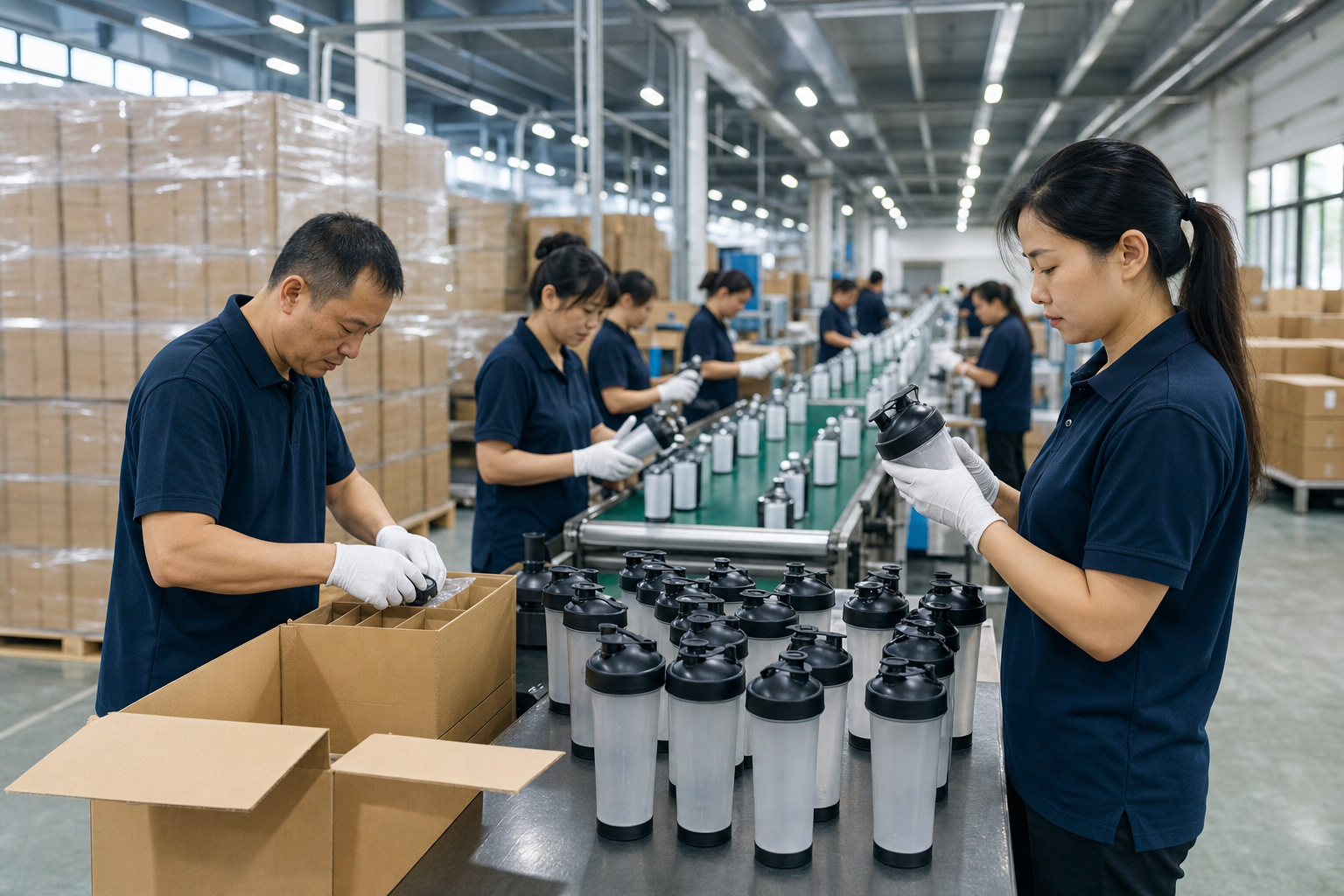
Key Takeaways
- Most bulk blender bottle projects start at 3,000–5,000 pcs MOQ for custom colors, with 30–45 day lead times in Zhejiang, China.
- A 600–750 ml bottle with 0.8–1.0 mm wall thickness is common for retail; thinner walls cut cost but increase warpage and crack risk.
- Ask for AQL 2.5 major / 4.0 minor inspection, REACH-compliant materials, and lid cycle tests before you approve production.
- FOB China pricing for standard bulk drinkware often ranges from USD 1.20 to 3.80 per piece depending on material, decoration, and lid complexity.
If you are buying a bulk blender bottle for retail, gym chains, Amazon, or corporate programs, the hard part is not finding a supplier. It is sorting a real factory from a trading company and making sure the bottle you approve is the one that ships 45 days later. In Zhejiang, we see this every week. A buyer signs off on a 28 mm lid seal, then the line switches to a thinner gasket and the leak test starts failing.
The better way is to treat sourcing as a spec sheet job, not a price hunt. Lock down capacity, material, sealing method, drop-test target, and print method before you ask for USD quotes. A serious factory in China should quote within 24 hours, give an MOQ around 3,000 to 5,000 pieces for custom color, and run 80,000 to 120,000 units per month depending on the mold line. One PO typo on our side once changed 600 ml to 500 ml, and the buyer flagged it before production. Good catch. That is the level you want.
What you are really buying
A bulk blender bottle is not just a plastic cup with a cap. You are buying a system: bottle body, mixing insert, leak-resistant lid, carry loop, print durability, and carton protection. If one part fails, the whole order turns into a customer-service problem. We saw that on a 12,000 pcs gym chain order when the snap lid popped open in a drop test from 1.2 m. That is why the right wholesale drinkware program starts with the use case. A gym chain wants a rugged 700 ml bottle that survives daily dishwasher cycles. An e-commerce seller wants a lighter bottle with a clean label area and low return risk. A distributor may need a broad canteen wholesale program that includes shaker bottles, bulk canteen lines, and a bulk drinkware package for retail bundles.
For standard beverage protein shakers, 600 ml, 700 ml, and 750 ml are the sizes we ship most. In our Zhejiang factory, the common custom MOQ is 3,000 pcs per color for molded items and 1,000 pcs for stock-decorated runs. If you want a special lid, expect tooling or existing-mold modification fees of USD 500 to 2,000, depending on the hinge and vent structure. That is normal in China. What is not normal is a supplier who says yes at sample stage and then swaps the resin grade before mass production. Ask for the resin code, the lid material, and the actual weight in grams before you sign the PO. QC pulled the sample at 92 g, and the buyer flagged it because the approved spec called for 98 g.
- Body material: Tritan, PP, copolyester, or PETG
- Seal type: silicone gasket or integrated sealing ring
- Decoration: silk screen, laser engraving, or sleeve label
- Packaging: single box, gift box, or brown master carton
Materials and performance choices
Material choice drives both perceived quality and your complaint rate. For a bulk blender bottle, Tritan copolyester is the premium pick because it stays clear, takes a drop better, and does not hold odor like cheap resin. PP costs less and runs lighter on the line, so it works for price-sensitive drinkware wholesale programs, but the surface looks softer and scratch marks show up faster. We’ve seen buyers push for full PP to shave cents off the quote, then come back after the first retail test because the bottle looked tired after two weeks. If you want a mass-market line, a PP body with a Tritan lid is a practical middle ground. If the target is a best wholesale drink bottle, buyers expect clear walls, tight seals, and a base that sits flat at 0.3 mm tolerance.
Wall thickness matters more than most buyers think. We usually run 0.8 mm to 1.0 mm for injection-molded bottles in the 650–750 ml range, checked with a caliper at the gate and the shoulder. Below 0.7 mm, you may save 5% to 8% on resin, but the math does not work once sink marks, deformation, and stress cracking start showing up in QC. For wholesale canteen and canteen bulk projects, the same logic applies: cheap resin looks good on the PO, then eats your returns budget. If you need beer tumbler bulk or growler wholesale products, keep the neck finish stronger and the seal tighter. A growler bulk order that holds carbonation needs a better cap stack-up than a plain sport bottle, and we have seen that go sideways when the buyer flagged a loose lid after drop testing.
Pay attention to compliance. For Europe, ask for REACH paperwork and food-contact declarations before the sample is signed off. For North America, request FDA food-contact support and, where needed, ASTM-style test references in the lab file. If the bottle is going to a corporate gift program or retail shelf in the U.S., ask whether the print ink still passes after 50 dishwasher cycles; we run that test on the rack, not in a spreadsheet. One buyer once sent a PO with “dishwahser safe” typed three ways, and that typo turned into a week of back-and-forth because the supplier never confirmed the ink spec.
Cheap material saves pennies. Weak sealing costs you refunds, one-star reviews, and freight you cannot recover.
Pricing, MOQ, and real lead times
Pricing for bulk blender bottle sourcing comes down to four things: resin, mold status, decoration, and packing. We run a 700 ml shaker bottle from an existing mold at about USD 1.20 to 1.90 per piece on 3,000 pcs FOB China. Tritan, multi-part lids, or custom print with stricter packaging push that to USD 2.20 to 3.80. Add a custom box, barcode label, and individual polybag, and you should count another USD 0.12 to 0.35 per unit. On the line, the buyer always asks for the lowest unit price; the math does not work that way.
Real lead time for standard production in Zhejiang is 30 to 45 days after deposit and sample approval. We ship ocean freight in another 7 to 20 days, depending on destination and port congestion. If you need fast replenishment for Amazon FBA or a seasonal promo, lock the carton dimensions early and ask for a split shipment plan. We had one PO with a wrong FNSKU carton size typed as 12 pcs instead of 24 pcs, and that single typo would have forced relabeling. For growler wholesale bulk or beer growler wholesale programs, the package gets heavier, and freight usually rises by 12% to 25% versus a simple shaker bottle. Lowest unit price? Wrong question.
When you compare quotes, compare resin weight, logo method, carton count, and inspection level. A supplier quoting USD 1.35 with 68 g weight is not the same as one quoting USD 1.35 with 82 g weight and better lid hardware. QC pulled the sample last week and found a lid tolerance gap of 0.3 mm on one lot; that kind of issue shows up later if you only stare at FOB. In China, the numbers tell you if the price is real.
- Typical MOQ: 3,000–5,000 pcs per design
- Production cycle: 30–45 days after sample approval
- Common inspection: AQL 2.5 major / 4.0 minor
- Freight impact: 15%–30% of landed cost depending on route
How to vet a supplier in Zhejiang
Zhejiang has a dense drinkware supply chain. Good for price. Tough for casual buyer checks. A real factory here should show mold ownership, production photos, inspection records, and live capacity without playing games. If they cannot tell you which line makes the lid and which line assembles the bottle, you are probably dealing with a trader. That is not a disaster by itself, but you need to know who actually runs the line.
Ask for four things before you place a PO: a pre-production sample, a raw material certificate, a production inspection plan, and a packing spec. We also ask for the gasket tolerance and lid torque data, usually in mm and N·m, because that is where leaks start. For a bulk canteen or canteen wholesale order, push for drop-test and leak-test results at room temperature and after cold storage. For alcohol flask bulk or alcohol flask wholesale bulk requests, sealing error shows up faster because the wall is thinner, and we have seen buyers ignore that until the first complaint lands. The same goes for beer tumbler wholesale and beer tumbler in bulk lines if the cup is headed for outdoor use.
A practical factory should state monthly capacity plainly. One of our Zhejiang lines runs 80,000 to 120,000 pieces per month, depending on decoration type and packaging load. That number matters when you move from a test order to a repeat program. Capacity without QC is dead weight. Ask for line clearance records, first-article checks, and a final random inspection before loading. We run AQL 2.5 on the line, and if a supplier dodges that question, the math does not work.
Decoration and branding that survive use
Brand owners ask for logo placement first. We push back on that. A logo that scratches off after two dishwasher cycles does more damage than no logo at all. On bulk blender bottle runs, silk screen printing is the low-cost choice, and it works best for one or two colors on a smooth panel. We run laser engraving on stainless lids and metal accents when the buyer wants a mark that stays put. Sleeve labels and heat transfer fit complex artwork, but they add handwork and the reject pile grows fast at QC.
If the line also covers wholesale growler or wholesale drinkware for beer promotions, the decoration has to survive condensation and wash cycles. We’ve seen a buyer flag a beautiful print after a 48-hour chill test because the ink turned cloudy. For beer growler bulk orders, pick a method that holds up in cold storage and under repeated rinsing. For alcohol flask in bulk orders, brushed metal with laser marking usually beats bright color print, especially on premium retail sets. The wrong question is “how much artwork can we add?” The right one is “what still reads clean after 20 uses?”
Before you approve artwork, ask for a pre-production mockup with real Pantone targets and placement measurements. Keep print position within 1.5 mm on standard retail packaging. For export programs, barcode scans need to hit 100% on the carton format you actually ship, not some ideal version in a design file. We once caught a PO typo on the FNSKU that would have sent 8,000 units to the wrong warehouse. That kind of mistake costs more than the decoration.
What to specify on the PO
- Logo method and Pantone number
- Printable area in millimeters
- Packaging style and carton drop-test target
- Barcode type, FNSKU, or retail SKU label position
Quality control before shipment
Quality control belongs in the order, not in a loose email thread. We write the inspection sheet into the PO, and we pin the standard down: AQL 2.5 for major defects, 4.0 for minor defects. Define the failure points line by line: leak, cosmetic blemish, lid misfit, print defect. If you skip that step, the factory will fall back to its own standard. That might work for domestic canteen sales. It will not hold up for your market.
For a bulk blender bottle, we check the lid closure, gasket compression, mixing insert fit, and bottle deformation after hot-water exposure. QC pulled the sample and ran a 30-minute hot fill test at 80°C; that one test catches most odor complaints and weak sealing. If your bottle is aimed at premium retail, ask for a drop test from 1.2 meters onto concrete with water inside. On a recent line run, the buyer flagged a 0.3 mm lid gap, and that small gap turned into a leak claim later. For stainless or metal-related items such as beer tumbler wholesale bulk and growler bulk, salt spray or corrosion checks matter when the channel is outdoor and bar supply.
Packaging is part of quality. A bottle that passes function but arrives scuffed still comes back. Use divider inserts or individual boxes if the finish is glossy. Keep outer carton weight below 15 kg when possible; 18 kg cartons get crushed more often in transit, and we've seen that go sideways more than once. We send packing photos, pallet dimensions, and carton compression strength before loading. If the supplier cannot show those, the cheapest quote turns into the most expensive shipment you receive.
Request a bulk quote with exact specs
Send your capacity, material, logo method, and target market. We will price it like a factory, not like a broker.
Frequently asked questions
What is the usual MOQ for bulk blender bottle orders from China?
For custom colors or custom packaging, MOQ is usually 3,000 to 5,000 pieces per design in Zhejiang. Stock-mold items with simple print can start around 1,000 pieces, but your unit price will be higher. If you add a new lid mold or special insert, expect tooling costs of USD 500 to 2,000 and a longer sampling cycle. A serious supplier should tell you the MOQ by color, not hide it in one vague number.
What price should I expect for a custom bulk blender bottle?
For a standard 600–750 ml shaker-style bottle, FOB China pricing often ranges from USD 1.20 to 1.90 at 3,000 pcs for PP, and USD 2.20 to 3.80 for Tritan or more complex lid systems. Add USD 0.12 to 0.35 for custom packaging. If a quote looks far below that, check the wall thickness, gasket quality, and whether the seller is quoting a stock item instead of your real spec.
How long does production take in China?
For standard bulk drinkware in Zhejiang, production usually takes 30 to 45 days after sample approval and deposit. If the item needs a new mold or a special finish, allow 45 to 60 days. Ocean freight adds 7 to 20 days depending on destination. If you sell on Amazon, leave time for carton labeling, FNSKU application, and a pre-shipment inspection so you do not miss your inbound window.
Which material is better, PP or Tritan?
PP is cheaper and works well for price-driven drinkware wholesale programs. Tritan is clearer, tougher, and better for premium retail because it feels more like a high-end bottle and resists odor better. For a bulk blender bottle, Tritan is usually the safer choice if your target price can support it. If your customer is highly price-sensitive, PP with a good lid and 0.8–1.0 mm wall thickness is a practical compromise.
What documents should I request from a factory in China?
Ask for a food-contact declaration, REACH-related material support for Europe, and a basic QC report using AQL 2.5 major / 4.0 minor standards. If you are importing into the U.S., ask for FDA food-contact support documents and carton labeling details. For larger accounts, request production photos, inspection sheets, and pallet data. A Zhejiang supplier with real export experience should send these without hesitation.