Key Takeaways
- A serious bulk coffee travel mug usually starts at 500-1,000 pcs MOQ, with 25-35 days lead time after sample approval.
- 304 stainless steel is the safe default; 201 steel saves cost but is weaker on corrosion resistance and premium perception.
- Expect FOB China pricing around USD 2.10-4.80 per unit for 350-600ml vacuum tumblers, depending on lid, coating, and logo.
- For corporate gifts and coffee mug promotional products, laser engraving is durable; silkscreen is cheaper but better for simple one-color branding.
If you are buying a bulk coffee travel mug for retail, gifting, or a private-label launch, the hard part is not finding a mug. It is matching the lid, steel grade, coating, and carton spec without paying for mistakes you could have caught on day one. A 500ml travel mug can look the same in a supplier catalog and still differ by 0.3mm wall thickness, 304 versus 201 stainless, or a lid that starts leaking after 2 weeks of use.
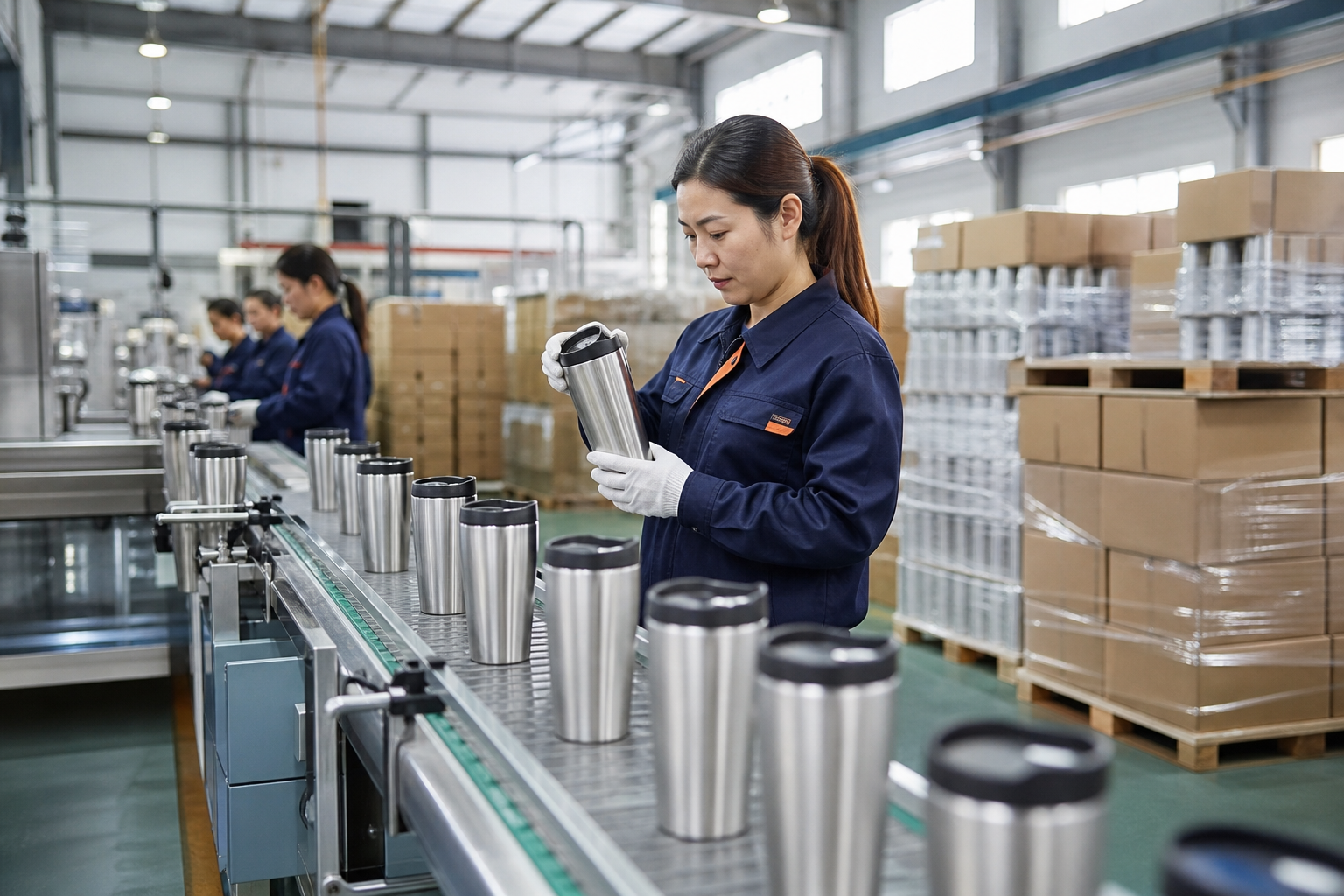
We build drinkware in Zhejiang, China, and we see the same pattern on the line: buyers start with price, then MOQ, lead time, coating yield, and logo method decide the real cost. A coffee mug factory direct quote may look strong at USD 2.85 FOB, but if the print setup, insert cards, or master carton spec are off, the landed cost climbs fast. QC pulled the sample on one order because the PO had a typo on the lid color code, and that tiny mistake changed the whole schedule. You want a bulk coffee tumbler that ships cleanly, passes REACH, and feels solid in hand at 7 a.m. on a commute. Anything less gets flagged.
What You Are Really Buying
A bulk coffee travel mug is a stack of choices, not one item. Capacity, insulation, lid design, finish, and carton pack all change the result. Skip one, and the mug still looks cheap but performs badly. For coffee brands and corporate gift buyers, 350ml, 450ml, and 500ml cover most orders. We ship those sizes every week. In Zhejiang, the gap between 450ml and 500ml can be USD 0.08 when the mold is already stable, which is why the buyer’s “just make it bigger” request usually misses the math.
The build matters most. A double-wall vacuum body with 0.4-0.5mm 304 inner steel is the standard for mid-market retail. On our line, QC pulled the sample and checked the wall with a caliper before packing. If you want a lighter cup for giveaways, a non-vacuum bulk coffee mug can work, but it will not hold heat for long. Expect 6-8 hours hot on a standard vacuum tumbler, and about 4 hours with a simple push-on lid. A real coffee mug manufacturer should say that before the PO is signed, not after the buyer flags a complaint.
Practical buyer check:
- Ask for steel grade, not just “stainless steel”.
- Confirm wall thickness and body weight in grams.
- Request lid leak test data, ideally 24-hour inverted testing.
- Check whether the coating is powder coat, spray paint, or bare steel.
Materials And Build That Matter
For a bulk coffee tumbler, the body material is where the job starts. 304 stainless steel is still the safest default for a coffee mug private label program because it holds up against corrosion and the buyer sees it as a proper retail grade item. We run into this on the line all the time: if the quote comes in too low, one factory will quietly switch the outer shell to 201 steel, then the inner shell too. That is fine for a giveaway run, not for a premium shelf product. Ask for the inner and outer steel specs separately. Some coffee mug suppliers try to blur that line, and that is the wrong question to leave open.
The lid is where failures show up first. A proper travel lid needs clean threading, food-safe silicone, and a vent that controls flow without throwing coffee on the customer’s shirt. Push-button lids feel nicer in the hand, but they add cost and more parts to inspect. For a bulk travel mug sold to office buyers, a simple slide lid often keeps the price in the USD 2.10-2.60 range FOB China. If you switch to a flip lid with lock, expect USD 2.80-3.80 depending on finish and packing. We had one PO where the buyer flagged the lid note as “sliee lid” on the paperwork, and QC pulled the sample before packing started.
Coating affects returns too. Powder coat gives better grip and better scratch resistance than basic spray. For matte black or matte white, you get a cleaner retail look, and we’ve seen complaint rates on scuffs drop by 2-3% when the carton inserts are done right. A coffee mug factory direct supplier in Zhejiang should show salt-spray, adhesion, and drop-test data on request. If they cannot pull those sheets fast, the math does not work. On one 18-day run, the line caught a coating rub issue after a 1.2 m drop test, and that saved us a bad shipment.
What to ask before you approve samples
- Inner steel: 304 or 316, and thickness in mm
- Outer steel: 201 or 304
- Lid silicone: LFGB or FDA food-contact compliant
- Coating: powder coat, spray, or polished
- Temperature claim: hours hot and cold, with test method
Pricing, MOQ, and Factory Reality
The market price for a bulk coffee mug moves with the build, not with the label on the door. A plain 350ml vacuum tumbler with one-color silkscreen usually starts around USD 2.10-2.40 FOB China at 1,000 pcs. A 500ml matte powder-coated model with laser logo and color box lands closer to USD 3.20-4.80. If you need coffee mug custom made tooling, embossed details, or a special lid, we quote a one-time mold fee from USD 150 to USD 800, and the gap comes from cavity count, slide parts, and lid structure. We ran a 304 stainless sample last week and QC pulled the caliper on the wall thickness twice; the buyer had flagged a 0.3 mm change on the PO, and that small typo would have shifted the whole quote.
MOQ is where buyers lose time. A serious coffee mug manufacturer in Zhejiang may accept 500 pcs for one stock model, but 1,000 pcs is more common for custom colors or custom lids. For coffee mug customized finishes, some factories will split MOQ by color, but you should confirm the same batch uses the same coating lot. Mixed-lot production can show shade variation you can spot at arm’s length. This is the wrong question to ask: “Can you make 300 pcs?” The real question is whether the line can hold one coating batch, one carton spec, and one inspection standard without mix-up.
Lead time matters more than most procurement teams admit. A realistic schedule is 7 days for sampling, 10-15 days for sample approval and packaging confirmation, and 20-25 days for production. If the supplier promises 12 days total on a new custom order, ask what they are skipping. In Zhejiang, China, a coffee mug OEM manufacturer with a monthly output of 300,000-500,000 units can still miss your date if you change artwork after the first pre-production sample. We ship fast when the file is clean, but we’ve seen this go sideways on a 2 mm logo shift and a carton typo that held the whole booking for 4 days.
Buyers who treat a custom tumbler as a commodity usually pay for it twice: once in unit price, once in rework.
Logo Methods And Brand Value
The logo method changes how your bulk travel mug is seen on shelf and in hand. Laser engraving stays on stainless steel, and on brushed or painted bodies it gives a clean look without ink to scratch off. We run a fiber laser at 50W on the line for this, and the mark still passed rub testing after 200 cycles. Silkscreen costs less and works for plain branding, but if the buyer keeps asking for dishwasher-safe claims, this is the wrong question to ask because wash abuse will wear the print. Heat transfer and UV print handle complex graphics, yet the line needs tighter control on curing and registration.
If you are building coffee mug private labeling for retail, match the logo method to the selling price. A USD 2.50 mug with a full-wrap UV print can look off, while a USD 4.00 matte tumbler with laser engraving feels in step with the retail tag. For coffee mug promotional products, one-color silkscreen is still the cleanest way to hold cost down and keep production steady. We usually see a setup charge of USD 20-60 per color, and free setup sometimes kicks in once the order passes 3,000 pcs. MOQ talks matter here; the math doesn't work if you want luxury art on a giveaway cup.
Do not skip artwork placement. On a tapered bulk coffee travel mug, a logo near the shoulder will distort more than the same logo centered on the body, especially on a 2.5 mm wall with a 15° taper. Your coffee mug supplier should send a print template with exact dimensions, not a blank mockup. QC pulled the sample once and found a 3 mm shift between the art and the seam, which the buyer flagged right away. If you sell to distributors, ask for blank and branded samples before final approval. We have seen one PO with the logo file name typo, and that small mistake turned into a full reprint after 5,000 pcs were packed.
Compliance For Europe And North America
If you are shipping into Europe or North America, compliance is not optional. A coffee mug supplier list that starts and ends with catalog photos is the wrong question to ask. For EU-bound orders, we ask for REACH on coatings and silicone contact parts, then LFGB or FDA declarations where they fit the material stack. For North America, check food-contact materials, Prop 65 for California, and carton labeling if the mugs go into retail or Amazon FBA. We had a buyer flag a PO typo on “silicone lid” versus “silicon lid” last month; that one line changed the paperwork trail.
Testing should match the use case. If the mug is for hot coffee, we check odor, seal performance, and coating migration under heat. If you push the load through a coffee mug distributor network, ask for drop testing from 1.0m to 1.2m in master cartons. AQL still does the job: we run AQL 2.5 for major defects and 4.0 for minor defects on finished goods. That is a fair baseline for a mid-price bulk coffee tumbler, and the math does not work if you skip it. QC pulled the sample off the line and found a lid leak at 98°C, not on the first piece, but after the third heat cycle.
Do not assume a certificate replaces factory control. A document can be valid while the actual line is sloppy. You want a coffee mug factory direct supplier that can show incoming material checks, in-line inspections, and final packing photos. We keep a 0.2 mm wall-thickness check on the workbench for a reason. In China, especially Zhejiang, that gap between paperwork and production discipline is where most sourcing problems start.
Packaging, Shipping, and Retail Readiness
Packaging decides how the product arrives, and that decides how much you lose. For a bulk coffee mug sold as retail-ready, one color box with an insert, barcode, and warning label is usually enough. For coffee mug in bulk orders going to fulfillment centers, we set carton size around the pallet first, then the product. A 500ml vacuum tumbler often runs 25-30 pcs per master carton, but the count changes with box size and whether we use foam or egg-crate dividers.
If your route is Amazon, ask for FNSKU placement, carton labels, and polybag suffocation warnings where required. If you are selling through distributors, master cartons need to survive warehouse handling, not just look clean. We had one buyer flag a loose lid at pre-pack; the body passed, the lid popped in a 1.2 m drop test, and the order got held. That is why we run drop tests and vibration checks on the line, not only print checks.
Shipping terms matter too. FOB Ningbo or FOB Shanghai is common for Zhejiang factories, and the gap is usually inland trucking, not product cost. If the supplier only offers EXW, do the math on your forwarder pickup before you sign. A coffee mug supplier that ships 50,000 pcs monthly will know carton optimization, pallet size, and export markings. Ask for that data before the PO is issued; we have seen a typo on a carton mark turn into a customs delay.
Get a quote for your bulk coffee travel mug
Send your capacity, lid style, logo method, and target price. We will match you with factory-direct options from Zhejiang, China, with clear MOQ and lead time.
Frequently asked questions
What is a realistic MOQ for a custom travel tumbler?
For a standard bulk coffee travel mug, 500 pcs is possible if the model is already in production. For custom color, logo, or packaging, 1,000 pcs is more realistic. If you need a new lid or mold work, the MOQ can rise to 3,000 pcs because the factory must spread tooling and setup costs. A Zhejiang coffee mug factory direct supplier may still quote lower, but check whether the unit price includes decoration, inner box, and export cartons. Otherwise the “cheap” offer becomes expensive after packing and freight.
How much should I budget per unit FOB China?
For a mid-market 350-500ml vacuum tumbler, budget USD 2.10-2.60 for basic one-color branding and simple packaging. Matte powder coat, laser engraving, and color boxes usually move the price to USD 3.00-4.80 FOB China. If you specify 316 steel, a lockable lid, or premium retail packaging, the cost can go higher. The exact quote depends on steel grade, lid complexity, coating yield, and carton spec. For coffee mug promotional products, price sensitivity is high, so keep the feature list tight.
Which logo method lasts longest on a travel mug?
Laser engraving lasts the longest on stainless steel because it removes the top layer instead of sitting on it. It is the best choice for a coffee mug private label program that needs a premium look and high wash resistance. Silkscreen is cheaper, but it is more suitable for simple graphics and promotional runs. If you want full-color artwork, UV print or heat transfer can work, but they need better process control and can cost USD 0.20-0.60 more per unit depending on size and finish.
What compliance documents should I ask for?
For Europe, ask for REACH-related material declarations and food-contact compliance for the lid and seal. For North America, request FDA food-contact declarations where applicable, plus any Prop 65 awareness notes if you sell into California. If you use silicone parts, ask for LFGB if your customers expect stricter testing. A serious coffee mug supplier should also provide factory audit documents such as BSCI, ISO 9001, or similar if your procurement policy requires them. Do not rely on a supplier directory entry alone.
How long does production usually take?
For a custom bulk coffee mug order, sample development usually takes 5-7 days for stock models and 10-15 days for new decoration or packaging. Production is typically 20-25 days after sample approval and deposit, so the total cycle is often 25-35 days. If the order includes new tooling, complex packaging, or multiple SKUs, add another week. A coffee mug factory in Zhejiang with 300,000+ units monthly output can move fast, but only if your artwork, colors, and carton spec are frozen early.